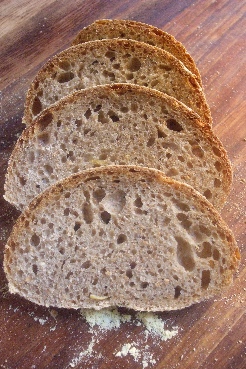
Submitted by Daisy_A on August 19, 2010 - 4:33pm

Sourdough Wholemeal Lemon Bread: Adaptation of a Jan Hedh Formula


I was led to Swedish baker Jan Hedh's book Artisan Bread by Dan Lepard's recommendation on TFL. I owe him thanks for that as it full of great formulae and beautifully photographed by Klas Andersson. There is lots in it to inspire.

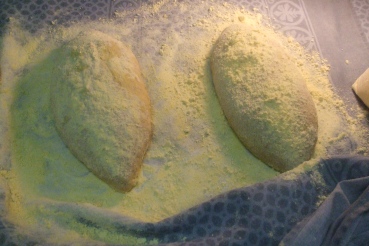
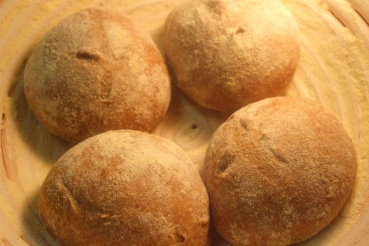
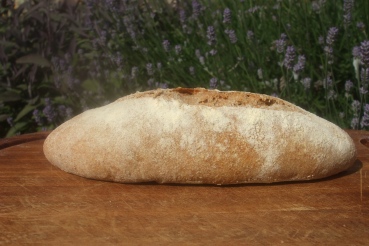
One of my favourite Hedh breads is a lemon bread flavoured with lemon zest and green olive oil (pp.126-7). Created by Hedh when lead baker on a Swedish cruise ship, this aromatic bread was designed to work well with fish dishes. It can be made in the shape of a lemon-shaped, small dinner bread or a more traditional round roll. The breads are dusted in yellow semolina flour during the second proof, to make them even more lemon-like.

Hedh's recipe gives enough for a small batch,  In fact this is one of the few breads that I can batch bake in an hour after preheating my small domestic oven, baking 3 dinner breads in the first firing and 4-6 round rolls in the second.

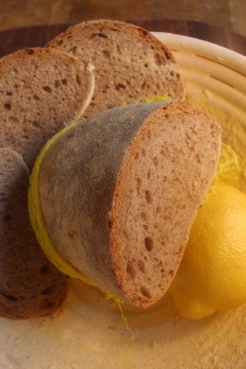
The bread has a great texture. It is moist but remains firm even when sliced thinly. It takes savoury toppings well without bending or getting soggy, making it also ideal for open sandwiches and canapés.

We have enjoyed it with fish dishes and also topped it with tomato, oil and vinegar or tangy cheese and pickles. It is also good dipped simply in olive oil. However one of my favourite ways to eat it is sliced thinly with no accompaniments, so that the subtle and delicious lemon taste can be enjoyed to the full.

Even before recent discussions on TFL about copyright  I had been trying to contact Hedh's British publishers to get permission to reprint the recipe. I have had no success so far as it looks as though they have gone into receivership.

This means also that Hedh's book will become harder and harder to find.  Large sellers like Amazon and Smiths are logging it up already as out of stock. The bakery that Hedh co-owns - St. Peter's Yard in Edinburgh  - still had around 60  copies of the book when I rang them a couple of months ago. They don't post out; however if you have friends in Edinburgh do sweet talk them into getting a copy for you as it could be your last chance to get your hands on this great book!

Hedh's original lemon bread is a yeasted bread made with a preferment of yellow durum wheat flour (grown traditionally on the Swedish island of Ven), and light rye flour with stone ground, strong wheat flour added to the final, machine-mixed dough. The version I am writing up here is my adaptation, a sourdough made with semolato, whole rye flour and wholemeal flour, which is hand mixed.

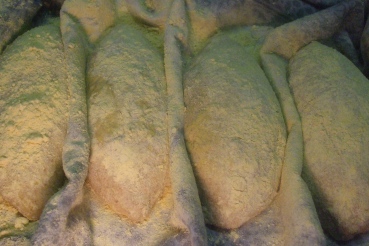
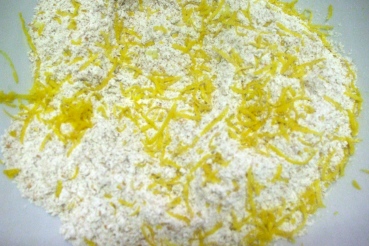
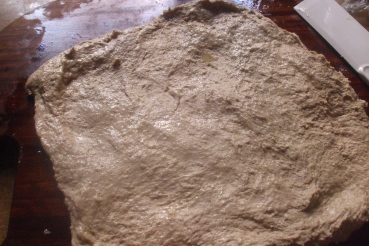
Some pictures of the different stages plus a chart of the adapted formula and process follow:

Sourdough Wholemeal Lemon Bread: Adaptation of Jan Hedh Recipe

This bread is flavoured with lemon zest rather than lemon juice. This results in subtle highnotes in the final bread, rather than a widespread lemon taste. It is well worth getting organic and unwaxed lemons to zest if available. When grated and mixed with the flour the lovely aroma also fills the kitchen! The wholemeal, olive oil infused dough has a lovely, silky consistency and is good to work with.

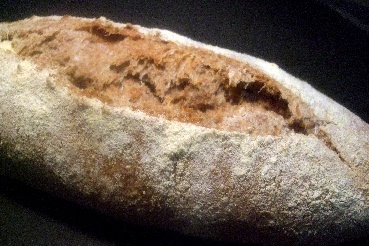
I have baked this bread several times. The original instructions make no reference to scoring the bread. I made the first batch without slashes and they came out well. However the picture in the book shows a loaf with an open top. I later read in the Introduction that Hedh proofs and bakes some of his breads with the seam side upwards. The loaf then splits along the seam, giving it an attractive rustic look. My shaping skills are not yet so good that I can prevent an unscored loaf rupturing elsewhere. I now normally score the breads with one long stroke along the top and this has worked well to date.

I was concerned that a predominantly whole grain formula at lowish hydration might produce too dense a crumb and loaf. I imagine that the loaves might rise higher when Hedh's original formula is used. However the preferment seems to work well with sourdough as well as baker's yeast and I have been able to get quite an open crumb and good rise for the size of loaf and type of flour used.
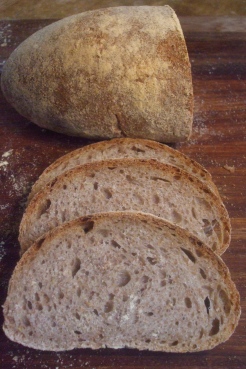
My sourdough starters are quite feisty but the relatively low levels of starter in the preferment and final dough have meant that the overall fermentation has taken place without the dough losing elasticity. The amount of starter and fermentation times I give are relevant to my own situation. I am realizing more and more now that with sourdough starters any formula is just a guideline! Please feel free to adjust this to suit your own starters.

I hope that other TFLers might enjoy this bread. If you do try it I would be glad to learn from your feedback.

Daisy_A


The quantities below are for 4 dinner breads:

With this formula I used a wholemeal starter at approximately 66% hydration. I have made this bread successfully with wholemeal flours from Dove's Farm, Waitrose and Bacheldre Mill. Bacheldre Mill was the most fruity and aromatic. I used Dallari semolato because it was the only one available locally at the time but would prefer to use DeCecco, a brand that is sometimes available, also recommended by nicobdv.

I estimate overall hydration including starter hydration at 530/945 = 56% but I'm always open to correction!

Total Formula Weight  
Wholemeal flour 695g  650+45
Semolato or other yellow durum wheat flour 150g  
Whole grain rye flour 100g  
Water 530  250+250+30
Green, virgin olive oil 50g  
Sea salt or other salt 20g  
Zest of 2 medium lemons, preferably unwaxed, organic Approx. 10g Will weigh next time!
Total 1555


Preferment Weight  
Semolato or other yellow durum wheat flour 150g  
Whole grain rye flour 100g  
Whole meal starter at approx. 66% hydration 30g  
Water 250g  
Total 530g  
Final Dough Weight  
Wholemeal flour

650g

 
Water 250g  
All preferment  530g  
Wholemeal starter at 66% hydration 45g  
Green, virgin olive oil 50g  
Sea salt or other salt 20g  
Zest of 2 medium lemons, preferably unwaxed, organic Approx. 10g  
Total 1555  
Method  


Preferment

Make the preferment approximately 12 hours before baking, normally the evening before:

Mix a small amount of starter with water to form a paste

Add the rest of the water to the starter mixture

Combine the flours and pour the water and starter over the flour.

Mix for 8-10 minutes in preferred fashion. (I 'air knead' in the manner of Andrew Whitley in order to incorporate the starter fully)

Cover and leave in an oiled container in the fridge

 
Mixing of final dough

Wash and zest lemons, mix into flour

Add preferment to flour

Dissolve second lot of starter in second lot of water and pour over flour

Mix by preferred method for 3 minutes

Add oil and salt and mix by preferred method for 8 minutes. (I air knead for 8 minutes then perform one stretch and fold on the bench). 

Make sure that all new starter and preferment are mixed in well.

Mix for another 7 minutes if needed, to form an elastic dough.

Place in a lightly oiled, covered container

 
DDT C26  
First proof Approx. 90 minutes with 1 S&F at 45 mins. Adapt as needed.  
Preshaping Quarter, form into balls and leave covered for 10 mins.  
Shaping Shape dinner breads into tapered, lemon-like rolls and smaller rolls as small rounds. Brush with water and dust with polenta or other yellow flour.  
Second proof Proof on a floured couche for 60 mins. or until doubled in size  
Preparation Preheat oven to C250 and prepare to steam. For steaming I preheat 2 small fajita trays and pour boiling water onto them as soon as the bread is in the oven.  
Baking

I bake the dinner breads for 10 minutes at C250 with steam, open door to releas steam and turn the oven down to C230 for the rest of the bake

Check internal temperature after another 12 minutes, bake for further increments of 3-5 minutes, if needed, until internal temperature of around C90 is reached and crust is an attractive light golden colour.

Jan Hedh recommends baking rolls for around 12 minutes


Great write up

And a very lovely breads, Daisy!

user icon

Thanks Lindy

Thanks Lindy - much appreciated!

Daisy_A

user icon

Thank youf for all your work, Daisy.:)

What a quite wonderful detail!   I started to make a starter and I want to try it someday. :) unless my starter dies. 

Regards,

teketeke

user icon

Thank you for your encouragement

Thank you for your encouragement, teketeke.

I am also enjoying reading about your baking. I am sure you will be fine with a starter and carry on to make some great breads with it.

Starters can be moody, particularly at first, but they are quite hard to kill! If you are worried you can always dry and freeze a portion of starter as an insurance. There are instructions on how to do it on the site.

A lot of the success with starters comes down to being systematic with them. Many bakers, me included, find that hard. In contrast, I can see that you are very systematic in the way you approach your baguettes and other baking. I think that you would be a fine starter keeper!

Do keep us posted if you develop a starter.


With best wishes, Daisy_A


user icon

Wow, Daisy! Iam blown away by

Wow, Daisy! Iam blown away by the attractiveness of your crumb! Beautiful bread, and healthy so too!

Thanks for posting this recipe.

khalid

user icon

Thank you Khalid

Thank you Khalid,

This means a lot coming from you as I know that you specialize in baking with wholegrains and have produced some truly lovely breads.

With kind regards, Daisy_A

user icon

With many thanks

Dear Daisy_A,

Thank you for sharing your beautiful pictures and formula for this bread. I just love lemon - what a wonderful idea for flavoring bread. In combination with golden yellow durum flour this truly is a gorgeous loaf! And, as for shaping the loaves like a lemon, what fun! I had never heard of Jan Hedh prior to your post and I'm grateful to discover this formula and another author. I will try to locate a copy of the book!

Thanks again!!! Regards, breadsong

user icon

Many thanks breadsong

Hi breadsong,

Many thanks for your message - it's much appreciated as I am quite a novice baker. I'm really glad that this appealed to you.

I was drawn to Jan Hedh by Dan Lepard's recommendation so am quite happy to pass it on!

There are lots of great breads in the book but like you I love lemon and find it hard to get beyond the lemon bread as it is so lovely!

I hope you can find a copy of the book at a library or store. It is becoming harder to find now, outside of Peter's Yard. There does seem to be a new English title on pre-order 'Swedish Breads and Pastries', although I'm not sure what this is like.

I must say I have to return the compliment on the baking front. Your breads have inspired me. I think I left a comment on the chipotle sourdough and the recent dried tomato and asiego looks great too!

With very best wishes, Daisy_A

user icon

Very fine loaf

Hi Daisy,

This is a great write-up, with some fabulous photos.

The link to the copyright discussion was much appreciated, as I missed most of that, being away at the time.

Your comments about a lower hydration than many on TFL are used to are very interesting.   In the end it comes down to a good formula, and hands-on techniques and skills.   To make this loaf in the style you have, and use semolina, wholemeal and rye flour, and no white flour; that is a judicious decision to keep the hydration lower.   Clear vindication of your decision: top quality finished product!

I note it is just zest in the formula.   I had wondered when I started reading your post whether or not any lemon juice might have been used.   Given citric acid can be used as a reducing agent in the same way as L-Cysteine, SMS, or a protease enzyme, I worked out that the lower hydration would definitely have had a positive effect were that the scenario.

Still working on getting this book, and hit on a new idea this morning!

Best wishes

Andy

user icon

Thanks Andy for this feedback

Hi Andy,

Wow - I was blown away by your feedback! I know you are so encouraging to bakers of all levels but also being a professional and keen to see people improve as much as possible, you are no flatterer. So coming from you this meant a great deal. Thank you for taking the time to respond.

This formula just seems to suit me as a baker and sit well in my hands. It's interesting given your suggestions for my baking that is is a lower hydration dough. It is easier for me to shape and score than higher hydration doughs. Good olive oil adds a lot to the mix, though, and although water is relatively low, I have found the final loaf to be one of the most moist that I bake.

Most of the pictures are from the first time I baked it and I didn't know enough then to think that the flours used might produce a dense loaf if handled heavily. I know this is small beer compared to the many different breads scheduled in a professional bakery but when I baked this it was the first time I had scheduled two breads together, this and a quite complex rye bread. I was fussing so much over the rye I almost didn't proceed with the lemon bread. However I decided to go ahead, processing it as deftly as I could and baking it after the rye. I think this helped in two ways, in that the bread wasn't overworked and it went into a well-heated oven. Hedh's formula is good though - must move on to some more!

The decision not to use lemon juice comes from Hedh. He states that using the juice produces a 'looser dough'. He seems to want to avoid this but obviously other experienced bakers might want to work with a looser dough and more lemon.

One of the changes I made to Hedh's formula was from yeast to sourdough. Given that my starters can be proteolytic at times I will probably stay with zest only for now, if juice can act like protease. However I do use orange juice in yeasted, rye recipes. 

I also like the way the taste of zest only plays out in the final loaf. We don't have a fine zester or microplane so you can see the zest pieces are relatively large. They are also from organic, unwaxed lemons so quite intense. The mix of flours makes the bread taste satisfying in general and then every now and again you get a real lemon ping!

Thanks also for commenting on the photographs. I was glad to see both you and breadsong mention them. I have an old point and shoot with optical zoom and I can't produce pin sharp images with it so have worked hard on composition. However with the exception of the photo I sent to Yeastpotting no one has remarked on the photos. up to now, so that felt good!

I realize that I had not included many photos in the main text of earlier posts, which can make them a bit drier than posts with more images. That was largely because I was covering formulae that had been written on widely by more experienced bakers so didn't feel my photos of the process would add much. Here, however, it's a little-discussed formula so I thought it might help. Also I've done this more times so more photos. The dough is obliging too - doesn't roll off the bench while you are getting your camera out!

Hope your plan to get a copy of the book works!

Thanks again and very best wishes,  Daisy_A

user icon

ingredients and their proportions are NOT copyrighted

 - it is the method that falls under copyright.

See this TFL post by LindyD on copyright http://www.thefreshloaf.com/node/19127/appeal-help#comment-129672

Quote:
Here's a quote from the United States Copyright Office relating to recipes:

Quote:
Mere listings of ingredients as in recipes, formulas, compounds, or prescriptions are not subject to copyright protection. However, when a recipe or formula is accompanied by substantial literary expression in the form of an explanation or directions, or when there is a combination of recipes, as in a cookbook, there may be a basis for copyright protection.

Quote:
... just the ingredients and amounts can be listed without issue; the copyright violation takes place when the author's directions of what to do with those ingredients are reproduced.

So can we please have the ingredients and the amounts?


user icon

Happy to share but please see my input to the thread you quote

Hi subfuscpersona,

I'm happy to share the few details changed from Hedh's original formula. 

However just some points first:

If you follow through the thread that you quote, you will see that I have quoted exactly the same information as LindyD, the point you underscore here about copyright. Her response precedes mine in the thread as it is in a higher reply chain. Mine is in the general thread, although posted earlier in time:

Mere listings of ingredients as in recipes, formulas, compounds, or prescriptions are not  subject to copyright protection. However, when a recipe or formula is accompanied by substantial literary expression in the form of an explanation or directions, or when there is a combination of recipes, as in a cookbook, there may be a basis for copyright protection.

So I am aware that this is US law. Hedh is published in Sweden and the UK and his UK publisher seems to be defunct, which is quite sad, really.

I didn't lay everything on the line in the first posting out of respect to Hedh, whose books are not yet sold as widely in the US and UK as those of some other bakers. Or put another way, if I share a Hamelman formula, it's likely many TFLers will have the original text: if I share a Hedh formula, it's likely they won't. I write and work in publishing sometimes so am quite protective of authors. I know how hard they work to put a book together!

Had I got Jan Hedh and the Publisher's permission I would have published both formula and method. However the UK publisher has ceased trading, as stated. Publishing a minor and quite tasty adaptation of the lemon seemed to be a good starting point. 

However I don't aim to baffle other bakers and do talk about the changes I made. I had thought to elaborate on this so will do so now, particularly as the last English version of the book has now been sold, apparently.

Hedh uses 10g of yeast and 15g of yeast where I use 30 and 45g of sourdough, respectively. He doesn't state fresh or instant yeast but says in his introduction that he prefers to work with fresh yeast. 

At first I found it difficult to get durum flour so for one bake I used Italian type 00 in place of durum. This may have given a more open crumb but a less 'nutty' taste. I now use durum, same as Hedh.

On Day 2 Hedh uses 650g stone ground 'strong wheat flour' where I use stoneground wholemeal. 

The sourdough is the only amount that differs: the strong wheat flour is the only ingredient that differs. Otherwise all ingredients and amounts are the same and are listed in the chart above.

I hope you enjoy baking the bread if you try it. 

Best wishes, Daisy_A


user icon

Hi, Daisy I could finally

Hi, Daisy

I could finally tried your lemon bread!!  I started with raisin yeast water / KA AP = 1:1.5  Total amount was 750g.  I made 4 loaves like this:

I think that poppy seeds are a good match with your lemon bread :)  I used Bellino Semolina ( Durum wheat) that I bought at Amazon.  I like this crumb, Daisy. So does Hajime! He ate 2 loaves and said, " I really like this bread."

Thank you for posting this bread!

Best wishes,

Akiko

user icon

Hi Akiko, I'm so glad you got

Hi Akiko,

I'm so glad you got to do this bread! Those loaves are soo beautiful. The shaping is fantastic - really elegant and even and so beautifully set off with the poppy seeds.

I'm so glad you got an open crumb also! I always love the texture of this bread but when I looked back at the formula I thought maybe I misremembered what I had done, as I think it is only around 56-58 hydration, depending on starter, before the oil is added. You did a great job with your crumb. 

Did you like the lemon taste? I found it quite subtle. Great that Hajime likes it so much also! 

So great that you did this!

With very best wishes, Daisy_A

user icon

Hi Daisy,Thank you for your

Hi Daisy,

Thank you for your thoughtful words!!

Yes, I do like the lemon taste in the bread. So does Hajime. I thinly sliced the bread to make " Tuna Melt" that was tasty.

The hydration was 56.2%.  I didn't feel like tough dough because of the olive  oil was added later like you mention about the olive oil above.

I kneaded the dough until I passed the window pane, then I missed to do S&F after 45 minutes. So, I used a different method to strength the gluten in the dough. I fermented the dough at 68F until doubled to punch down once. Then I left the dough at room temperature ( 68F) until the dough rose tripled ( I wanted  the dough volume was doubled not tripled - So the dough would be chewier but I was out  at the time). It took 7 hours in total for the first proof.  The final proof took 1 hour at 68F.   So this crumb was softer than I expected.  The 4 loaves were gone quickly!! 

P.S  I forgot to dust the dough with the durum wheat while shaping. :( Next time, I won't miss that! :)

Next time, I might put some fillings in the bread. I don't know what kind of fillings are going to be... hmmmm.. That is fun!!

:)

Akiko


user icon

Hi Akiko, Thank you for your

Hi Akiko,

Thank you for your message. It's great to share a favourite bread. I'm so glad you and Hajime like it!

I bet it is good with tuna melt. Jan Hedh created it to go with fish. We had it with prawns. It was lovely. I like to eat it on its own too and with cheese.

Your loaves looked so lovely with the poppy seeds. Durum wheat on top is fun too as it is quite 'lemony' looking and tastes a bit nutty. 

Look forward to seeing what you do with this!

Very best wishes, Daisy_A

user icon

 Hi Daisy,I made your lemon

 Hi Daisy,

I made your lemon bread again :P  Hajime really likes your bread! 


I overproofed it a lot.. but it came out nicely. Today, I used dried lemon peel in the bread for fun. It was good, too. Great post, Daisy! :)

I also changed the amount of the preferment for my raisin yeast water.   I used 70% raisin yeast water as to 100% preferment total flour.

Best wishes,

Akiko

user icon

Hi Akiko, Many thanks for

Hi Akiko,

Many thanks for your message. I'm so glad you and Hajime are enjoying baking and eating this bread!

That loaf looks lovely - such a creamy and glistening crumb. It's interesting to know that this works with fruit yeast water as well. Thanks for sharing this :-)

Daisy

user icon

Hi Akiko, Many thanks for

Hi Akiko,

Many thanks for your message. You did a great job with this! Thanks for the notes on the raisin water yeast. Did you use RYW on both Day 1 and Day 2? If so how muh on Day 2. It would be good to try this with RWY. I'm sure it will create a good flavour too, as you say. Great that you're leading further experimentation! I'm so glad you and Hajime like this...

Very best wishes, Daisy

user icon

  Hi Daisy, I am a big fan of

  Hi Daisy,

I am a big fan of your lemon bread.  Here is the details of  what I changed a bit of  your lemon bread. 

https://www.evernote.com/shard/s46/sh/2486dc93-7754-48b9-b6ab-b2d89a5ac8b8/705c211c9676b58fab2acec2d31a93ec

Salami and peperoni with jalapeno cheese sandwich is Hajime and Jerry's  favorite that they can bring it to school and work. It doesn't go bad in about 6 hours if they have ice pack to keep it cold for a while.  Therefore your lemon bread is already in my daily bread :)

Thank you, Daisy

Akiko

user icon

Egg yolk?

I am planning to bake this bread starting tonight with the preferment.   I read over Daisy's notes and Akiko's and was planning to try it with my new raisin yeast water (banana yeast water fed with raisins actually) and noticed that Akiko included an egg yolk which I don't think was in the original.  Akiko can you explain why you added the egg yolk?   Also I saw that you mixed in malt powder as well.   Again, can you explain why and also how much?    Thanks so much.   I'm really looking forward to trying this.  -Varda

user icon

Hi Varda, I hope it goes well

Hi Varda,

I hope it goes well for you! 

Best wishes, Daisy

user icon

Your welcome, Varda.

 Hi Varda,

It may be this is a late response, and it may be too late...... I am sorry.    Yes, I used egg yolk and a little bit of malt powder.  Egg yolk -- Keep the bread moist, I also like the egg yolk + durm wheat semolina flour combination..  ( White egg- have the bread more volume)      Malt powder-- At fist time, I thought 10g lemon zest was too much then I added malt powder, which bacome nice flavor to my taste, I also the color was nice, which my son likes it.   There is nothing special reason...            I don't know how much I exactly put the malt powder in, but the others, I used 1g malt powder.    Overall, I changed it for having fun. :P

Please let me know how it turns out,

Akiko


user icon

If this were a facebook post

I would "like" your answer, Akiko, that you change things around a bit for "having fun"! That is as good an explanation as any!

Karin :)


user icon

 :)  Thank you for your kind

 :)  Thank you for your kind word, Karin!  

Akiko

user icon

Egg yolk, malt, yeast water

Akiko, Thank you for answering.   I went through a few more rounds of thinking this through and decided to try and stick as close to Daisy's original posted formula as possible - which means no yeast water, and I'll also try her 100% whole wheat flour for the final dough.   I'm keeping my fingers crossed.    I'm looking forward to trying my new raisin yeast water, but I felt there was too much new going on already to throw that into the mix.   If my bread comes out lousy, I'll just pretend it never happened, but if it works I'll post and update.   (Just kidding.)  -Varda

user icon

Hi Varda, Hope it comes out

Hi Varda,

Hope it comes out well! I've found this a lovely dough to work with. I found despite the low hydration it is quite silky due to the oil and shapes well. Hope you enjoy it. Look forward to any postings. 

Best wishes, Daisy

user icon

well here it is

I'm stunned by how much rise this had.   I believe it is the highest percent of whole wheat that I've every used.   It smells amazing.   Can't wait to cut into it.

user icon

Hi Varda, Wow! Those look soo

Hi Varda,

Wow! Those look soo beautiful.

I know: that got me about the formula also - how much rise it had for the high percentage of wholemeal. Still if it's healthy and tasty, what's not to like? Eating whole grain shouldn't be like doing a penance LOL. 

Look forward to the tasting notes. You did a great job.

Best wishes, Daisy

user icon

Thanks Daisy

I just cut and tasted.    Very intense flavors from the whole wheat and the lemon zest.   Wow!   I  followed your formula with a few changes.   First, I didn't want to put in starter twice so I upped the amount of seed starter in the preferment by the amount of starter you said to put in the final dough.   This was a quick and dirty adjustment but I think it was ok.    Second,  my seed starter was 93% bread flour, 7% rye.   I know you used a whole wheat starter.   Since the amount of seed starter is quite small, I doubt that made too much difference.   Third, I used regular old extra virgin olive oil, not green.  I'm sure green would have been nicer.   Finally, I added water during the mix just to make the dough come together.    Hydration (not counting olive oil) was 63%.  Since I made half the amount of your formula (two loaves) I used one lemon rind which did come to 5 grams.   Next time I think I'll use a bit less.   All in all delicious, interesting, and intense formula.   Thanks so much!  -Varda

user icon

Hi Varda, Wow - that crumb

Hi Varda,

Wow - that crumb looks well developed and glistening and lovely caramel crust!

Thanks for letting me know about the adjustments. It looks like they worked well. You got a great rise and dough development.

I think I put on the crackle cookies that my palate is adjusted to very intense flavours so beware! This is Hedh's formula also for use with fish, where I suppose lemon fits. However it has to be right for whoever it tasting it. I think other TFLers have used 2-3 grams of lemon. Many thanks for these notes. It's great to see the creativity that different bakers bring. 

Very best wishes, Daisy

user icon

 Very nice looking loaves,

 Very nice looking loaves, Varda!

Akiko

user icon

Thanks Akiko

It feels like baking with other people even though we are all far apart.   It's fun.  -Varda

user icon

Hi Varda, I'm with you on

Hi Varda,

I'm with you on that one! I like the sense of virtual 'neighbourliness' on TFL, that you can wander into each other's kitchens as it were, ask for help and see what's baking...

Best wishes, Daisy

user icon

Hi Akiko, Great to know that

Hi Akiko,

Great to know that this is one of your daily breads :-).

Mmm that sandwich sounds delicious! I tend to eat this bread with fish or just on its own but of course lemon goes with so many things. Your lemon and meatballs sounded great also. You are encouraging me to branch out! 

With very best wishes, Daisy

user icon

New Edition

There is a brand new 2010 edition of Jan Hedh: "Swedish Breads and Pastries" (Skyhorse Publishing). I purchased it 3 months ago, it's really worth it.

Karin

user icon

 Thank you for the info,

 Thank you for the info, Karin!

I will check it out when I got to the book store.:)

Akiko

user icon

Recipe not in book

I just looked through my new edition of "Swedish Breads & Pastries" - this recipe is not in there! There are only a Lemon Ciabatta and a Lemon Sandwich Bread that are quite different. So we are entirely at the "mercy" of Daisy's recipe.

Happy baking,

Karin


New book this autumn?

Looks like there is a new book out this autumn:

Artisan Breads

Don't know if it is "new" or a reworking of the previous 2007 Artisan Bread book?

cheers
S

latest info

The book is published - from Skyhorse Publishing in the US - available through Amazon.

In case someone is reading this and hasn't seen the other recent threads - WARNING!!

The book is a re-publish of the original Artisan Breads - the publishers thinking of the American audience decided to add ingredients lists with cups and tablespoons, and in error managed to lose the weight measurements completely!  If you buy this book and want to use weights (as Jan Hedh strongly recommends) then you need to email the publishers and request a pdf with the weights for all recipes...

So - good news is the book is now available; not so good news is you have to supplement it with extra bits of paper for the correct ingredients!

S

user icon

Jan Hedh book

Hi Salilah,

Many thanks for this update. I will try to bring my original Anglophone copy to the bread meet :-)

Sounds like a poor call to miss out weight measurements but isn't the book itself and the photography gorgeous?

Best wishes, Daisy

Yes it's a wonderful book -

Yes it's a wonderful book - that's why I didn't really want to return it!

Some of the recipes seem a bit more as if they are designed for looks rather than taste - various permutations of spinach, tomato and other doughs to make an "italian flag" bread <grin> is one I remember!  But I like the variations he has come up with, and ideas for things to do - and yes the photos are wonderful!

Good point re the get-together - I've quite a few bread books (the usual suspects I expect) - very happy to bring any along that others might not have (e.g. Bourke Street Bakery, River Cottage Bread) - should we (nearer the time) have a thread listing what we are bringing??  (which reminds me - from another thread - I could bring along my home-made proofing box - that would be a source of amusement!!)

Sali

user icon

There ARE weight measurements!

I have the newest edition (from 2010), and there are weight measurements in grams for every recipe. That, unfortunately, does not mean that there are no errors at all (like the much too high amount of bran in the "Pain au levain with bran and vinegar" on page 46). The other four breads I tried so far were correct.

But, even with some flaws, I can only recommend this beautiful book with its interesting recipes. (Doesn't a whole list of errata exist for Hamelmann and Leader's books, too?).

Karin

Differnet book?

Is this a different book, or is it a different printing of Artisan Breads?

My copy (ISBN 978-1-61608-487-5) is copyright 2011, page 46 has a photo (of French baguettes with poolish) and there is no mention of a bread with bran?  I'm guessing there is another book?

Still really interesting recipes and beautiful photos, so now that I have the pdf of weights, I'm happy and would definitely recommend it!

user icon

There are 2 books!

You are right, Salilah, I just checked with amazon, there are two baking books by Jan Hedh: this is the one I mean: http://www.amazon.com/Swedish-Breads-Pastries-Jan-Hedh/dp/1616080515/ref=sr_1_1?s=books&ie=UTF8&qid=1320358018&sr=1-1

That, of course, explains a lot, since the Lemon Bread is not in this one.

Karin

user icon

Hi Karin, Thanks for flagging

Hi Karin,

Thanks for flagging this up. Hedh's recipes seem to work incredibly well with my starters so I might look into this if there are new recipes in the Breads and Pastries book.

Best wishes, Daisy

user icon

Hedh's lemon bread/Book reissue

Hi Karin, Akiko, Salilah,

Have to say this is a lovely formula. Such a shame it is not in the Breads and Pastries book. The original lemon bread formula was from the publication Artisan Bread (Riverhouse West, 2007), which was a translation of the Swedish Brød (Prism, 2004).

Unfortunately Riverhouse West went out of business so we are probably more at the mercy of the publishers than me. It is just crying out to be reissued. I pretty sure the last UK copies have gone now. I think one of Andy's students may have got the last one from Salt Yard after the shout out above.

My text doesn't have a subtitle so I don't know if the new, subtitled text is the same. It seems to cover some of the same ground, going by the pictures. The 'kugelhopf' is in there, at least. It would be great if it is a reissue. 

I've no desire to be secretive on this. The more people who can get the recipes the better! However out of respect to Hedh I'm not comfortable publishing this recipe in its entirety without permission. I've approached both publishers and heard nothing from either.  

The adaptation can work well also - trust me! That is as long as you don't go by weight and add the massively overestimated 36g of lemon rind I had in the first adaptation. This has been adjusted to 10g - apologies from me and many thanks to Akiko for making notes and actually weighing the zest of two lemons!

However as ingredient lists don't seem to be copyrighted and as the original recipe is for a loaf with fresh yeast and a greater proportion of regular bread flour, the original ingredients for days 1 and 2 are below. This makes around 4 medium, torpedo-shaped loaves or up to 24 rolls. The original ingredients just say 'yeast' but I'm pretty sure it's fresh as this is what Hedh refers to in the Introduction. I'm sure experienced bakers will be able to grasp how to produce a loaf from these and the blog notes! Beyond that I'd urge people to snap up the new book if it is a reissue!

Very best wishes, Daisy

DAY 1 

STARTER

100g fine rye flour, preferably stone ground

150g durum wheat

10g [fresh] yeast

250g water (2.5 dl)

.

.

.


DAY 2

KNEADING

[Zest of] 2 yellow, ripe lemons, preferably organic

650g strong wheat flour, preferably stone ground

15g [fresh] yeast

250g water (2.5 dl)

50g green olive oil of the best quality (.5 dl)

20g sea salt

Polenta flour for the topping


user icon

 Thank you for all of your

 Thank you for all of your information, Daisy, Karin, and Salilah,

I am new to bake European style bread, and I want to get know about it.  I have been enjoying to try new recipes and  fascinated with the taste the new flavor.   Thank you for taking the time to write the formula, and try to get the permission! I appreciate all your work. 

Happy baking!!

Akiko

user icon

Dear Akiko, It's great to

Dear Akiko,

It's great to pass things on and see what other bakers do with formulae. Thanks for all that you have done with this also and for all your notes. 

Very best wishes, Daisy

lemon bread

Your breads are simply beautiful look great nice spring
Thanks
Chefscook

user icon

Hi Chefscook, Many thanks for

Hi Chefscook,

Many thanks for your kind words! Daisy

lemon bread

I was wondering do you think I could add lemon to sourdough and how that would taste
Thanks
Chefscook

user icon

Hi Chefscook, As this formula

Hi Chefscook,

As this formula is basically sourdough with lemon, I'm sure that adding lemon to regular sourdough would be fine.

I don't know if you were thinking of lemon juice or zest? Hedh recommends against using juice in his original formula as he says it will be too sour. In this formula there is 10g of zest per 1.5kg of dough. This is in line with Hedh's original formula, but some bakers have found that  2-5g of zest per 1.5kg is more to their taste.

In the formula above, the wheat adds a kind of sweetness to the formula, although Hedh uses more bread flour, so it must work with that also.

If adding lemon to a regular sourdough appeals, why not try a gram of zest in a small loaf and see how that tastes? If it appealed you could work up from that. 

Hope you find a way of getting the taste you want.

Best wishes, Daisy_A


user icon

Lemon Juice

Hi chefscook,

Citric acid is known to break down gluten.   I am aware that Ascorbic Acid, [Vitamin "C", also in Lemon juice] will strengthen the dough, but this is largely achieved through relatively intensive mixing.

De-naturing the protein in the sour is highly undesireable, so I would take Daisy_A's counsel, and stick with zest only.

Best wishes

Andy

lemon bread

Daisy thank you for your prompt reply I did not specify what I was going to use lemon zest or juice it was for lemon zest that I was going for and my sourdough is ready to go and I will be adding the lemon zest and pepper I like to. Experiment with different recipes
Thank you
Chefscook

user icon

Hi Chefscook. Sounds great!

Hi Chefscook.

Sounds great! Do let us know how it turns out.

Best wishes, Daisy

user icon

Grumble grumble

Coming home from work to find out that the last lemon in the house - completely and utterly dedicated to be zested and transformed into a wonderful loaf with delicate high tones- was... you feel it coming... already transformed into a salad with a tzatziki dressing :-| Both dressing and salad were wonderful... I am just going to put my preferment back in the fridge I guess, and see what's going on in there tomorrow morning. It might actually hold. Let's call it an experiment :-) we'll see!


Freerk


update! My hands are smelling of olive oil and lemon :-) I had to come to the dough's rescue this morning (this is not going to be a flawless bake I'm afraid). I halved the recipe, and the amount of olive oil got somehow "lost in translation" I was kneading away at a very very stiff dough, wondering if that could be right. I managed to develop some gluten nonetheless. But in the end I thought it couldn't be right. I upped the hydration a little (just on sight, my estimate is it was about 15 grams more or so, and then in the end I discovered the olive oil fail.... The dough was already in its first rise, but I dared to knead in the extra olive oil anyway.... oops, hope this is still going to work! Let's see what's going to happen! There are some variables slightly out of balance now, so I'm not holding my breath for a perfect "first timer".

Did the preferment survive the extra time in the fridge? Did the dough give up on me after disturbing its first rise? Will I make it in time before I'm off to work?.... Find out on the next episode of Lemon Bread!


I guess I should have waited 'till the peace and quiet of the weekend, like I was planning originally.... :-|


user icon

Hi freerk, You made me laugh

Hi freerk,

You made me laugh about the lemon. Should've put a label on it ;-0. Still how nice to come home to freshly-made tzatziki salad!

Hedh says that he designed this bread to be eaten alongside seafood on cruise ships. So although it seems like a special bread for him, the dough is actually quite robust - as it would need to be if you might have to make it at sea as well as on shore!

I think your dough could be all right. Even though this adaptation is sourdough and Hedh's used fresh yeast, both preferments start off with a small amount of yeast for the total formula, so I imagine that the preferment might still have been viable.

As for olive oil: I'm not an experienced baker so I'll stand open to correction here, but I've found that because of its viscosity olive oil can be much easier to work into a dough in the later stages than say butter or egg. The hydration is low - only 55% before the oil. Some other bakers have added a little more water in either the preferment or total dough, for preference. However even at 55 plus oil the formula has the uncanny ability to produce an open crumb, so a stiff dough in the early stages isn't necessarily problematic. 

I'm hoping that you get a bread you like that you can build on. Could be good with tzatziki salad as well as fish, but you'd need two lemons!

Best wishes, Daisy


user icon

I hold my breath,

sit at the very edge of the chair, feel the goose bumps coming, all in anxious anticipation of your sequel, Freerk....don't torture us any longer!

Karin

user icon

start breathing again!

Start breathing again Karin! I produced a total fail :-|

I was trying to squeeze this bake into my work schedule, and dough just won't have that..

After leaving instructions to put the bread in the oven I rushed of to work. It went in underproofed, alas. Very attractive looking little bricks!

Patience is indeed a virtue! Lesson learned...

;-) freerk

user icon

Hi freerk, My sympathies...I

Hi freerk,

My sympathies...I know what it's like to try to mix work and baking when work is hectic. Hope it hasn't put you off having another go...

Hope work is going well. 

Best wishes, Daisy

user icon

It didn't kill me, so I guess

It didn't kill me, so I guess it made me stronger :-) i'm getting back in the saddle as we speak; working on a new nice and feisty starter especially for the occasion.

Work is fine! Tuesday I'm off and it's going to be a beach day! Yeah!

Freerk

user icon

Hi freerk, Good to hear about

Hi freerk,

Good to hear about your new starter!

Was going to ask about the beach but was it hailing?

It's great that so many bakers are picking up on this bread as it is one I really wanted to share. It made me want to bake it again so I did it at the weekend.

The scoring shows my usual aesthetic once I move beyond straight lines: looks like a big cat got up on the bread, gave it a good mauling and got down. However rise was good and flavour delicious. We went for intense - 15g lemon, which gives the mouth a lemon after burn, a bit like an oaked rioja but with lemon and wheat! Might blog some more on this as I took more notes on process this time.

Best wishes, Daisy


user icon

it's a beauty!

it's a beauty!

user icon

Thank you!

Thanks freerk :-)

Comment viewing options

Select your preferred way to display the comments and click "Save settings" to activate your changes.