
It was raining outside my tea room. Polly my dog was happy in her house. I was in heaven painstakingly (not contradictory in terms) typing the French letters (the annoying à and é and ç) into my on-line translator. The music was vibrating the thin rice-paper calligraphies on my mahogany-colored wall.
I consulted a couple of translations for Lionel Poilâne's Pain Rustique recipe in his [i]Le Pain par Poilâne[/i], page 143. The 390-page book contains a dozen recipes. I studied the translations. I read the recipe very carefully. And in the end, I said to myself, disbelieving, "Is that it, so simple?" "Is this the recipe that makes the famous Miche Poilâne?" (No.)
One of my sisters told me there is a single product hawker's stand in Taipei which sells red bean pancakes. Any time of the day you go there, there is a long queue waiting to buy the man's red bean pancakes. He has a dedicated pot to cook his red bean paste at home; the pot is never used for anything else. He has several other dedicated utensils for the job. My sister gave me his recipe. It sounded so simple, I said, "Is that all? You are not leaving any steps out?" She said, "No." She gave me the man's list of ingredients: red beans, sugar, flour, and water. I said, "You are not leaving any secret ingredients out?" She said, "No."
Still disbelieving from reading the Poilâne formula, I got up from my chair and walked past a neglected pile of books left there since I came back from Taipei last October. At the rate I buy books there is no way I can finish reading all my books in my lifetime, but I keep on buying. The postman, the DHL man, and the Fedex man, as well as the occasional sub-contractor for Australia Post, all know there is somebody whose name sounds like (to pronounce slowly) "shopping" that lives behind that gate (and what an annoyance having to ring the bell for the gate to open!).
Anyway, I retrieved from that pile a book which is, on the surface, dedicated to baguettes, a Mandarin translation of the best Japanese baguette formulas. And, boy, can you get any more perfectly shaped baguettes than those any where else in the world? My oh my, the formulas are so detailed! And, interesting!
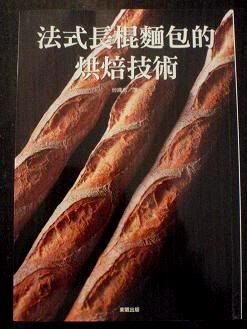
[i]Baguette no Gijutsu (Baguette Techniques)[/i], published by Asahiya Shuppan, Japan
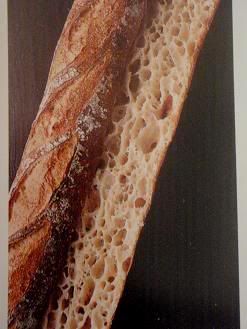
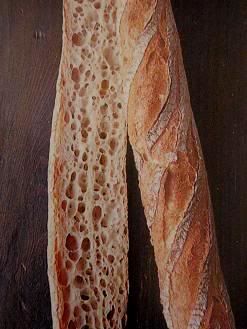
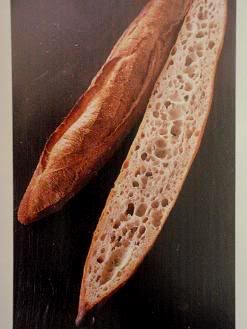
[b]right[/b]: Totszen Baker's Kitchen, Yokohama (page 28)
[b]middle[/b]: Fournier Bakery, Osaka (page 8)
[b]left[/b]: Lobros Bakery, Tokyo (page 124)
The way I see it, this book is about methods of pure fermentation of flour. Baguette is only the form in which the result is show-cased; the bread could be in any shape or form. There are 35 very detailed baguette formulas by today's top Japanese bakers in a very easy to follow format. The bakers play with fermentation possibilities in a wide ranging ways and dough hydrations of between 57 and 83%. The book reads to me like 35 flour fermentation love stories. The baguettes are solid works of fine craft and done in tightly controlled environment (the Japanese way!). Using the simplest ingredients, their objectives are all the same: to bring out the best flavour in flour through their individual fermentation methods. Only a third of recipes use levains, and not even at high baker's percentages, for a more clean taste of flour. Some use other pre-ferments; but pre-ferments are nothing new. What I find interesting is pre-fermenting the main dough flour.
Have you ever heard of autolysing flour and water for 12 hours? Maybe you have, but I haven't. With this post, I am making baguettes using Fournier Bakery's formula on which the gorgeous looking crumb pictured in the middle above is based. The book says Fournier won the 2006 French Baguette Competition organized by Torigoe, the oldest Japanese miller of French style of flours.
[b][color=red][u]Fournier Bakery's baguette formula [/u][/color][/b]
[b][u]Ingredients in baker's percentages [/u][/b]
- 100% bread flour (I used 650 grams of Australia's Kialla Organic unbleached plain flour)
- 70% water (I had 455 grams)
- 15% liquid starter (I had 98 grams. See note [color=red][b]*[/b][/color] below)
- 0.1% instant dry yeast (I used two-thirds of a 1/3 tsp)
- 1.9% salt (I had 12 grams)
Overall dough hydration is 72.1%. My dough weighed about 1200 grams. I did three times the formula in three days, totaling 18 baby baguettes of 200 grams each (see below).
Note [color=red][b]*[/b][/color]: As most of us are weekend bakers, it is best that our starter undergo at least two refreshes (ie, refreshment build and levain build) before being incorporated into the final dough. I did three builds for my levain, each time discarding all but 20 grams for the next build. I timed the last build to coincide with the 12 hour autolyse of flour and water (see step 2 below).
- Place only flour and water in the mixer, turn on first speed for two minutes.
- Autolyse for 12 hours at 16 ºC. (I did about 9 hours. As it is summer here in Australia, my temperature averages around 25 - 27 ºC.)
- Add liquid starter and instant dry yeast and mix in first speed for one minute. (The book says the levain is ready for use when its pH is 3.7. I had no way of knowing the exact pH of my levain but because it had just gone through 3 builds, I would guess that the pH value might be a lot higher than 3.7.)
- Add salt and mix in first speed for 2 more minutes, and second speed for 1 minute and 30 seconds. When kneading is complete, the dough temperature should be 22 ºC. (Note: I did all my mixing and kneading by hand. It was very messy, especially trying to get the liquid starter mixed into the dough. I did not use ice water to try to get my dough temperature exactly as per the formula. I figured that I would just watch the fermentation carefully.)
- Bulk fermentation is 3 hours in total at 22 ºC as follows: three times 2 letter-folds in a plastic container at 20 minutes intervals, then twice more 2 letter-folds at 60 minutes interval, totaling 5 times. (As my room temperature and dough temperature was about 25 - 27 ºC, [b]I did only 2 hours bulk[/b].)
- Divide the dough into 350 grams pieces and pre-shape them (I divided my dough into 6 pieces of 200 grams each because my baking stone is small, 34 cm x 34 cm.)
- Shape into baguette, 60 cm long. (I shaped mine into 32 - 34 cm long).
- (Note that it should only be 30 minutes from Divide to Shape, including the rest in between, during which time the dough pieces should be placed in temperature controlled room at 22 ºC.)
- Proofing is 60 minutes at 22 ºC and 70 degree humidity. (The book says when the dough completes its fermentation, its pH should be 5.2.) (For [b]the last 30 minutes of proofing[/b], I moved my dough into the refrigerator as I was afraid that it might over-prove.)
- Pre-heat oven to 250 ºC. Score the dough with 7 slashes. Steam the oven before loading the dough. Once the dough is in the oven, turn the oven down to 240 ºC. After 3 minutes of baking, steam the oven again. Bake for a total of 30 - 32 minutes. (My dough only needed 23 minutes of baking at the highest temperature my oven could go. I could only manage 4 slashes on my dough.)
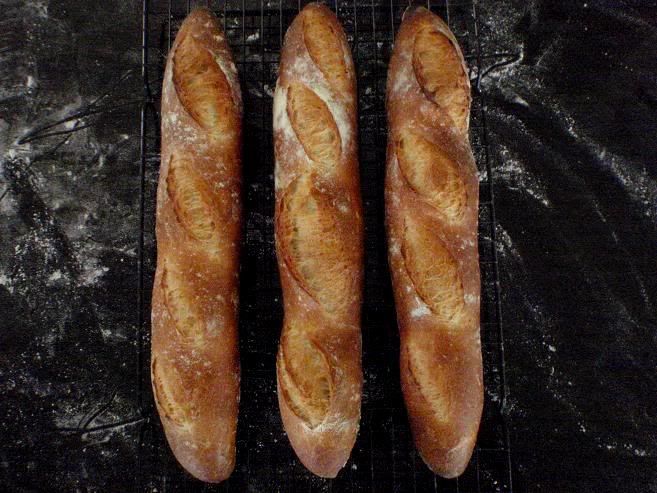
To recap: Fournier's fermentation is 4 1/2 hours all-up at 22 ºC. I did 3 1/2 hours at 25 - 27 ºC, including 30 minutes in the refrigerator, which had an added advantage of chilling the surface of the dough for easier slashing.
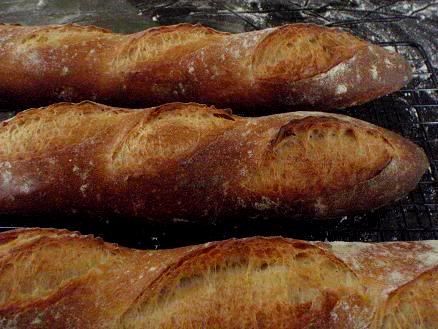
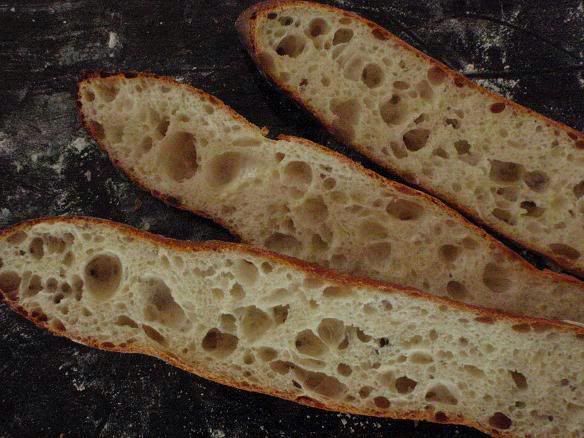
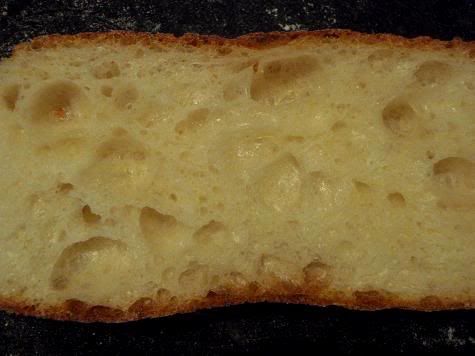
The challenge of baguettes to me is how to shape them uniformly. There is no better way than repetitive practice. It was only towards my last 3 baguettes (those pictured above) that I worked out how to do them with same length and thickness. The key for me is, after pre-shaping and rest, pat the dough out to very flat (not to worry, I was not squeezing the gas out by patting). Then, use minimal movements possible to shape the dough. I find that excessive handling serves no purpose. Out of the 18 baguettes that I made, the three next best ones are below:
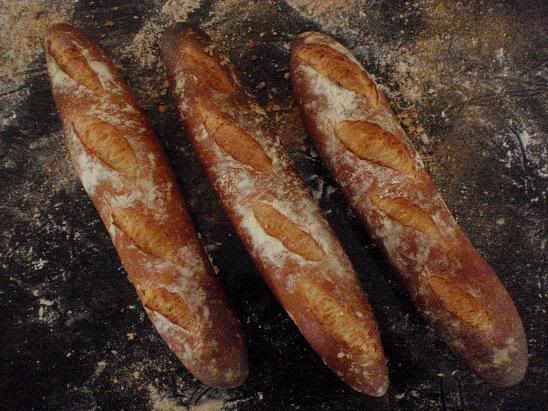
I find slightly under-proof works better than slightly over-proof. As my dough pieces were small, just 15 minutes more than necessary could make it over-proved. Once the dough is done fermenting and ready to go, no amount of chilling in the refrigerator can arrest it because of the [b]internal dough temperature[/b]. The flavour will still be good but oven spring would suffer.
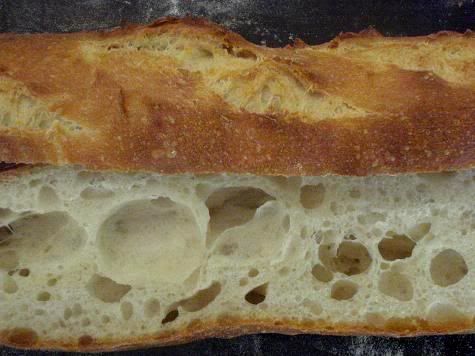
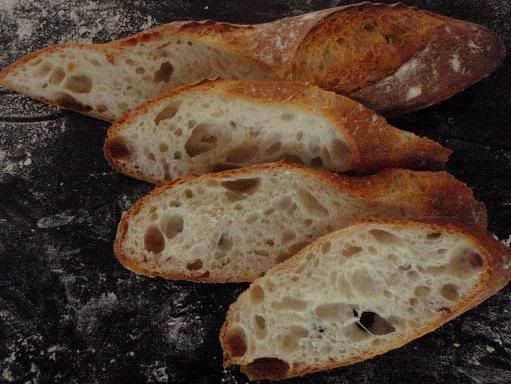
It would be interesting to try out more formulas in the book to learn more ways of pure fermentation. There is nothing wrong of using other type of flours (for instance, various whole grains flours) on these baguette formulas, paying attention to temperature and time issues etc., and see how they affect fermentation outcomes. I learn in this book that there are infinite possibilities.
Just as I was cleaning up from today's mess, it's almost time to go and pick up my son from his tennis. I tied up two baby baguettes to give to Andrew's coach. Don't people just envy us because we possess these presents to give away?
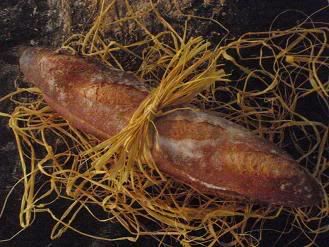
I was late collecting my son. When he saw me, he said, "Soft effort, Mum, soft effort." Gee.
It has stopped raining now. It is lush and green outside the window. Polly would not be allowed to go out for a while yet, not until the grass is dry.
Shiao-Ping
- Shiao-Ping's Blog
- Log in or register to post comments
YUMMMM, you are so good at it.
Way to go, shiao,
BTW, you should put bran in your flours, i guess it complements the awsome bread with health benefits.. :)
Mebake
... but with this particular experiment I only wanted white flour (inlcuding the levain).
you hit the nail on the head! What beautiful looking baguettes you made using the Fournier Bakery's formula...the whole package...crust,crumb and shape. You had me on the edge of my chair when I though you were about to announce the translation of the holey grail. It is not nice to tease someone like that! :)
Judd at WeekEndLoafer.com
Yeah, I am beginning to think the book is a holey (holy) grail to fermentation (joking...).
And, as for "shopping" goes, yesterday I was at my local fruit and veggie store, I saw some very nice and small Royal Gala apples (below). Con the fruiterer told me they are the new season apples.
If you pronounce "shopping" very slowly, that's what you get.
Shiao-Ping
Outstanding Shiao-ping. Your baguettes look absolutely delectable. Your ability to convey to us all, amazing.
Thank you for all the links. I enjoyed looking through Asahiya Shuppan's online shop (interesting to see the Japanese translation of Hamelman's book, as well as the original of the book TxFarmer introduced the other day). Also checked out the bakery websites; rather amused to see the different waters used by Totszen for their various breads.
Hi Robyn, thank you for your remarks.
"Shuppan" is the pronounciation of Mandarin characters, meaning "publishing. Tohan Corporation, Tokyo, is the one who arranges the copyright, translation, and overseas distributions of many of the Japanese publishing houses. Many of my Mandarin translated cookbooks from Taiwan are Asahiya books via Tohan.
Robyn
Can you please see what the Japanese title of the book means in English [b]here[/b]? Shouldn't it mean something like "The Technique of Baguettes"? I was being too hasty when I used the English translation, [i]Baguettes [color=red]No[/color] Gijutsu[/i]. The English translation came out of the website. The "[color=red]No[/color]" is really the sound translation of the little Japanese swirly looking symbol in the middle of the Japanese title, but it is wrong in meaning, right? because it doesn't make sense. "Gijutsu" means technique, right? So, can the title be translated to "Gijutsu of Baguettes" or "The Technique of Baguettes"?
Thank you.
Shiao-Ping
Hi Shiao-Ping
I think that a natural translation to English would be "Baguette Techniques" but as you see from the Mandarin title, were the book to be translated into English I'm sure it would have an entirely new title! Perhaps you could leave it as Baguette no Gijutsu and add in brackets (Baguette Techniques).
You are right about the word ’の', pronounced 'no', it indicates possession and is used a lot in Japanese. In English we often infer such relationship, without needing to use an 'of' or an apostrophe to translate the 'no'.
btw 出版 is pronounced 'shuppan' in Japanese too and has the same meaning.
Cheers, Robyn
I will take your suggestion and modify the book title to [i]Baguette no Gijutsu (Baguette Techniques)[/i] in my post because I really don't like [i]Baguette No Gijutsu[/i]; it doesn't make sense. But I understand your point that if there were an English version the actual English title may be different.
Thank you.
Thank you for this useful information. I couldn't get 18 baguettes into my refrigerator for love or money.
I like the rather narrow shape of the Japanese baguettes shown.
On the subject of making gifts of bread, something all bakers enjoy, I am sure, readers may find "The Gift" by Lewis Hyde to be of interest.
Thank you for mentioning the book. I have just ordered the book. I would love to read it.
I didn't put 18 baguettes into my refrigerator in one ago. The two of the three batches of dough were done at the same time, one batch to retard (6 baguettes)and the other batch (6 baguettes) at room temperature. The third batch was done after the first 12 baguettes were baked.
The amount of holes in the crumb is shocking! Fantastic!
Thanks for posting this!
Nick
PS where did you find the translation for Lionel Poilâne's Pain Rustique recipe?
has ever been translated to other languages. But Lionel Poilane had a couple of other books which have English versions (check out www.amazon.com and www.amazon.fr) and these are his "tartine" books (the open-faced sandwishes using his bread); I have those books as well but really they are not very interesting if what we want is to be able to produce his miche.
Because [i]Le Pain par Poilane[/i] is in French, so I have to translate it myself using on-line translation tools.
Amazing! Now those are the baguettes I would love to pull out of my oven : /
You give me hope and something to work hard for Shiao, thank you! : )
What a remarkable project Shiao-Ping. I have read that Prof. Calvel had many Japanese proteges and spent a lot of time in Japan instructing in the ways of French breads. I'm not surprised to hear there are books by famous bakers from the area who have taken the skills to a high art form.
The crumb structure is quite impressive is it not? The finished loaves must be light and airy. When I first saw the crumb images I was reminded of the double hydration and whipping of a thin batter to create tiny aureoles. I'll have to study your writing to better understand how this crumb pattern occurs.
Did you enjoy the flavor and after taste of the breads? I hope you continue to research this style, most interesting.
Eric
... sorry... it will take more time to find it in the book again... I will be back...
One of them is the chef (and baker) owner of restaurant, Painduce, in Osaka:
Page 26 of [i]Baguette No Gijutsu[/i] page 25
I find his baguette style very attractive and unconventional. The chef says his slashes are to symbolize [b]wind[/b] (I can't really see [b]wind[/b] except slashes in a sort of waving formation). He says in the book that his baguette mission is two-fold:
(1) to pass down to the next generation what he had learnt from Prof. Raymond Calvel and Philippe Bigot (who brought French baguettes to Japan); and
(2) to create modern day Japanese baguettes based on the French tradition.
His baguettes uses direct method (100% flour, 2% salt, 0.1% instant dry yeast, and [b]83.3%[/b] water). Interestingly , he uses Type 100 flour (ash content 100%) made in Japan. Many would think such high ash content would render baguette flavour slightly bitter. How he addresses this problem, he says, is through (i) high hydration; and (ii) the slow and long fermentation at low temperature to try and bring out the sweetness in flour. He obviously likes the nuttiness that comes with a high ash content.
Main points of his method are:
Shiao-Ping
Flour can not have an ash content of 100%. This would imply that the flour is 100% mineral (non-combustible) with no carbohydrates, proteins, fats, etc. (i.e., organic compounds). Perhaps you meant 0.1%.
SteveB
www.breadcetera.com
I'm glad you chimed in here. For us in the US market, what would be the prefered way to elevate the ash content in a Bread Flour or AP mix?
Eric
Hi Eric,
Since much of the mineral content of wheat is located in the bran of the wheatberry, one can increase the ash content of bread flour or AP flour by simply adding either whole wheat flour or wheat bran.
SteveB
www.breadcetera.com
I think Steve means 1% ash content :)
French flours are classified as T55, T65, T80 etc., where the number indicates the flour's ash content. I.e. T55 has approx. 0.55% ash content. Similar for German flours, e.g. Type 812, Type 1050, Type 1600 etc., where a Type 1050 flour has roughly 1% ash content and a Type 1600 has roughly 1.6% ash.
Hmm... if you, for some reason, would want to elevate the ash content of a bread flour/AP mix, you would have to add mineral rich parts of the grain - for instance bran and germ. At least here in Norway, you'll find wheat bran, oat bran and wheat germ readily available in most grocery stores.
Edit: Steve beat me to it with his post above!
Hans Joachim, you are absolutely correct! I should have said 1%, not 0.1%. But what's an order of magnitude between friends? :)
SteveB
www.breadcetera.com
We artisan bakers work best with arbitrary units anyway :)
I beg your pardon on the ash content. And, thanks, hansjoakim and Steve, for pointing it out. The book did say [b][color=red]1.0%[/color][/b] (page 27 of the book). I mis-read it in a hurry. When I read Chinese, I scan 5 - 10 lines in one glance. I am sure English speakers do that with English write-ups. [b][color=red]1.0%[/color][/b] is 1%. (Thank goodness, I didn't put it down as 10%.)
Thank you.
Shiao-Ping
10% is also unbelievable. Would be closer to the mud pies made as a little girl, my cousin and I would pick up grain around the silo to mix into them. Can you visualize mud baguettes? Me too, but we never perfected our play to go beyond round pies.
I was just wondering about their rating of type 100 as compared to type 1000 (Or type 1050) pointed out. Once found type 960 wheat, yes, a bread flour. Does sort of contradict the low gluten flours the French like to use.
The baguetts are so lovely! What an inspiration! Time I finally got started on them (what!?) as I've been holding off for a long time. I was just getting the hang of mini baguettes in China and had the good fortune that we ate them after sunset in dimmly lit sidewalk food stalls. I haven't made one in over two years. My French sticks are nothing to brag about but I'm ready to bake something presentable, seen in daylight.
Mini
Type 1000 flour is probably German. German flour types are an order of magnitude higher than french flours, i.e. french t55 is german 550, french t65 is german 650, and french t100 is german 1000.
Hi Shiao-Ping and Eric,
i was hoping somebody might mention Prof. Calvel's role in the development of bread in Japan. I might have guessed one of you two might beat me to it.
I have to say the breads you based your work on are some of the finest baguettes I've ever seen. Your efforts to re-produce these are sublime.
I think I really have to turn my attention to long and cold-fermented straight doughs. I guess I first came across it with Reinhart's Pain a l'Ancienne. Of more interest was the work of a French baker in Garforth, near Leeds when I was lecturing there. He made a Pain Normande, named after his Normandy origins. He had a frame in his very cold walk in fridge, housing 3 plastic buckets of dough. On the first day the dough was mixed with 72% hydration, and the dough was housed in a plastic container in the bottom row. Next day it moved up and made way for the next batch of dough. Next day it reached the top row, with the 2 subsequent doughs beneath. 72 hours after mixing, this dough was finally scaled off, proved in banettons and baked. I went to meet Thierry Dumouchel with a colleague from the Breadmatters course, for a trip round his bakery. Traceability on his organic French flour was unbelievable; he knew which farmer and which field the wheat had been grown in. Sadly the Pain Normande had already sold out, so I never got to taste it!!
I've just posted on Caraway Rye; hope you can check it out.
My best wishes
Andy
That is very interesting! I imagine the yeast he put in would be tiny, right? I also first came across cold-fermented straight dough through Reinhart's Pain a l'Ancienne. So, 72 hours you reckon! If we organize ourselves right, 72 hours is no problem at all.
I read your Caraway Rye with keen interest. I would love to do it but I was thinking to add a 15 hour cold autolyse on the flour and water portion of your final dough process. Then I realised the main part of your hydration is with the rye sour, so if I mixed the final dough flour with its water, it would be like a stone. In actual fact your overall dough hydration is in between 64.8% and 73% if we take into account of the molasses. So I think I might need to add 5 - 10% extra hydration to the final dough flour for my 15 hour autolyse and see what happens.
Regards,
Shiao-Ping
Hi Shiao-Ping,
I think I've worked out a way for you to do the autolyse. It just involves adjusting your leaven build, ending up with a stiff levain, and then you can transfer the extra water into the final dough. For example if you used Hamelman's Detmolder, your hydration in the sour ends up as 109.33%, compared to my sour in the caraway rye bread where the rye flour is hydrated at 156.75%. The difference between theese 2 figs could just be added in as final dough water to enable you to do the autolyse.
I've sent an e-mail to Meridian Foods concerning their Blackstrap Molasses. It is lovely and thick, and an organic and ethical product too; totally wonderful. When I was studying for my bakery quals we had to do a lot of work on balancing cake formulae. As you probably know, syrups have become very popular in many new types of confectionery product. They have a hygroscopic quality which beats sucrose, and they are derived from natural sources and most are somehat less refined than ordinary suger. We used Organic Brown Rice Srup and Organic Barley Malt Syrup by the pallet-load when I was working on the batch confectionery side in the early 2000s. I got quite involved in researching the specifications for these materials. The water content was consistently labelled as 20%. you are quite right that there is therefore extra water in my formula for the Caraway Rye. My best guess is around 20% minimum, but the carbohydrates are listed as 65g per 100g on the jar, so I guess the water may end up being as high as 30%, or, g per 100. If we said my recipe used 27g of water derived from the molasses, then this increases the overall water from 866g to 893g. 893 as a % of the 1333g flour content is 67% Now here's a one for you: what do you do with the 14% moisture content in the flour????
I don't get where you think the rye flour is only 23.2%. There are 333g of rye flour in a total flour mix of 1333g. Do the maths, and you get 24.98%; or, am I missing something?
In my freezer, right now I have ice cubes and 500g of "00" type flour. In my fridge, turned up full power, I have a half litre of water. I have some dried yeast in the store cupboard.
It's my 45th Birthday on Wednesday, and my wife is taking me away for a "mystery experience", as it's half term so we are both on holiday!! The last thing before we go away, and I aim to be baking these cold and long-fermented baguettes [demi-baguettes] in my case; my oven set-up can only cope with the shorter length. It's now Sunday just before lunchtime
I'll let you know how I get on
Very best wishes
Andy
Hi Andy
Thank you very much for your reply.
(1) About the hydration for the flour/water autolyse: That is a great suggestion! I will do as you suggested and shave your rye sour hydration to 109.33% from 156.75% and see what happens.
(2) Molasses: There is something quite wholesome about unrefined product like molasses. And about syrup, I often wonder why certain recipes call for syrup instead of just more sugar, now I understand why. Back on molasses, you said the carb. is listed as 65 g for every 100 g (ie, 65%). During that pre-Christmas and New Year period when I was doing a lot of rye and using molasses, I got the feeling that the hydration effect of molasses on dough was more than 35%. In fact, from an empirical standpoint, I felt that its effect was more like 50%, if not more. Now, I am NOT talking about how much water there is in molasses; I am talking about the hydration effect of molasses on dough. You recalculated the new hydration as 67% (as opposed to 64.8% in your [b]Caraway Rye Bread[/b] post). However, did you find your dough behaved like a 67% dough? I know that because of rye content, the dough would be more slack and less volume, but you bread [b]looks[/b] to me more like it's got more than 67% hydration.
(3) Rye flour content in your Caraway Rye Bread: In your rye sour of 100, it is 7 wheat + 23 dark rye + 70 dark rye. Therefore, rye flour is 93 out of 100. Is that correct? That's how I got 23.2% rye flour content in the total flour mix of 1333 g.
Hope you have a great birthday. The last time my husband had his 40th birthday, we had a progressive party. Everybody was singing Chitty Chitty Bang Bang (Dick Van Dyke's movie of the same title) in the van going to our first stop in the Botanical Garden in Singapore, and on the way home we all sang "Port Out Starboard Home, Posh with a Capital P..." It was a lot of fun.
Thanks again for your reply.
And Best Wishes to you too,
Shiao-Ping
Hi Shiao-Ping,
You are quite right of course about the rye %. I had neglected to take account of building the original leaven by using a seed cultur based on wheat rather than rye...how silly of me, and thanks for pointing that one out.
Of course using the Detmolder is but one alternative. If you want further hydration for the autolyse, you could build a stiffer rye sour if you wanted. I do believe Hamelman incorporates a poolish into his autolyse methods. But I think this is fine for a relatively short period; you are looking at an extended time period, so that idea may not work.
Regarding molasses, you are right about the empirical effect, and I have an idea it is to do with the hygroscopic nature of sugar, inducing flow in a dough or cake batter. I will post some more on this on the Caraway Rye bread topic on my blog http://www.thefreshloaf.com/node/16273/carawy-rye-bread-black-strap-molasses-superwet-ciabatta-too. Any contribution to further the discussion would obviously be welcome and valued, from yourself, or, anyone reading this post
Best wishes
Andy
...dedicated and amazing baker, Shiao-Ping. These baguettes look awesome. I'll give them a shot when I get back home. Thank you for the inspiration!
I know... She's a tough one to keep up with...
Tim
Thank you, MC and Tim.
Shiao-Ping - What beautiful mini-baguettes! Crust and crumb both - and your cuts look as good as anything I see in bakeries.
I had never heard of a 12-hr autolyse; however, it strikes me that what you're doing is close to creating a preferment in terms of flavor development - except that in this case you're using all your flour and water and not adding any yeast. Still, I would expect the baguettes to have some of the nutty flavor that a poolish yields. Please tell us how the flavor compared to other baguettes you've made.
As ehanner noted above, Calvel trained many Japanese bakers after World War II, and in fact was held in higher esteem in Japan than his native France. At our baking class at KAF last summer, James McGuire remarked that in his opinion the Japanese have surpassed the French in the quality of their baguettes.
Larry
... of their baguettes." Ahh, how interesting. I had no idea.
The flavour compared to other baguetters that I've made (including those that I made at SFBI courses) is that these are [b][color=red]a lot sweeter[/color][/b].
Those baguettes look amazing. The crumb structure is perfect. You asked about the 12-hour autolyse and it just happens that the Pain a l'Ancienne recipe from Philippe Gosselin also calls for an overnight autolyse using iced water. I find that this prolongued autolyse gives unbelievable sweetness to the dough.
Don
The Pain a l'Ancienne that I did was based on Peter Reinhard formula which autolyses flour, yeast, ice water, and salt, ie. the whole lot. The French autolyse is just with flour and water, right, and normally for anywhere from 10 - 15 minutes up to 60 minutes, right? To autolyse flour and water for 12 hours, as in Fournier's baguette recipe in this post, is the first time that I'd ever come across with. I guess when the yeast is not there, it is possible for the dough to sit longer in the fridge. Some of Hamelman's sourdough recipes says if the dough is to be retarded, it is best to leave out the instant dry yeast.
All 35 recipes in the baguette book use very small amount of IDY, averaging 0.1% (even [b]in absence[/b] of levain). In comparison, at SFBI, we used 0.6% IDY ([b]in addition[/b] to levain). The very low IDY enables longer fermentation (at low temperature) which is the key to flavour.
My husband is in China for business and I bought the book for him to take back. Now that I see your fantastic creation, I am even more eager to try those formulas out myself. Great job and the crumb structure is excellent!
Thanks for your comment and look forward to your baguettes!
Shiao-Ping
I must study the formula, and I wish I could see you handle the dough.
David
oh you don't want to get in the way between me and my dough.... My daughter uses her camera to take video whenever she spots me shaping the dough. There were some really funny ones, flour every where... and me giggling away.
Thank you very much for the write-up and photos. A real keeper....Beautiful!
Sylvia
It was great fun for me to do the post too.
Shiao-Ping
I was just thinking about our baguette table back at SFBI, you were always curious, positive, and most of all ready for all the challenges that come with making bread, but especially baguettes! Your a great inspiration.
Jeremy
Oh yeah, and you were always the first one to finish whatever tasks, swiftly and smoothly.
Shiao-Ping
Really grateful for your willingness to share the outcomes of your relentless research into baking techniques of the best-of-the-best world-wide. These baguettes look terrif!
I haven't come across many (any?) sourdough baguettes, so very interested to try these. Like other posters, I'm most interested in your assessment of the flavour.
Cheers!
Ross
PS: I have a Czech friend living in Tokyo, who complained recently that he could only get sweetish soft white bread there. Craving bread closer to that he enjoys back home, he bought a breadmaker (he didn't know about my excursion into the wonderful world of home-baked sourdough, and the tremendous results available to the home baker, but he does now!). I wonder if any of the bakers featured in your book have bakeries close to where he is in Tokyo...if the names and commercial addresses of any of the Tokyo-based bakers are in your book, would you mind letting me know here or by PM? Thanks!
Well, I get the feeling that artisan bakers don't normally talk about baguettes when the subject of flavour comes up because the idea about a baguette is that it is light and crunchy. I get the feeling that when people talk about flavour, they talk about the great miches. However, the good baguette will strive to have good flavour, too, on top of the other baguette characteristics. I will have to say that these baguettes were the best that I have ever tasted since I started making sourdough breads. These taste so much "sweeter" than all the other baguettes that I have ever had. Last night, like any other typical Friday nights, I didn't cook and my husband BBQ'ed. We had these baguettes to go with the steak and salad. My husband murmured out loud, "Oh yeah" when he took his first bite. So, I guess that was a vote of confidence.
To expand on the baguette idea, if you get a formula you like, [b]and[/b] if you are a person who likes a lot of crust, as the French do, you can divide and shape your dough into baguettes! I went to a very famous bakery in San Francisco and I tried their baguettes but I didn't like them at all because they were dense! To me the idea about baguettes is that they are light, so the challenge is always how to pack (I mean, develop) the flavour in the light texture. I believe Fournier's formula achieves that goal for me.
Hi Shiao-Ping, magnifico baguettes! I am going to try these over the weekend but please tell us how you baked them, on a baking stone, cookie sheet, or otherwise? I do not have the books so would appreciate any input on the last step. I am inspired! Thank you...
... inside the oven as your oven is being pre-heated.
Shiao-Ping,
I am trying to see what the slashing pattern is from the book, Baguette No Gijutsu. It looks like he is wrapping the surface in spiral cuts instead of the traditional overlapping down the center pattern. The effect of this is to create weakness in the surface, allowing even expansion, which is evidenced in the magnificent crumb.
I have a batch of long autolyse SD formula in process and will try to score in a similar fashion later today. It only took me 5 years to get moderately proficient at the traditional method. I'm sure this will be a long learning process also. Lol
Eric
Thank you Steve and hansjoakim. If I sifted the roughage out of WW flour would I be defeating the purpose?
Eric
If you sifted out some of the bran from whole wheat flour, you would obtain a flour with a lower ash content than the whole wheat flour but higher than that of conventional bread flour or AP flour.
SteveB
www.breadcetera.com
Just a post-add.........Gosselin's true formula is, in fact, a pure autolyse of only flour and ice water. The yeast and salt is added AFTER the retardation and then mixed and allowed to ferment. Reinhart's version was modified for the home baker. I personally prefer the results using Gosselin's original method.
Franc
One more way to slow down the fermentation (and for even longer fermentation if we want) - the ice water + the retardation.
Hi, Shiao-Ping.
FYI, here's a link to my blog entry on Gosselin's original formula: Philippe Gosselin's Pain à l'Ancienne (according to Peter Reinhart, interpretted by dmsnyder, with modifications)
You will note that it's very similar in approach to some of those used by the Japanese boulangers in your book.
David
I'd like to read it again.
Shiao-Ping
Hi Shiao-Ping,
"Baguette no Gijutsu" looks a fascinating book to delve into. Since so few TFL'ers speak Japanese, I was wondering if you might be interested in doing a Baker's Challenge based around the book. An idea would be for you to post a translated formula in whatever time interval works for you and have anyone who wishes share their results on the board. It could be a fun experience and a great way to develop our bread skills. I know you have your own busy life to lead but I hope you would at least think about it.
Jessica
Wecome (and I love your fairy photo if only I could have an enloarged one to see it more clearly)!
You had a great idea. The only problem is that I don't like anything that is a challenge or competition. What would help is people share their ideas as to what works for them in their techniques; for instance, how they shape a perfect baguette, or how they shape so as to preserve the holey structure and at the same time conducive to "grigne," etc. Or, if people share what they find in terms of ways of fermentation that improve flavour, etc.
I do plan to translate more of Mr. Nippon's baguette formulas. Not all 35 formulas come with fabulous baguette photos; there would be no need to do them all. I plan to do the more unusual ones and post them if they work.
Thanks for your suggestion.
Shiao-Ping
Hi Shiao-Ping,
I was using "Challenge" only in the sense that people use it to describe baking a series of formulas and sharing the results. I agree that the most exciting aspect is the personal challenge to attempt new approaches and techniques and then to share our learnings with everyone on the site. I did not mean this in any competitive sense at all. I am so glad that you will be sharing more of Mr.Nippon's formulas with us and thank you for taking the time to do the translations.
BTW, thank you for your comment on my "fairy" photo. It is actually a somewhat botched attempt at a semi-circular "epi" which ended up looking like deer antlers. A friend of mine, who is a major recipient of my fairy-gifts snapped the photo as we were laughing about my "masterpiece".
would no doubt be the result of amylase getting 12 (uninterrupted by yeast) hours to work on converting the starches to sugar. You've sold me...I'm going to try these today!
Would you let us know how you go. It would be most interesting for me to see if you find this formula results in sweeter crumb.
I just made these Baguettes today and they are the best I have ever had in all my life! I am thrilled and will not likely make baguettes in any other way ever again! Thank you so much for sharing. Now I need to figure out some way to implement this formula at work, scaling up production for a commercial venue rather than for my home kitchen.
Hi ChefRon, Thank you for yor comment. There are plenty more great baguette formulas out there. Have fun!
Hi Shiao Ping,
Your baguettes look amazing!
Can I ask you how you prepare your liquid starter? Pardon me, I am still new to baguette making so I am not very good at the terminology like levain and refreshment build, or how much to prepare.
Many thanks in advance for your advice!
Sorry for the late reply. You were asking about liquid starter. It is basically one to one flour to water, equal amounts of flour to water in terms of weight.