
Daniel Leader's book, Local Breads, is simultaneously one of the most intriguing and most frustrating bread books. His breads are rooted in the baking traditions of several European countries, but rendered in ingredients and techniques that are generally accessible to home bakers in the United States. Many are utterly delicious and lovely to behold. But ... one has to recognize going in that a number of the formulae are riddled with errors, often in the quantity or proportion of the dough ingredients.
Such is the case with his Classic Auvergne Dark Rye, which begins on page 158 of the book.
My descent from home baker to mad scientist began innocently enough. When asked "What kind of bread would you like?", my wife responded "How about something with oatmeal? Or rye?" Since I was at that moment looking at the Auvergne Dark Rye, it seemed auspicious. So much for superstition.
The levain is built with 45 grams of stiff levain (50% hydration), 50 grams of water, and 50 grams of fine or medium whole rye flour. So far, so good. This was my first week home from a 3-week trip to South Africa and I had refreshed my starter, which I keep at 50% hydration, early in the week. Having mixed the levain, and put it in a covered container, I retired for the night.
This morning, I mixed the first stage of the dough, which called for all of the levain, plus 350 grams of hot tap water, plus 500 grams of medium to fine whole rye flour. The rye flour I have on hand is a medium-to-coarse stone-ground flour, so no big change. (I had mis-read the formula the first time through and thought it called for medium to light rye, which is another thing entirely.) The resulting dough was a thick paste, nearly, but not quite, as stiff as modeling clay. In looking at the notes, I read that Leader describes the dough at this stage as a "thick, smooth batter."
Uh oh.
I did a quick search of TFL, found a few questions about the bread, but no answers. I searched the Web; same result. I posted here with questions and received mostly condolences (which were appreciated).
Deciding that I was already past the point of no return, I decided to forge ahead. So I added water and stirred. And added more water and stirred. And added yet more water, until I had a thick, smooth batter. It only took an additional 325 grams of water. Keep in mind that my "thick, smooth batter" may have an entirely different consistency than Mr. Leader's "thick, smooth batter". Chasing a description is not unlike chasing the wind - even if you do catch it, how do you know for sure?
For those of you keeping tally, the dough currently stands at 45 grams of levain, 50+500 grams of flour, and 350+325 grams of water. That's really, really high hydration! And it isn't soupy, which is another adjective that Mr. Leader uses to describe the dough!
I let it rest for the prescribed time, then mixed in the salt (20 grams) and bread flour (200 grams). The dough formed a big ball on the KitchenAid's paddle attachment and allowed itself to be pushed around by the dough hook. I eventually did a few stretch and folds in the bowl and called it good, then set it aside for its second fermentation.
Mr. Leader recommends that, at the end of the second ferment, the dough be scraped out onto a "lightly floured" counter, where it can be gently shaped into a "loose boule, without overhandling it." I eye the dough, then flour the countertop heavily. Not surprisingly, the dough sticks to everything that contacts it; hands, scraper, counter top. After a few brief tussles, it is in an almost round shape which lasts until I try to move it onto the waiting parchment paper and peel. Eventually, the less-than-round dough is on the peel, where it is patted into a somewhat misshapen, um, miche. In the French sense of the word. I allow it to ferment at the prescribed temperature for the prescribed time. The surface doesn't appear to have the promised cracks, but then, is it realistic to expect that it could with that much water in it? Into the preheated 500 dF (!) oven it goes, with steam. Baking time is estimated at 35-45 minutes, so at 35 minutes the thermometer is inserted and easily reaches 205 dF. I declare it done.
The surface still isn't fissured, although there may be a network of smaller cracks lurking beneath the flour on the surface. The color is a deep mahogany. As it cools, the crust softens and the bread feels slightly spongy. It will be tomorrow evening, at the earliest, before I cut into this bread. The thermometer's stem had gummy bits clinging to it when I pulled it out of the loaf, so it will require some time for all that moisture to distribute itself evenly throughout the loaf. I really don't know what to expect. It could be so moist as to be almost cake-like. It could be a gummy mess. Time will tell.
Here's a picture of the exterior:
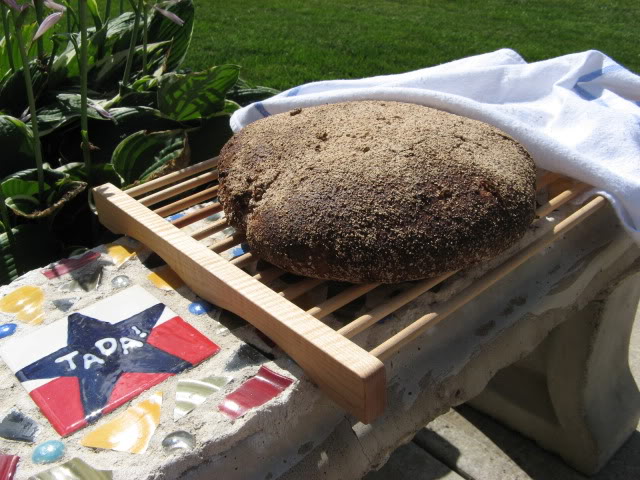
I would estimate that the loaf increased 50-75% in height, due to ovenspring, from its unbaked height. It didn't appear to spread any further while in the oven. It looks pretty (albeit rough) on the outside. I'll post again after cutting into it tomorrow.
Paul
Postscript - the crumb:

I have to say that I am very pleasantly surprised by this bread; especially considering the amount of improvising that went into it. It has a straight-up, hearty rye flavor; no seeds or spices are included. For me, that's a good thing. There's no particular sourness as of this first tasting. The crumb, while close-textured, is not heavy or stiff. Instead, it is very moist, with a pleasing yielding firmness. The crust is fairly soft and relatively thin; not so surprising when you consider how much water is in this dough, even given the high baking temperature. I'm looking forward to some great sandwiches this week.
For anyone who is thinking of giving this a first, or second, try, you may want to note that I took the bread out of the oven at shortly before noon and left it on a cooling rack, covered with a tea towel, until about 9:30 p.m. Then I wrapped it in plastic film (it's bigger than any of the plastic bags I have on hand) and left it until nearly 7:00 p.m. today before slicing it. The purists among you may prefer to leave the bread completely unwrapped. My concern was that the air conditioning might pull moisture out of the bread faster than I wanted. There was no gumminess, probably thanks to the long cooldown with plenty of time for some of the moisture to evaporate while the rest of the moisture redistributed itself.
The other tip that I would suggest is to do the shaping directly on the parchment paper. Why wrestle something this sticky into shape, only to have it be distorted during the transfer onto the paper?
Now that I've lived through the experience, I think I could make this again and have it turn out reasonably well. But probably not in the next few weeks. Someday. Maybe.
Paul
- pmccool's Blog
- Log in or register to post comments
It looks really interesting, Paul. I can't wait to see the inside and hear how it tastes. I'm a big Leader fan in spite of his flaws. (The tada by it's side is very funny.)
--Pamela
Xaipete,
When we moved from from Houston back to KC, some of my wife's friends managed to combine some paint-it-yourself ceramics with a concrete garden bench, on which the loaf is resting in this picture. The Texas star is probably self-explanatory. The initials of the ladies' first names spell TADA. I'm hoping for a ta-da! moment when I cut into the bread later on.
Paul
You have beautiful hosta :-) Let me show you what mine look like this year:
That bread really doesn't look half bad. And if it is, you'll be able to start a new one tomorrow. Unfortunately, I think I'm stuck with this look for the rest of the season.
Debra,
A couple of clumps have gotten so big for their location (including the one in the photo) that we'd like to give them a new home. You're not so far away, really. Send me a note if you want some, gratis.
Sorry to hear that your's weren't so luxurious this year. The ends appear to be bitten off. Do you have hungry rabbits or deer that treat your gardens as salad bars?
Paul
Paul,
Thank you for your generous offer---I'd take you up on it, but I know they'd just end up destroyed too. Every hosta in my yard looks the same. You'd think we had a goat. It's never been this bad before, and deterrents stopped having any real impact a few years ago.
But wow, your bread sure looks great in spite of all the difficulties you encountered in making it. Nice work!
Debbie
Ahh, 20 grams of salt, now I remember.
Suave,
I generally weigh my ingredients, but for small amounts I usually use the volume measurements, if they are available. In this case I went with the 1 tablespoon quantity noted in the formula. It looked about right for this amount of dough, and the dough itself tasted okay. We'll see about the finished bread.
The 20 gram quantity would be just north of 2.5%, which would be a bit salty for my taste.
Paul
I can't wait to see inside and hear how it tastes. Dave
Hate waiting myself. It looks promising from here.
Eric
Hi, Paul.
Are the errors in the recipe obvious enough for you to figure out what the proportions are supposed to be? Hmmmm .... I'll take a look myself, too.
David
For all of you waiting to see the crumb, go back to the top of thread. I've updated the blog entry with a crumb photo.
Thanks,
Paul
David,
No, the errors in the formula weren't obvious, until I started comparing what was going on in my mixing bowl with Leader's description of the dough. We were miles apart. Without his description, this would have been another Auvergne brick. As I noted in the original post, I just kept adding water until my dough's texture looked like it might be what he was describing. I almost doubled the amount of water in the formula to get to that point. I don't remember the exact percentage, but I think it was in excess of 130%. That beats the foccacia recipe from RLB's Bread Bible that I made last year.
As Suave pointed out in one of his notes, the 20 grams of salt seems a bit high, but some people might enjoy that.
If you are looking to make another rye foray, you might want to give this one a shot if only for the academic exercise of making it work. I'm happy with the outcome, but it was a nail-biter during the process.
Paul
Hi, Paul.
The crumb looks very good and it sounds like good eating. Whew!
It's great that you ended up with a really good bread. It's a shame you still don't know what the original is supposed to be.
David
And I think you nailed it David. Experienced baker will salvage the loaf, but there's no way of knowing what the original intention of the author was.
Thanks for the interesting and thorough write up of your loaf, Paul. It will be really helpful for those (like myself) who want to make this bread at some time in the future.
I love the look of the loaf and the crumb shot. Let us know how the flavor develops over the next few day.
Great job and a difficult formula. You are truly a master to have decoded Leader's formula into a workable bread.
--Pamela
I need to close the loop in case some unsuspecting soul is moved to duplicate my attempt at this bread. As I reported, it was a delicious bread and appeared to have been a successful bake. But...there was something lurking further into the loaf. At about 1/4 to 1/3 of the way in, the bread got progressively stickier with every slice I cut--even several days after baking. The flavor was still good, but the gumminess was incredible. Oddly, the crumb structure was fully developed, so I don't believe it to have been underbaked. So far as I can tell, the incredibly high hydration that I went to in pursuit of Leader's "batter" description was simply too much.
If you want to see a successful version of the bread (even though it still isn't quite what Leader describes and shows in a photograph), read LeadDog's post on the topic. He aimed for an 85% hydration in the final dough and it seems to have been an excellent decision.
Paul
Hi Paul,
Do you think the gumminess could be due to underbaking?
If I understand your first post correctly, you baked it for a total of 35 mins.?
Rye doughs keep a lot of moisture, and they need a long, bold bake. Even for a modestly hydrated rye loaf, I would initially go for a 50 - 60 mins. bake - starting out at 250 dC, and then lower the temperature progressively to approx. 180-190 dC towards the very end. Just a thought!
But I think that would be contrary to the intended results for this particular bread. It appears to be based on a high-temperature (500 dF or 260 dC), short bake. My guess is that this is to force significant oven-spring which, in turn, produces the characteristic deeply fissured crust. Of course, if the water quantity in the formula was off, then the baking instructions could be messed up, too. It would probably have been better if I had gone to the longer end of the recommended baking time (35-45 minutes). Since the internal temperature was 205 dF, I assumed it was done; the later observation of the crumb structure seemed to confirm that assumption. With the amount of water I put into the dough, the crust would probably have been bullet-proof if I had baked it until the center achieved a non-gummy texture, even if using falling temperatures, a longer bake, and allowing a day or more before cutting into the loaf.
I sent an e-mail to the Bread Alone bakery a couple of days after baking the bread relating my experience and asking for suggestions, but have received no reply. It's a shame not to have an accurate formula/process for this bread, since it tastes really good. LeadDog seems to have found a good balance between the formula's too-low hydration and my hyper-hydration experiment. I'm not sure how well it replicates the original Auvergne bread, but it looks like a good bread.
Paul
I'm in the process of trying this one for the fist time. Like PMcCool, I found the dough so stiff and dry it would not incorporate the bread flour after Leader's ferment of the 500g rye. My improv was to add 125g of water, which makes the final dough hydration 67% Shaping the final boule was easy at this hydration level.
This is the first time I've had issue with any formulation in the book. But the again, maybe my technique is not accustomed to rye and this approach.
Oven is preheating now, crossing my fingers for a non-gummy bread with HUGE oven spring (the ferment and proof times in this recipe are really short, so there is not a lot of apparent fermentation).
I suspect that your addition of 125g of water will produce much more acceptable results than my addition of 325g. It definitely wants more than the formula indicates. Maybe our combined attempts will provide brackets for what the real amount should be.
This has the potential to be a terrific rye bread, if the hydration riddle is worked out.
Bonne chance!
Paul
All looks pretty well salvaged. I'll let the loaf cool and post pics of the crumb after slicing and tasting. Based on my hydration level, I would say it needed to be scored or I should have baked it in a covered dutch oven to get the top to crack as shown in Local Breads. FWIW, I use a pan of lava rocks in the base of my oven to get a good volume of steam. I thought my lava rocks would provide equal steam to the dutch oven for this loaf, but not quite...
Before and after pictures posted when I can figure out how to upload them into TFL.
I don't know if this contains ALL corrections, but it's at least a start ...and there is an email address in it where you can write for more info or to provide feedback:
http://www.breadalone.com/PDF/local-breads-corrections.pdf
Brian
here on TFL. It is a series of posts from bakers finding problems, not a neatly organized table, so you may have to read quite a bit to find out about a particular issue.
Paul