
When reading recipes for French Bread, a lot of baking books will tell you to combine the ingredients in the bowl of a stand mixer and then beat the bejeezus out of the dough. 10, 15, even 20 minutes of beating is not unusual to read about in order to get maximum gluten development.
But stop and think for a moment: bread has been around for some time, longer than stand mixers have. Do you honestly think the village baker had the strength to knead a trough full of dough for 20 minutes in the days before stand mixers? Or that he had a gaggle of Oompa Loompas to do the mixing for him? Of course not!
Heavy mixing is how boulangeries today make pain ordinaire, I've been told. But more interesting breads with better, more subtle flavors require different techniques. One of the simplest is known as autolyse.
How do you use the autolyse technique? Simply combine the flour and water from your recipe in your mixing bowl. Cover the bowl with plastic or a damp towel. Walk away for 20 minutes to half an hour. That's it.
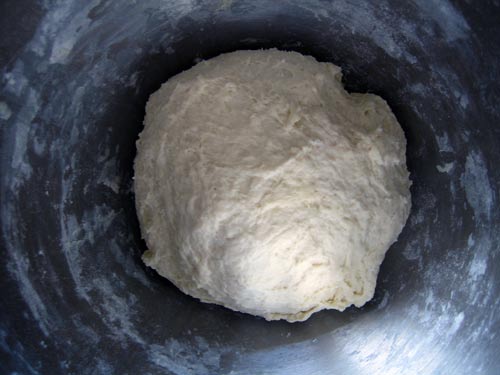
While you were away the flour was absorbing the water and the gluten strands have begun to develop. Now you can mix in your preferment, your salt, and the remainder of your yeast and, with very little mixing, achieve a high level of development with considerably less work. The crumb of your dough is also likely to come out much whiter since it has not been highly oxidized by all the beating and whipping.
Better bread, less work. What's to complain about?
Next up: Number 7: The Wetter, The Better.
But stop and think for a moment: bread has been around for some time, longer than stand mixers have. Do you honestly think the village baker had the strength to knead a trough full of dough for 20 minutes in the days before stand mixers? Or that he had a gaggle of Oompa Loompas to do the mixing for him? Of course not!

Heavy mixing is how boulangeries today make pain ordinaire, I've been told. But more interesting breads with better, more subtle flavors require different techniques. One of the simplest is known as autolyse.
How do you use the autolyse technique? Simply combine the flour and water from your recipe in your mixing bowl. Cover the bowl with plastic or a damp towel. Walk away for 20 minutes to half an hour. That's it.
While you were away the flour was absorbing the water and the gluten strands have begun to develop. Now you can mix in your preferment, your salt, and the remainder of your yeast and, with very little mixing, achieve a high level of development with considerably less work. The crumb of your dough is also likely to come out much whiter since it has not been highly oxidized by all the beating and whipping.
Better bread, less work. What's to complain about?
Next up: Number 7: The Wetter, The Better.
Comments
Hmmm .... Interesting
Would this work for Struan - Mix the cup of water with 7 cups of flour , mix 2/3 minutes then walk away and come back and add everything else including the 1/2 cup you use to adjust the wettness with?
Thanks
Slidething
I've used this method a couple of times now, but I'm at a loss for the best way to mix in the salt thoroughly. For a dough that will be stretched and folded instead of kneaded, I get worried that the salt won't be mixed in well. Generally by the time it has sat for 20 minutes the gluten is too strong for spoon mixing, but I get incredibly messy trying to work it in by hand and feel like I'm defeating the purpose of avoiding heavier mixing or kneading. I then put the dough in the fridge overnight and the next couple of stretch and folds are with cold dough, which is much less messy. I do not have a stand mixer. Any suggestions?
I agree Hitz, adding the salt after autolyse makes hand mixing and kneading more difficult. The salt seems to draw moisture out of the dough and form an unpleasant film on the surface of the dough that takes a lot of extra time to work out.
I've found it simpler to just whisk together the dry ingredients (salt and flour), and then add the liquid ingredients (water and liquid sourdough starter). Mix everything to form a shaggy mass and let rest for 30 to 40 minutes. Then knead or stretch and fold as you prefer.
I suppose adding salt before autolyse is not technically correct, but I've tried both methods and really can't tell the difference in the final loaf.
Prairie19
So far I have combined all of the ingredients including the yeast in my pizza dough mix for instance. 1 min on low until all are mixed and then a 20 min sit before the 8-10 min knead with mixer. Havent tried it without the yeast yet but according to Jeff Verasano and his pizza article for Neo pizza, he says he hasnt seen any difference in using either just water and flour, or water flour salt, so he suggest just putting it all together and still reaping the benefits. I do know that my dough before the use of autolyse is way different than the dough with it. My crust browns better and tastes more complex and the texture is just better. Maybe i will try no yeast someday but the dough i ;make is outstanding for sicilians or thin crust pizzas.
I think you will find that using the stretch/fold method (preceded by the autolyse period) will result in a crumb that is not whiter, but one that retains the subtle cream-color (very subtle) of the flour. It is over-oxidation via pummeling the dough in a mixer that brings about the white crumb, while a less oxidized dough will retain some color. I have evidence of this from two fronts: a class at King Arthur Education Center where the effect was clearly demonstrated by Jeffrey Hamelman and in my own efforts as a Serious Home Baker using a autolyse followed by stretch/fold method with all my doughs.
Simply combine the flour and water from your recipe in your mixing bowl. Cover the bowl with plastic or a damp towel. Walk away for 20 minutes to half an hour........ Now you can mix in your preferment, your salt, and the remainder of your yeast and, with very little mixing.......so did you add some of the yeast to the flour and water if then we are to add remainder of yeast?
I am very unclear as to whether or not part of the yeast is suppose to be added to the initial mixture.
... both of you is "No, don`t add any yeast to the mixture of water and flour that will be autolysed!"
Have a great day!
Because I didn't do it that way!
I've got my fourth batch rising right now. Did two yesterday.
It is miraculous what autolysing does. Cannot thank you people enough!
Now all I have to do is figure out how to get the BOTTOM brown... o.O lol
I don't claim to be a bread baking expert, but over the last year I've discovered the benefits of autolysing. My solution to the issue noted (trying to knead in salt / yeast etc into autolysed dough) is very simple (so simple I never even thought to do otherwise), but I think very effective.
When initially combining the water and flour to autolyse, simply don't use all the flour. I use roughly 75% of the total amount of flour, with the full amount of water.
This means that after autolyse, the mixture is still very "wet", and the yeast and then salt can be mixed in easily enough, before the remaining flour is added. As I bake with lots of grains etc as well, this is the perfect time to mix them in (before the remaining flour is added).
Like most of my baking these days, the precise amounts of ingredients are based entirely on feel rather than precise weights etc. So it might take a little bit of trial and error to get it perfect, but give it a try!