
After seeing Renee's and Lin's achievements with crumble bigas, I wanted to try them again. I was especially interested in the one that used both a biga and a poolish, between them including all the flour.
I decided to work with the most difficult flour I have, a stone-ground whole wheat pastry flour made by Snavely's Mill. They only sell wholesale; a local discount grocery bought some 50 lb bags and broke them down into 4-lb sacks, which is how I got mine. The flour has a good taste in baked goods but being a pastry flour is really tough to make a decent loaf from. I have found that a mix of half the WW and half King Arthur bread flour works better and tastes good, but still doesn't make for great breads. I thought this flour should make for a good stress test for a crumble biga.
I decided to use all the WW flour in the biga and all the white flour in the poolish. The poolish would be at 100% hydration and the biga at 45%, as Renee and Lin have suggested. Of course, 45% might not be the best value for this particular WW, but we have to start somewhere. I couldn't make all the hydrations work out with exactly equal amounts of the two flours, and the WW ended up being about 58% of the total.
Target flour: 300g
target hydration: 68%
Biga
------
- 175g - WW pastry stone-ground sifted #30 screen
- 79g - water
- 0.25 - tsp yeast
Poolish
--------
- 125g - bread flour
- 125g - water
- 0.25 tsp - yeast
Add salt at final mix.
Overall hydration: (79 + 125)/(175 + 125) = 68%
From my notes:
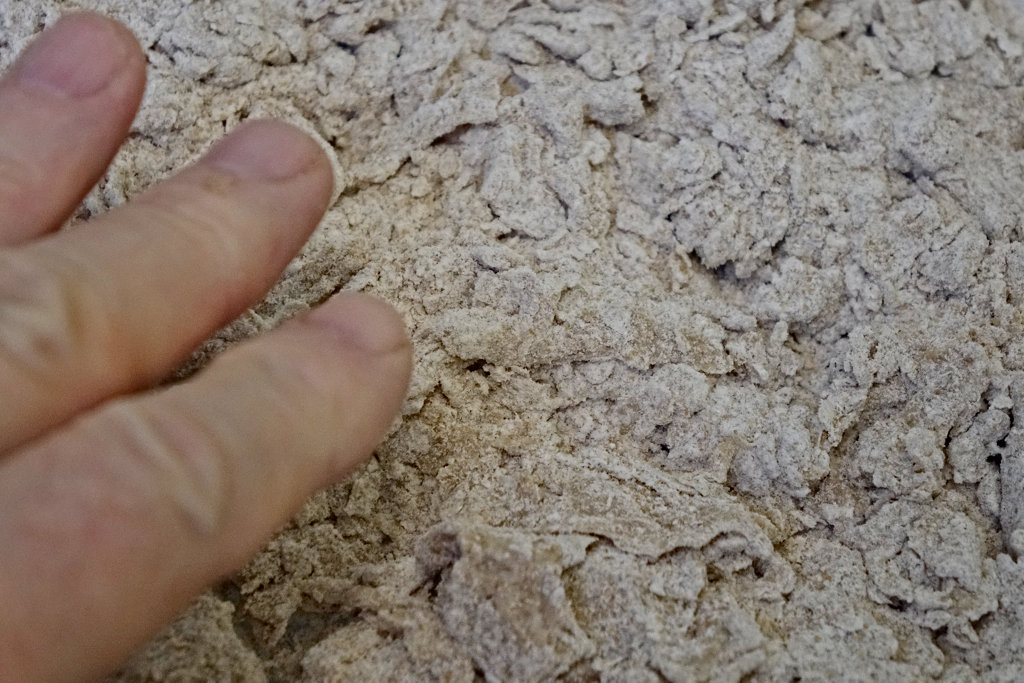
Making the crumble biga: I poured all 79g of water into a glass baking dish and sprinkled the yeast over it. Then I added 79g of the WW flour and stirred it in gently with a small spatula. At this point the mix was quite wet, of course. Then I added the rest of the flour and started to work it in without working it too much (since one goal is to get minimal gluten development). I ended up working the dough gently by hand, much like working butter into the flour for biscuits. This worked well and did not get my hands very covered with dough. I took a picture of the crumbled biga at this point.
Here I made a radical change from what everyone has suggested:
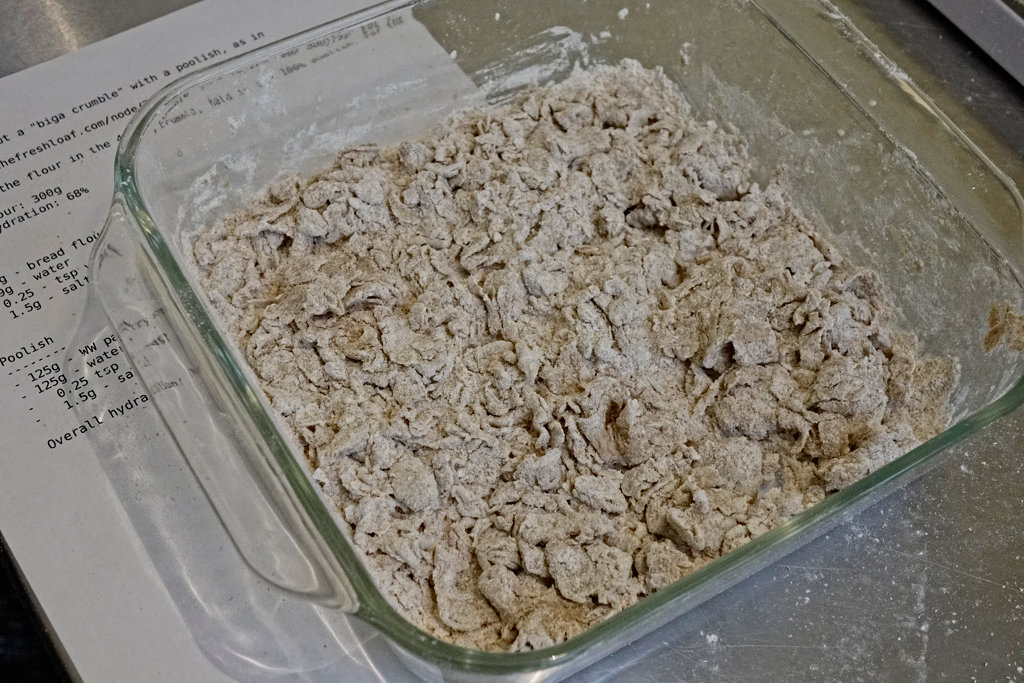
I put both preferments into a proofer at 80°F. I fermented the poolish for 5 hours, It seemed nicely active, with many bubbles. I removed it to the counter. I kept the biga at 80°F for a total of 6 hours; I couldn't really detect any activity. Here is a picture of the biga at this point,
Then I combined the two preferments.
The biga was very dry, and next time I would spray it with water at the start of fermentation. Combining and getting the lumps out was hard. I repeatedly squeezed the dough through my hand and eventually got the two components fairly smooth but still not completely uniform. I waited 1 1/2 hours then kneaded them in the bowl. After kneading the dough seemed a little wet, somewhat sticky, and not very strong nor elastic.
After half an hour, I did a shear-lamination style stretching session. After another 1/2 hour, S&Fs in the bowel. At this point the dough seemed dry, tacky not sticky, and was strong and elastic. It felt like a more conventional dough after 3 - 4 S&F sessions. After another 30 - 40 minutes the dough had risen nearly double and I shaped it into a log. Proofed free-standing for ~ 1 hour. It was too late to bake so I put the loaf covered with plastic wrap into the fridge for overnight.
The baking schedule was devised to keep the surface of the loaf relatively cool as long as possible; the loaf being cold from the fridge would help; I suspected that the WW pastry flour wouldn't support much oven spring. So the plan was to preheat the oven to a lower temperature than usual and then to boil the baking steel to give it more heat.
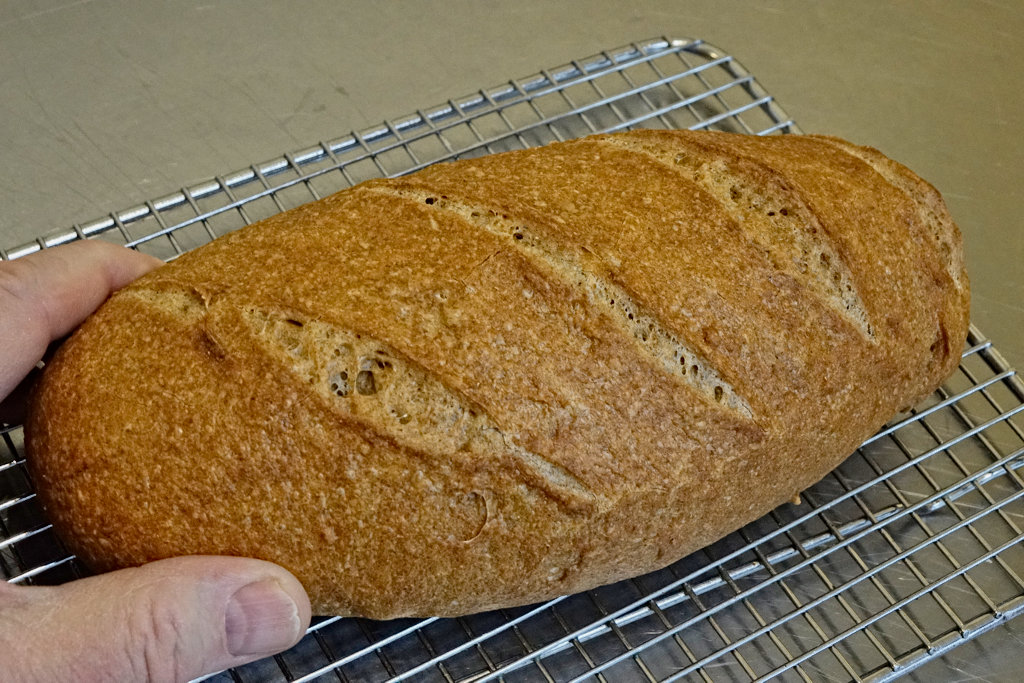
9 hours later I preheated the oven to ~410°F. Then I broiled the baking steel for 6 - 7 minutes and turned the temperature setting down to 300°F. I took the loaf out of the fridge just before broiling the steel and kept it covered, Slashed, and baked with steam for 13 minutes then reset temperature to 410°F. The loaf was finished in only 25 minutes with the interior temperature 207°F, the crust hard to a tap, and the color a medium shade of yellow-brown. The bottom was lighter in color, suggesting that I could have broiled the steel longer.
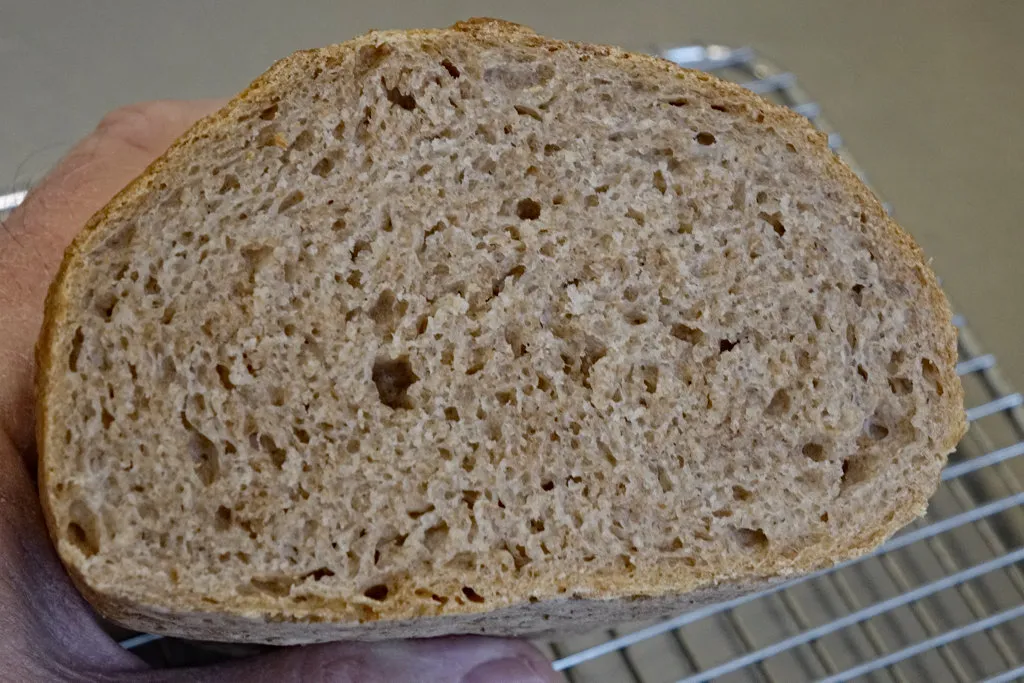
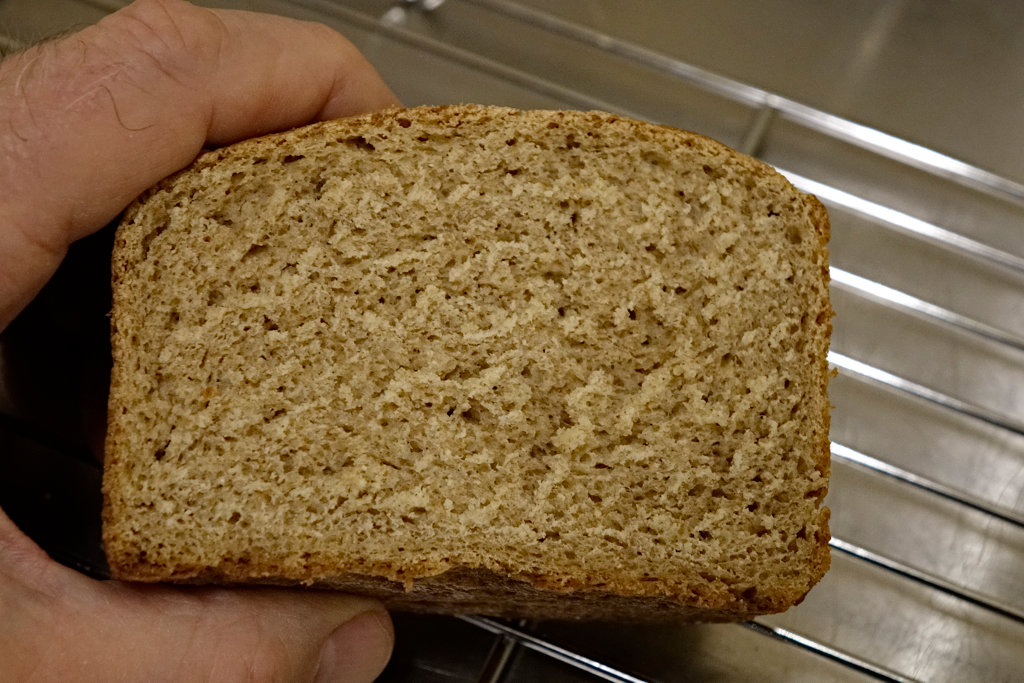
The finished loaf had risen but not enough to open the scores very much. It felt on the dense side to heft. The crumb was not very open but not really dense either. The crumb had a soft mouth feel. The flavor was very mellow with a pleasant richness and a hint of almost an EEVO-like flavor even though no oil had been used.
I sliced the loaf when it was still warm and that shows up in the image of the crumb. The bread was soft and mellow with a mildly rich flavor. The crust was thin with a little crunch. Overall, an acceptable but not great loaf. Perhaps this is a good as it gets with this flour.
By comparison, here is a crumb shot of a yeasted loaf I made with the same flour, where I used 90% WW, 10% masa harina, and added an egg for more structure:
- tpassin's Blog
- Log in or register to post comments