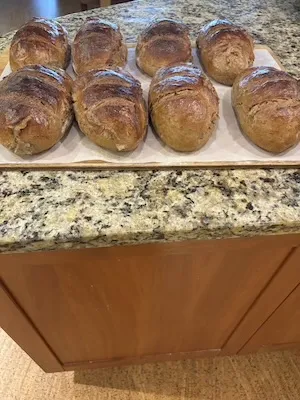
Inspired by Moe’s comment about not being able to good rye bread as well as requests from some of my customers for a good seeded rye bread. From their comments it seemed what they were looking for was likely a light caraway rye and not a dark 100% rye. So with that in mind I looked through my archives for something that might suit and came across a formula for Jewish Sour Rye that I hadn’t made since 2014. Notes from that bake said it came from this site possibly by way of the cookbook Secrets of a Jewish Bakery.
Not having a copy of that book I checked my library which did. Comparing the formulas I made some slight adjustments to match the book. Unfortunately, I returned the book before the bake so had to guess about a few things and if anyone has a copy of the book I would appreciate their input.
This bake also touched on several recent comments/issues on this site, which I’ll get to as they came up.
Dough Temperatures. Having taken several classes from SFBI as well as King Arthur I’ve learned that dough temps don’t just impact fermentation but may also impact flavor. One professional baker at one of these classes told of an experiment that had been conducted and found that for a typical artisan style bread that when the final dough temp exceeded 75°F flavor was compromised. For an enriched bread when the temp exceeded 80° flavor was compromised. Also having a vague memory that rye bread likes it warmer, and my kitchen hovers around 64° this time of year I set a target of around 78°, however the final temp was only 74°
Dough Development. Experience with rye breads has been that there isn't much development of gluten and slower, longer mixing is the best. I use a Famag Spiral mixer and mixed all in, except for the caraway, on the lowest speed for about 8 minutes until there was no dry flour showing. Increased the speed to 3, which is still pretty slow - for other breads I typically ix on 5 for gluten development, and mixed for 4 minutes before adding the caraway seeds and mixed for another 5 minutes.
Ferment. The old instructions said to ferment 15-20 minutes and proof about an hour.That seems unrealistically short and due to how cold my kitchen is I went with a little over an hour with 2 full stretch and folds at 15 and 30 minutes. Dough was nice and gassy at this point. Also given the low temperature of the dough after mixing the longer ferment was necessary.
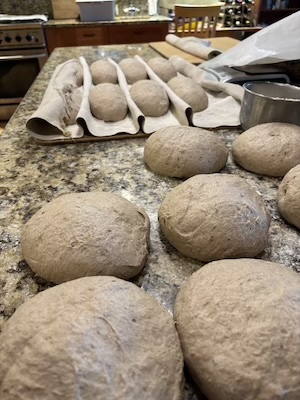
Dough Strength. From my 2014 bake I had a note that after proofing the dough had little strength, was hard to score and collapsed during baking. The instructions I had for this bread indicated no pre-shape so given that rye doesn’t have much strength I opted for a pre-shape to rounds with a short 15 minute rest. Final shape blunt batards.
Proof. 1 hour
Scoring. Having had recent difficulties getting a good score I changed the blade in my lame. Never underestimate a simple solution. Went with 3 horizontal scores
Baking Temperature. Again, my incomplete notes on baking temperature said the loaf should be baked at 375°, with a note in parenthesis that said 500°. Not sure what was correct I opted for somewhere in the middle. I bake in a Rofco so went with around 425° on the stone floor. Baked for 25 minutes with steam, vented and went another 5.
Formula. I have notes that I modified the formula from different sources, without noting from here, possibly from another user here. I added the onion and caraway in the first build - though forgot to grind the caraway and used it whole at this stage. There was o malt syrup in the original, but I left it in anyway as it is common in rye breads. The original seemed to use light rye for all of the rye but I opted to use fresh milled whole rye for the first two builds then a light rye purchased from the local food co-op. I made 15 loaves, pre-bake scaled at 500 gr. .
For clarity I’m including the % calculations as well as the quantities I used for each stage. I likely calculate things differently than some of you so in this manner you should be able to follow what I did. Not included in the formula is a cornstarch glaze brushed on the loaves before and after baking. For this bake 20 gr cornstarch mixed in 76 gr water, poured into 300 gr boiling water.
| % | First Stage - Tuesday Evening | Gr |
| 100 | Rye Flour - whole fresh milled | 43 |
| 100 | Water | 43 |
| 13.13 | Caraway Seeds, Ground | 6 |
| 4.5 | Onion, minced | 2 |
| 50 | 100% Liquid Wheat Starter | 21 |
| 267.63 | Total | 115 |
| % | Second Stage Sour - Wednesday Morning | Gr |
| 100 | Rye Flour - whole, fresh milled | 285 |
| 100 | Water | 285 |
| 40 | First Stage Sour | 114 |
| 240 | Total | 684 |
| % | Third Stage - Wednesday Evening | Gr |
| 100 | Rye Flour - Light Rye | 1708 |
| 100 | Water | 1708 |
| 40 | Second Stage Sour | 683 |
| 240 | Total | 4100 |
| % | Final Dough | Gr |
| 100 | Bread Flour | 2628 |
| 50 | Water | 1314 |
| 2.5 | Salt | 66 |
| 1.4 | Yeast | 37 |
| 156 | Third Stage Rye Sour | 4100 |
| 4.5 | Malt Syrup | 118 |
| 1.39 | Caraway Seeds | 37 |
| 315.79 | Total | 8300 |
| % | All Ingredients Total | Gr |
| 43.66 | Rye Flour | 2036 |
| 56.34 | Bread Flour | 2628 |
| 100 | Total Flour | 4555 |
| 71.83 | Water | 3351 |
| 1/41 | Salt | 66 |
| .79 | Yeast | 37 |
| 2.54 | Malt Syrup | 118 |
| .46 | Wheat Starter Culture | 21 |
| .90 | Caraway Seeds | 42 |
| .04 | Onion | 2 |
| 177.97 | Total All Ingredients | 8302 |
After baking. You can likely see that several of the loaves had blow outs on the side. After some consideration as to the the cause I realized that I had brushed with the cornstarch glaze after shaping before proofing. That caused it dry against the couche and I had to pry it away from the couche to get loaded in the oven. So that was the likely culprit.
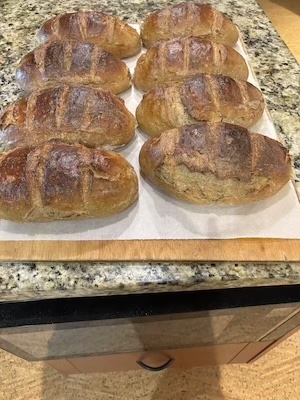
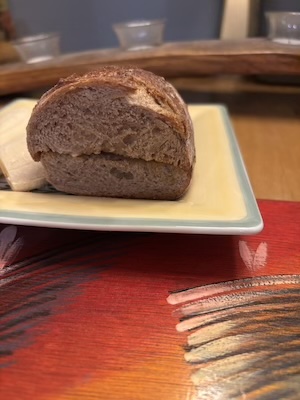
Overall I would say that this was a very successful bake. Everyone liked the bread and I thought the flavor was excellent. I highly recommend giving it a try.
- islandbakery's Blog
- Log in or register to post comments