
I've been thrashing my way through to a bread for my wife Carol,. She suffers from a mess of intolerances, IBS and an autoimmune neuropathy that necessitates a/the Mediterranean Diet. Said MD does not have a canonical definition, but means different things to different people. Carol's requirements:
- no gluten, no lactose
- whole grains
- EV olive oil
- acid-reflux diet restrictions
- low/no/fat
- egg white only, no yolk
- no starch
- restricting things that cause gas or nausea (possible with xanthan gum)
As you might imagine, this eliminates virtually anything resembling normal wheat-based bread right from the start. I've been at it with my Zojirushi Virtuoso for a year or so now. I started out with a Zoji GF brown rice bread Rx, modified to restrict the ingredient no-nos or at least limit them and fought my way through months of results that cratered and had considerable potato starch. Eventually, I tried adding potato flakes at a suggestion here and managed to achieve a loaf that didn't crater but still had too much starch and my wife didn't like much. <sigh>
So I flogged the net again (all the nifty picture-book GF breads are mostly starches) and finally found this one to adapt that uses equal parts of millet, TEFF. brown rice and sorghum flour, no starch at all, my current adapted Rx here. At this point I have a 3.5" high loaf that looks like this... It's still a work in progress.
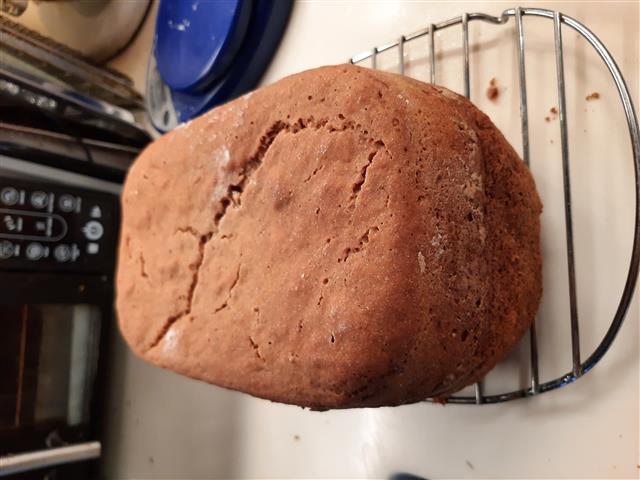
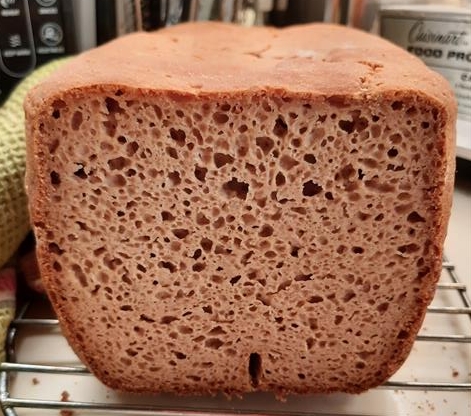
I would wish a higher rise, a more plastic texture (note from the picture that the loaf cracks rather than splits as a wheat bread) and a less gummy mouth feel (sigh, how do you replace gluten with gum and not have it taste gummy?). Any suggestions?
And a specific question about GF bread made in a bread machine concerning the dough consistency. I learned the hard way that a dough with the consistency of the proud elastic consistency of a wheat bread...but made with GF ingredients....would create bullet-proof flat bread. GF dough needs to be more liquid...note I do NOT use the word hydration because that brings in the matter of the flour assimilating the liquid. Question: what consistency should it be at at the end of the knead circle?
(More wisdom: GF has no gluten to develop and only rise once...if you do another knead it will not rise again, you will have flatbread).
While wheat bread in a bread machine will develop and cohere into an elastic wad of dough, GF dough never does: the knead cycle is really just a mix cycle. The GF dough pools at the bottom of the bread machine like this, thin consistency on the left, thicker consistency on the right
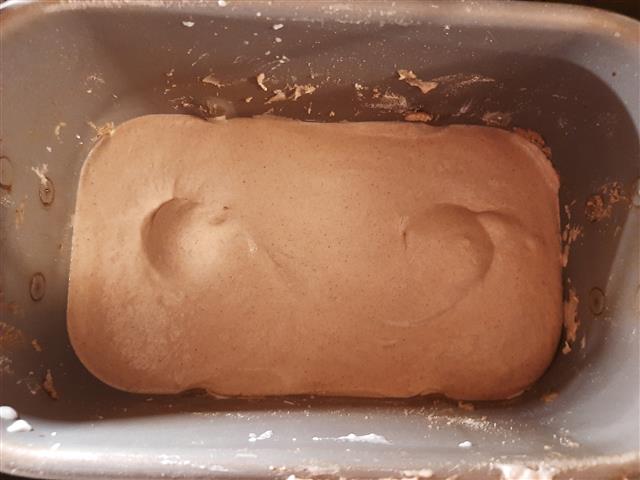
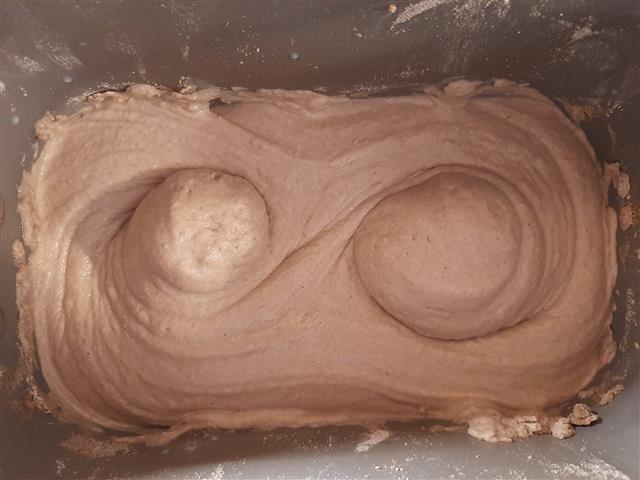
Question: How does the consistency, wetness, of GF dough affects rise and final loaf height? Does a thinner wetter dough make it easier for the yeast to lift the dough? Or does a thicker dough provide more strength, more flour component to structurally support the risen bread? Or is there a sweet spot in the middle?
- sdean7855's Blog
- Log in or register to post comments
I took a few minutes to look at some of the earlier posts in your journey to a suitable bread for your wife. The constraints that you have to work within are a real challenge.
When you were attempting to address a cratering issue, you mentioned that you had abandoned psyllium husk and were focusing on gums as the primary means of providing structure in the bread. May I ask why? From my limited gluten-free baking experience, I have found psyllium husk in lieu of gums to be very helpful in addressing a lot of the complaints about gf breads; particularly regarding crumbly texture and rapid staling. Have you conducted any further attempts using psyllium husk instead of gums?
I note that your are working with a bread machine and have managed to miss your reasons for that choice. Would you be willing/able to mix the dough/batter by other means and bake it in an oven, instead? That would allow you some additional latitude while eliminating the bread machine idiosyncracies.
Best of luck with your continued efforts.
Paul
I will give that a try in one of my followons. My wife beats me about the head and shoulders about my attempts to produce something more like bread than some GF bread-surrogate extrusion. "The last one was just fine, why do you have to keep changing it" I persist.
A less successful efforts:
It's fine, I don't mind the cratering.
This was my successful, looks like bread, with potato starch and potato flakes that she said tasted bad (the dough, not surprisingly, looked like.....mashed potatoes)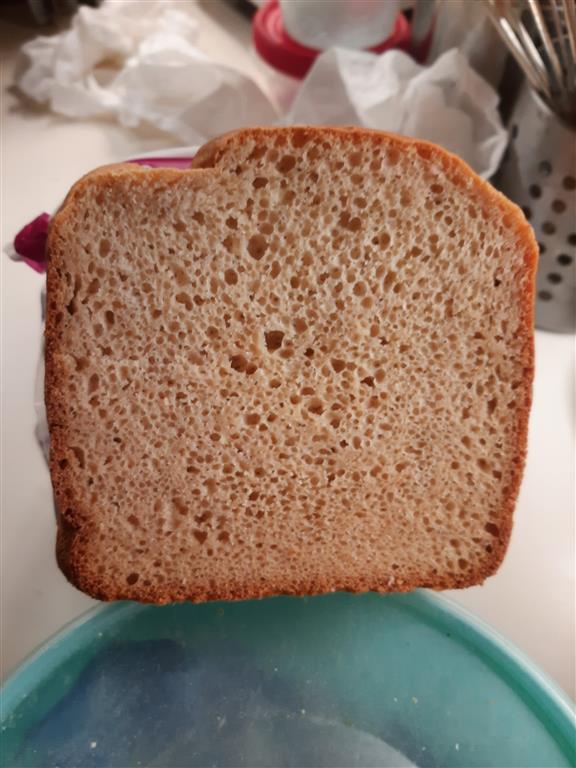
My wrists and thumbs are shot, bone on bone at 78. And being a Zojirushi Virtuoso, I can program it fairly well outside of the baking temperature which is non-adjustable/
When I try to access your current Rx I get this message in my browser console.
This is sigh inducing. the HTTPS vs HTTP and SSL encryption thing is overblown/hyped IMHO (with a lifetime career in computers). Encryption is need if you exchanging finance related stuff. It's not for exchanging recipes and pictures of kitty-kats, none of which are involved. I suppose you might worry that some SOB has embedded something nasty in a Word doc, but that's stretch. The thing is that you (the owner and the one who pays for its costs) have to pay a not-insiginificant Price extra for the encryption...when it isn't needed for family memories, recipes, the Bugattis my father had when I wuz a teenager or my imagery....and I'm living on a Social Security shoestring. It's as if you had to buy a Brinks truck that you only needed whendriving to the mall to do shopping. Since you're not shopping at my website, you don't need the Brinks truck.
According to your errmsg, there's nothing insecure with my website,rather the problem is with your route to it...which I have no control over
would buckwheat meet your wife's dietary requirements? There were a couple of 100% buckwheat recipes posted on this site that sounded extremely good -- for instance, https://www.thefreshloaf.com/node/73198/almost-abes-100-buckwheat (i believe it uses whole eggs, but you could probably get away with meringue only)
Rob
But thanks....everyone has their favorites.
You've really come a long way, persisted over so many variations and have, what looks like, a very nice loaf. I hope she likes the taste.
As far as making a loaf that doesn't crack. Looking at your flours, you really have a lot of whole grain flours. I am wondering if this dough/batter would benefit from a bit of a rest/autolyse. This would allow the grains of flour to really fully hydrate. They may be more pliable and not rob the delicate structure around them of moisture and cause that structure to shatter or crumble or crack. Same idea in whole wheat breads but in the GF world.
You could incorporate a rest in a few different ways. It could be as simple as mixing the dough completely and then just letting it sit for a minimum of 30 minutes. Then proceed with the rest of the cycle.
OR
Another way would be to mix most of the flour and liquid in a preferment to sit for a few hours. Then add that to the bread machine in the usual fashion with the remaining flour and then yeast on the top.
I have always preferred psyllium husk over xanthan or guar gum. Both powdered and coarsely ground psyllium husk can be used. It is less "gummy", I have found. Was there a problem using it? Would using a different variety (ground vs coarsley milled)help?
Would using something like HiMaize (a resistant starch) be acceptable. I'm not sure why the restriction on digestible starches-is it calories?blood sugar?glycemic index? Resistant starch is not digestible and will not spike a blood sugar. As in most fiber foods, it is a great pre-biotic but it does act like a fiber in the large bowel and has all the usual considerations of that, so maybe that is the issue. In general, a starch component would help provide a gel texture and reduce the gumminess but if the digestible starches (tapioca, potatoe)are not acceptable, maybe the indigestible (resistant) variety would help.
Just an opinion but I think there is a sweet spot in terms of the thinness of the "batter". Too loose and the bubbles escape forming a dense loaf, too thick and it can't push up and expand. GF can be touchy-similar to working with rye. In wheat-based bread, the protein/gluten forms a netting to hold the bubbles made by the starchy gel. In GF, starchy gel traps the bubbles, gums and protein helps provide a structure to hold the bubbles.
I think this was more than .02! It has been interesting following your progress over the years. Thank you for all of this.
I will give this a try, either by:
Thanks. I wonder if I''ll see the need for further hydration after the rest/autolyse.
"...millet, TEFF. brown rice and sorghum flour, no starch at all..." About that. All those things are still predominantly starch.
Well, there's starch and then there's starch...The whole grain flour does have starch in it, but as a complex carbohydrate. Like the difference between eating sugar and a ripe pear. You would allow that eating sugar is a bad idea, but fruit is not...?
As for my wife's situation: she has an autoimmune condition (highly refined foods and enironmental factors, most likely) called small fiber neuropathy. They (the neurologists) can barely put a tag on (lest God forbid, it should be idiopathic), but they have precious little idea of what the eff to do about it, where it comes from...she gets an infusion of gamma globulin (say those two words, real fast, ten times in a row) and to eat a Mediterranean Diet whatever that is and presumably because Mediterrean people don't have this problem.
So, we are the two of highly intelligent people with 4 graduate degrees between us, mostly hers...trying to do something about the googamugga that had shadowed her consciousness.
I don't really understand the "no starch" requirement since grains have most of their calories as starch. I suppose you mean powdered starch, but why is that so different?
TomP
Well, fr'instance potato flour is made my dehydrating potato into flakes and then grinding that into flour, pretty straightforward Starch is highly processed using industrial chemical and physical processes., refined, clarified. You can thicken a soup with it, but you wouldn't make a side dish out of it.
I see - you/she are distinguishing a fine powder from the carbohydrates in ground grain. That's mainly what I was asking for.