
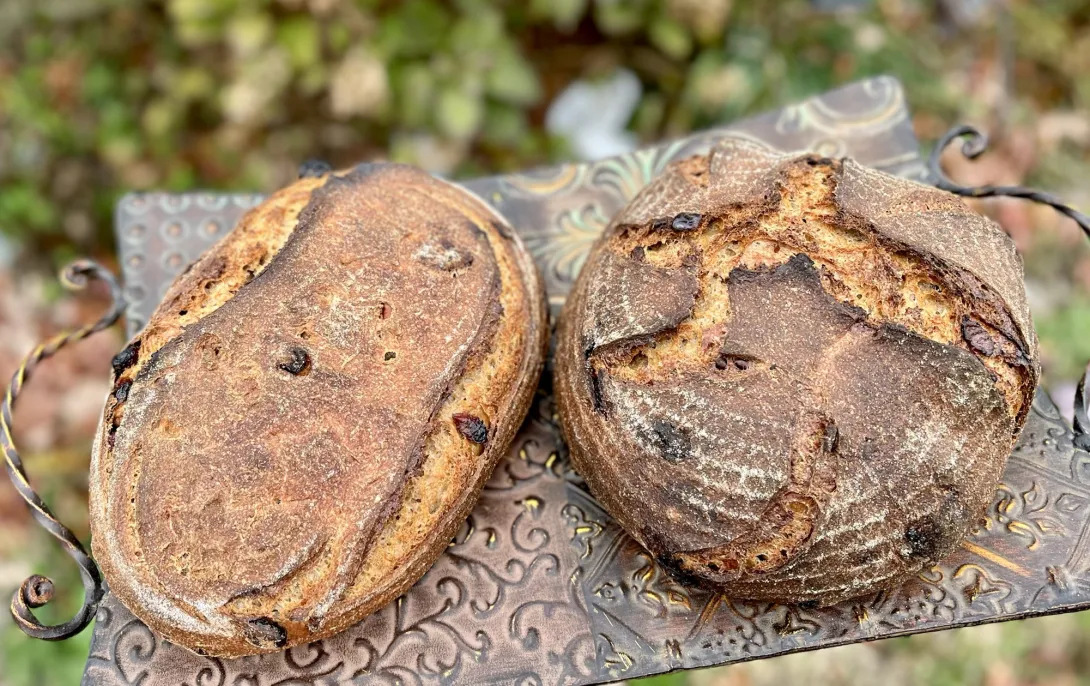
Made with fresh-milled Rougue de Bordeaux wheat milled from Barton Spring Mills berries, as well as fresh-milled spelt.
The cranberries were soaked in water and drained before adding to the dough right before bulk. The ricotta cheese adds a nice softness to the final crumb.
I love pecans so this was the perfect pairing with the cranberries but feel free to use walnuts or any nut you desire.
I was very happy with the crumb, which was moderately open for a 76% fresh-milled-grains bread. I added just the right amount of cranberries and pecans so you get the proper amount in every slice.
This bake used fresh milled flour, milled with my Mockmill 200. I sifted once with a #30 drum sieve and re-milled at the finest setting.
I used my Ankarsrum to mix up the dough and open-baked it on a baking stone with steam.

Formula

Levain Directions
Mix all the levain ingredients together for about 1 minute and cover with plastic wrap.
Let it sit at room temperature for around 6-7 hours or until the starter has almost doubled. Either use in the main dough immediately or refrigerate for up to 1 day before using.
Main Dough Procedure
Note: I use an Ankarsrum Mixer, so my mixing order is slightly different from that of a KitchenAid or other mixer. Add all the water to your mixing bowl except for about 1/4 of the water. Add all the flour to the bowl and mix on low for 1 minute, until it forms a shaggy mass. Cover the mixing bowl and let it rest for 20 minutes. Next, add the levain, salt, ricotta cheese, honey, and the remaining water (as needed), and mix on medium-low speed (about speed 4) for around 15 minutes, until you have a nicely developed, smooth dough. You should end up with a pretty smooth and silky dough. Mix longer if necessary until you develop good gluten strength. Note: I added the pecans and cranberries in the mixer after the dough was fully developed and mixed for a minute until incorporated. Sometimes I will laminate the dough instead and add the inclusions that way after the mixing is completed.
Remove the dough from the bowl and place it in a lightly oiled bowl, and do several stretch and folds. Make sure the dough is as flat as possible in your bowl/container, and measure the dough in millimetres and take the temperature of the dough. Based on the chart from http://www.thesourdoughjourney.com, determine what % rise you need and make a note. If you have a proofer, decide what temperature you want to set it at and what rise you are aiming for. If the dough is fully developed, you don’t need to do any stretch and folds, but I like to do one or 2 sets, which I find helps the crumb.
After the dough is about
Once the dough reaches the desired bulk rise, pre-shape and let rest for 15-20 minutes. Finish shaping and place in your banneton, bowl, or on your sheet pan, and cover it so it is pretty airtight (note: I just read a post that suggests it is not necessary to cover the dough when refrigerating it. I have not tried this yet, but that is the way most professional bakeries do it, and they do have dedicated retarders for dough).
When you are ready to bake, preheat your oven to 540°F an hour beforehand and prepare for steam. Let your dough sit at room temperature while the oven is warming up. When ready to bake, score as desired. Prepare your oven for steam. I have a heavy-duty baking pan on the bottom rack of my oven with 1 baking stone above the pan and one on the top shelf. I pour 1 cup of boiling water into the pan right after I place the dough in the oven. I then lower the oven temperature to 450°F for a miche or 455°F for smaller individual loaves. Bake until they are nice and brown, and the internal temperature is at least 205 – 210°F.
Take the bread(s) out of the oven when done and let them cool on a baker’s rack for as long as you can resist.


- Isand66's Blog
- Log in or register to post comments
I got a huge order from Barton’s sale and also from Breadtopia’s sale. Won’t need any berries for a long time! I also ordered new stones from Breadtopia for my MockMill. Even after cleaning with white rice it was obvious that after all these years and especially corn grinding they are quite smooth.
Looking forward to trying your combos. Just put a 1/2gallon batch of yogurt into their warm chamber.
Have a Merry Holiday of baking. c
Enjoy all your berries! I ordered some as well that came last week.
Let me know if you try any of my concoctions. This one and the other one I posted both came out excellent.
Happy baking holidays!
Ian
And it looks good, too!
Paul
It was a tasty bake.
Appreciate your kind words.
Best regards,
Ian
I used to make a similar flavor profile bread as my "Breakfast Bread" and I would add coriander and cardamom. Not a large amount-about a teaspoon of each for my 700g flour. Wow! Subtle but delicious difference. I also toasted the nuts. Sometimes pecan and sometimes walnuts.
Beautiful loaf and write-up. Thanks!
Your ideas sound great. I’ve toasted the nuts before and I agree it’s an extra flavor bomb. I will have to try adding some coriander and cardamom in the future.
Appreciate your comments.
Best,
Ian
Ian, these look amazing and up to your usual excellent standards. Perfect time of year to use cranberries in our loaves!
Happy Holidays.
Benny
It came out as good as I could hope for. I love adding cranberries and nuts to breads and this one was amazing toasted with some good cheese.
Best regards,
Ian