
I cannot get a loaf to completion to save my life. Dough is liquidy after bulk fermentation and will not hold shape.
A little background. I started baking sourdough during the pandemic like half the world did. Created a starter from scratch using Joshua Weissman's method and baked bread successfully using his recipe for a bit, then switched over to this recipe
http://www.thefreshloaf.com/node/33725/my-basic-sourdough-bread-recipe
Bread was awesome for a few years using the Weissman method with the one hour autolyse and the four stretch and folds before bulk fermentation. Then, last year, I left my starter in the fridge without feeding for too long and it molded. Threw it out and made a new one from scratch a few month ago. It developed mold before it was viable so I threw that out and started again. Moved it to clean jars every feed. Got it to ready. Tried to make bread and the dough would not come together. After the bulk ferment in the oven with the light on, when the dough has doubled, I take it out of the container onto a cutting board and it spreads out like a liquid. Sticky. No structure at all. I've tried about a dozen times over the past few months and every time the dough comes out unusable.
I tried this with the Weissman method with the one hour autolyse and the four stretch and folds and also with The Bread Code method with no autolyse and one minute of stretch and folds before bulk fermentation. Neither made any difference. Liquid dough after bulk fermentation. I even tried using a stand mixer for kneading before bulk fermantation. Still liquidy,
I tried the recommendations from My Sourdough Journey on how to strengthen a weak starter by doing a few peak feedings at 2 flour:2 water:1 old starter until the starter was peaking at 8 hours and smelled yeasty. No change.
I switched the starter from 100% bread flour to 50% bread flour/50% whole wheat. Same liquidy dough.
So what has changed and what has stayed the same since successful bread?
Flour is the same. King Arthur Bread Flour and a little bit of King Arthur Whole Wheat flour. Same thing I used before. Both in the starter and in the bread. I even bought a bag of Bob's Red Mill Bread Flour to see if the flour was the problem and no change - same liquidy dough.
Water is different. We switched from an undersink coconut fiber carbon filter to one of those fancy Reverse Osmosis deals. Waterdrop G2P600 if that matters.
Salt is the same. Morton's table salt.
Scale is different. Old one crapped out so got a new one. It seems calibrated well so I don't think that is the issue.
Here is what the starter looks like this morning 10 hours after feeding (1:1:1)
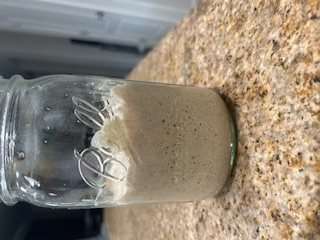
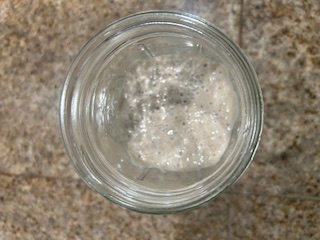
Any ideas what I am doing wrong?
You admit that the water has changed, but don't say if you've tried different water. Reverse osmosis water, which lacks minerals needed for yeast activity, is not recommended for bread dough.
I think I am going to bring the old Brita filter out of retirement and see if that makes a difference. Maybe a big jug of water from the grocery store too for comparison.
The link does not work, but no matter - I'd suggest that your starter is no good. I'd try switching it to whole grain for a while, a different bag from what you are using, and maybe starting a new one at the same time.
I would say both are in play - the water and the starter. Assume that the starter is shot for whatever reason. Create a new one using pineapple juice instead of water to begin - first read Debra Wink's posts about it:
https://www.thefreshloaf.com/node/10856/pineapple-juice-solution-part-1
https://www.thefreshloaf.com/10901/pineapple-juice-solution-part-2
Make sure that none of the old starter gets into the new.
Use bottled drinking water that isn't R-O or "purified" so that it still has some minerals in it.
You could also try making a straight yeasted bread with your R-O water. This might not be definitive because the dried yeast comes with its own yeast food, but it if fails and you still have the same problems you will know for sure it's not the starter per se.
TomP
I have made plenty of bread with Dry Active Yeast and the R/O water. That bread has always come out just fine. Normal amount of rise from bread made before the new filter. But also there is a ton of dry yeast in those recipes and a short rise time compared to sourdough.
The R/O filter says that it has a remineralization stage where it adds minerals back but it doesn't say which ones or how much. I also cannot find definitively what said filter changes the pH of the water to. I am now thinking that it changes it enough to negatively affect the yeast production.
The tap water in this area terrible. It tastes and smells metallic. The coconut filter we used before helped but I could still smell and taste how bad it was and could not drink it though the others in the house were fine with it. A plumber told me to expect the faucets and shower heads that I changed when we moved in to last about 8 years before the water corrodes them. This is year 5 so I cannot verify that yet but I believe him. The R/O filter made the water drinkable for me, but maybe the change is too much for bread. I do have a Brita filter that isn't doing anything currently so I might try using that and see if that changes anything
Here is the starter this morning. Last feeding (1:1:1) was 10 hours ago.
To me it also sounds like something is not right with the starter. Before chucking it out and starting again, you might want to give a try to a starter remedy that worked for me a while back when I had a similar situation with my overnight preferment becoming sludge.
When I refreshed the starter ahead of a bake (a 1:2:2 starter, flour, water feed, keeping 40g of the starter for the next bake on the fridge), I added 1tsp of chickpea flour into the mixture and proceeded to my preferment as usual. The next morning, no sludge and the loaf was pretty much ok. A couple of feeds like that fine tuning the addition of the chickpea flour as needed and the starter became absolutely perfect and is still baking great loaves almost a year later. User the search function to find my original post and some explanations by others as to why this might work.
Mix thick - let it thin out (thinner the better) - repeat. After a few it should be a starter. I should note - there is a difference between making and using a starter. Enjoy!
It's definitely your starter, and I think it would be faster to just start a new one. This time use pineapple juice as someone mentioned or my personal favorite, apple yeast water. It will get you going much much faster.
You should also mark your jar with the level of dough right after you feed it, and that will let you see how much it has risen. 1:1:1 after 10 hours at warm room temperature should have peaked at triple and then fallen.
You talk a lot about the starter and quickly mention bulk fermentation but there are some key pieces of information I don't see in the info. What is the room temperature where the bulk fermentation takes place and how long are you running bulk fermentation. Too warm,too long on the bulk fermentation and the enzymes degrade the gluten and you get moist>sticky and then gooey>liquid dough. Just like an over-fermented preferment.
Mold is often introduced by our hands. Don't forget to wash your hands well and often before handling.
Water can have a big impact on the SD culture. I,also, have awful water so I just buy bottled spring water for people and cultures.
You also may have an imbalanced culture and the pineapple juice method is helpful in growing a more balanced culture.
Happy Thanksgiving!
I am bulk fermenting in the oven with the light on. After your comment, I made sure the container was as far from the light as it could be in the oven just to be safe. Temped at 74 during last night's bulk ferment. Bread failed this morning though. See newest post for sad sad pictures.
I am very fastidious in washing my hands with the starter. I now move to a new container every feeding just to be sure.
Are you leaving it out at room temperature until you see visible growth when you feed it? I used to keep mine in the fridge for 4-6+ weeks w/o feeding it and it was fine when I did feed it. I'd leave it out for several hours and it would bloom. Also when I feed it, it is thick like a dough. I also pour off the alcohol when it pools on the top if the smell of it is strong when I open the container.
I made my starter from a 1lb bunch of organic grapes and 1cup flour 1cup water. Saw this right after cooking with Julia and the Acme bread guy. I was feelin homesick for their bread. You mix the flour and water then out the grapes with the stem in a cheese cloth, submerge them and slightly crush them. Leave in fridge for a week or so and check. It gets ugly. I think it is 2 weeks them you take out the cheesecloth and there's yer starter. Feed it and now you have a new pet to care for. :-)
I never got a sour taste out of it. I get better results baking a baguette with poolish and just using yeast ( per YT channel kingdombread-tampa) but I add the sourdough starter to it anyway hoping for the sour to finally come through.
Update
So I decided to try using Brita filtered water with my existing starter and 2:2:1 feedings every 12 hours to strengthen it to see what would happen. After a week and a half, the starter was much more bubbly and smells strongly of yeast (not bacteria).
I attempted a batard last night. After bulk fermentation in the oven with the light on (container on the opposite side from the light so it wouldn't overheat), I placed the dough on the counter and miracle of miracles, the dough was not a liquid. It held together. When I tried to shape it, though, it was not as solid as it appeared. It fought to hold shape. But it did hold mostly. After an overnight proof in the refrigerator, I baked this morning. Here is the result
Not great, but better than before. I abandoned baking after taking the lid of the dutch oven off and seeing the flat thing before me.
I am probably going to try bottled water next. I am starting to suspect that the entire water quality to the house has changed in the past few months. Unless any of you have different suggestions of what I should try first. If that doesn't work, I will try pineapple juice next.
The overnight proof in the oven was probably too long a time. It's better to use shorter times until you know for sure that you need or want them. Most proofs would be done in 2 - 4 hours, and your loaf would have had problems holding a shape after such a long time. But you could gave plopped it into a loaf pan (gently!) and baked it.
Keep the hydration relatively low, and if you need to leave the dough overnight for scheduling reasons, put it (covered) into the fridge.
YomP
I rushed when I wrote the last reply and didn't catch my mistake. What I should have written is
I bulk fermented in the oven with the light on until the dough had doubled, then I shaped the loaf - which mostly held its shape but was a little softer than ideal - and placed it in a banneton which went into the refrigerator overnight.
This morning I baked the loaf and the pics are the result.
Hydration is 67% in the recipe I use
300 g bread flour
75 g whole wheat flour
150 g starter (1:1)
225 g water
9 g salt
The starter is new, so expect a change. Odds are a little time will help (the starter that is). I would beware though. What works one day may not the next time. Not until the starter balances out - and that takes time. Enjoy!
I forgot - water - leave tap water overnight to allow the chlorine (or its derivative) to dissipate before using. Enjoy!
Are you bulk fermenting in a warm oven overnight? How many hours? Does the dough double in size? Does it double and fall?
Are you proofing overnight (as in many hours) in a warm oven the same way?
Am I understanding this correctly? No wonder the dough is struggling.
Try this instead:
Mix the dough to windowpane.
Start to rise at room temp and once you see it is active and about halfway risen, put it in the refrigerator for 8-10 hrs.
Take it out of the refrigerator for 1 hr to slightly warm up.
Shape-proof at room temp for 1-3 hrs depending on activity of dough.
Bake when it is not quite doubled.
I was very unclear in my last reply.
This most recent loaf I followed the method The Bread Code recommends:
Mix all ingredients, then wait 10 minutes. Stretch and fold for about a minute until the dough no longer sticks to the bottom of the bowl. Rest two hours. Coil fold all four sides. Bulk ferment in the oven until doubled. Shape and place in banneton. Into the refrigerator over night. Bake in the morning.
Interesting. You prefer refrigerating during the bulk ferment instead of during the final proofing?
It looks like your strter is too acidic and is braking down the gluten structure.Do feeding at 1:5:5 10g starter 50g flour 50g water for a few feedings,your starter should more than just double.Keep it warm at 24-28C. Or maybe start with 1:3:3 and then increase the ratio as it gets stronger. At the start it might need up to 24h to ripen and then the speed will increase. I do 1:6:5 ratio every 12h for mine,the acidity is lower which allows the dough to not turn out soupy. 1:1:1 ratio and s not great for sourdough because it makes it very acidic in the long run.