
Second Pullman loaf - orange raisin bread experiment
For some reason I've been daydreaming of raisin bread recently. In years gone by I've tinkered with various orange-raisin-oatmeal formulas but they always seemed too heavy, probably because I was including too much oatmeal. My objective is to develop a bread formula that has not only the tartness of the juice but also the tang of the peel, rather like a marmalade, but also like raisin bread.
This is my account of my latest experiment, which I consider rather successful over all (although I did slip up a bit on the proofing time).
Ingredients:
about 210g of Home-made marmalade of a sort, made (see procedure below) from
1 smallish seedless navel orange and
1/2 cup granulated white sugar
100g of raisins
1 tablespoon SAF "red" instant yeast
1.5 teaspoon salt
450g unbleached bread flour
300g very warm water
Procedure:
I started out by making some marmalade; in the past I've tried just throwing an orange in a blender peel and all, but I wanted some obvious peel in this loaf. First I halved the orange (which was about 3 inches diameter or so, a rather thick-skinned specimen) and sliced up the halves. I put the slices in a small sauce pan and scraped as much as possible of the juice left on the cutting board into the pan too. I added a half cup of granulated sugar to the pan, stirred it up a bit to draw out some of the juice, and heated the mixture to boiling. I boiled it on fairly high heat until the sugar was well disolved, turned the heat off for maybe 10 minutes, then concluded it was more like orange peel soup than marmalade. I brought it back to a boil and boiled it rather vigorously until enough moisture evaaporated that it was more like marmalade (no free-flowing liquid syrup) than soup; I stirred it while it boiled. Understand, I've never made marmalade before although I eat it regularly on toast, crackers, etc. I was winging it, and I didn't take careful notes, although I've glanced at various recipes for marmalade and candied orange peel over the years.
Anyway, once the marmalade was made I left it to cool uncovered in the pan and my wife and I went shopping. When we got back and had put all the groceries away I did some other stuff and around 9PM made up some dough, putting all the ingredients listed above into the bowl of my Kitchenaid mixer and mixing it up thoroughly with the dough hook. The resulting dough was very loose and sticky, presumably because of the sugar and remaining moisture in the home-made marmalade. It was nothing I wanted to try to knead, so I just scraped it into the pullman pan (which I sprayed with oil first, anticipating possible problems getting the sugary dough out after baking) and spread it out more or less evenly in the pan with a spoon. I put the lid on the pullman pan and put a folded kitchen towel on top to keep the heat in as I did in my earlier first loaf with this new pan.
Then I left the loaf to proof while my wife and I watched a video (The King's Speech, which runs 118 minutes, almost two hours).
When the movie was over I checked the pan and discovered that the dough had filled the pan and begun to sneak through the cracks past the lid in a mad bid for escape. Two hours was too long to proof this formula! I wiped off the escaping dough as best I could but did not pull back the lid for fear of what might happen. I preheated the oven to 450F, popped the pan in, set the timer for 25 minutes, and had some coffee. When the timer went off I pulled the loaf out of the oven, managed to slide the lid off despite some "escapist" dough that got quite crispy in the cracks between pan and lid, and managed to pop the loaf out of the pan. One bit of crust stayed stuck in the pan, perhaps on a spot I did not oil well enough. The loaf had a thin ridge of dark, crispy "escapist" dough around the top which I broke off and discarded.
Results:
It appears from the uneven browning (see photos below) that although the dough escaped through the cracks it did not fully contact the pan lid. The crumb is very moist and chewy with a very nice flavor, sweet with a tartness of orange and a distinct tang of orange peel - my wife says it's delicious, and I am inclined to agree. The crust is rather thinner and softer than I'm used to - a slightly longer bake in future trials might be appropiate. Overall, this is a formula I'm definitely going to save carefully and use again (but next time with a shorter proofing time)!
Here are some photos.

Loaf and pan^
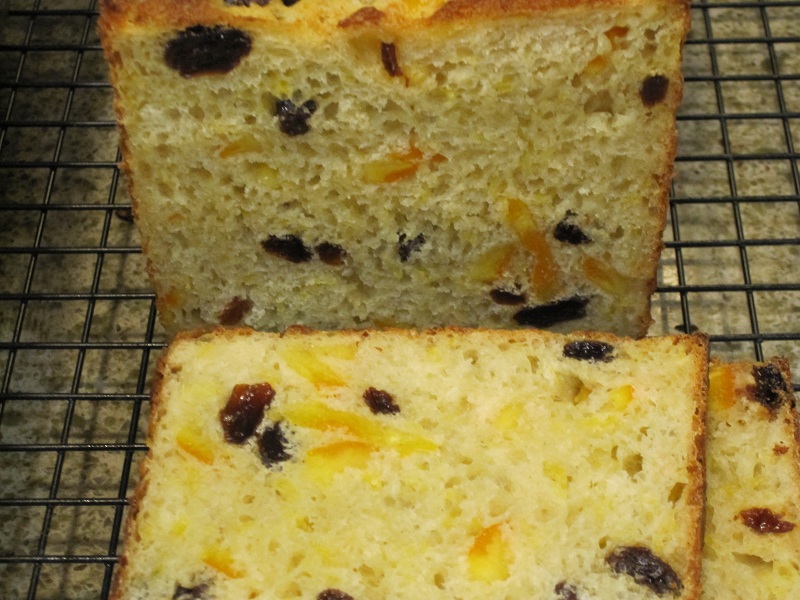
Crumb shot^
I'm very very happy with this loaf!


Comments
Hello, The fruit distributed in the crumb of your bread looks delicious.
I've got a jar of ginger marmalade I've been holding on to; now you've got me thinking...!
Your bread does look very tasty and thanks for the flavoring idea.
from breadsong
was the bread very moist? to the point of being 'wet'? or was it jst moist yet light?
It looks lovely! Thanks for this marmalade-incorporated bread. Did you still slather on the marmalade nonetheless ;))
I've got some homemade marmalade as well. now you've got me thinking...
It was soft and quite chewy, not soggy (or underdone) in any way.
I'm not sure how easy it would be to duplicate it exactly because the moisture content of the marmalade is a bit of an unknown. Using store-bought marmalade might make it easier to duplicate although that fresh home-made marmalade I made was tastier than most I've bought.
Hi,
it just occurred to me that you may want to try this recipe:
http://www.guardian.co.uk/lifeandstyle/2010/feb/20/marmalade-chelsea-buns-recipe
it has the two things you like - marmalade AND currants. I made this recently. I must say the marmalade got a bit lost in it - i was expecting a stronger taste of marmalade, especially since my own had loads of bitter peel, but it didnt really come through as much.
It's interesting that that recipe from Dan Lepard calls for a touch of vitamin C (ascorbic acid) which is an anti-oxidant/preservative.
i sometimes see it listed as one of the ingredients in bought bread