
Submitted by RonRay on November 6, 2010 - 9:11am

The Banana Saga 長篇故事 and Conclusion (updated 101116)


Previous Blog:  http://www.thefreshloaf.com/node/20032/1-little-2-little-3-little-chia-rye-loaves


Have your ever felt that the expression "Couldn't see the forest for the trees." applied to you?
I think that this may be a case where it really applied to me <Blush>

When I first read Shiao-Ping's blog on making a sourdough banana bread - Banana Pain au Levain (see link)
http://www.thefreshloaf.com/node/14432/banana-pain-au-levain
I thought what a great gift such loaves would make for some of my friends. It certain was different from the usual gift. But, by the time I had finished the article, I found I was a bit concerned over two things that the author had experienced; first the hydration surprises she had encountered, and secondly, what she said about the slowness of the rising:
"dough appeared very sluggish.  It was almost as if my starter was finding it tough adjusting to bananas, "

Well, I went off and pursued other interests. However, I found my thoughts kept coming back to bananas, and to those two points that Shiao-Ping had raised. Checking on Google quickly revealed that the amount of water in bananas was closer to 75% than the 65% which she had initially assumed - base upon pumpkin percentages. Returning to the original blog, I found two others had already reported somewhat similar findings. Well, good. Most likely that cleared up the hydration issues, but what about my second issue - the slow rise?

Did the wee yeasty beasties really have problems with the addition of bananas in their diet? The more I consider this, the more interesting that question became for me. If you think I get interested in odd subjects, that's okay, others have mentioned that before.

I have spent a great amount of time studying my sourdough cultures and I have a very well establish baseline data set on my primary White Levain, which data I often use for comparisons. Suppose I take seed from that levain and build a variant levain, a Banana Flour Sour, at the same test hydration level that I used in establishing my baseline reference plots. Yes, I decided that was a clean way to get an initial handle on this slow rising point.

A Comparison

So, I took a seed from my primary White Levain (WL) and did a build/refresh containing as much banana as could be used while still maintaining the 100%HL . Maintaining that hydration level was necessary to match the WL reference data. The table below provides details.

     Table 1. Compositional breakdown of the 200 gram batches used on Day 0 through Day 8 of Banana Flour Sour at 100%HL testing

As soon as the refresh was mixed, the 200g test batch was place within my homemade temperature controlled chamber. The TC was set to maintain 80ºF (26.6ºC) +- about 1ºF. The level of the top edge of the levain was then recorded, and for every 15 minutes thereafter until the peak of the rise had been reached/passed, ending the Growth Phase.


      Figure 1. Comparing Average Rise of my Reference White Levain with the same WL Seed and a 67% Banana Puree + 33% AP Flour Refresh.

Certainly, at first reading of the data, Shiao-Ping's observation that "dough appeared very sluggish" was validated in the rise-time difference between the reference Lag and Growth Phases and those of the test Banana Flour Sour (BFS) culture.

One could argue that a good portion of the BFS Lag Phase could be explained by a difference between the average starting temperatures of the two cultures at test start, and I fully agree. However, that would not explain the difference in the Growth Phase slopes.

The temperature difference, just mentioned, resulted as follows. Both the WL reference and the BFS started from seed stock consisting of 200g of culture, which had undergone refreshment 24 hours prior, had been monitored through rise until the peak (Stationary Phase) had been reached, and then been returned to the refrigeration. The difference occurs in the refreshment temperatures. The WL was fed room temperature AP Flour and room temperature water, whereas, the BFS was feed 33% room temperature AP Flour (APF), plus refrigeration temperature banana puree (B) for the remaining 67% of its refreshment. There is no question that this difference would result is a longer Lag Phase for the BFS build. Hindsight is usually 20-20. But, this was not intended as a NASA grant application, and sliding the BFS curve to the left 30 or 45 minutes would affect the elimination of the "sluggish" nature of the rise slope.

A Bit of Back-slopping

Alright, there appeared to be less than euphoria on the part of the culture's beasties to feed on fruit - banana - rather than grain - wheat flour. Now, was this just a "fact-of-life", or could the culture's behavior shift if it were played with. To me, it seemed that the final height of the Growth Phase indicated that the banana was being used as material to created the CO2 desired, just at a slower rate. I have read the sugar, like salt, slows the growth rate. Certainly there was a lot more sugar in the new refreshment than the old.

If I simply repeated taking 100g of WL seed stock and adding the same 33% APF and 67% B (banana = B) as the refreshment, reasonably, I could expect pretty much the same curve, and that wasn't very informative. Whereas, back-slopping introduced two opposing factors. First, by using a portion of the previous build to act as the seed for the next build I could expect a lowering in the vigor of the BFS culture if B wasn't a viable food, and alternatively, I could expect an adaptation to the use of the B as a major food source if some of the beasties could handle it better than others - sort of a survival of the banana eaters. If B was really not a food for all the beasties, then the BFS culture should go downhill even faster, since, for the next several refreshments, the total % of B in each build would be increasing - Day 0 had a seed that was a pure water/APF composition, to which the 33% APF and 67% B was fed. Day 1 would have a seed that was a 100g of the residual of Day 0, to which the 33% APF and 67% B would serve as its refresh. So, each day would shift to a slightly higher % of B, until it peaked at a level 67% B total.

It looked as if the BFS culture had to go downhill if B was a poor food source for the beasties, and, on the other hand if it were a population mix, then I should see preferential growth of the B-eaters and resulting improvement in the rise slopes of the tests. Or at least, that was how it seemed to me.

                        Figure 2. The Rise Plots for Day 0 and 8 Days of Back-slopping with a Banana Flour Sourdough Culture.

Now, if one takes the starting temperature handicap that was mention earlier into account, it would appear that the BFS Day 7 and 8 are essentially equal to the reference WL data. I thought that this made it reasonable to think of the culture as now being happy to fed on either and both flour &or banana. In fact, after nine days of taking readings every 15 minutes, I was very eager to do a bread baking test, although, the addition of the BFS "disposable" daily 100g of culture, mix in with some a couple of white levains and a rye made for interesting and great sourdough waffles, and let me note that the wee yeasty beasties did not get all of the banana sugars. There was a lot of B-sugar that went into my waffles, as well (º0º)

The Banana Flour Sour Bake

In my usual fashion, I made one batch of dough, 1285g and split it into three, 428g parts. It took me time to bake the 3 loaves, just over a period of a week, in fact. The first and third loaves were done in a Dutch oven, with only their internal moisture for the steam. The second loaf was with steam and on parchment paper on the oven stones, but the temperatures match those given below for the DO loaves.

The two done in Dutch oven had preheated DO to near 500ºF (260ºC) and dropped to 410ºF (210ºC) as soon as the loaf was in the DO. After 20 minutes, the lid was removed, loaf turned out and replaced in the oven directly on the stones. The temperature was set down to 350ºF (177ºC) for 10 minutes and then turned off totally, while the door was cracked about ¼ inch (6mm) and the loaf left in for 10 addition minutes. The instant internal temperatures were ~ 207ºF (97ºC).

                 Table 2. Formula for Banana Flour Sour 3 Loaf Bakes Total of Banana 9% [ 6% water, 3% solids ]

The White Levain, BFS Levain and water were combined. Then the 2 flours mixed in and covered for 20 minutes. Total turned out into large bowl where the salt was added and worked in with 30 S&F followed with 30 minutes rest and another 2 sets of 30 S&F. At that point it was a bit over 2 hours and the dough was divided into 3 parts of 428g each in their individual 1L/1Qt oiled and covered plastic containers and placed in fridge. One loaf was used the next morning. Shaped and given 5 hours rise time and baked in a DO. Treatment of the third loaf was about the same 6 days later. The other loaf was made 3 days later, but shaped and formed in cloth-lined, clay loaf form.

                                                           First Dutch Oven Boule from WL+BFS Levains.

                                                             First Dutch Oven Boule's Crumb.
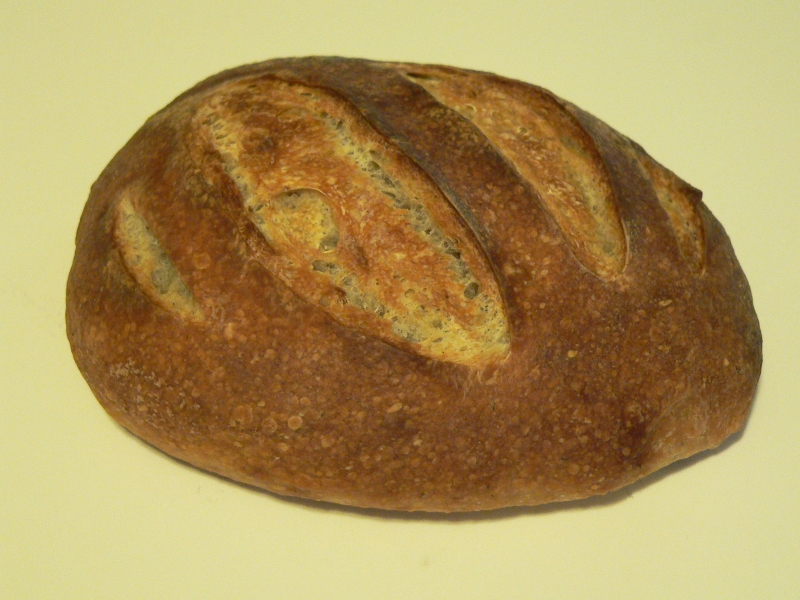
                                                            Second Boule - Steam & Stone from WL+BFS Levains.

                                                           Second Boule's Crumb

                                              Third Loaf, A Dutch Oven Boule - A Small Amount of Chia on Top.

                                Third Loaf's Crumb.

Yes, But.....

Baking each of the loaves went well. The crumb was fine, crusts great. The taste fine, with a slightly different flavor. Ah, but I would really be stretching the facts to say that I could taste anything that I would consider a banana flavor ! Well, there was only about 9% banana total in the loaves, and 6% of that was water. I guessed I'd just expected to much after eating those waffles with their great banana flavor, and that flavor coming only from the discards of the levain builds, and also being mix with a lot of other sourdough discards in the same batter.

The way I figured it, Shiao-Ping's Banana-Pain-au-Levain had about 38% banana in it. So, did I really expect 9% to overpower my little loaves?

Alright, how could I really load in the banana and still use my new found banana loving culture. If I added more banana, the hydration level (HL) was going to have to go above 100%HL, and a total banana based levain would have 25% solids (let that equal "flour") and the remaining 75% of the banana was water. A 75:25 ratio, or just plain 300%HL -WOW !!!

           Table 3. Details of the Five Builds to Reach Maintenance Level Pure Banana Starter 300%HL

A series of five builds gave a progression of hydration levels, starting at 100%HL, then 233, 285, 297, 299 and finally got me to a maintenance level of a Pure Banana Levain with 300%HL. This Pure Banana Levian seemed more viscous than I had expected. It even tripled on a rise and did not collapse, as a 100%HL flour levain would do. I found I enjoyed eating the discards directly with a spoon. The taste is like banana with a touch of vodka added to it.

                   Table 3. Formula for Bread Using 49% Starter, where the Starter was Pure Banana Levain @ 300%HL

Of course, I made a new bread ASAP. The method was a close match to the one Shiao-Ping gives for her Banana-Pain-au-Levain. I calculated her loaf as having 38% banana (solids plus water), and this formula yields a loaf the is 49% banana (solids plus water).

The mixing, shaping and baking all went as expected.

                                                           The 49% Banana Loaf Made with Pure Banana Levain @ 300%HL

                                         The crumb of 49% Banana Loaf

It was unbelievable! There was no discernible banana flavor, as least none that I could detect. It was a fine loaf, tasted fine. It did stay moist longer than most sourdough loaves. The crumb and crust were certainly in an acceptable range and the flavor was a bit different, but more towards the taste of rye than anything else.

As must be evident by this point in my "banana saga", this whole banana thing was getting to me. So, what to do next. I already had worked out a formula that would use no additional water, other than that from bananas. It had a Baker's % of 81.5% banana, all of which was in the form of Pure Banana Levain #300%HL. But, I decided that until I had a better handle on where had all the flavor gone, I could see little point in proceeding. What had Shiao-Ping done that I was missing? Well, the best way to attempt an answer to that was to bake her loaf as given in her blog. Something I no doubt should have done in the beginning - a fact now not lost upon. :-(
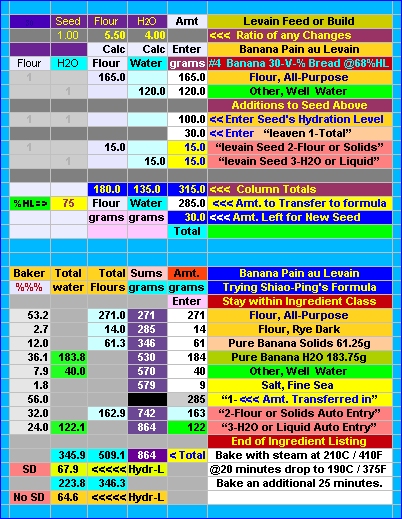
      Shiao-Ping's Banana Pain au Levain Formula Recast with the Levain Build

          Repeat of Shiao-Ping's Banana Pain au Levain


          The crumb from the Repeat of Shiao-Ping's Banana Pain au Levain

Guess what.... No banana flavor that I could detect. I could not believe it. I followed the posted formula and methods as close as anyone could expect. I knew I was missing something, but WHAT !!!

Lacking any better idea, I went back to the original posting, intending to read ever word again. There it was - it hit me like one of the trees had fallen on me - in that forest I had never noticed for all of the trees... The second sentence - "... the bananas in my house have gone sesame (ie, growing freckles) ..." I have been using fresh bananas. Generally, they still even had some green at their stems.

Well, my next attempts will need to wait, until the bananas I have just purchased, have gone beyond sesame!

In my own very weak defense of missing the obvious, let me say that the only use I have ever made of bananas in baking had been in a 70 year old banana cookie recipe that I came across some time ago. In making those, I take fresh bananas, slice them into 1/4" thick rounds, and freeze them for a day, and then let them thaw in the fridge. They turn into a dark brown mush that a simple hand-held blender with single whisk-like blade can whip into a smooth mush. So, I carried this method over into this pursuit of the elusive (for me) banana flavored loaf.

It has actually been a worthwhile endeavor, I have new waffle alternatives, and a most unusual "Banana foaming levain desert" as a result, of my explorations. I also certainly have lots of new information to think about. There is one thing I am sure of, and that is that I will bake a banana flavored bread - no matter how long it takes.... LOL

RonRay


****************************************** Appended 101116 The Banana Saga Concluded長篇故事


Yesterday, the bananas had been aging for 2 weeks, since purchased. Even within the thin plastic grocery bag I could smell the strong banana scent fairly well. As I removed the plastic, two of the eight bananas fell off their common stem. They were “well passed ripe”. I made 484g of banana puree with them, and no water was required to make it, so there was 40g of water, that I was temped to drop from the formula for this batch of dough. I mentally chastised myself for that thought. I would make the closest match I could to the original Banana Pain au Levain in Shiao-Ping's blog. And that is exactly what I did.
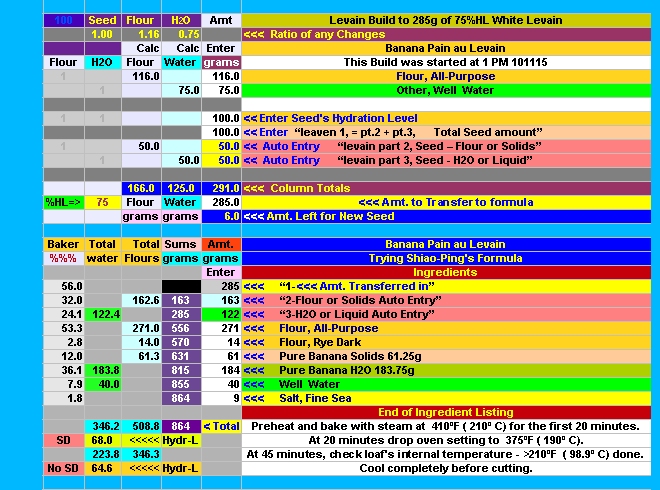
 

     A Simple Restating of Shiao-Ping's Formula with the 75%HL Build Combined.

While I did stick to the formula values, and essentially the same procedures, I did differ in the baking method. Some of teketeke's experimenting with alternatives to Dutch Ovens had interested me (See link) http://www.thefreshloaf.com/node/20460/banana-saga-%E9%95%B7%E7%AF%87%E6%95%85%E4%BA%8B#comment-143159 and other entries in the thread below. So, when I saw a sale on turkey baking pans / turkey ovens, I bought one.

I have a 2 quart cast iron Dutch Oven and an Emerilware Enameled Cast Iron 6-Quart Trinity Pot. The 2 quart is perfect for most of my boules, but the Emerilware 6-Quart is both too deep and too heavy for me to safely throw in and out of a screaming hot oven. Also, being as deep as it is, makes turning out a high hydration dough from a brotform into such a deep drop does too much damage to be practical. Lurking over Mini, Daisy and Akiko's posts gave me an idea, which I wanted to try and this 864g loaf, now rising in a brotform, was just the thing to try the idea out on. I cut the handle off of an old Teflon frying pan that was destine for recycling, so that it would fit within the turkey pan/oven. This would hold the loaf and there was room outside of it to add a small amount of boiling water just before closing the lid.

       Turkey Oven and Lid with Old Frying Pan - Less Handle Inside
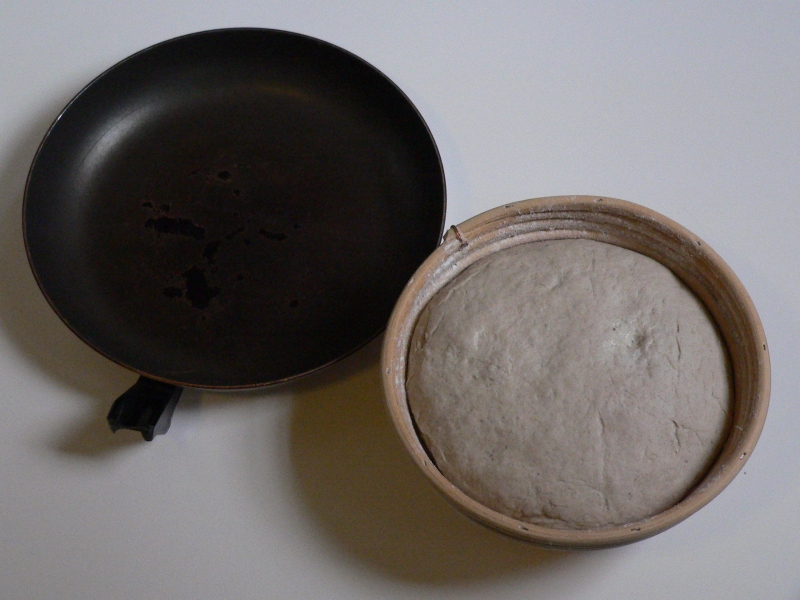
 

       Risen Loaf in Brotform about to be placed into Handel-less Old Frying Pan
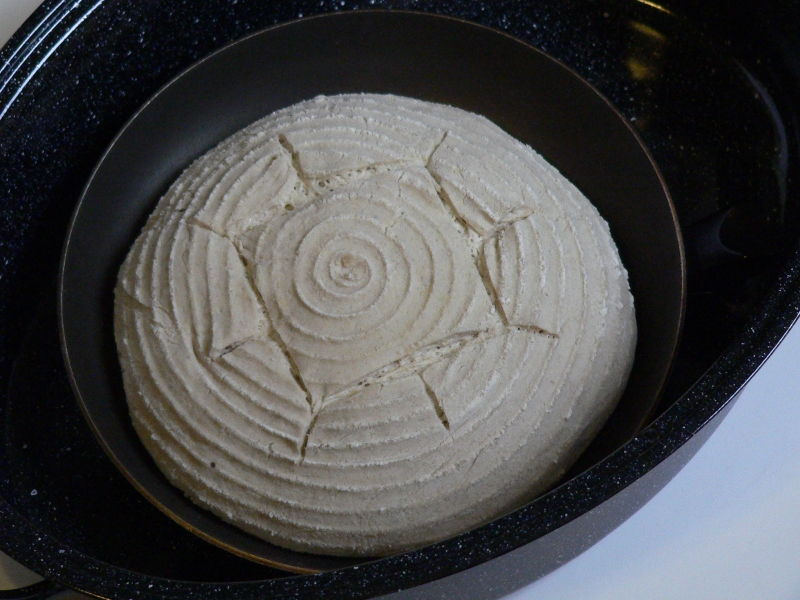
      Loaf in Frying Pan in Turkey Oven - Ready for about 90g of boiling water in Turkey Pan


      Finished Banana Bread Loaf


Crumb of Banana Bread Loaf

Ah, banana scent floating from the baking bread.... At last ;-) And old, old bananas was all it needed...

Crumb is rather moist, but very tasty. It was not as strong a banana flavor as I'd expected from the heavy scents that came off the puree and again during the mixing, rising or the baking, but it surely is enough, and would well and pleasantly do for now.  I found it a nice bread to add to the increasingly long bake list.  An a happy ending for the conclusion of my Banana Saga.

Ron

======== 101118 Note:

**********You might enjoy checking out the forum topic of Wild Yeast at:

http://www.thefreshloaf.com/node/20693/culturing-growing-and-baking-range-wild-yeasts

Ron 雷朗

Next Loaf Baking: http://www.thefreshloaf.com/node/20693/culturing-growing-and-baking-range-wild-yeasts#comment-143857


user icon

Do they have drugs for this ?

GRIN GRIN ..........

now THAT is dedication !

Gorgeous loaves !

anna

user icon

No drugs, but...

Anna,

They tell me that some native cultures made a very effective boose from bananas - I may try that next ;-)

Ron

user icon

Things are coming together, the spreadsheets with

the various colors, the mention in another post of the beautiful watercolors and fractals, and here I had you pegged as a physics prof at the Academy, heh.

anna

user icon

I've been called many things

but being called in time for dinner was the most important ;-)

They were all hobbies, Anna... Sorry to disappoint you LOL

Ron

user icon

Hi ron, Loaves look delicious

Hi ron,

Loaves look delicious I have to say!

Interesting methodology. I have just been revised Mixed Methods methodology as part of correspondence with two MSc researchers. Seems like your graphs are the quantitative response to Shiao-Ping's qualitative 'dough appeared very sluggish.  It was almost as if my starter was finding it tough adjusting to bananas' ;-)

I'm normally firmly qualitative but have found it useful to note down some rudimentary data about the relationship of proofing times to temperature (using a warming dish and thermometer) in order to get my sourdough through the '4 seasons in one day' British weather! (Kitchen can change between 24 and 16C over one day). I 

Re the levain - you probably know but there is a Japanese tradition of using fruit and water based natural leavens?There are posts on TFL that reference this.  

Waffles sound great, but if general baking with bananas is anything to go by though, browner bananas should impart more flavour to the loaf.

Look forward to hearing about further experimentation. 

Kind regards, Daisy_A

user icon

They were....except for...

Hi, Daisy_A

They were good, but disappointing from the lack of banana flavor - let's hope their turning to mush within their peels will provide that missing flavor... LOL

Yes, I like quantitative data - it cuts down of "Baker's Legends".

As for "British weather", I do understand - I was there from 1950 through 1953. It had "interesting weather" - even a smog the killed jet airplane engines, at times, and "Heat waves" when it got to 80ºF...

Thank you for the reference to the Japanese natural leavens. I will definitely try to locate that TFL info you mentioned.

(º¿º) Ron


user icon

Hi Ron, I found the

Hi Ron,

I found the information on leavens again. It was by a poster called 'wao' on this thread

http://www.thefreshloaf.com/node/6012/baking-natural-wild-yeast-water-not-sourdough

Yes I'm afraid we do think 80F really hot in England! There is something lovely in the changing of the seasons but we don't experience the hot stuff so often!

This in contrast to the time when I lived briefly in the South of Spain and very few people ventured out in the city in August until about 10 at night, when it had 'cooled down'...

Kind regards, Daisy_A

user icon

I read through the whole link

I read through the whole link, Daisy_A. That was a very interesting thread. It is also interesting that in HML Dan Lepard essentially used the"yeast water" (not so named) to get his method of sourdough levain started. I tested it once and it was one of the fastest sourdough starters I ever did from scratch.
Thanks again,
Ron

user icon

Thanks for the link

Interesting, I have scanned down it a ways.

One of the leavens I have is a water, sugar, and potato yeast. I maintain it, but it has too much sugar for my taste in breads - except on rare occasion, when I'll do an Anadama Bread, or something like that.

I guess most of us will have to get used to warmer weather, if we don't die first :-)

Ron


user icon

Hi Ron, Thanks for the

Hi Ron,

Thanks for the message. I really loved some of the links within that thread also, particularly this one 

http://weekly.yahoo.co.jp/13/countrylife/pan_handmade1.html

The jars of fruit and other yeasts look so lovely even though sadly I can't read the text. 

Interesting about the Dan Lepard starter. The starter for Moro sourdough is raisin water also. Jan Hedh uses it too sometimes. Apparently the practice can be dated back to Roman times. I've heard it can produce a vigorous starter culture, as yours did.

Kind regards, Daisy_A


user icon

I do not read Japanese either

Hi, Daisy_A

"I really loved some of the links also, particularly this one" 
Well, I would have found it of greater interest if I knew a way to get a translation -
I do not read Japanese either, so I guess we are both left to wonder what was said. LOL
Dan Lepard's starter using a boost from raisin and other currants isn't that unusual, I guess most fruits collect wild yeast on their skins - at least I have been told that the grayish film on grapes, blue berries, etc. is loaded with yeast. I do know I have never had a failure with starting a culture when grape skins, raisin or currant were included in with the initial rye, ww, and water.

Ron


user icon

Hi ron, I gave it a bash in

Hi ron,

I gave it a bash in Google Translate - quite a bumpy translation but it was possible to understand a bit more, particularly the flavour notes that the different fruits and herbs gave. 

http://translate.google.co.uk/translate?js=n&prev=_t&hl=en&ie=UTF-8&layout=2&eotf=1&sl=ja&tl=en&u=http%3A%2F%2Fweekly.yahoo.co.jp%2F13%2Fcountrylife%2Fpan_handmade1.html

I've read Moro used raisin water with sourdough because they are influenced by Middle Eastern food and this was a technique used in Middle Eastern bread making. Would make sense as it would be one of the most widely available fruits and like you say, plenty of yeast on the skins. Different to traditional UK practices, which often used beer barm.

Kind regards, Daisy_A

user icon

Thanks

Your Google link has translated it for me... I am off to get enlightenment... (ºuº)  Ron

Japanese translation

I'll fully translate one of those sections as an example for you, if you wish, Daisy_A/Ron Just let me know which 'fruit' interest you. Or perhaps you'd like a bit more information on how it is used in bread....?

Robyn

user icon

Thanks, Robyn

I finally figured out how to use the US Google translation service - after Daisy_A fed me the UK version. I got through all the Japanese links that were in Wao's thread. Also read through Wao's thread (again) and just finished. Very interesting how that tied so many loose ends of things I noticed over years, but had not linked. So, I do thank you for your offer, but I'll ask to hold off on your kind offer until someday when I really need some help on something in Japanese - if you'll permit me that latitude... ;-)

Ron

Understood

Will help, within reason! :-)

Robyn

user icon

I do thank you (º¿º) Ron

I do thank you (º¿º)

Ron

user icon

Hi Robyn, Many thanks for the

Hi Robyn,

Many thanks for the offer. I remember reading before about how Wao made her breads on the link below and finding it really interesting, although I didn't try it at the time. It sounds as though you have used such yeasts or are aware of how they are used in bread making?

http://originalyeast.blogspot.com/2008_02_01_archive.html

I don't know what Ron's focus might be but I'd really like to know more about how herbs as well as fruits are used in this type of fermentation.

If you could offer a translation, I would be really interested in the section on herbs/basil which is reading up as section 

With thanks, Daisy_A

Yeast Water - translation


Here you are Daisy_A,

I first saw Wao's thread last year when I was getting to know my sourdough starter and didn't want to be distracted. Frankly, I am so happy with my starter now that these yeast waters aren't making it onto the list. So no, I have no experience with their use. Just able to do a bit better job than google translate on this occasion......(I'm a big fan of google translate!)

May/June: Herb Yeast

Ingredients

Herbs such as Basil (enough to fill the jar)

Water (sufficient to immerse the herbs)

A heaped tablespoon of honey or unrefined sugar

The method is the same as that for yuzu yeast**, for basil, just use stalks and all. As herbs have less sugar content than fruit, by adding a bit more honey or sugar, the yeast grown will be good and active. As fermentation proceeds the leaves will become brown but it will become apparent that the herb's fragrance is increasing in the yeast.

The fermentation strength [of this version] is not particularly strong, however by using it in conjunction with tomato yeast or one of the other yeasts, bread with a good rise can be made, with even greater fragrance. Basil yeast goes well with olives so they could also be included as an ingredient in the bread. Otherwise bread made with basil yeast is a good match with fresh tomatoes, cheese and so on.

Herb yeast can also be used as a seasoning when cooking. Marinade overnight salt and peppered chicken in a combination of herb yeast, mustard and olive oil. Cooked in a frypan, the resulting chicken will be plump and juicy.


**(2 for the price of 1!)

January/February: Yuzu Yeast

http://en.wikipedia.org/wiki/Yuzu

Ingredients

Yuzu (enough to fill the jar)

Water (sufficient to immerse the yuzu)

1 tablespoon of honey or unrefined sugar

As the fermentation strength of yuzu yeast is very stable, it is recommended as a good one to start with, for first time makers of yeast at home.

The skin is left on so please select pesticide-free fruit.

Method

Chop yuzu to a suitable size and put it and the honey in a sealable jar which has previously been sterilized with boiling water. Fill the jar 80-90% with water. Close the lid firmly, and slowly shake the jar a few times. Place in a spot out of direct sunlight (15-25°C). Remove the lid daily and check the condition of the yeast and the development of the fragrance. After approx 3 or 4 days, the yuzu will rise to the surface and large bubbles will form. When a sweet fragrance is really apparent, it's getting close to ready. Once the stage is reached that there is vigourous bubbling when the lid is removed, it is ready.

You could then use the skin of the yuzu, after removing the pith, with sugar to make candied peel. If this candied peel is used as ingredient, the bread will have an even fresher, distinct flavour/fragrance.


Note: Google's translation said “site of the sunlight” but a direct translation of the original would be “direct sunlight doesn't strike place”. While Google Translate is really handy, we can't always rely on it!

I'll be curious to see what results you get if you try this. There are so many Japanese people having success with yeast waters, I'm not sceptic, just suffering from too many breads too little time (TMBTLT)  syndrome!

Cheers, Robyn


user icon

Nice job, Robyn

I am pleased that I actually got the proper means from the Google translation and some brached off definition searches. That was very nice of you ;-)

Rpn

user icon

You probably know this...

Hi Robyn, Akiko, Daisy_A,

You all knew and used Google translate, and I still wouldn't know how to use it, if Daisy_A hadn't pointed me to it. As Robyn pointed out, sometime the translations are a bit "rough". I mention Google translate to a friend and he said he'd never tried it, but always used Yahoo's "Babel Fish" for his translations. Naturally, I ran off to try it, and compare it with Google's translations.

What I did find was that if you open two browser windows, and have both Google and Yahoo translate the same pages it is a greater help than using either one alone. Between the two of them I get a much better idea of what was "really" being said

http://translate.google.com/translate?js=n&prev=_t&hl=en&ie=UTF-8&layout=2&eotf=1&sl=ja&tl=en&u=http%3A%2F%2Fwww.asahi-net.or.jp%2F~be5y-ymnu%2Fbreadup%2Ftennenkoubo.htm

http://babelfish.yahoo.com/translate_url?doit=done&tt=url&intl=1&fr=bf-res&trurl=http%3A%2F%2Fwww.asahi-net.or.jp%2F~be5y-ymnu%2Fbreadup%2Ftennenkoubo.htm&lp=ja_en&btnTrUrl=Translate

Above is an example from one of Akiko's offered links.

Ron


user icon

Thanks for this Ron

It's interesting to see how the two different translation programmes treat the same text.

Kind regards, Daisy_A

user icon

Many thanks Robyn

Hi Robyn,

How wonderful of you to make this translation - many thanks!

Google is okay for a rough translation but machine translation is never going to beat a personal human translation :-)

With languages I know I now read recipes in the original. Doing this I have realized (something confirmed by Mini and Karin with reference to German and Austrian ryes), that key steps and ingredients can be mistranslated or just missed out in some of the translated recipes that get the widest international circulation.

Since then I've tried to go to mother tongue recipes even if it's only a bumpy Google version! Get some interesting things - 'rye wallpaper' in Borodinsky was kindly translated for me by Candango as 'whole grain rye'. So good to have an international membership and members with language skills!

Obviously your translation makes things so much clearer, particularly the fine details, many, many thanks.

Thanks also for the method entry on Yuzu and the Wiki link because of course when I got there I was thinking what is that? I wonder if some of the Japanese and Korean shops in the UK stock this? Sounds a great fruit and could perhaps be grown in Britain if it goes to minus 9?

I can see from the description that these breads could be beautifully nuanced, like Japanese teas. I also like the idea of the ingredient infusing the whole loaf, rather than being only rolled in. 

I'm like you at the moment, though - so much to do on the sourdough and rye front, However I do fancy this approach in the spring when a wider selection of fresh herbs is here again. Hope to keep you posted. 

With best wishes,  Daisy_A

user icon

I didn't know you are

I didn't know you are interested in Japanese water yeast method until Robyn told me. What a coinsidense!  I have just started to make a water yeast using a piece of grape fruit that is very fresh. 

 Many of Japanese home baker use water yeast because they don't taste sour at all.  I can't say that is true because I have not experienced yet.  But I have known some of Japanese home bakers who join in Cookpad make sweet bread instead of sourer bread. That is what they said.   So I will tell you about the result if my grape fruit water yeast goes well. 

I think that you could use any kind of fruit except Lemon or sourer fruit. One of my Japanese homebakers made lemon water yeast that came out  really sour bread.

In fact, I was making another wild yeast using 2 table spoon of fresh clementine ( a small orange , MIKAN in Japanese)  that I squeezed  and the same amount of rye flour. I kept making the yeast for 2 days, then I took 10g of it into the my white starter that I have had already since end of August this year.  What a suprise! I got a fruity falvor of sourdough now.  I don't taste any sour for my sourdough now.    I just taste a fruity nice flavor.    I may add another new bug into my starter every 3 months that Robyn mentioned that someone do.   I got this information from one Japanese site.

http://www2.memenet.or.jp/yukine/mokumoku/bread/okiraku/index.html

I saw some of Japanese use asian pears, strawberries, peaches, apples, grape fruits ( that is me), or any kind of dry fruit that are all organic.  Many Japanese bakers use organic raisin that is easy.  Although I was an unsucessful when I tried it this summer in the same time I was making a wild yeast using Orange juice and whole wheat.


http://www2.memenet.or.jp/yukine/mokumoku/bread/bread_howto.html

I am not sure if I could translate it to English very well... Robyn is an expert!   I may need Robyn's help. :)

P.S When you use fresh fruit or dry fruit for making yeast, As Robyn describes, I also sterilize every tools which I use for making a water yeast.  I put the stuff  in a boiling water for a few minutes, then I wait until they are dried completely. I don't wipe the stuff with any paper towels or clothes that will have some germs on them.

Happy baking!

user icon

I am very interest, also...

teketeke, thank you for posting those two sites.  I, too am getting very interested in water yeast.  Daisy_A told me about it only a few days ago - before that, I had not heard of it. I would be very interested to hear of your findings and see pictures of how your water yeast projects go.

and Happy baking to you, as well!

Ron

user icon

Wild and fruit yeast baking

Hi Akiko

Many thanks for posting on this. I didn't know you were making starters with fruit - what a happy coincidence!

Thanks also for posting the links to the new site. The bread proofed in a grass basket with a slight red colour looked absolutely beautiful.

I read quite a lot about this technique when Wao posted on it but had enough on my hands at that time with the sourdough and rye.

What I do like about the idea of fruit, vegetable and herb yeasts, though, is that the flavour might be all through the bread in a subtle way. I've also seen some pictures where it coloured the bread slightly, which I thought was lovely.

I would love to try it at some point. We get organic vegetables delivered every week and I grow things in my garden also. I was thinking about it and thought that spring would be better for using herbs from the garden as they are not as fresh now as in spring. I have a lovely lavender in the garden and am hoping to use that in cake baking and ice cream. This is new to me but I would like to explore it!

I'd be interested to hear more about your experiments - the citrus fruit yeast waters sound very interesting. I still have clementines coming in the vegetable box :-). 

Thanks for your PS and don't fear.  If I use this method I will keep everything sterile. I regularly sterilise my sourdough jars and spoons and use wooden utensils when I can as they may repel bacteria better. 

Wishing you continued happy baking! I look forward to hearing more.

With best wishes, Daisy_A

user icon

Hello, Ron and Daisy  I hope

Hello, Ron and Daisy  I hope that I will be successful this time!  I will tell you the result even though if it is good or bad.  This is  the second day of my grape fruit yeast water

I saw some tiny bubbles around the food which is a good sign.  I have added 1tsp honey into it which I followed the webiste's instraction.  Some fruit that has less sugar content is needed 20% ( maximum) honey as to the water you use. You don't have to use honey for fresh grape that has a lot of sugar, and also for dry fruit.

I have read wao's blog http://www.thefreshloaf.com/node/6012/baking-natural-wild-yeast-water-not-sourdough   This is very helpful!  I saw many members of TFL has had good results!!

To Daisy-- 

 The bread proofed in a grass basket with a slight red colour looked absolutely beautiful.

That is one of alternative of bannetons in Japan. It is made of bamboo. By the way,We call it " ZARU" ( pronounce : " ZALU), which is I think the Zaru ( bamboo basket) was most commonly used as a strainer, a dish for noodles, and harvesting crops.  When you put the word " bamboo basket ", you will find similar one or the same one.

Wow, I wish I could smell your garden!!  Here is abosolutely winter now as much as we got 2 inches snow on my drive way today.   I'd like to hear if you make harb yeast that will be very interesting.    

About Vegetable yeast :  I bought vegetable yeast ( when I was 18 year old) from a shrine  http://www.asahi-net.or.jp/~be5y-ymnu/tnkb.html which they have made their own bread since 1976.I was just curious about it, but I couldn't make nice breads as much as I expected. Only I could make was pizzas. That was really good. It was not sour, and I tasted vegetable's sweetness..   I used to feed apples, carrots,  and chinese yam (長いも)that has created good flavor.hmm Now they feed rice, too. I don't remember that one. May be it is the new thing.

http://www.asahi-net.or.jp/~be5y-ymnu/breadup/tennenkoubo.htm

I kept the vegetable yeast for a couple years, then I gave up because I couldn't make nice breads. I was also tired of feeding.. I was too young to take care of such a yeast...   

It is very nice to see you and Ron are interested in this.  


In fact, I was making another wild yeast using 2 table spoon of fresh clementine ( a small orange , MIKAN in Japanese)  that I squeezed  and the same amount of rye flour. I kept making the yeast for 2 days, then I took 10g of it into the my white starter that I have had already since end of August this year.  What a suprise! I got a fruity falvor of sourdough now.  I don't taste any sour for my sourdough now.    I just taste a fruity nice flavor.    I may add another new bug into my starter every 3 months that Robyn mentioned that someone do.   I got this information from one Japanese site.

http://www2.memenet.or.jp/yukine/mokumoku/bread/okiraku/index.html

I have to correct about Mr. Reguard's way ( how to maintain his starter)that Robyn mentioned me when I added new bug into my original one. He makes completely a new starter every 4-6 weeks.   So it is different from mine and the Japanese one.

http://www.farine-mc.com/2009/11/meet-baker-gerard-rubaud.html

Thank you, Robyn!


wishes, ( Wish me luck!)

Akiko


user icon

I wish you very good luck, Akiko

Akiko and Daisy_A

For many months I have fed a culture that was called Potato Sourdough Starter, but now I think it is really a vegetable yeast water. It is maintained by 3 Tbs water, 2 Tbs sugar, and 1 Tbs of potato flakes. All that I've read so far on yeast water is just what I did to originally grow the culture. It is very active after feeding. I tested it with a small batch of flour and it raised well, but have never made bread with it. You can see where I got the idea at:

http://www.youtube.com/watch?v=DnXZCuQoeio&feature=related

All the reading about yeast water sent me off today to buy apples and try yeast water from apples. I sliced 3 apples - all but apple cores and stems and placed the pieces in a 1.5L jar. Covered with water and fed 1 tsp of honey.  Then, I decided to add 1/4 tsp of the Potato Starter's water to the apples. I sealed the jar and have place it in my homemade Temperature Chamber set for 80ºF (26.6º). That was 2 hours ago (101109 4:00 PM)

Start of Yeast Water Apples (I hope). I will let you both know how it proceeds.

Ron

Update:  At 16 hours (101110 8:00 AM) the culture actually has a few bubbles being generated - not many, perhaps as many as 2 dozen, collecting in small groups of the undersides of apple slices where they press against the glass sides.  Also, a slight change in odder when opened, and the water has shifted towards a weak peach shade.

user icon

Hi Ron, Akiko, Ron - sounds

Hi Ron, Akiko,

Ron - sounds like you were ahead of the curve - making vegetable yeast water without knowing it! Again bubbles sound like a good sign.

I'm interested in your homemade chamber by the way. Is it based on an aquarium tank or something similar? How do you heat it safely? My proofing breads are on lidded pyrex pots of hot water at the moment. With practice I can stabilise the temperature but it does fluctuate over the long term.

Kind regards, Daisy_A

user icon

Proofing Box, etc.

Hi Daisy_A,

Yes, I am sure the really fast starting of activity in the apple slices is the result of that one little 1/4 tsp. of the potato yeast water. But, Wao and others say that if you have an active water yeast culture you can "jump-start" a new type with a bit of the seed - as with most cultures.

I used to use a small aquarium to control the temperature of starter growths, when I studied their curves. It was very small and convenient to just store away when I wasn't studying anything that needed a reasonably controlled temperature. The oven light gave enough heat for proofing and I use wireless temperature sensors, so I didn't have to run and check things to be sure of the temperatures.

The aquarium, in the apple slice photo, is the "warm control box" and is simply an aquarium on its side with a door on the left (that was the top). In the current position, it is 12" wide x 10.25" high x 20.25" front to back. It cost less than $20 US. It could be insolated, but the small added cost of power is more than offset by being able to see everything very clearly without needing to opening it. Making measurements of the starter's surface levels is hard enough through a glass wall of a jar, so I want minimal visual interference and the aquarium glass gives that.

Inside is a Le Parfait French Glass Canning Jar - 1.5 Liter ( that is the same as the jar with the sliced apples ) it is full of water and an aquarium submersible water heater set to hold the water at 80ºF - but, it can be set to other temperatures when desired.

Here is a summary of what I use. The chamber's temperature is sensed by a Honeywell TS33F wireless Thermo-Hygrometer with the sensor on the end of a lone wire. That can be moved to any position, but normally hangs from the center of the chambers "roof". It transmits every 45 seconds to a Honeywell TM005X Wireless Indoor/Outdoor Thermo-Hygrometer station that allows me to have 3 remotes plus the temperature at the master station, and that is also portable, but generally sits next to me at the computer. A second identical remote sensor unit normally sits near the chamber in the kitchen, but is moved to sense the small fridge's internal temperature, when that is being used for controlled retardation.

I use two of the following switches, one for controlling cooling and one for heating:
Single Stage ETC Temperature Control w/ Sensor (120/240V Input) - Includes Sensor on 8' Cord (SKU: ETC-111000 Brand: Ranco $48.95 US + shipping)
You can see the one controlling the aquarium's heating in the apple slice photo. It is the grey box to the left of the aquarium door. It can be set from -30º to 220ºF and will switch "on" or "off" for a differential range of 1º to 30º. These units will turn "on" or "off" at these ranges, depending on how you set them - for heating or cooling. So, one is used to turn on a small fridge if the inside of the fridge gets hotter than the setting, and the aquarium unit is set to turn on the two internal lamps if the temperature falls below its set point. Each unit comes with the sensor on an 8 foot cord. In the aquarium, the sensor is attached to the metal shield on one of the lamps. The bulbs in the lamps are low wattage - 15 watt CFL (coiled fluoresce lamps).

That took more to explain than I though it would, but that about covers it. Sometime this winter, I plan to combine the two (heating and cooling) units so a muffin fan can move cooling air into the warming chamber, if needed.

If you have not already seen the following two posting, you might want to look at them Both seem like good designs for most home baker's needs.

SteveB's
http://www.thefreshloaf.com/node/8947/quick-proofing-box-available-materials#comment-46000

Spacey's
http://www.thefreshloaf.com/node/19536/home-made-proof-box#comment-134170

Ron


user icon

Hi Ron, Many thanks for this.

Hi Ron,

Many thanks for this. I do appreciate the detail. I'm not unhandy about the house. I can paint and varnish like a pro, thanks to tuition from my mother who could decorate tiny sloping rooms that even some professional decorators baulked at. Electrics, though, that's another matter. I'm a bit more wary of those and of plumbing because of the greater things that could go wrong. It was after reading Steve's post that I went for hot water pyrex pans - heat but no electricity! So the detail is welcome as the field is not familiar to me.

However I'm sure reptile and aquarium systems must be pretty safe otherwise fish would be getting blasted every day, which they aren't! Will have to read this a few times, however, to begin to understand the technology. We have wireless Internet and now I think of it our control for our new heating boiler is wireless as well...

Thanks for taking the time to explain this.

Glad also that the yeasts are going well in this environment.

Best wishes, Daisy_A

user icon

Meant to mention...

The HP units were acquired from Amazon. So, using the part ID#s will let you view details at Amazon. Also, if you want the source I used for anything else, just ask - I am sure I could dig up the source records.

user icon

Thanks for this

Hi Ron,

Thanks for this. I'm in the UK so couldn't find quite the same thing on Amazon UK but did find similar things from aquarium and pet tank suppliers.

Kind regards, Daisy_A

user icon

Hi Akiko, Ron, Robyn, Many

Hi Akiko, Ron, Robyn,

Many thanks for posting on this, Akiko. I do indeed wish you good luck with the fruit yeast! Bubbles sound like a good sign,don't they?

I also was offered a sourdough starter when I was 16. It wasn't yeast water but more like an friendship starter with sugar, which was set outside to develop natural yeasts with flour. I didn't take it in the end - I realised I was too young and Bohemian to care for it properly. Didn't want to tell my friend it had died! It was the custom in the farming community in Cumbria where I grew up, to keep starters this way. I guess lots of places must have these traditions. So good that bakers are trying to sustain things like the fruit yeasts.

I don't know about fruit yeast storage. I think I read somewhere - maybe from what you or Robyn wrote or on one of the sites - that yeast starters were not kept long term like sourdough but changed after a fortnight or a month. I also remembered that some bakers chose new fruits for the new month. That really appealed because then you would have seasonal starters, depending on what fruit, herbs and vegetables were coming into season :-)

I read too that Jan Hedh didn't keep a raisin water based flour levain going for more than a few weeks also. In contrast I think Moro have kept their sourdough (originally raisin based), going for many years. 

As for feeding a starter rice, wouldn't this be a fermentation like saki? (Not my cuisine so correct me if I'm wrong!) I suppose most edible and fermentable things could be used?

With best wishes, Daisy_A


user icon

Hello, Daisy and RonI have

Hello, Daisy and Ron

I have read both of your comments without missing, but I didn't have to write you back. I am sorry. 

My grape fruit yeast is doing well now. There are a lot of small tiny bubbles on the surface. I made a little portion of levain ( 30g yeast and 30g ap flour) last night. It rose only 1cm this morning ( in 9 hours) and I saw some bubbles on the surface. It is not ready to bake bread yet. But it will be ready soon.

 I am impressed with Ron's proofing method! Thank you for posting this, too. Now, I gave my husband to make a proofing box for me! 

To Ron:  Your apple yeast looks pretty good already.  you could add other water yeast into the apples, then you can have apple water yeast within 24 hours! As you mentioned... 

Daisy, I will write you back later more..   Now, we are ready to make bread with natutal yeast , aren't we? We can take care of them now :) 

I will post more details with pictures.   I am keeping my water yeast around at 24-28℃ range.  I can't conrol the temperature all the time.  But it works so far.  The temperature is more than 30℃, you will have some bacteria that you don't want. That is what the yumn tennenkobo.com read.

See you later,

Akiko


user icon

Akiko, I am pleased that you

Akiko,

I am pleased that you also found my proofing box information of use. And doubly pleased that your grapefruit yeast water is growing well. My apple water yeast is also doing well.

I fed it another teaspoon of honey last night. This morning when I opened the top, a rush of bubbles formed a foam and the odder was most pleasant. The "jump-start" of the 1/4 tsp of potato water yeast really work well - It is not yet 48 hours old and is making many bubbles.

That is up to this morning (º¿º)

Happy bubbles ;-)


user icon

Looks nice and bubbly Ron :-)

Daisy_A

user icon

Hi Akiko,

I hope I am grown up enough now to take care of a sourdough starter LOL.

I'm bonded to my little starters now but I have to say that after the initial amazement at creating a starter at all I went through a short phase where I was worn out by my wheat starters being so messy, so naughty and wanting feeding all of the time! I couldn't part with them though as they are so cute and make such great tasting bread! They are much better behaved now they are older and a firmer consistency. Rye has always been better behaved and more reliable - it is like the 'responsible' sibling.

Glad to hear your fruit yeast is going well :-) 

Kind regards, Daisy_A

user icon

Hello, Ron and DaisyI have

Hello, Ron and Daisy

I have tried translating this website a bit for a few days.


 http://www2.memenet.or.jp/yukine/mokumoku/bread/bread_howto2.htm

l

How to make home made yeast : Fruit yeast+Levain+to maintain water yeast  

 <Step 1 >To grow yeast from fruit

1.Prepare
・A Sterilized jar(Approximately a jelly bottle (200ml) )
・Water(Use warm water for winter)
・Heaping 1-2 tbsp of raisins which are not coated with oil  
(The raisins which are coated with oil look very shiny, and  the raisins which are not coated with oil covered with white stuff。It is okay to use grapes, apples, and any kind of orange plus honey or sugar ( Honey or sugar should be  maximum 20% as to the water that you use 。You can use more sugar for the fruit which has less sugar, and less sugar for the fruit for the fruit which has a lot of sugar。Grape and Dry fruits have high sugar content so that you don't have to add sugar or honey into them.)

2.Put the raisin in the bottle and pour water that will be double height of the raisins.
When the room temperature is 20℃, put the bottle in a water bath ( temperature is 30℃ (This is only once.When the water bath gets cold, take out the bottle from the bath ) Don't expose it to the direct of the sun even thought it is  winter. Place it cooler place when it is summer.
 If you can get some water yeast from others, you will be able to make your  water yeast within 24 hours at least.

3. Add some water, if the raisins suck up some water and looks plump then it is exposed to the air on the surface. 

4. Open the lid and shake it lightly several time a day ( It is better as many as you do this)(To avoid to have mold and get more oxygen )


→STEP2<Step2>  TO make sure if this fruit yeast is ready for bake bread

(1) You can see some bubbles around the raisins within 3 days. If you don't see any bubbles on 4th day, Warm it up at 30℃→ You should make it from begging, if you can't see any bubbles.

(2) Shake the bottles and open the lid, the liquid will be white at the second. (you can see a lot of tiny bubbles on the surface)-- You better wait around 1-3 days after this. ( This is the point!) 
Meanwhile, you better shake the bottle and open the lid to get new oxygen and get rid of unneeded carbon dioxide.

(3) Strain the raisin-liquid and keep it in a refrigerator.
At this time, the raisins are not sweet, and it is almost empty as much as you can smash them easily with your fingers.(You can eat the raisins if you add some water yeast that you can get from somebody. That should be made within 24 hours at least)
You can maintain this yeast to feed fresh fruit and water, apples juice, or water and sugar and so on (※1)
You can drink it. Pour some apple juice into the yeast.  
There are lot of bubbles like above when you shake it and open up.

→STEP3

<Step3>  To make levain

To make levain
(1) Mix the fruit yeast ( room temperature) and some flour using a spoon or muddler, and put it in a bottle.
(Ratio of  yeast : Flour  0.5:1 ( the same ratio of bread dough) or 0.5~1.5 ( soupy) :1   She uses 1:1 ratio.

(2) Several hours at room temperature(Approximately it will take 5-6 hours at 24℃。It will take more than 10 hours in winter)You can see  an successful fruit yeast on the picture on the left that has bubbles all over the dough  (※2)
You shouldn't use a levain that has no bubbles although it pasts 24 hours.  You should discard a levain that you smell sour, and when you taste very sour.  You can make a new levain after the levain is refreshed.
How to refresh your fruit yeast
Water yeast:water:honey=1:1:0.2~0.4、(little sweet when you taste)
Mix it up and place it at the room temperature until bubbly
She throws away when the levain is sour eventhough it tastes lactic acid that is more likely fine.

Used whole wheat flour on this picture:
Using Import Bread flour is not problem although it is harder  ( yeast :flour =1:1)。It should be different how much it rises depend on the ratio that you use for your levain. It doesn't rise when the levain has more water than the flour because the bubbles disappear from the dough easily. The levain that has less water than the flour will rise triple in bulk. You can judge if it is a good one: Take a look!  how much bubbles in the dough.
Ratio of   yeast : Flour  0.5:1 ( the same ratio of bread dough) or 0.5~1.5 ( soupy) :1   
You better use the same ratio for your levain every time so that you can see how much the dough rises.

(Reference)
 TO comparison
of  flour types
On the left  Yeast50g+Graham(Coarsely grounded)25g+Bread flour25g
On the right Yeast 50g+Bread flour50g+ Water5g
(She added more water to the right one because bread flour absorb more water to make the same softness of the left one)
[The result of this comparison]
It didn't seem to have a big difference, even it was expected that the left one will rise faster because graham has enzyme to decompose protein more than the right one.
 Levain with graham has less gluten that cause lose more bubbles,but the levain with only bread flour has strong gluten, it can keep more bubbles inside the dough so that rises more than the other one.
 About the bubble size:   Graham (LARGE) > Bread flour (SMALL) Is it the difference of the gluten ?

<Step3'> levain 2 ( To make more levain when it is winter )

After step3, You can add flour and water following the ratio (Levain(step3)  :Flour : Water =2:1:1、1:1:1、1:2:2 or so)、You can place it in a refrigerator after you keep it  some bubbles on the surface at room temperature like you make a fruit yeast above。
 You can skip this step 3, but the bread will more rise, and also have a shorter time for a bulk fermentation get though this step by step.  In addition to it, The flavor will change, like the typical smell is weaken, and the taste will be milder.

Most likely, she uses this step in winter. On the step 2 levain ,  She uses Flour : Fruit yeast= 60 g: : 60 g ( wet dough),  and adds 40 g flour into it when the step 2 levain has fullen risen ( lot of bubbles all over) as a step 3 levain. the dough will be  the same as  bread dough.

→STEP4

<Step4> Baking bread

→A round boule recipe

→Sandwich bread recipe(Working)

→Bâtard
(Working)

Rider :
  You can make bread without reading this below. You could continue to read If you are  interested in more details.

(^-^)v

※1
How to
maintain
fruit yeast
Place your extra fruit yeast into a bottle that is well sterilized, add some 100% apple juice into it, leave it at room temperature until bubbly, and keep it in a refrigerator. Your fruit yeast will be stronger whenever you feed.  Thus, there are many people who maintain their yeast like this.
Now,Her yeast is 2 years old.  You can keep your yeast in a refrigerator for a  month without feeding. Although, You better refresh your starter discarding most of it, leaving a little amount of the yeast.

You should use 100% fruit juice that is not preservatives added as possible as you can. It is okay to feed some juice that is concentrated juice or  sterilized juice, or you can feed some fresh fruit that are cut it up in small pieces plus some water.
She never tried to feed sugar + water so that she is not sure if it is okay to feed this. It is okay to feed honey + water.

There is no problem to feed other stuff.
 It is not only 100% fruit juice, but it is also good to feed grounded carrots or  Chinese yam or  rice soup, or sake ( Japanese alcohol)  It is difficult to maintain to feed vegetable yeast.(You have to feed it very often) although, you will have delicious bread. this vegetable yeast will be like levain. ( You can preserve  100% fruit juice or fresh fruit +water for a week, honey + water will  be more than a week, Vegetables may be a couple day in a refrigerator without feeding. )

There is no rule of the ratio. It will take a longer time to be fully fermented if you feed little fruit yeast to a big amount of food.(Depends on your room temperature, It takes a half day to one day to rise fully, when you feed 1 tsp yeast : 100 g food.)  Yeast :  Flour = 1:1 will be ready within a couple hours.  You can put it in a refrigerator directly, if you add little food to big portion of your yeast.
 You better discard your fruit yeast if the yeast doesn't rise at all within 24 hours.
It is the best way to do is what leaving little food in the yeast, not let it fully fermented.
It doesn't need to have carbon dioxide in the yeast so that you better shake the bottle and  open the lid  and get some fresh oxygen, and get rid of the carbon dioxide.  The bottle is needed to be washed sometimes, otherwise, the bottle itself gets dirty.

You will see some white stuff in the bottom. We call it " ORI ( pronounce : OLI) that is fruit starter its self which has active one and dead one. She shakes it as well before using and it has never had a problem though others believe that you  should  scoop the surface, not to use the ORI because the ori effect the bread ( worsen taste)  

※2
Levain 
method
Mixing some water yeast and flour to make predough to bake bread, we call it : "CHU-SHU"( Levain), Other hand, We make bread using fruit yeast directly, we call it "Straight method"(We generally make bread the same way with commercial yeast.-Method of Straight and Poolish)

As she mentioned this above,   When you use levain method twice, the bread will more rise, and also have a shorter time for a bulk fermentation. She read this method is recommended by some bread baking books.

In the case of when you leave your levain for 3 days、There is a way to feed the same amount of the levain to risen until fully, you will have a double amount of the bread instead.

If you feed the levain regularly, you can maintain the levain as a starter ( we call it " MOTOSHU or PANSHU"  -- Sourdough culture)  She is not sure about the temperature, but it is supposed to be below 24℃.
In summer, it should be keep around cooler places. otherwise, you will have sour bread.

An 
amount
of water
I  don't have to translate it to English because she talks about Japanese flour which is imported.
パン作りの際の小麦粉と水の割合は、小麦粉により異なるので小麦粉の袋に割合が書いてあればそれに従う。
その際、中種の水と粉の量を計算に入れること。
計算、面倒?電卓が手元にない?そんな時のために目安の表を作りました。ここをクリックして見てね。
例)
カメリアやコープなどの輸入小麦を使った強力粉で食パンを作る場合の水加減
粉:水=100:66なので(中種は1:1の場合)
粉200g+中種90g+水(245×0.66-45=117g)
粉300g+中種135g+水(368×0.66-68=175g)
南部小麦(テリヤ特号)で食パンを作る場合
粉:水=100:55なので(中種は1:1の場合)
粉200g+パン種90g+水(245×0.55-45=90g)
粉300g+パン種135g+水(368×0.55-68=135g)

カンパーニュの場合は水を少し多めにします。
基本的に、粉と水と塩だけでパンは出来ます。私は砂糖小さじ1とバターか植物油大さじ1を少し入れます。 ナッツとドライフルーツも入れると美味しいです。
動物性のバターよりも植物性のなたね油、オリーブオイル、マーガリンやショートニングの方が合うようです。
食パンを作る場合は、油脂+牛乳かスキムミルクを加えると柔らかくしっとりします。
水は当日の湿度や小麦粉の湿り具合にも影響されますので、捏ねながら様子を見て調節します。

And here is my grape starter.

I see some tiny bubbles on the surface.. But it is not enough to bake bread yet. Last night, I put 30g grapefruit liquid from the bottle that is filtered and 30g AP flour in a container to see how much grow. 

This is 11/10/2010 6pm after I mixed them up.

This is the next day of the grapefruit levain. ( 11/11/2010 6 am) It rose only 1cm from last night.  Although I could see some bubbles on the surface.

About the taste: I tasted the grapefruit yeast itself and it was really bitter!!  But when I taste the levain this morning, it came out nice mild sweet flavor, not sour.

I am not sure that my grapefruit yeast will become real yeast because I could see less bubbles on the surface right now. ( 11/11/2010  9:16pm)  It looks weaker than this morning...  I should come up some idea to keep the yeast the right temperature all the time like Ron's! 

This is how I keep my starterS! using a stand light to spot the yeasts.  I started to make Clementine yeast( LEFT) too. ( From 11/8/2010)   Grapefruit yeast( RIGHT) -From 11/7/2010

You could see a lot of bubbles on the clementine's because I just shaked it before taking this picture.  The clementine yeast doesn't seem to go well right now.. I didn't see much bubbles even I shaked it.  

Ron- Your apple yeast looks fabulous! Are you feeding honey everyday?

Daisy-- LOL  I am pretty much old enough to take care of them.  I am glad to hear that your wheat starter goes well.  My white starter didn't go well as much as I expected because most of bread that I baked came out too sour for my taste. Since I added new bug into the starter, It has been risen well and has very nice aroma.  As you mentioned that some memebers of TFL,  I may add some fresh new bug into it, when I feel like it. :)     My rye starter is very stable, too.  I don't have to worry about rye stater much. It is easy to take care of it.

P.S When I shaked the grapefruit yeast, then it "SHUUUU..." sounds came out as soon as I opened the lid. It is a good sign, too. but I am concerned about less bubbles on the surface right now... :(    For clementine's one has " SHUU" sounds comes out too,  but it is not as loud as the grapefruit one.

I will continue to report my experience.:)

Akiko


user icon

Melomels and Methegli

Hi, Akiko & Daisy,

I have read all, but a bit busy and have not had time to pull everything together for a detailed update. I may not be able to write much for a day, or so. I have to go into Washington for most of the day tomorrow. If that were not necessary, I would try my first AWY (Apple Water Yeast) bread.

Akiko, thank you so much for all that translation effort you put into your last posting. As Daisy said, it must have been a labor of love. I have read through it twice and it helped me on some points I was unclear about. And thanks for the report on your progress with the grapefruit and clementine fermentations. My AWY goes SHUUU as well when I open the lid. (^_^)

Last night I added 20g AWY to 33g APF (60.6%HL) so I could get a feel of the dough with a bit of hand kneading, as well as a first test of its leavening ability. In 9 hours at a cool 71ºF (21.7ºC) it had done less than double. I moved it into the TC Box and at 80ºF(26.7ºC) it had more than doubled in the next 3 hours. So, since I cannot start to do any bread baking testing until Sunday, or next week, I took 50g of that 60.7%HL and added 80g APF + 70g more of the AWY and mixed an 80%HL of 200g. That is now in the 80º box and if it gets to a 50% rise later today, I will place it into the fridge to re-warm Sunday.

Yes, I have fed some honey each day to the apple growth. I only feed it 1 tsp each day. That is only 5g into 1000g of apple/water ( 1/2% ). But today, I gave it a second teaspoonful after stealing 70g of its fluids.

Did either of you know that mead is the oldest alcoholic manmade drink - simply fermented honey? Well, last night, I found out that:

Mead + Fruit = Melomels

Mead + Spices or Herbs = Methegli

http://www.winning-homebrew.com/melomels.html


And, what I have brewing that I've called AWY, could also be called a weak "Cyser" [Cyser-is a mead made with a blend of honey and apple juice or cider.]
If you look at that link you can see the fruits and other things they use, which should also work for water yeast - like rose hips (great vitamin C source).


Ron

user icon

Many thanks for the translation

Hi Akiko,

Many thanks for translating this - that must have been a labour of love! It is a good translation - much clearer than with the online translators - you did a great job :-) 

I am having to read it carefully more than once to understand the different steps in the procedure. Am I right in thinking that in this version the baker first makes a raisin water and then uses this to kickstart the fruit yeast?

Glad to hear your own starters are going well. Thanks for including pictures.

Best wishes, Daisy_A

user icon

Your welcome, Daisy! It is a

Your welcome, Daisy and Ron! It is a good thing for me to use English! It is good practice!

Ron, Your Apple water yeast is going very well!! Thank you for writing up so well eventhough you are busy! I'd glad to see your process, too. I noticed that I can't leave the yeast without feeding for days. I didn't feed anything to my clementine, it went weaker and weaker.( less bubbles) I have read about the drink on her blog and the other sites. I am going to check the site you linked tonight . Thank you!

Please tell me when you find some sentences are not clear

She didn't mention about this on her blog. But I assume that she did. Otherwise, She would have spent a lot of time to make every kinds of water yeast!!

My grape fruit yeast is okay. I made another levain for grape fruit and clementine last night, again.  In this morning, The grape fruit one rose double in bulk! The clementine is not ready yet. It didn't rise at all, I could only see was some bubbles on the surface. Then I made another new big portion of levain this morning ( 100g yeast, 100g flour)  I am making bread using 1.2.3 sourough method. The levain is not ready yet to add more flour and water ..( final dough step) When I drop a spoonful of the yeast into room temerature water, the dough didn't float. ( This technique is from Tartine book- I  could borrow it from the library! I canceled to buy it at Amazon.com)    I will post the result with pictures :)

Happy baking,

Akiko

user icon

Thanks again for doing this

Hi Akiko, Hi Ron,

Thanks again Akiko for doing this. I meant to say too that it was good to have some of the key terms translated. I had read Panshu on a few blogs and didn't know it meant 'sourdough culture' but this makes sense.

English is clear. I have fun sometimes translating recipes - it is quite good language practice and then you get to cook them afterwards :-)

Hi Ron and Akiko,

Your yeast waters look good! I suppose there is an ages old link between bread and alchohol. Mead sounds good as does apple wine. I think I said on the Exponential Growth arts event they had homemade wine from windfall fruits and hedgerow fruits that they had made as well as bread - was great :-)

Wishing you both continued happy baking.

Best wishes, Daisy_A

user icon

Hi, Ron and Daisy again :)I,

Hi, Ron and Daisy again :)

I, myself didn't know how to figure out when my fruit yeast is fully fermented after feeding. So I found this wesite that tell us more about details.

 http://members3.jcom.home.ne.jp/yeast/content/koubo/tugi/


How to maintain water yeast

Ingredients

  • left over water yeast after using   1-2 tbsp 
  • 100% fruit juice                             200cc
  • A bottle(500cc)

Method:

         1.Sterilize the bottle 

         2. Let your fruit yeast and the 100% fruit juice at room temperature.

         3.  Pour the 100% fruit juice into the bottle.

         4. Add 1-2 tbsp the fruit yeast into the bottle. ( It will be fermented quickly if you add more the fruit yeast)

        5. Shake it very well and leave it at room temperature ( Around 25℃ is the best.) * When you start to make your fruit yeast, the temperature should be around 28℃. More than 30℃ will be ruined your fruit yeast because it will have unwanted bacteria and be acid.

      6. It will be fully fermented in 24 hours.( You better shake the bottle sometimes to have oxygen and get rid of carbon dioxide that is no need.

  • The time when it is fully fermented: When you shake the bottle, A lot of bubbles will show up around the top, and you also hear " SHUUUUUuuu" from the bottle in the same time.

of 【Being fed by 100% Orange juice】

  • It grew well and you can see bigger bubbles。
  • You can smell a pint of alcohol and orange.

【Being fed by 100% apple juice】

  • The bubbles welled up from the bottom to the top, and they stay around the surface.
  • It smells apple alcohol ceedle ( alcoholic manmade drink-  :) Is it the same ?  Ron?)

Memo

  • It is fun to test and  use any kind of 100% juice to make a variety of breads.
  • She had mild bread when she used 100% apple juice ( That is her experience)
  • She had bread that remained the flavor of  the orange's bitterness when she used 100% orange juice.
  • There is another way to use honey + water. You will find when you look up using INTERNET.
  • The yeast that is maintained has more activity than the fresh fruit yeast that you just made.

Daisy- Apple wine sounds very fashionable!  I can't drink alcohol that makes me sick if I have a cup of alcohol.  That is funny that I used to drink when I was a college student :) 

Happy baking!!

Akiko

user icon

Another Helpful Translation ;-)

Thanks, again Akiko for the informative translation ;-)


It smells apple alcohol ceedle ( alcoholic manmade drink- :) Is it the same ? Ron?)

Mead is a honey "wine"

[Cyser-is a mead made with a blend of honey and apple juice or cider.]


No, Apple cider, is the whole apples (some less than in good condition) crushed and then strained as a fluid - just like apple juice (made from only fine apples), but with more of a "bite" to the taste, from seeds and older apples. Both cider and juice may start to get "hard (have alcohol content).

You can find more about cider at the link below.

http://gonewengland.about.com/cs/recipes/a/aaciderdrinks.htm

Ron


user icon

Thank you for your response,

Thank you for your response, Ron! Now, I understand " CIDER" Thank you very much!

 I was little confused about APPLE CIDER. I usually see " APPLE CIDER" is non-alchoholic beverage.  We, Japanese call the cider " SEE DO LU( cidre)" which is well known as alcoholic drink in Japan so that many of Japanese may think of "CIDER" is a kind of alcoholic drink.   So, there are alcoholic ( Hard cider) and non-alcoholic apple cider in America and Canada and England. 

http://en.wikipedia.org/wiki/Apple_cider

Best wishes,

Akiko

user icon

Cider thoughts

Hi Akiko, Hi Ron,

Interesting to hear about US categories for cider, e.g. 'hard cider'. In the U.K. we would normally use 'cider' to refer to an alcoholic drink and 'apple juice' to non-alcoholic juice, including that which is pressed and un-flitered. I have to say, though, older use of the term may have been different.

We drink the unfiltered juice all the time, apart from when we have the very occasional glass of organic cider (yum!) Production of local ciders, including those from craft breweries such as Weston's, is on the rise again, which is good. 

Also Akiko - I think you are right it is not only green to make your own fruit wine but trendy too! I drink so rarely now I was only able to have a glass but it was lovely.

Best wishes, Daisy_A

user icon

Ah, my memory is at it again

I vaguely remember - or think I do - having some English cider that was more like a beer, when I was there. However, since that was about 60 years ago, a few of the details are rather vague ROFL
Ron

user icon

You could be right Ron

Some of the traditional cider makers such as Weston's are undergoing a renaissance right now. We visited their centre on a family holiday.

They make 30 different ciders and perries. Didn't have them all! However some did remind me a bit of wheat beer. Rosie scrumpy was a particular family favourite :-).

Kind regards, Daisy_A

user icon

Yes, you have it right ;-)

Akiko,

That is just right, As children, sometimes they "play drunk" on cider. As a child, I knew that hard cider was alcoholic. When we had a jug of cider, and I heard my father tell my mother "The cider has changed." I thought it was alcohol. I found it an drank some - tasted awful, but "so what".... It had turned to vinegar, and the next day I stayed in the bathroom most of the time. LOL

Ohhhhh my

Ron


user icon

Daisy- We all love apple

Daisy- We all love apple cider juice ( non-alcholic) that is not filtered in Autumn every year!  In New York, It is well known as The Big apple, We have a tons of apple cider every stores from September to end of Octorber. 

Ron- LOL.... That made me exactly LOL!!

Akiko

user icon

That sounds good!

Good too that it is seasonal and local.

We have apple juice from this Suffolk farm. It's delicious :-)

Best wishes, Daisy_A 

user icon

Hi, DaisyI took a quick look

Hi, Daisy

I took a quick look to see the website that you linked. That looks really good!

Golden Harvest Farms is where we always go for apple picking and get some apple cider doughnuts! YUM!!

I love apples, not matter what!!  My favorite apple is FUJI which is come from Japan.  Have you heard of it?

Fuji - High sugar and low acid content, giving it a flavorful sweet taste.  The flesh is extremely crisp and juicy and stays that way longer than any other sweet apple.  Fuji's perform well when baked or frozen, but are perhaps best suited for eating fresh or in salads.  Fuji's were introduced to the US from Japan in the 1980's  They are a mix of Red Delicious and Ralls Janet - an antique apple that goes back to Thomas Jefferson in 1793.

Akiko

user icon

Hey that looks great!

I love farms where you can go and look round before buying the produce. Doughnuts look good too!

I have hear of Fuji but apparently there is not enough sunshine to grow it in the UK :-( A Japanese-American apple that could be good! I have heard they have a good flavour. 

I think you have this in the US but we have Apple and Potato Days in the UK where you can go and find information and buy apples and potatoes and also sample food and drink, with games for children as well? This is the nearest Apple Day to us 

http://www.gardenorganic.org.uk/events/show_event.php?id=427

Again more heritage English apples are being grown again after a period of the orchards being cut back :-)

Best wishes, Daisy_A

user icon

Apple and Potato Days

Daisy, I have never heard of either Apple or Potato Days, but this area of the country isn't that heavily into growing either of them. I would not be surprise if they had such days in areas where they were major crops.

Ron

user icon

Found an Apple Day Are you in

Found an Apple Day

Are you in Maryland, Ron? Seems to be an Apple Festival in Darlington

http://icehousecrafts.blogspot.com/2010/10/darlington-apple-festival.html

Daisy_A

user icon

I found it...

Hi, Daisy - Yes, I am in Maryland. I looked up Darlington, and found it on a map. A small town that is about 3 or 4 miles from the northern border with Pennsylvania. I had never heard of it before, but that is in an area where there are apples grown. Interesting, thanks ;-)

Ron


user icon

Hello, DaisyUnfornuately, We

Hello, Daisy

Unfornuately, We don't have Apple and Potato Days here.  It soulds fun, doesn't?  Although we can get some samples of apple cider doughnuts and apples and some fresh fruit at the farm. :) I love samples :)

Hi,Anna- :)  My next favortie is Honey crisp.  :)

Akiko

user icon

Apple things

Hello Akiko,

Yes Apple and Potato days are fun. My friend and I grow potatoes but just in a small space so if we go to Potato Day we can buy just a few of a whole range of potatoes rather than having to buy them by the sack :-)

Going to the farm and getting apple cider dumplings sounds great too, though! I love the packaging too - so appealing and colourful. 

We get an organic box and recently the apples have been Red Pippin (Fiesta) and Red Windsor - quite nice and aromatic and fresh. I like the names of the apples you are speaking about - Fuji (for Mount Fuji?), Honey crisp. Yum.

Hi Anna,

Gala sounds good too. I think we can get those in the UK. 

Kind regards, Daisy_A

user icon

Fujis are my favorite apples as well.

Next would be Galas.  

anna

user icon

I could add the pictures that were blank.

 http://members3.jcom.home.ne.jp/yeast/content/koubo/tugi/


How to maintain yeast water ( 水種--水=Water, 種=Yeast )
Ingredients

  • left over water yeast after using   1-2 tbsp 
  • 100% fruit juice                             200cc
  • A bottle(500cc)

Method:
         1.Sterilize the bottle 
         2. Let your fruit yeast and the 100% fruit juice at room temperature.
         3.  Pour the 100% fruit juice into the bottle.
         4. Add 1-2 tbsp the yeast into the bottle. ( It will be fermented quickly if you add more the fruit yeast)
        5. Shake it very well and leave it at room temperature ( Around 25℃ is the best.) * When you start to make your fruit yeast, the temperature should be around 28℃. More than 30℃ will be ruined your yeast fruit because it will have unwanted bacteria and be acid.

      6. It will be fully fermented in 24 hours.( You better shake the bottle sometimes to have oxygen and get rid of carbon dioxide that is no need.

  • The time when it is fully fermented: When you shake the bottle, A lot of bubbles will show up around the top, and you also hear " SHUUUUUuuu" from the bottle in the same time.

【Being fed by 100% Orange juice】

  • It grew well and you can see bigger bubbles。
  • You can smell a pint of alcohol and orange.

【Being fed by 100% apple juice】

  • The bubbles welled up from the bottom to the top, and they stay around the surface.
  • It smells apple alcohol cedre ( Hard cider)

Memo

  • It is fun to test and  use any kind of 100% juice to make a variety of breads.
  • She had mild bread when she used 100% apple juice ( That is her experience)
  • She had bread that remained the flavor of  the orange's bitterness when she used 100% orange juice.
  • There is another way to use honey + water. You will find when you look up using INTERNET.
  • The yeast that is maintained has more activity than the yeast fresh fruit that you just made.
user icon

I added all pictures the other one, too.


How to make home made yeast : Fruit yeast+Levain+to maintain water yeast  

 <Step 1 >To grow yeast from fruit

1.Prepare
・A Sterilized jar(Approximately a jelly bottle (200ml) )
・Water(Use warm water for winter)
・Heaping 1-2 tbsp of raisins which are not coated with oil  
(The raisins which are coated with oil look very shiny, and  the raisins which are not coated with oil covered with white stuff。It is okay to use grapes, apples, and any kind of orange plus honey or sugar ( Honey or sugar should be  maximum 20% as to the water that you use 。You can use more sugar for the fruit which has less sugar, and less sugar for the fruit for the fruit which has a lot of sugar。Grape and Dry fruits have high sugar content so that you don't have to add sugar or honey into them.)

2.Put the raisin in the bottle and pour water that will be double height of the raisins.
When the room temperature is 20℃, put the bottle in a water bath ( temperature is 30℃ (This is only once.When the water bath gets cold, take out the bottle from the bath ) Don't expose it to the direct of the sun even thought it is  winter. Place it cooler place when it is summer.
 If you can get some water yeast from others, you will be able to make your  water yeast within 24 hours at least.

3. Add some water, if the raisins suck up some water and looks plump then it is exposed to the air on the surface. 

4. Open the lid and shake it lightly several time a day ( It is better as many as you do this)(To avoid to have mold and get more oxygen )


→STEP2<Step2>  TO make sure if this fruit yeast is ready for bake bread

(1) You can see some bubbles around the raisins within 3 days. If you don't see any bubbles on 4th day, Warm it up at 30℃→ You should make it from begging, if you can't see any bubbles.

(2) Shake the bottles and open the lid, the liquid will be white at the second. (you can see a lot of tiny bubbles on the surface)-- You better wait around 1-3 days after this. ( This is the point!) 
Meanwhile, you better shake the bottle and open the lid to get new oxygen and get rid of unneeded carbon dioxide.

(3) Strain the raisin-liquid and keep it in a refrigerator.
At this time, the raisins are not sweet, and it is almost empty as much as you can smash them easily with your fingers.(You can eat the raisins if you add some water yeast that you can get from somebody. That should be made within 24 hours at least)
You can maintain this yeast to feed fresh fruit and water, apples juice, or water and sugar and so on (※1)

You can drink it. Pour some apple juice into the yeast.  
There are lot of bubbles like above when you shake it and open up.

→STEP3

<Step3>  To make levain

To make levain
(1) Mix the fruit yeast ( room temperature) and some flour using a spoon or muddler, and put it in a bottle.
(Ratio of  yeast : Flour  0.5:1 ( the same ratio of bread dough) or 0.5~1.5 ( soupy) :1   She uses 1:1 ratio.

(2) Several hours at room temperature(Approximately it will take 5-6 hours at 24℃。It will take more than 10 hours in winter)You can see  an successful fruit yeast on the picture on the left that has bubbles all over the dough  (※2)
You shouldn't use a levain that has no bubbles although it pasts 24 hours.  You should discard a levain that you smell sour, and when you taste very sour.  You can make a new levain after the levain is refreshed.
How to refresh your fruit yeast
Water yeast:water:honey=1:1:0.2~0.4、(little sweet when you taste)
Mix it up and place it at the room temperature until bubbly
She throws away when the levain is sour eventhough it tastes lactic acid that is more likely fine.


Used whole wheat flour on this picture:
Using Import Bread flour is not problem although it is harder  ( yeast :flour =1:1)。It should be different how much it rises depend on the ratio that you use for your levain. It doesn't rise when the levain has more water than the flour because the bubbles disappear from the dough easily. The levain that has less water than the flour will rise triple in bulk. You can judge if it is a good one: Take a look!  how much bubbles in the dough.
Ratio of   yeast : Flour  0.5:1 ( the same ratio of bread dough) or 0.5~1.5 ( soupy) :1   
You better use the same ratio for your levain every time so that you can see how much the dough rises.


(Reference)
 TO comparison
of  flour types
On the left  Yeast50g+Graham(Coarsely grounded)25g+Bread flour25g
On the right Yeast 50g+Bread flour50g+ Water5g
(She added more water to the right one because bread flour absorb more water to make the same softness of the left one)
[The result of this comparison]
It didn't seem to have a big difference, even it was expected that the left one will rise faster because graham has enzyme to decompose protein more than the right one.
 Levain with graham has less gluten that cause lose more bubbles,but the levain with only bread flour has strong gluten, it can keep more bubbles inside the dough so that rises more than the other one.
 About the bubble size:   Graham (LARGE) > Bread flour (SMALL) Is it the difference of the gluten ?

<Step3'> levain 2 ( To make more levain when it is winter )

After step3, You can add flour and water following the ratio (Levain(step3)  :Flour : Water =2:1:1、1:1:1、1:2:2 or so)、You can place it in a refrigerator after you keep it  some bubbles on the surface at room temperature like you make a fruit yeast above。
 You can skip this step 3, but the bread will more rise, and also have a shorter time for a bulk fermentation get though this step by step.  In addition to it, The flavor will change, like the typical smell is weaken, and the taste will be milder.

Most likely, she uses this step in winter. On the step 2 levain ,  She uses Flour : Fruit yeast= 60 g: : 60 g ( wet dough),  and adds 40 g flour into it when the step 2 levain has fullen risen ( lot of bubbles all over) as a step 3 levain. the dough will be  the same as  bread dough.


Rider :
  You can make bread without reading this below. You could continue to read If you are  interested in more details.(^-^)v

※1
How to
maintain
fruit yeast
Place your extra fruit yeast into a bottle that is well sterilized, add some 100% apple juice into it, leave it at room temperature until bubbly, and keep it in a refrigerator. Your fruit yeast will be stronger whenever you feed.  Thus, there are many people who maintain their yeast like this.
Now,Her yeast is 2 years old.  You can keep your yeast in a refrigerator for a  month without feeding. Although, You better refresh your starter discarding most of it, leaving a little amount of the yeast.

You should use 100% fruit juice that is not preservatives added as possible as you can. It is okay to feed some juice that is concentrated juice or  sterilized juice, or you can feed some fresh fruit that are cut it up in small pieces plus some water.
She never tried to feed sugar + water so that she is not sure if it is okay to feed this. It is okay to feed honey + water.

There is no problem to feed other stuff.
 It is not only 100% fruit juice, but it is also good to feed grounded carrots or  Chinese yam or  rice soup, or sake ( Japanese alcohol)  It is difficult to maintain to feed vegetable yeast.(You have to feed it very often) although, you will have delicious bread. this vegetable yeast will be like levain. ( You can preserve  100% fruit juice or fresh fruit +water for a week, honey + water will  be more than a week, Vegetables may be a couple day in a refrigerator without feeding. )

There is no rule of the ratio. It will take a longer time to be fully fermented if you feed little fruit yeast to a big amount of food.(Depends on your room temperature, It takes a half day to one day to rise fully, when you feed 1 tsp yeast : 100 g food.)  Yeast :  Flour = 1:1 will be ready within a couple hours.  You can put it in a refrigerator directly, if you add little food to big portion of your yeast.
 You better discard your fruit yeast if the yeast doesn't rise at all within 24 hours.
It is the best way to do is what leaving little food in the yeast, not let it fully fermented.
It doesn't need to have carbon dioxide in the yeast so that you better shake the bottle and  open the lid  and get some fresh oxygen, and get rid of the carbon dioxide.  The bottle is needed to be washed sometimes, otherwise, the bottle itself gets dirty.

You will see some white stuff in the bottom. We call it " ORI ( pronounce : OLI) that is fruit starter its self which has active one and dead one. She shakes it as well before using and it has never had a problem though others believe that you  should  scoop the surface, not to use the ORI because the ori effect the bread ( worsen taste)  

※2
Levain 
method
Mixing some water yeast and flour to make predough to bake bread, we call it : "CHU-SHU"( Levain), Other hand, We make bread using fruit yeast directly, we call it "Straight method"(We generally make bread the same way with commercial yeast.-Method of Straight and Poolish)

As she mentioned this above,   When you use levain method twice, the bread will more rise, and also have a shorter time for a bulk fermentation. She read this method is recommended by some bread baking books.

In the case of when you leave your levain for 3 days、There is a way to feed the same amount of the levain to risen until fully, you will have a double amount of the bread instead.

If you feed the levain regularly, you can maintain the levain as a starter ( we call it " MOTOSHU or PANSHU"  -- Sourdough culture)  She is not sure about the temperature, but it is supposed to be below 24℃.
In summer, it should be keep around cooler places. otherwise, you will have sour bread.

An 
amount
of water
I  don't have to translate it to English because she talks about Japanese flour which is imported.
パン作りの際の小麦粉と水の割合は、小麦粉により異なるので小麦粉の袋に割合が書いてあればそれに従う。
その際、中種の水と粉の量を計算に入れること。
計算、面倒?電卓が手元にない?そんな時のために目安の表を作りました。ここをクリックして見てね。
例)
カメリアやコープなどの輸入小麦を使った強力粉で食パンを作る場合の水加減
粉:水=100:66なので(中種は1:1の場合)
粉200g+中種90g+水(245×0.66-45=117g)
粉300g+中種135g+水(368×0.66-68=175g)
南部小麦(テリヤ特号)で食パンを作る場合
粉:水=100:55なので(中種は1:1の場合)
粉200g+パン種90g+水(245×0.55-45=90g)
粉300g+パン種135g+水(368×0.55-68=135g)

カンパーニュの場合は水を少し多めにします。
基本的に、粉と水と塩だけでパンは出来ます。私は砂糖小さじ1とバターか植物油大さじ1を少し入れます。 ナッツとドライフルーツも入れると美味しいです。
動物性のバターよりも植物性のなたね油、オリーブオイル、マーガリンやショートニングの方が合うようです。
食パンを作る場合は、油脂+牛乳かスキムミルクを加えると柔らかくしっとりします。
水は当日の湿度や小麦粉の湿り具合にも影響されますので、捏ねながら様子を見て調節します。


user icon

Wow

Akiko,


That makes it a great reference document at TFL. Thank you.

Ron

user icon

Thank you, Ron.  I am sorry

Thank you, Ron.  I am sorry that I couldn't delete the old ones that are double posts now.

By the way, I think that my grapefruit water yeast was just born today.

I am still making a loaf by the grapefruit water yeast , the loaf sleeps in a garage now (50F)-retarded)   I could say " My grapefruit water yeast was born " if the loaf came out an edible bread.  

To be continued...

Akiko


user icon

That looks great

Don't worry about double posts.

As for word order and word reversals... I like Water Yeast, but Yeast Water would also work.

Of course, word order can change everything at times... Like Venetian Blind and Blind Venetian  LOL.

I also got more than doubling of the small 53g test and then got a good rise when I used that to inoculate a 200g build of levain.  I also strained of 700ml + of Apple Water Yeast and made 247g of apple sauce from the solids that were left after straining the batch.  I'll try the "apples sauce" as an addition in waffles tomorrow morning.

I have lots of process progression photos, but have neither the time nor energy to do anything tonight. I stayed up late and got up early to care for all the little yeasty beastie projects before I went into Washington. It has been a long day.

Ron

user icon

Wow, Ron "Apple sauce" is

Wow, Ron

"Apple sauce" is what I was wondering if I could test for my grapefruit water yeast ( yeast water),  You just got the idea of the word order!!! LOL  This is a great answer! Thank you, Ron!

You already gave us a lot of information!  I could understand your apple water yeast's progresses. I am very glad to hear your water yeast going very well!

Thank you for your kindness.

Akiko


user icon

You seemed to enjoy using water yeast...

Ron asked me: 

You seemed to enjoy using water yeast - judging from that thread - and I have wondered why you seemed to completely stop using the method. Would you mind telling what made you loose interest - if, indeed, you have done?

Ron, I knew you would ask after noticing the topic went to wild yeast water.  I had fun alright but traveling interrupted me then.  I still use it as a tool when strapped for yeast or a starter.  It's fun to know there are many ways to 'raise a loaf.'  Whenever I come across a good piece of ripe fruit, like the persimmons at the moment, I think about it.   Now if you let the yeast water sit past the fizzy stage, it does turn into wine or a refreshing drink (sturm) and I don't ever remember getting sick -- must be my stomach is iron clad over the years. 

This last year I've cut back my bread intake drastically.  But because the bread selection is so poor here in Korea outside of baguettes and sweet soft loaves, I bake more here in more varieties than in Austria.  Which does give me something to do.  Hubby doesn't like too many surprises in his bread...  like bright colors or sweetness...  and he didn't like it when I sprinkled sesame seeds on the pretzel rolls.  Austria has more flour variety and here I'm asked for more traditional breads. 

Now that you have fruit starters, how many of them will you keep?  Actually once they have been converted to flour eating starters, baked a few loaves and come full circle around back to sourdough, the excitement sort of wears off. 

It is an interesting way to pin-stripe a loaf or add very subtle flavors.  Can the process also be reversed?   Maybe also fun to try.  Take a starter and add fruit slush & flour to refresh it. Or add different slushes to several starters, divide up a low hydration  unleavened dough into coresponding bowls and when all the doughs are mixed up and gone thru bulk proofs recombine to marbleize a loaf and give it a final proof.  Hey!  That sounds so cool I might even try it!  Be careful with the root vegies, always good to blanch them first killing unwanted fungi and bacteria before cutting them up.  (Blanching varies but roughly 3 minutes in boiling water and then dropped in cold water to stop the cooking.)

Can you imagine the variety in loaves with so many trying different shapes, flavors or colors?  Not for the squeemish.  Would be interesting to get the timings right.  Swirls, twists, braids, dough inside dough inside dough... even stacked layers... dough balls... checkered bread.  Layers of speckles and dark and light?  The ideas are flowing in...

Mini

user icon

Wow, Mini  That is a

Wow, Mini  That is a wonderful idea!

Take a starter and add fruit slush & flour to refresh it. Or add different slushes to several starters, divide up a low hydration  unleavened dough into coresponding bowls and when all the doughs are mixed up and gone thru bulk proofs recombine to marbelize a loaf and give it a final proof.

I could imagine how the breads will have nice aroma!!

I think that it may be the same thing what I did recently. I made a starter from some squeezed fresh clementine juice and some rye flour , and on the second day, I added some of it into my white starter.  It was very successful. I tasted nice flavor to my bread.

I have read about your blog " ROPE BACTERIA"   Since then, I have a vinegar spray bottle in my kitchen :)

 http://www.thefreshloaf.com/node/8539/rope-thankful-small-kitchen

http://www.thefreshloaf.com/recipes/bakedpotatobread#comment-2856

Thank you, Mini

Akiko


user icon

Thank you Mini

You certainly do not lack in ideas. It is a shame that one cannot stretch time - to allow more events in an unrushed way - to be dealt with. You offer some interesting ideas (^_^)

I am Off to Washington for the day... Happy baking

zÖÖm Ron


user icon

If only to own an iron

that stretches and flattens the wrinkles in time.  Maybe one day...

user icon

Now, that would be a money maker

Hi Mini,

Now, that would be a money maker that could put Billing Gate to shame... ROFL

Ron

user icon

Thanks Mini

Your ideas sound as if they would be fun and make some interesting bread at the same time. A great combination ;-)

Ron

user icon

I have a question for you guys

I edited name of " water yeast" on the post that is later website that I traslated I used to name. But, is it right?

http://www.thefreshloaf.com/node/20460/banana-saga-%E9%95%B7%E7%AF%87%E6%95%85%E4%BA%8B#comment-142812


 In Japanese, we call it " MIZU SHU" -水種 (水ーWater 種ーYeast) Threre are some words in English, We reverse these words. Example,  Rubber bandー輪ゴムー輪(Band) ゴム(Rubber) Name- Jeffrey Hamelman- Hamelman Jeffrey in Japanese.

IN the other hand、There are also some words as same as English that we don't have to reverse these words.  Example,  Last night-昨夜 -昨(Last)夜(Night) Sundayー日(Sun)曜日(Day)

I just thought which is right... 

Akiko


user icon

As my name is reversed

Akiko, can you read my name (my name is reversed) and artist chop? Top to bottom, right to left....

lei2 lang2 hua4 jia1

Ron Ray aka Lei Lang      LOL

user icon

Looks beautiful,

Looks beautiful, Ron

Although I'm afraid I can't read the original.

Kind regards, Daisy_A

user icon

Me too...ROFL

I'm afraid I can't read the original either, Daisy. It originated with a Chinese lady artist that I knew who thought I needed a chop for some of my paintings.
I, too, though it beautiful.

Did you every look at any of my paintings, or fractal art?

Ron


user icon

I agree, it is beautiful

I guess it's easy to insert as well. 

I did look at the paintings actually and I thought they were exceptional. I'm afraid I just find fractals too perturbing. However to get that level of detail and saturation of colour in watercolours shows an extremely high level of skill. Some artists can't get that with oils.

I say this as someone who has seen a lot of paintings. My husband works in the arts and I work in the field of Cultural Studies so we try to get to as many exhibitions and collections as we can.

Best wishes, Daisy_A


user icon

That is FUNNY! Ron :) By the

That is FUNNY! Ron :) 

By the way,What does the " aka" mean? 

In Japanese,

Lai ( Thunder) 雷

Rou (APPX, the end of male's name. example "太郎””四郎”。。。) 郎

Sho(Write) 書

Ka(House) 家

My name is 亜希子  亜(Is from 亜細亜 Asia)希(Is from 希望 Hope)子(Child)-APPX、End of  girl's name.(幸子、洋子、久美子。。) 

Akiko


user icon

"aka" means "Also Known As"

Akiko aka Asian Hope Child....

With no "real" 'R' sound in Mandarin, "Lei Lang" is about as close to "Ray Ron" as one can get, with the choices of  "proper people names".
Lei2 ( Thunder ) 雷
Lang2 ( Master - male of house ) 郎
hua4( Painting ) 書
jia1( Master ) 家

So, my art chop would read "Ray Ron, Painting Master". I used it on a few paintings and most of my posted fractals  (where my web-name is YarNor, my name backwards... LOL)

雷郎


user icon

Oh I see!!! Ray Ron Painting

Oh I see!!!

Ray Ron Painting Master...  It sounds very cool!  Mr.雷朗!

P.S Your handwriting is very neat!

Akiko 

user icon

Once, but no more

P.S Your handwriting is very neat!

I fear not. Now, I fear is it but a shaky old man's hand writing, (±¿±)

Ron

user icon

What a beautiful name

Hi Akiko,

Asian Hope Child, Girl. What a beautiful name. Do you mind me asking whether there are calligraphs for Daisy or Pearl (other meaning of my name)?

Best wishes, Daisy_A

user icon

Hi, DaisyDaisy-雛菊 

Hi, Daisy

Daisy-雛菊  Pearl--真珠  

Both of them are  very beautiful names!   My parents named " 亜希子”, but they didn't mean " asian hope child" instead of that, they named me 亜希子 because there is a talented and smart woman 亜希子 who is a famous professinal baseball player's  wife  in Japan. (The baseball player already retired, of course.. I don't know if he is still alive) They wished that I would be like her.  Their didn't get their wish LOL

Ron is very talented, isn't he? 


user icon

Many thanks for the calligraphs

Hi Akiko,

What beautiful calligraphs - many thanks indeed! 

I see - you were named after someone. Doesn't the name mean the same thing still, though? Talented and smart? I'm sure that applies to you also if your posts on TFL are anything to go by :-) Yes Ron is talented too!

I was named after my Great Aunt Margaret, but she herself used to call me Pearl when I was little, so thank you for doing that calligraph also :-)

Best wishes, Daisy_A

user icon

Many thanks/word order

Hi Akiko,

Thanks for all the wonderful translation work you are doing to help everyone interested in natural fruit yeasts :-)

You ask about the order of the words. I think either works but when I've come across a similar term with raisins it's been 'raisin water', so maybe 'yeast water'?

In English 'fruit yeast' implies that the yeast is made with fruit so 'water yeast' does not fit quite so well although it makes sense.

'Grapefruit water yeast' on the other hand does work as a composite term as it implies the yeast is made with 'grapefruit water'. However you could also say 'grapefruit yeast water', implying the water was infused with yeast made from grapefruits. The only term not to work so well is the simple 'water yeast' (implies yeast is made from water).  Hope this makes sense!

Thanks again for all you have done. Kind regards, Daisy_A


user icon

Thank you, Daisy and I

Thank you, Daisy and I appreciate your thoughful comments for me.  Thank you, too!

Yes, The word order of your idea makes sense. " water yeast" and " yeast water " and " grapefruit ( fruit name) yeast water"  sound good.  

And, I will post the result of " Dutch oven" later :)

Akiko

user icon

:( I almost finished to post

:( I almost finished to post the result of grapefruit water yeast bread, All of sudden, my computer shut off this website for protection.  Hmm.. It happens a lot recently... I don't know why..

-----But, I want to post this result  for fun anyway.

Before I tell you the result of this water fruit bread, I want to tell you another story.

On 12th, I made Hamelman's whole wheat levain with white starter, meanwhile I had used a big stainless bowl to cover my bread to have good crust. yesterday, I came up some idea to use a frying pan and the stainless bowl as a dutch oven.

I had good bloom and ear but the bottom was burned. 

---------

On the 12th( the same day above),  I made 123 sourdough bread with my new grapefruit water yeast. I had fed 100g water + 1tsp honey into 100g grapefruit water yeast. It took a half day until it is fully fermented.   I made a levain with 110g yeast and 110g bread flour.  The water hydration was higher than the 123 sourdough recipe ( 75% overall)

so then I used a flower saucer for my dutch oven method this time.


I used Sylvia's steaming method besides the dutch oven. When I took the lid out of the pan, It was barely cooked and flatten~~!!  I immediately took the bread out of the pan, then placed it on the baking stone to cook well. I started to rise in the oven. phew.... I felt good at the moment...  I like this flavor as well as I like my new white starter.

----Today, I made another 123 sourdough bread with CLEMENTINE water yeast :) it was successful, too!   It was born today.   I had fed 100% apple juice to the clementine. See what happen...  This ingredients are as same as the grapefruit one above. Although I didn't change the water hydration this time.

For the dutch oven method, I will test a new thing.

I forgot to say that I retarted both of the 123 sourdough breads.

To be continued again :) I will put more pictures of my water yeasts by then.

Akiko


user icon

Akiko, that is great progess !

I was just on the way to bed when your post notice came, and I had to say congratulations!

Some people would be very pleased with your "Big holes in the crumb..."

http://www.thefreshloaf.com/node/19830/36-hours-sourdough-baguette-everything-i-know-one-bread

Look at this crumb, for example.

Good night, ;-)

Ron


user icon

I has similar problems with SS bowls that were too deep

and it worked better with shallower bowls (heats faster) and also when the bowl was also a fry pan with same or a darker color (less heat reflection.) That's how I ended up with thick rimmed woks one on top of another for a baking chamber.  Got a wok you can invert over the loaf?

Mini

user icon

Thank you, Mini! I  put a wok

Thank you, Mini!

I  put a wok in my bread shopping lists now :)

AKiko

user icon

Thanks for the tip, Mini

My stainless steel bowl is also about the size of Akiko's in the picture. Might start with something shallower then.

Best wishes, Daisy_A

user icon

Top idea Akiko! I had been

Top idea Akiko!

I had been wondering how to do this 'Dutch oven' stuff. I don't want to trust my Le Creuset to the oven but I have a bowl and a black Aga iron frying pan with an iron handle, which will take the highest oven heat, if heated up with the oven. Might give that one try with a boule for formulae that call for it.

Best wishes, Daisy_A

user icon

Day 3&4 of making Yeast Water

Apple Water Yeast, Day 3 & 4

On the third day the brew looked active enough, so I tried a test Apple Water Yeast (AWY) and AP Flour mix, of 22g AWY + 33g APF and in 12 hours - first 9 hours at 71ºF(21.6ºC) it rose 35%, last 3 hours at 80ºF(26.6ºC) it jumped to 116% rise (more than double). So, I took that levain and started a 200g, 100%HL build.

The apples had a great variation in how much different pieces had been changed, so I decided to even things up a bit. So, Day 3, at 9 PM, I took a Cuisinart SmartStick 200-Watt Immersion Hand Blender and without removing the apples from the jar, I emulsified the remaining apple slices.

On Day 4, 18 hours later, most of the activity on the apple parts seemed complete enough that I decided to strain off the the AWY.

I obtained 254g of mildly alcoholic "apple sauce" and 700 ml of Yeast Water (AWY), both of which I placed in the refrigerator.

Along with the successful 200g of 100%HL AWY levain.

Now, I can try it in bread...  ;-)

Ron


user icon

Hi, Ron I just want to tell

Hi, Ron

I just want to tell you about my experience. I think that yeast water ( water yeast) dough is more likely wetter than soudough culture dough.  It was really soft like pudding while shaping when I made 123 sourdough with my grapefruit yeast.

Your progress is very helpful! 

I'd like to hear your first bread of apple yeast!

Happy baking,

Akiko

user icon

I baked the first one today

Hi, Akiko

I made the dough late last night, and split the dough into 3, equal parts. Placed in their separate 1L/1Qt containers. Today I made the 1st loaf. I have photos, but not in the PC yet. I will post info tomorrow, but it went well.

zÖÖm Ron


user icon

Congratulation, Ron!!!   I'd

Congratulation, Ron!!!   I'd like to see your first loaf 's picture!! 

Happy baking, Mr.雷朗書家 :)

Akiko

user icon

Ahhhh Soooo

Ms 亜希子

I have posted the AWY loaf infomation/photos (^_^)

Ron aka 雷郎

user icon

The result of the bread of

The result of the bread of the clementine yeast.

Today, I made another 123 sourdough bread with CLEMENTINE water yeast :) it was successful, too!   It was born today.   I had fed 100% apple juice to the clementine. See what happen...  This ingredients are as same as the grapefruit one above. Although I didn't change the water hydration this time.

For the dutch oven method, I will test a new thing.

It didn't work..   The bad thing was that I put the pan the lowest level in the oven, too.  As Mini mentioned, I better use a shallow pan on the bottom.

200g levain ( 100g clementine 100g bread flour)

400g water

600g bread flour ( I put some rye flour  around 50g, bread flour  550g )

14g salt

-----71% hydration  is too wet.   " Okiraku Tennen koubo pan"'s  writer suggested  70% hydration is for imported flour.  But I think that it is better to use 66% hydration for Japanese bread flour like she uses.

Example:

200g levan ( 100g fruit yeast, 100g bread flour)

362g water ( 700g( 600g bread flour + 100g bread flour from levain) x 66% -100 ( the amount of  fruit yeast liquid)

600g bread flour

14g salt

------ If I use " OKIRAKU" recipe,  My formula will be like this below.

http://www2.memenet.or.jp/yukine/mokumoku/bread/bread_howto3.html

200g levain ( 100g fruit yeast, 100g bread flour)

440g bread flour ( OR 330g bread flour +55g whole wheat flour + 55g rye flour)

187-264g water (53%-67%)

6.6g salt ( 1.2%) 

I didn't measure sugar from volume into metaric so I don't know about the sugar amount exactly.

0-15g butter or oil


I think that you can add more salt up to 2%.. I have not tried this recipe yet though. 

By the way, when I used 100% apple juice, it rose faster for some reason. For the taste, I prefer feeding fresh fruit to my fruit yeast ( I mixed up grapefruit and clementine yeast because I can't take care of two fruit yeasts and white starter and rye starter) that has more flavor in my opinion.

Akiko


user icon

When did I say that?

As Mini mentioned, I better use a shallow pan on the bottom.

:)

user icon

Oops! I am sorry, Mini

it worked better with shallower bowls (heats faster)


I am sorry about that, Mini!

Akiko

user icon

Thanks for the detailed feedback

Hi Akiko,

Thanks for this information. Even though there may be more charring with this method - this just makes it look more like the Tartine loaf LOL! Top looks superb.

Kind regards, Daisy_A

user icon

Hello, again

About feeding ratio:

I fed as " OKIRAKU Tennen koubo" writer mentioned, 10g yeast, 1tsp honsey, 100g water.  It didn't fermente within 24 hours. 

I fed 50g 100% apple juice and 50g mix of the yeast, then It was fully fermented within 6 hours.

----------------------

I tried new " Dutch oven" method.  Mini suggested to use a wok.. I don't have any woks. so I just tried the shallow pan that I was using for the top for the dutch oven before.

The plate that is between the pizza stone and the pan is a camp stove toaster

I used Susan's Norwich sourdough changing the hydration.

180g levain ( 90g fruit yeast, 90g bread flour (AK))

Final dough

450g bread flour ( Ak ) ( I used  50g rye flour and 400g ak bread flour)

58g whole wheat

267g water

11g salt

( This hydration is 60% overall) I think that 66% is better.   It was too dry.

I forgot to take a picture of this bottom! It was not burned!! I didn't retard it.  I think that is succesful.    I did use of Sylvia's steaming method in the same time. but I may not need it.  Franko used the Sylvia's method when he used a dutch oven.  His bread looked very good indeed. ----- That was my mistake, again. He used 2 different kinds of method, the first one is a dutch oven method and the second one is Sylvia's steaming method.  I remembered that he tested, and somehow. I mixed them up in my mind.   Next time I don't use the steaming method.and see what happen.

Happy baking!


user icon

Thanks for further information on the Dutch Oven technique

Hi Akiko,

I see it comes out better with a shallower pan on top as Mini says. Maybe that is why using a bowl on top of my stone doesn't produce better results than stone and steaming - it's too deep! Will try with shallower pans if I can find any suitable.

Boule looks superb! It's so golden and well-shaped. What was the crumb like?

Best wishes, Daisy_A

user icon

Hi, Daisy! Yes, Mini is right

Hi, Daisy!

Yes, Mini is right about the method. Using 2 pans is much better than I put the big stainless bowl on the top on the pan.  

The crumb was like this. :)  My bread knife has to be replaced soon.   Today, I made OKIRAKU's boule that I posted yesterday. It was better than this. I will post the photos later. :)

Thank you for your kindness, ALWAYS :)   I focused on " yeast water ( or water yeast) a lot, then now I was working on " DUTCH OVEN" in the same time. I, myself was into " RUSH HOUR" situation :o  Now, I am okay :) I found my Dutch oven :)

Akiko

user icon

Thank you too

Hi Akiko,

Many thanks also for your kindness, particularly for translating my name. That was really special. 

I made a happy discovery. I had the bottom of a 'combi cooker' down in the cellar. The coating had become brown so I didn't want to use it directly with food. However I will try it covered in parchment to bake bread. The bread won't touch the sides directly. 

Good that you are out of 'Rush Hour'. Your loaves are looking great!

Kind regards, Daisy_A

user icon

The past Rush Hour week

Hi, Akiko

I, too am glad you are out of "Rush Hour" - I think we both there, and if you look at what the 3 of use have posted this past week, it is not surprising that we had rush hour problems.

If you have missed this post, please look at it:
http://www.thefreshloaf.com/node/20460/banana-saga-%E9%95%B7%E7%AF%87%E6%95%85%E4%BA%8B#comment-143303

Also, would you be so good as to look at my AWY loaf posting and see if you have the same problems with missing images that Daisy reported to me - I would appreciate that:
http://www.thefreshloaf.com/node/20460/banana-saga-%E9%95%B7%E7%AF%87%E6%95%85%E4%BA%8B#comment-143250

Tonight my house smell of BANANAS.... ;-)

Ron


user icon

Missing Pictures

To Ron@ 香蕉房子 

I'm afraid the AWY crust and crumb pictures are the only images I can see. All other pictures from higher up the blog are now missing :-( I could see your 'chop' picture previously, but now it's gone too...

Daisy_A 

user icon

I could not see them for a while... but can now

I could not see them for a while... but can now. Can you?


Ron

user icon

Yeah Ron, can see the pictures now

That was a treat - those breads look spectacularly crackly and delicious.

Seem to have all pictures now except 'Second boule's crumb' for some reason.

Good to be able to see them. Daisy_A

user icon

Thanks, Daisy

If you don't mind check to see if you now have 'Second boule's crumb'...

I uploaded all images as a refresh, and missed that one. (~^~)

Ron 雷朗


user icon

Yes Ron it is there now :-)

Daisy_A 雛菊  

user icon

My First Apple Water Levain Loaf

The completion of this, my first experimentation with yeast water leavening, came yesterday afternoon when I got my first taste of my first loaf. It all started for me a week ago Saturday, when Daisy_A pointed me to a TFL thread started by Wao, nearly 3 years ago - in Feb. 2008 "Baking with natural wild yeast water (not sourdough)" :
http://www.thefreshloaf.com/node/6012/baking-natural-wild-yeast-water-not-sourdough
This first of 3 loaves came out as well, or better, than I had expected, except for the flavor, which was excellent other than for the fact that I could discern no apple flavor , perhaps, I am "taste blind" to fruits ... LOL

Method:
a/ Mix the water with the levain, then add the flour and combined in large bowl and give 20 minutes to autolyze.
b/ Mix in the salt and do 1 set S&F (30/set), then cover and rest 20 minutes.
c/ Do two additional sets of 30 S&F, at 20 minutes intervals.
d/ Let the covered dough rest 10 minutes after the third set of S&F. During that 10 minutes prepare 3, 1L/1Qt covered plastic containers by dropping 1/4_tsp of olive oil, or grape seed oil into each container. Spread the oil on the inside to lightly cover.
e/ This should place you at about 1-1/2 hours from the initial mixing. Prepare the work-surface with a Silpat sheet, dusted with APF.  Turn out the dough on the lightly dusted Silpat sheet. Stretch into a rectangle and do a letter fold (or two) then form a rough log of the dough. Cut the dough into 3, equal (weigh) pieces and form each into ball shapes.
f/ Place each ball of dough into one of the 3 containers. Manipulate the containers and dough balls to oil the surfaces of the 3 doughs.  Cover and place into a fridge for retardation of 8 hours, to 8 days.
g/ When you want to bake a loaf, just take out a container . Turn out the dough, gently shape, and place in preferred proofing form to rise.
H/ I removed 1st loaf after overnight, shaped to boule, and dropped it into a floured cloth nest. Place in an 80ºF(26.6ºC) proofing box.
I/ It was given 6 hours of re-warming and rising. Dutch Oven (DO) preheated 30 minutes to 450ºF(232ºC). Boule turned out into the preheated DO, slashed, and inside of rim of the DO sprayed and lid covered it at once, then returned to oven at 450ºF(232ºC). Since, all required steam is inside the DO, no external steaming method was used. That is the main reason I love a DO method some much.
j/ At 15 minutes, oven reset to 400ºF (204º C), and at 20 minutes DO cover removed
k/ At 30 minutes, turned out of DO and placed loaf on oven stones, until 45 minutes.
l/ Internal = 211.9ºF / 99.9ºC and weight = 325g (down from about 380g - 15% drop in weight.
m/ Cooled on wire for 1 hour before cutting.

     Apple Water Yeast Boule baked in Dutch Oven


The taste was excellent. No trace of sourness, but none of apple, either. A very slight sweetness, or perhaps, it was the lack of sourness?

I look forward to seeing if the is a taste change as I get to try the other two loaves, presently undergoing prolonged retardation in the low 30ºF (1 to 2ºC) condition.

Ron


user icon

What a great write up, Ron!

Congratulation and Thank you for taking a time to write this post with excellent details, Ron!   I like your scoring pattern that is very popular in Japan.   My fruit yeast breads are not sour at all, either. I like these breads.

I think that is natural that you didn't taste apples into your loaves when you use " levain" method. That is what other Japanese bakers who bake bread with fruit yeast say the same thing.   Especially, When you used apples for your fruit yeast, the bread will be milder than the other kinds of fruit yeast bread.  I read these things in some Japanese websites. 

I am interested in what you wrote that " retard your loaves 8 hours to 8 days" That is very new to me.  Have you tried to retard your bread for 8 days? It is like refrigerated pizza dough! 

Sometimes, I use the baking ratio when I make baguettes like you did above. ( 15% baking ratio)  I may try it for my loaves with fruit yeast, too :)

Happy baking、Ron 雷朗 :)

Akiko 亜希子


user icon

Thank you, Akiko, for those

Thank you, Akiko, for those kind words. The loaf was very much a success, I think. I like sour sourdough - sometimes. I have no one to eat my bread, except myself. So, I often make dough and split it into 3 parts, I keep one refrigerator, that I store flour, and such storage items, very cold 33-36ºF. I place two of the three pieces of dough there. The longer a dough piece is retarded the more sour it becomes. The longest test was 15 days and it made beautiful loaves, but they were so sour that they made the throat sour if I ate too much at one time LOL I want to see if the AWY loaves start to be sour, as well.

Sometimes, I use the baking ratio when I make baguettes like you did above. ( 15% baking ratio) I may try it for my loaves with fruit yeast, too :)

I do not understand what 15% your are referring to? The only thing I said that was 15% was the weight lost from before baking until after... The loaf lost 15% weight in water while baking. Did you mean that 15%?

Ron

user icon

 Hi, RonWe some of Japanese

 Hi, Ron

We some of Japanese home bakers  calculate how much water lost after baking their breads like you do.

Here is the baking ratio:


A ( The bread's weight  before baking ) - B( The bread's weight after baking) ÷ A x100 =  Ratio of  how much water the bread lost.

 As I calculte your bread's baking ratio that you made above,

380-325÷380x100= 14.47368  So,, It is close to 15%   or 14%  if 14.47368 is rounded off to the second decimal places.

 For baguettes- 20-23% around.  ( some bakers say that will be up to 25%)

For sandwich breads- 10-11% ( some bakers say that will be up to 15% )

For boules-20-22%

For Sweet breads→8%

For batards→20%

:) Akiko


user icon

Now, I understand

Akiko,

I understand now.  I always do that - if I remember to make both measurements in time LOL  But, I just had not thought of it as a 'Ratio', which, of course, it is.

Thank you for the other ratio information, as well.  That is good reference material.

Ron

user icon

You achieved that in just a week - wow!

Hi Ron,

That's a great achievement in just one week!

I'm sure that the rigorous way in which you controlled the temperature and logged the data helped.

However the proof is in the eating and that loaf looks delicious - such a golden crust and glistening, open crumb!

Flourgirl posted on another thread about making a less sour bread with wild yeasts. I suggested she look here. Don't know if she's picked up on that yet.

Anyway - good going. Be interesting to see how the retarded loaves turn out.

Best wishes, Daisy_a

user icon

Good Grief, Daisy-雛菊 & Akiko-亜希子

Hi, Daisy-雛菊 & Akiko-亜希子

It was a busy ... (€¿€)

Just looking down this thread has gotten to be like going through Grand Central Station at 5:15 on a Friday....

One thing that can help reduce Dutch Oven Burned Bottoms is reducing the direct thermal transfer at the bottom of the loaf. Wheat brand, Semolina Flour, parchment paper and combination steps - like grains of uncooked rice with a form-cut disk of parchment paper to fit over the rice covering the bottom of the Dutch Oven BEFORE the raised-loaf gets dumped in on it all work to some degree.

Ron


user icon

Thank you for the tip that is

Thank you for the tip that is helpful, Ron!

I use parchment paper all the time when I make breads.  Many members of TFL use semolina flour for it.  I will get the flour soon. Thank you, Ron

user icon

Daisy_A Message to self

You are rubbish at using parchment paper. Use rice semolina flour next time! LOL

user icon

Oh, really ?

"rubbish" you say?

Ron 雷朗

user icon

Parchment pecadilloes

1 Parchment is not so well known in the UK. Thought it was the same as greaseproof, until the greaseproof paper went to ashes in the oven.

2 As a novice baker was nervous of approaching a very hot oven. Decided to transfer a baguette using parchment under it. Steadied it on the peel. Stepped back in relief after a deft oven transfer. After baguette took twice as long to cook, realised I had also er... peeled the peel and then steamed it. LOL (Luckily my peel is just a cheap bread board. Still use it but it is now curved).

3 Decided to use parchment paper in a Dutch Oven. Best parchment paper from the store is not that wide. Didn't want the paper to just sit under the loaf as I wanted to be able to remove the loaf using the paper. Cut it just long enough to handle. This was also just long enough for it to flop down over the loaf during baking and crimp it. Might have been attractive with regular crimps but crimps were off, making loaf look like  a flower cookie made by a drunken baker :-( 

4 Got best parchment is store but it is still only good to 230C. Pre-heated oven to 250C then turned down to 230C for baking but parchment still gave off odd fumes. Won't be doing that again...

In fact I'll probably go back to baking bread directly onto the stone...

Daisy_A

user icon

Look what you started Ron, LOL

Take your point tho' you got to love big stations ;-0

Do you think it's time for Banana Saga, Thread 2 or a thread with a title about fruit yeast for others who are interested?

Sadly I can't see all your photos, although I can see the last two. Would resizing help and cut thread length?

Anyway top thread and I got to see everyone's names as calligraphs :-)

Hi Akiko - I remember Franko did use parchment for his bake - could be good? Ron's science seems to make sense, anyway.

Hi Ron - Don't know if you saw on your way across the station but I left a comment higher up about your art. 

Best wishes, Daisy_A 雛菊

user icon

Banana Saga, Thread 2...(~^~)

I think something like Water, Water Every Yeast, or Yeasty Water Yeast would be a better thought.

If you, or Akiko wants to start a new thread, that would be fine. If not, I can do a consolidation posting as a new topic thread after the final two AWY loaves have been baked. But that may be a week from now.

My bananas for a new attempt at banana bread are near black - bought them Nov 3rd. I just started the levain build this morning, and hope to be retarding overnight. (^_^)

Sadly I can't see all your photos, although I can see the last two. Would resizing help and cut thread length?

I do not understand why that would be true? Enlighten me, please 雛菊.

Anyway top thread and I got to see everyone's names as calligraphs :-)

Well, how about Yeasty 雛菊 Yeasty 亜希子 Yeasty 雷朗書家

Is that what you had in mind? ROFL

Don't know if you saw on your way across the station but I left a comment higher up about your art.

I have now...Blush Thank you for the kind words. I had a long time to practice - did my 1st oil in 1951..in Paris... I think I'm getting old LOL

Ron 雷郎

user icon

Was just thinking that

Hi Ron,

Was just thinking we need to know the end of the Banana Saga first! 

Just thought you were saying the page was getting too full to navigate easily (like a station at rush hour). I think on another thread they put part 2 when posts got over 100. However we need to know the end of the Banana Saga before we have the Banana Saga Returns or Banana Saga 11: Yeast Water :-)

I'm afraid at my end the links to your pictures are all broken apart from the apple bread crust and crumb and the formulae (if these are jpgs). All I get is a box with a question mark. 

I thought it might be to do with size. I tried to load a 800x600 pixel photo the other day and the system would not take it even though this is the permitted max. However this doesn't explain all absences as the smaller pictures are not coming though either, sadly. I tried to view the page in another browser and there were even fewer of your pictures. Akiko's are not effected so I think the links to your images must be broken somehow...Would be good to see them.

I see - Yeasty Daisy, Yeasty Akiko, Yeasty Ron Ray, artist?

Paris, 1951. That must have been fun.

Kind regards, Daisy_A

user icon

I smell bananas

Hi, Daisy

Was just thinking we need to know the end of the Banana Saga first!

I just told Akiko that my house smells of BANANA tonight. I agree about a "finish"... (^_^) and I can smell the finish line.. I just put the dough in a brotform and placed it in a 44-47ºF fridge for an overnight retardation, What a difference those overripe bananas make. That is all I could smell while doing the 2-1/2 hours of the bulk fermentation and the S&M sets. I am sure this will happily close the saga ... applause

I also asked Akiko to check to see if she is missing images, like you reported.

Paris, 1951. That must have been fun.

Yes it was. I was living in London then, and bought a field painter's set of oils and went to Paris for three weeks - living in the student quarter. I had a list of contacts from a Med student friend of mine in London - "That I had to meet!" Funny how memory works. I can call up clear images of places and people from those 3 weeks, to this day.

Tomorrow... Banana Bread that taste like bananas   (ô¿ô)

Old Man Ray

user icon

Hi Ron, Good to hear about

Hi Ron,

Good to hear about the banana progress. I tried to send you a calligraph (translated roughly in Google), To Ron@ 香蕉房子  - Ron@ Banana House (LOL).

Look forward to seeing the result.

Best wishes, Daisy_A

user icon

Did you reverse that translation as a check?

Daisy,

I just ask Google to translate your set of glifs and it said:

"Child incense 蕉房"

Ron 雷朗


user icon

Yes - 3 times!

I did do reverse translation - 3 times! LOL. WIll have to double check that one.

Aha - I managed to get glifs that make sense in both Chinese Traditional and Japanese. Should have said intended Chinese Traditional, which is still giving me Banana House :-) Sorry Ron, didn't mean to say Ron@ Child Incense.

Daisy_A 雛菊 

user icon

I will wait for you to start

I will wait for you to start a new topic of "Yeasty 雛菊 Yeasty 亜希子 Yeasty 雷朗書家"  :P  If you don't mind.   

I really like the OKIRAKU's recipe that I made today.

I will look forward to test other kinds of bread recipe with fruit yeast in Japan for the new topic :) It may be better than using Hamelman's or other sorts of bread recipe with sourdough culture because the hydration is different, I think..

By the way, I didn't taste grapefruit, but I tasted more flovor than just sweetness. Not sour at all.   My children love it more than the sourdough. I didn't retard it.

P.S I am sorry that I continued to put some pictures of the bread.  I wanted to show you this result in the end of this topic.

:) Akiko 亜希子


user icon

I do not mind (^_^)

Oh, those photo make a good series. Looks like a very successful day, Akiko ;-)

user icon

Akiko that looks delicious

What an accomplishment! The yeast water and bread look so beautiful. In fact I think that is one of the things that attracts me to fruit yeast water. It looks so beautiful in the jar as well as making good bread.

Best wishes, Daisy_A

user icon

 Thank you for your

 Thank you for your compliment, Ron and Daisy!

 So far, so good! :)   Feeding fresh fruit makes my yeast water or ( water yeast) more active.   I found out that I don't like feeding 100% fruit juice because I taste of sweetness that I don't like.  Feeding fresh fruit is little trouble but it comes out wonderful bread that has a lot of flavor. 

I also found out that my fresh grapefruit yeast rises faster when I made OKIRAKU boule today.   The levain rose 3.5 times volume in bulk.

  " OKIRAKU" recipe,  My formula will be like this below.

http://www2.memenet.or.jp/yukine/mokumoku/bread/bread_howto3.html

200g levain ( 100g fruit yeast, 100g bread flour)

440g bread flour ( OR 330g bread flour +55g whole wheat flour + 55g rye flour)

264g water

10g salt

Method:

 the levain -( 12 hours) at 70F

Autolize-30 minutes----- Added salt

Bulk fermentation-1 hour 40 minutes ( 1 fold- interval 50 minutes)

Final proof - 1 hour

-Dutch oven method-Preheat 470F Bake 460F 10 minutes  (when I put the loaf, I sprayed around the top of the pan), Decreased to 450F 10 minutes ( I took out the top of the pan), continued to bake 20 more minutes. 

I gave one of my husband's co-worker whom I gave " SIMPLE WHEAT BREAD" that was posted by Daisy:) to.   She was very happy to get the loaf.

I gave a half of the "OKIRAKU" boule to my neighbor yesterday, too.  They all loved the bread. When I knocked at the door to gave another bread that was 5 grain bread with white starter plus grapefruit yeast to them,  A son who is 9 years old opened the door, then he was smiling as soon as he saw the loaf.  The mother said, " The bread ( okiraku) was  really good!"  

I am so glad to have my fruit yeast!  Again I added more pictures... and this Ron's Banana Saga will blow up LOL

Akiko

user icon

I could see all of your

To Ron and daisy

I could see all of Ron's photos.  hmm... What is wrong with that?

user icon

I am glad you can see them

Hi, Akiko,

Daisy told me, earlier that some of my photos were missing for her - just boxes with [???]. So, I needed to know if it was true for everyone, or perhaps just limited individuals, of possibly only Daisy. So, your report of seeing them all pleases me.

Ron


Photos not visible

Hi guys

I have been enjoying following along on this very active thread! What a lot of work the 3 of you have been putting in. And lovely breads appearing now too!

Today Ron, like Daisy_A, I can not see any of your photos except the last set. I'm on Mac OSX and have a reliable broadband connection. Usually if I switch browsers Safari/Firefox/Chrome I can get photos on TFL to load. At present in Safari the rest are all blank white boxes except for a small question mark, with a blue background. In Chrome again big blank with a little icon. In Firefox there isn't even a blank. I have occasionally seen those photos, but there is always one or more sets blank.

Over the last few days I haven't been able to see all of Akiko's photos, regardless of browser, either. Some of them I could, some were partially loaded and others completely blank.  Well today I can see all of Akiko's photos on my default browser Safari.

So my theory that thread length might be involved apparently doesn't hold....

Nevertheless I vote for a new thread to extend this one until the banana saga itself is  complete. And maybe another one for the yeast water.....

Cheers, Robyn

user icon

Okay

Hi, Robyn-

Glad you were lurking ;-)

What I believe will be the end of The Banana Saga is out of retardation and in the proofing box. Later today, I hope to be eating a flavor-full banana bread. So, it shouldn't be too long in any case.

I think there is more than enough information, interest, and examples to justify a consolidated topic thread on the subject again.

Ron


user icon

Good to hear from you

Hi Robyn,

Good to hear from you! Maybe it's a Mac OS thing, then, as that is my mode of connection, also? It's odd, though, because it is only certain threads and not site wide.

However I have to say the pictures seem to be back today, which is good news.

Best wishes, Daisy_A

user icon

I am glad that you can see

I am glad that you can see all my photos now :) 

Thank you so much all your help, Robyn!!  

Akiko

user icon

Opinion requested

Akiko, Daisy, Mini, Robyn, AnnaInMD, and any lurks with an opinion.....

I would like all of your opinions on this. I can no longer edit the initial - The Banana Saga 長篇故事 - blog posting - I think TFL has some time limit on edits?

Here is what I'd like your opinions on: The Banana Saga Completion 長篇故事
The loaf is cooling, and it will be sometime, tonight or tomorrow, before I'll have the posting finished.
Since, I cannot edit The Banana Saga 長篇故事, if I post on this thread, it will be a "reply" tacked at the end of this thread. If I post as a new blog - The Banana Saga Completion 長篇故事 - I can point back to this thread.

So,
A/ Tack it on this blog thread as a [ reply ].

B/ Post a new blog - The Banana Saga Completion 長篇故事 - pointing back to this thread.

C/ Post as a [ reply ] to the First reply posted, namely Anna's..


What do you think is the best course of action?

Ron 雷朗


Problem solved.... Thanks to Daisy-雛菊 ...I now know where the [Edit] tab is. Now, if I can just remember that until tomorrow.

user icon

Hi Ron, Don't know if

Hi Ron,

Don't know if convention has changed but if it was only written on 6 November 2010 the post should still be editable via the edit tag at the top of the box? (Looks like a file tag?) I can still get the edit option for blog posts earlier than this.

In other similar circumstances posters seem to have chosen either A or B, as far as I recall.

Look forward to report.

Kind regards, Daisy_A

user icon

Had it been a bear....

Ah, Dear Lady, I do thank yee... [Edit] tag noted... I was looking at the end - where edit appears on messages such as this.

Problem solved....   Thank you, Daisy ;-)

Ron 雷朗


user icon

Just passing it along the line...

Glad it worked Ron :-)

I only know this because I spent a mountain of time staring perplexed at the bottom of my blog, before reading the same message in another member's post.

Good to be able to pass it on.  Best, Daisy_A 雛菊

user icon

Yes, so am I

Daisy, I had a real sinking feeling as the photos all started to 'dissolve'....{-:True, but funny  ;-}

Ron 雷朗


user icon

Oh how odd

You mean you lost them at your end as well?

Btw - as above, Ron@Banana House in traditional Chinese but yes, Ron@Child Incense in Japanese. Lo siento - Sorry (literally I feel it), in Spanish! Should have said Chinese.

Daisy_A 雛菊 

user icon

I perfectly understand...

Daisy, I have made far worse verbal confusions between "American" and "British" word meanings when I live in the UK... We will not go into those, however.

I just posted the Updated (Edited) Conclusion of the Banana Saga.... Thankfully, because I have had a killer neck-headache since the middle of last night.

Ron 雷朗


user icon

Ron, just in case you are looking for another version

of how to make sure the dough always rises:

http://www.thefreshloaf.com/node/4608/steam-injection-home-oven

I have had great success with the ice cubes around the spring form.

Hope your head and neck pains have resolved.

Best,

anna

PS:  I just saw your post re help with editing. I believe, Daisy was able to assist.

user icon

Interesting method

Thanks, Anna

I will have to check my oven and that "steaming thing" his wife bought. But it has possibilities. Thanks for pointing me to it.

Yes, Daisy set me straight on the edit tab <Blush

My neck/headache is much better. Those things can be quite debilitating (~^~)

Ron


user icon

Know what you mean

Yes, that American <>English thing works the other way round as well!

Sorry you were suffering a headache. Good to see the Banana Saga concluded with such a fine, banana-flavoured bread. Although I have to say that crust and crumb on all of them have looked delectable.

Kind regards, Daisy_A 雛菊 

user icon

Day old is good, too

Daisy,

Well, I just had several slices of what is now a day old banana bread and it is still holding up well - including the crust ;-)

Check your TFL messages.

Ron


user icon

Glad the bread is going well

Have responded to pm. Daisy_A

user icon

Good crust, but

True, Daisy 雛菊,

But, until I get my broken denture back on Nov 29th it can be painful unless eaten very carefully... LOL

Ron 雷朗

user icon

WOW, Ron 雷朗You have been

WOW, Ron 雷朗

You have been working hard on your " Banana Saga"! I am very impressed with your work and your fabulous banana loaves and you had the loaf that has banana flavor at the end!!!Great work, Ron!!

For your headahe

Massage your head is helpful  


also, little bit of exercise

And  SLEEP :)

Take care, Ron.

P.S Your calligraphy is outstanding!  I never been to Paris ... I will eat more bread there if I am in Paris. LOL

To Daisy  I am glad that you found your way for a dutch oven!  One of Japanese home bakers use foil for the cover.. http://cookpad.com/recipe/682622#comment  although she also recommends to use the lid.   She places the parchmentpaper in the pan from beggining ( preheat) that is interesting..

Akiko


user icon

Hi Akiko, Thanks for the link

Hi Akiko,

Thanks for the link on the Dutch Oven. I used a wok lid, like Mini suggested. Had a lid but the handle wasn't oven proof.

I'm not so great at cooking with parchment and Dutch Ovens, though :-(. Back to stone and steaming for the next loaf...

Thanks for the exercises to relieve a headache - that should come in useful!

Kind regards, Daisy_A

user icon

Sleep is always good

Akiko, exercise can kill a person... LOL Thanks for your concern. My head is much better today. We had quite a weather change start yesterday and that often gets my sinus problem complaining.

Ron


user icon

New Forum Topic of Wild Yeast

Akiko, Daisy, Mini, Robyn, and any interested lurkes...

Check out the new forum topic of Wild Yeast.
All contributions welcome. ;-)

http://www.thefreshloaf.com/node/20693/culturing-growing-and-baking-range-wild-yeasts

Ron 雷朗

user icon

Dear Ron 雷朗

What a FANTASTIC saga, and dedication!  I had no idea!  I couldn't get over how good and translucent the crumbs of your second boule and third loaf were.  At first I had a big question mark in my head when I read that you baked the three loaves over a period of ONE WEEK (I would never have left my doughs in the refrigerator for so long for fear of gluten degradation), but obviously the long time in the refrigerator had done good for the doughs.  Just amazing! 

My Banana Pain au Levain last year was for a bit of fun rather than a serious endeavor.  At the time I also thought of using fresh mango puree, fresh apricot puree, and so on, for hydration and flavour.  I didn't follow through the idea in the end because I thought if I liked the fruit I should just have the fruit.

This is a very interesting thread; many ideas are new to me.  Thank you for a great write-up.

Shiao-Ping 小蘋

user icon

Thanks for your comment (^_^)


Shiao-Ping 小蘋

It is nice to have active, once again on TFL. I am also pleased that you found the "sage" interesting. As for gluten degradation, I have seen no evidence of it with periods up to 1 week at 37ºF ( 2.8º C). I may have seen some at 2 weeks (an accidental length that was too sour for even me LOL). I use temperature a lot, and find it an interesting variable. I have a total of 5 cooling options; A deep freezer, used only for long temp storage of low use flours, etc. A storage fridge that is maintained at 37ºF ( 2.8º C), and a second one held at 44ºF ( 6.7º C) - for everyday use. I use a small 8 bottle wine fridge that is a solid state and digitally controlled over a range of 51ºF ( 10.6º C) to 64ºF ( 17.8º C). I have another that is seldom used, but can be if needed. Currently, nearly all of my levains are made with 3-build stages - sourdough, and yeast water both. The small Wine fridge is very useful for this and the 3-builds I normally do over a 3-day period. I have yet to have a weak levain when using this method.

A word of caution of your choice of fruit purees, Some may give you unexpected problems. I added the following on one of the related TFL posting:
"Akiko (teketeke) mentioned to me something that I thought I should warn anyone trying to make yeast waters levains about. Certain fruits should not be used for yeast waters intended for leavening bread. They are those fruits (or vegetables) that contain Actinidain (or actinidin) kiwi, pineapple, mango and papaya. This protease enzyme breaks down protein. If you make a yeast water from these fruits, you can still use it as a meat tenderize, but NOT in your bread dough."

Ron


user icon

kiwi, pineapple, mango and papaya...

Thanks for that!

About gluten degradation, it's good to know that for you there is no problem for doughs up to one week at the low temperature of 37F.  For me it will be quite different: (1) the temperatures in my OLD fridge vary widely in different spots of the fridge from 2 - 8C; depending on how much foods already in the fridge, the temperatures are different again; and (2) I generally do large doughs of 1.5 kg and more; it takes a long time for the internal temperature of the large dough to cool down while in the mean time fermentation continues.   If I intend to leave the dough in the fridge for many days, I think I will need to mix it to lower than room temperature and have no more than 2 hours floor time.  This will then be similar to the delayed fermentation method that I once did.  I am waiting for a new wholemeal flour to arrive and that is the method that I thought I'd use as I was having trouble with the crumb quality of my wholemeal miche.  Thanks for the suggestion.

Shiao-Ping

user icon

I hope the info helps some.

I live along, and what I bake, in general I have to eat. So, 1.5kg batches are few and far between LOL

Ron


Ratio of yeast to fresh dough / proofing time

I love your graphs.  It's great to see science applied to bread making.  There is something I would love to see tested, and you seem like the perfect person to do it.  

I've gotten the impression that the amount of time bread takes to proof, or for starter to peak, is directly proportional to the ratio of fresh dough (flour + water) to yeast or starter. 

That's the theory I'd like tested.  Is the relationship linear?  If not, what is the relationship?  

I'm most interested in ranges around 24-48 hours, but I realize that's not what you seem to have been working with.  I'm also mostly interested in 100% whole wheat, which I expect to be different from white at longer time periods due to it adding more yeast.

user icon

I am glad you liked the presentation

I am glad you liked the presentation, and I thank you for your kind words.

I would encourage you to pursue exploring some answers to your questions relating to your theory. I am sure many of those that look to TFL for information would find your result of interest, as well as I would, even though I have little interest in 100% whole wheat myself.

Ron

Okay, it was worth asking.

Okay, it was worth asking.  My problem is aversion to maintaining a stable temperature.  But... maybe I'll give something a try eventually.  Last night I split my starter into two jars to try to improve my understanding of optimal ratios at 24 hour feed cycles.  I do have a couple extra nice Ranco thermostats laying around.

Comment viewing options

Select your preferred way to display the comments and click "Save settings" to activate your changes.