
Reasons to bake #18: Cold and miserable weather
The pain au levain with whole-wheat from "Bread" that I blogged about a few weeks ago, is quickly becoming one of my favourite levain breads. Here's one that I baked yesterday afternoon:
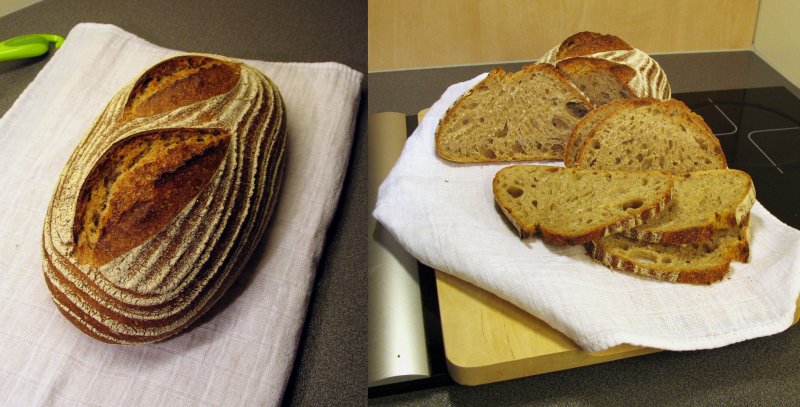
I'm always amazed by the fact that these levain breads only contain three ingredients: Flour, water and salt. It's fascinating how three so simple ingredients come together and, given enough time, produce delicious loaves. This loaf has a subtle and mild taste, and I usually eat it plain in order to fully enjoy the flavour.
In my last post, I wrote about a new rye starter that I made. The initial motivation to get a new one going, was to see whether there would be any significant difference in flavour compared to the stiff, white starter that I've had for about a year. The rye starter is incredibly active, and I've been keeping it on a 1:10:10 (starter:flour:water) diet, with feedings spaced roughly 12 hours apart. The resulting loaves taste pretty much like those leavened with the white starter, so I guess one of them will eventually be cut loose... We'll see. Anyways, below is a multigrain sourdough that I baked with the rye starter (no commercial yeast):
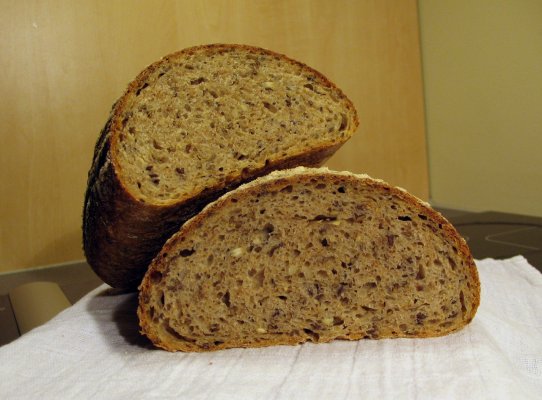
It's approx. 20% whole-rye (all from starter), 10% buckwheat and the rest bread flour. Multigrain soaker contains the usual suspects (i.e. flaxseeds, quinoa seeds, oat bran, rye chops, sunflower seeds). I gave the dough a 2 hr. bulk followed by proof overnight in the fridge.
I also baked some croissants over the weekend:
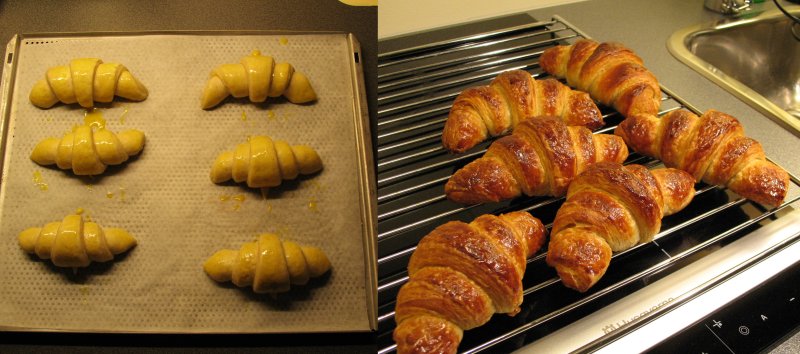
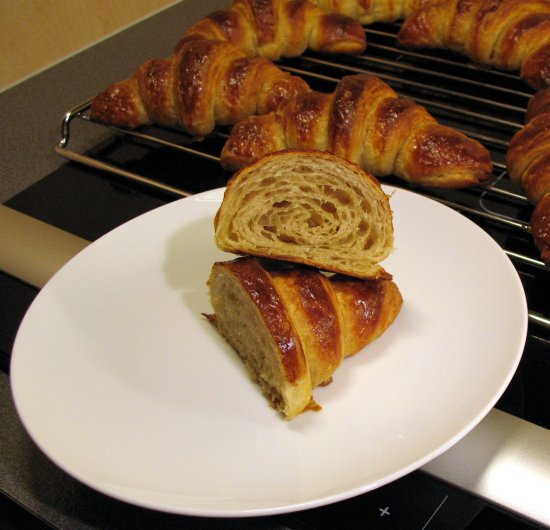
It's been a long time since I had a go at these, and I've definitely felt the cravings for buttery, flaky croissants for a while. I used the straight dough version from Suas' ABAP, and let the dough ferment 45 mins. at room tempertaure before I degassed and retarded the dough in the fridge overnight. Lamination (three single folds) the following morning, and makeup and final proof the following afternoon. A nice evening snack and splendid petit dejeuner the next morning :) They turned out alright, but rolling and shaping still need practice.
Finally, a humble carrot cake:
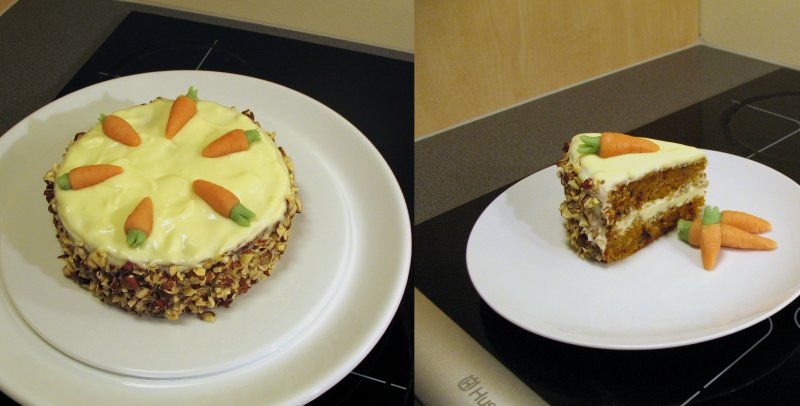
A very moist, soft carrot sponge and cream cheese filling made this an enjoyable dessert! Three pretty large, shredded carrots went into the sponge batter (baked in a 15 cm cake ring), but I think even more could go in there to give it a stronger flavour of carrots. The most enjoyable bit was actually making small, cute marzipan carrots :)


Comments
Every single bake of yours turned out fantastic! I especially adore the Whole Wheat levain from Bread too. It produces such a fine loaf in the end!
Your croissants look wonderful, so improving shaping may be a hard task! And the carrot cake looks delicious! Was that your own recipe?
Hans,
These are beautiful, and have a taste to match, I'm sure!
I have a question about your carrot cake. When you say "sponge batter," are you referring to the method of baking that uses beaten egg whites as a kind of leavening agent, rather than yeast or sodium bicarbonate?
Eric
@ arlo: Thanks a lot! There's always plenty of room for improvement, but the taste was right at least! For the carrot cake recipe, go here, then place the pointer over the book cover and click on "Search Inside This Book". Type "carrot layer cake" in the search field, and go to page 493. The recipe starts at the bottom of the page! Since I only made a small cake, I decided to skip the vanilla buttercream and the top marzipan circle. I doubled the cream cheese filling instead, and used the leftover filling to ice the sides and top.
@ Eric: Thanks :) The recipe calls the cake base a "carrot sponge", and I guess that's because it's a batter that's mixed somewhat similarly to genoise or sponge cake bases (eggs whipped to a ribbon stage and then flour, and in this case also carrots and walnuts, are gently folded in). There are tiny amounts of both baking powder and baking soda in this recipe however, so it's not a true genoise or sponge in that sense.
Again you have selected 3 things I enjoy so much in your post. Interesting that the flavor is similar to the old starter, using the new one on your multigrain. The crumb looks perfect as usual. For some time I have been of the opinion that a good sourdough starter is neither hard to create or unique, if you know how to maintain it. Your whole grain breads are an inspiration hansjoakim.
Your Carrot Cake is a work of art my friend.
Eric
hansjoakim,
How long did you wait between folds, and did you cool it in the refrigerator or in the freezer between folds?
On the final rollout for dividing and shaping do you have any advice on how to roll it out by hand? I've been making Suas' hand-mix/poolish and whole wheat with prefermented dough and I always have to struggle to get the dough to roll out thin enough before dividing and shaping. It is usually as elastic as tire rubber. Sometimes, by the time it's rolled out thin enough the dough is overworked and does not bake up as flaky as it should be.
I'd really appreciate any advice you could give on hand-rolling croissant dough.
-Greg
Gorgeous, Hans! I feel like I'am in a french bakery looking at your photos! Everything looks perfect and delicious! I love the wheat breads in JHB book...I've even been using Organic White Wheat and some dried cherries and pecans! It must be my sweet tooth or the hot weather and an abundance of fresh fruit!
Sylvia
David
hansjoakim-
That is a gorgeous loaf you produced! And the cake is beautiful as well - David can attest to my weakness for desserts - and dessert pictures.
Larry
Your Pain au Levain looks fabulous. The scoring is so nice and crisp!
What butter to flour ratio did you use for your croissants? What temperature did you bake them and any problem with butter seepage during baking?
Don
Wow, what productions! They all look so gorgeous and I am sure they're all very tasty as well.
I wish I felt like baking when the weather is miserable. We don't have cold and miserable weather, instead we have hot and miserable weather. When it's hot I don't feel like turning the oven on. I only baked two loaves of sourdough sandwich breads all week so we wouldn't run out. The neighbors' kids kept asking "where's the yummy stuff?" . I am afraid they will have to wait until the weather cools a bit for some treats.
Great looking goods, Hans. Your kitchen must have smelled quite heavenly!
It's been cold and miserable here for months, this year without a summer. Rather than using colder water for the dough, I've had to use water warmer than I used during my winter bakes. Crazy...but at least baking warms up the kitchen.
Thanks so much to everyone for such nice compliments! :)
@ Greg: It does take some work to roll out the dough in the end, but mine didn't turn out all rubber-like, thankfully. I've tried the straight version and the whole-wheat version from ABAP, and both have worked well for me.
I waited 30 mins. between 1st and 2nd fold and 45 mins. between 2nd fold and 3rd fold. I kept the dough in the fridge between folds. The dough rested in the fridge for approx. 8 hrs. between the final fold and make-up. I had to degas it a little bit, and "loosen it up" a little, by gently transferring it between my hands before rolling.
When I mix the dough in the mixer, I'm very careful not to overmix it. I add everything but sugar to the bowl, and mix to a shaggy mass on 1st speed. Then I gradually sprinkle in the sugar, with the mixer still going on 1st speed. After a few more minutes on 1st, I take it out and hand knead it a few times to get a smooth dough. I use my regular, domestic bread flour for the dough, but the flour isn't very high in gluten, I believe. If you're having trouble with an overtly rubbery dough, you could try to cut your bread flour with some cake flour? In many puff pastry doughs, one finds a 1:3 or 1:4 ratio between cake flour and bread flour. Perhaps you could try that?
I try to roll the dough no thinner than 1 cm when making the turns. How about you?
I've not tried the hand-mix version from ABAP, but at least in theory, a dough with poolish should be easier to work with, because of increased extensibility... I think I'll try the hand-mix version next time, to see how that works out. Well, I'm not sure if this has been any help at all, but there really isn't a whole lot more I can think of. A different flour, or cutting it with some cake or pastry flour is probably what I would try first. Best of luck Greg, and let me/us know if you sort it out!
@ Carl: Thanks :) Indeed, the starter is bubbling away at an impressive rate... It sounds like you've got a healthy feeding schedule going! I don't think mine smells like vinegar. It smelled horrible during day 2 and 3, but started smelling more like yogurt on day 4 and onwards. Now it's got a pretty mild smell, a bit stronger than the white starter, but still very pleasant.
@ Don: Thank you so much! I've admired your recent pain au levain as well, and not to mention your croissants and pain au chocolats. I think you're partly to blame for my recent hunger for croissants ;) The recipe I used has the butter for lamination weighing 25% of the total dough weight. For this specific recipe, that results in butter weighing 46% of total flour weight. The croissants were baked at 220 dC (without the fan going), and I didn't notice much butter seepage occurring.
@ Eric, Sylvia, David, Larry, althetrainer, Lindy: Thank you!! :)
Thank you for the help. First, I think I'll try the long rest after the last fold (before makeup). Normally I only wait about 1 or 2 hours. I also probably haven't been rolling the dough quite thin enough before folding. I've been only rolling it to about .5-.75 inch. Maybe the fairly short rest times in the fridge along with an excessively thick mass of dough don't allow the dough to get cold enough between folds. A few days ago (on a pretty hot day) I think some of the laminating butter got worked into the dough which really reduced the flakiness.
A week ago I tried using 100% AP flour (instead of the usual bread flour) with a hand mix. It was easier to roll out but the crumb was not at all what I wanted--it had too little structure. When pulled apart the croissants didn't strech and tear into long strands. It pulled apart too easily without stretching. I don't know if that makes sense, but I expect a croissant to kind of stretch and unwind when pulled apart. I have some cake flour so I'll try that, too.
I normally mix in a mixer but I don't go as far as Suas' formulas call for. I try to stop a little shy of an improved mix but I 'll follow your mix guidelines and see how that goes. I find that when the dough is too soft or weak it is harder to laminate the cold butter. There seems to be a fine line between butter that is too cold and hard and butter that is too warm and soft. I've found that lightly pounding and rolling the cold, hard butter before lamination softens it pretty well without warming it up or cracking it.
Thanks again, your pictures and descriptions are real inspirations,
greg
Hi Greg,
Yeah, I guess a slightly longer rest would make it easier to roll out. Just be sure to carefully press out gas that has generated during the rest before you roll.
It can be tricky to get the right thickness during folding: Roll it too thin and the dough will be overworked (and harder to roll out later on) and the butter might easily start to leak into the dough (as you experienced).
Yeah, I agree on the "unwinding into strands" when pulled apart bit! I've only ever read about American cake, pastry, all-purpose and bread flour, but never had the opportunity to work with it myself... Perhaps someone else could give better flour recommendations than me? Well, I think that a 1:4 or (a more conservative) 1:5 mix of cake:bread flours could be worth trying.
Come to think about it, there's a long thread on croissants over at the eGullet forum: Click here for that. It seems the board is down for maintenance right now though, so try again in a bit.
Thanks again, and best of luck :)
Your bread looks amazing! It definitely inspires beginners like me!
I have been looking at the wonderful pictures of your bread, and I particularly like how the bread turns out with the scoring. I haven't got much success slashing my sourdough...something that I'm still working on. -- Michelle
Thanks, Michelle!
If anyone finds the photos inspiring, well, then I couldn't possibly ask for more!
I also think scoring loaves is one of the trickiest parts in getting a decent-looking loaf. Every time, I force myself to take a deep breath before picking up the razorblade, and then keep my shoulders as low as possible before making the cut...
It's good that it's only proofed dough, however, and not some poor patient's belly ;)