
A new rye starter and a caramel cake
My trusted sourdough starter is a firm white one, that I've had for just under a year now. We got off to a shaky start, but it's become amazingly reliable and flexible. It seems to respond very quickly to feedings and has a great leavening capacity. My only minor complaint would be that it's very mild in flavour, and imparts only a slight tanginess to the loaves. So, as an experiment, I decided to start a new rye starter from scratch, and see if this would result in more sour breads. I had lots of rye flour on hand, and rye starters are said to be among the easiest to get going (in addition to e.g. spelt starters or rice starters). I used the recipe in "Bread": Equal weights of whole rye flour and water, mix and let sit 24 hrs. I went with 50 gr. each of flour and water:
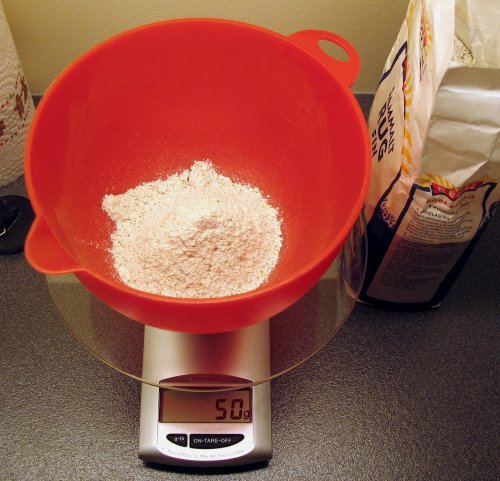
After 24 hrs., keep 50 gr. of the original mix, and add 50 gr. each of flour and water. Let sit another 24 hrs., and then continue this regimen, but with 12 hr. intervals instead of 24.
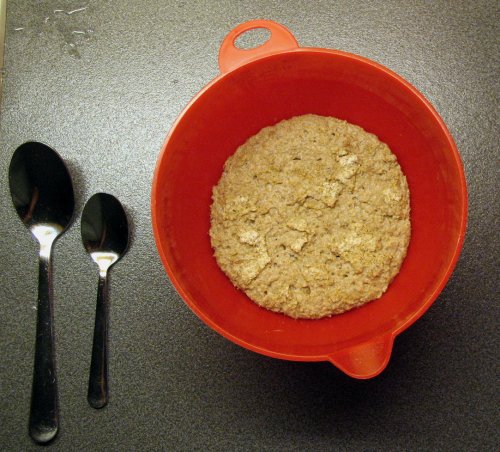
Nothing much happened the first 24 hours, but on the second day I got hit pretty badly with leuconostoc. The mix had tripled in volume, looked dark brown with hints of green, it was very runny and smelled rather pungent. *yuck* Well, soldier on, I say. The activity dropped markedly during day 3, and the odour became a lot milder, and smelled more of yogurt than of the leuconostoc madness. Nothing much happened in volume until the end of day 4, when the mix all of a sudden started tripling again! Phew! The culture started to smell healthy, looked greyish in colour (as I expected it should), and had a fragile, but not runny consistency when ripe and ready for new feeding. Below is a photo taken sometime during day 5. You can see some small patches of rye flour on the top - I usually sprinkle rye flour over the mix after each feeding, so that it's easy to gauge the level of activity:
I followed Hamelman's directions, and kept feeding out day 6, and then two more days to ensure that things are stabilized and healthy.
Today I decided to try it out, and devised a simple multigrain loaf for it. This one's approx. 33% whole rye, the rest bread flour, with a soaker of oat bran, flax, sunflower seeds and rye chops. I used equal amounts water and yogurt in the final dough, and added a tiny spoon of honey for good measure. I didn't use any commerical yeast, but prefermented 25% of the flour (new rye starter). I went with a 2 hr. bulk ferment (fold after 1 hr.) and retarded in fridge for 8 hrs. It could probably have gone a bit further in the fridge for the final proof, but I got scared with a third rye in there. It kept up well, and rose remarkably during baking:
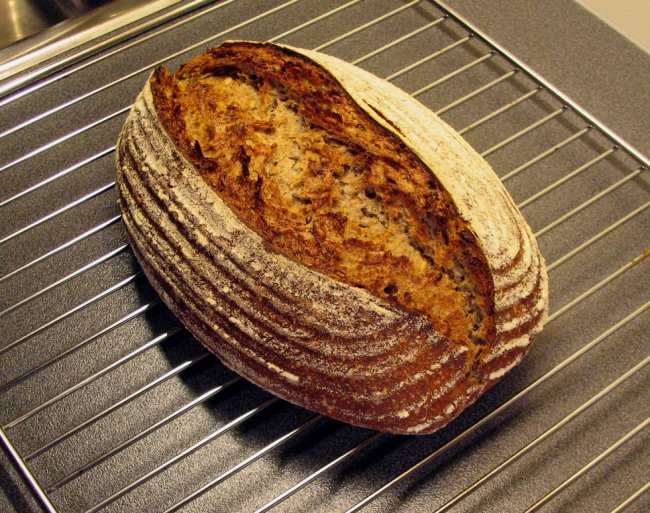
It was a lovely loaf, and I must admit, slightly tangier in taste than what I get with my firm white starter. A bit more sour, not overwhelmingly so, but pleasantly tangy. I think I'll keep both for the time being, and see how the new born develops in flavour as the weeks go on. In the meantime I need to come up with a name for it... I'm thinking about Aladdin, but it's far from settled yet.
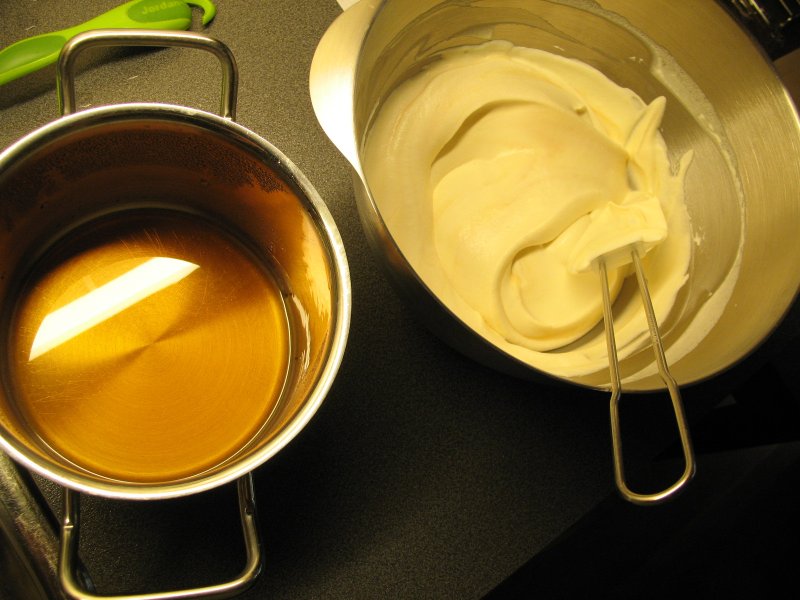
To celebrate the new starter and nice tasting multigrain, I decided to have a go at a caramel cake from Friberg's second pastry book. It's a delicious concoction of a thin shortdough bottom, and two sponge cake layers sandwiching a rich caramel cream. Here I'm folding caramel sauce into the cream:
And below is the cake before icing. It looks pretty cool if you ask me: You make one almond sponge and one cocoa almond sponge. After they've cooled, you use a cookie cutter to cut out the middle of each sponge, and interchange the middle cut outs. You only use half of each sponge in this assembly, so the remaining sponge layers can be frozen. Lovely thick caramel cream in the middle:
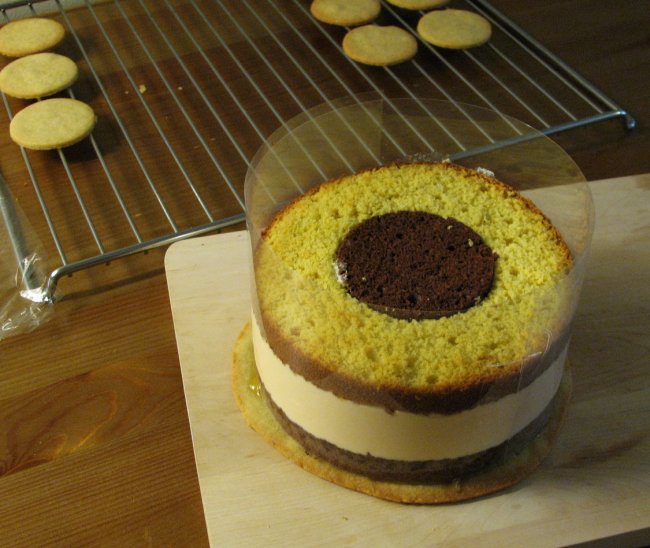
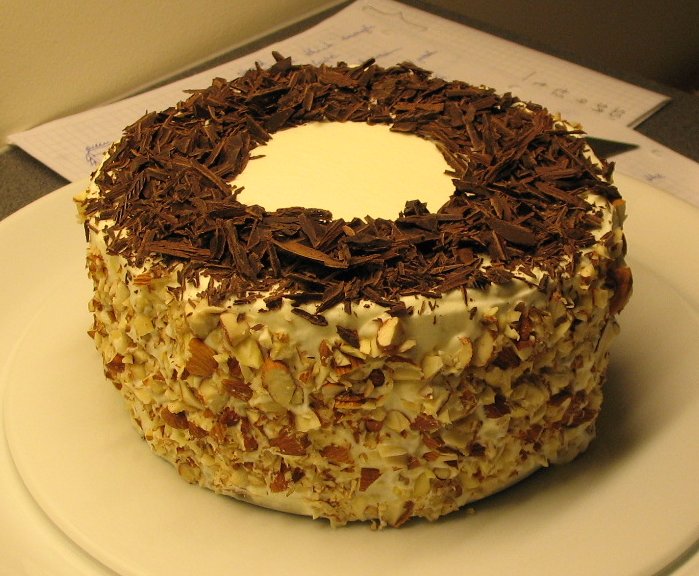
The caramel cream is set with some gelatin, so after a few hours in the fridge, you're set to ice it. Cut the protruding shortdough bottom, then ice with whipped cream. Decorate with some chocolate shavings on top:
And here's the first slice:
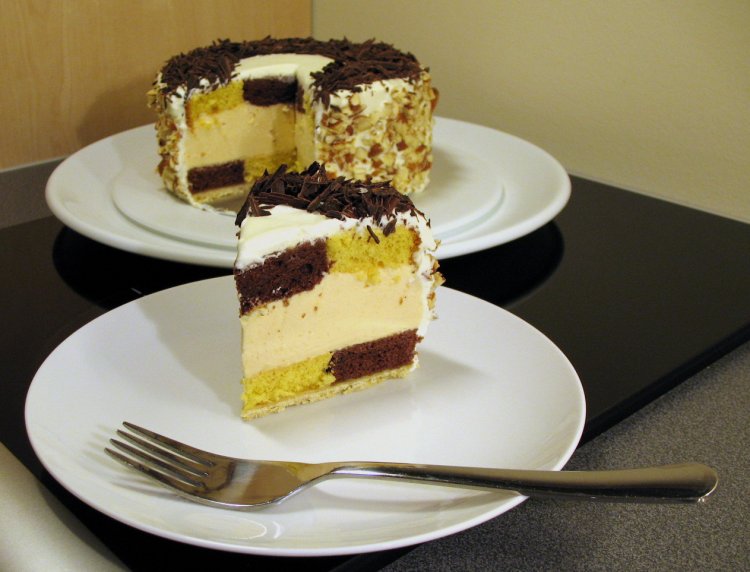
The taste is absolute caramel heaven! I really like the unusual look given by the two sponges, and the shortdough bottom gives a nice constrasting crunch to the creamy rest of the cake.


Comments
Beautiful baking, Hans! Your new rye starter sounds like it has a lovely flavor and what a beautiful loaf! Oh my, the patience you have for a cake this gorgeous and sounds like the flavors mingle all so deliciously together. I'm a big fan of a caramel, chocolate and nut combination. What is the flavor of the white frosting is it whipped cream? What an interesting and lovely cake pattern and thank you for explaining how it was done. Now if you could just beam me over a big slice!
Sylvia
see you put all the food groups in too....caramel, chocolate,nuts! It tops my list!
Audra
but I love the Caramel cake! In fact all your cakes. Are Friberg's pastry books advanced level? I love to bake, but am not into extemely complicated multi stepped recipes. The cake pattern is really nice, but the caramel creme is the what sets it over the top for me.
Betty
I hope you have some hungry helpers.
I've just recently moved over to using a rye starter as well. It sounds like you're feeding 1:1:1 at 12 hour intervals? I was feeding 1:5:5 at 12 hours myself but the weather has cooled lately and I find that 24 hours is working. I'll be interested as to how it settles in with you.
:-Paul
Sylvia: Yes, the frosting is just heavy cream whipped with powdered sugar (Crème Chantilly). You could go all out with buttercream frosting, but that would make it rather too rich for me, I think. Besides, the soft whipped cream combines well with pillowy sponges and cream inside.
Carl: Thanks! It's the first time I tried Hamelman's procedure, but I picked it since it looked so straight forward and hassle free. I'm curious to hear that you've had trouble with rye starters before, as they're supposed to be among the most robust there is - particularly so since they tend to stick to lower pH levels (and thereby create a "hostile" environment for bad critters), and since rye flour is rich in "good" microorganisms...
Audra: Thanks :)
Betty: Thank you! The caramel cream was just amazing. Pillowy soft, with just a hint of bitterness from the caramel sauce. I can't speak for anyone else, but for me at least, the two Friberg books are very advanced and highly challenging. Some of the stuff in them are just so far out there... But they're still amazing in that whether you bake from them or not, they're a great source of inspiration and information on the various methods involved. The first book is on par with e.g. Suas' ABAP and Gisslen's Professional Baking. An all-round book with the various doughs, batters, creams etc., a brief (and rather incomplete) chapter on bread baking, crackers, cookies, breakfast pastries, decorated cakes and some chocolate work. I think you can check out the table of contents on e.g. Amazon. The second book is where things get really serious. This caramel cake and the raspberry cake I made a few weeks ago, are both from the second volume, and probably the two simplest cakes from the introductory chapter. All recipes are multistep recipes (e.g. "600 gr. buttercream (p. xxx), 2 almond sponges (p. yyy), 360 gr. ganache (p. zzz)..." etc.), which I think is nice, because you can space the process out over a few days quite easily. And I think it's nice to work on preparing one item at the time, and then combine everything at the end. They're my favourite two baking books, and there's a lifetime of baking in those two volumes. By the way, Betty, another book that doesn't get a lot of attention, but is terrific none-the-less, is The Roux Brothers on Patisserie. It is from 1993, but I think it has aged brilliantly, with lots of classic, mostly French pastry items. All recipes are scaled to home-kitchen friendly sizes, the recipes are in weights, and it's got everything from bread and cookies to croissants, puff pastry, choux, tart doughs, ice creams and cakes. Highly recommended :)
Paul: Thanks :) Good point you raise there, Paul. Hamelman instructs on how to make the starter, but not on how to maintain it on a day-to-day basis. He's probably aiming this bit towards commercial operations that always make large sourdough builds for their doughs, and not towards home bakers who, more often, only need to maintain the starter from day to day. I fed it on a 1:1:1 regime for the first week, but when I thought it seemed fully developed and rather stable, I switched to 1:4:4, and eventually 1:5:5 as you, with 12 hr. feeding intervals. I'm not sure if there's a "best way" to go about it, but I think that sticking to a maintenance regime that's close to the way you build ripe sourdoughs is best. In "Bread" for instance, most rye sourdoughs are inoculated by 5% ripe starter, and left to ripen for roughly 16 hours. Ideally, I would like to keep a feeding regimen like that, since I would then get a more or less constant dilution of the ripe starter every time, regardless of whether I'm building a sourdough for baking or if I'm just feeding to maintain the culture. This would hopefully generate a stable, reliable culture. I'm more keen on spacing feedings apart 12 hours (you know, feed the critters before you have your breakfast, and before you have your dinner in the evening), so perhaps a 10 - 15% inoculation would be suitable. I'm not sure how important it really is; it's probably more important that the culture is allowed to ripen fully between each feeding, so it's not diluted and weakened too much over time... I have only made a starter from scratch once before, and this was also an experiment to see how easy or difficult it would be to get another one started. Was it just a fluke that the first one got off, or not? This method seems pretty robust to me: Separate feedings by 24 hours the first days to get things going and to get the pH dropping - that way leuconostoc is fended off. If one just sticks to it and keeps the faith during the lull of days 3 and 4, chances are good that things will pick up during day 5 or 6.
Turns out to be a great combination before and after the rye starter aquires more "depth." I wouldn't be afraid to add a little of your older wheat starter to it or add other flours (flours for a few days) along with the rye flour feeds.
Mini O
Another thought occured to me, would feeding a rye starter only rye chops slow the fermenting process down? Like when temperatures are higher? Or would it starve it because the food is large and too slowly available for the beasties? (Would this be the death of the starter but a source of sourdough flavoring so often seen in liquid form as a true product of a rye starter?)
Mini O
It would be interesting to try that out, Mini. Perhaps someone else has tried feeding with rye chops already, and could chime in?
My initial thought is that the activity should slow down, since (I guess) it is harder for the yeasties to extract food from bulky chops. In flour, it's already broken down and directly available. I guess the chops-fed starter would have a more pronounced sour flavour?
It could be an interesting experiment - either combine chops and whole rye in one starter, or make two separate starters; one with chops (for a sour flavour) and one with rye flour (for leavening)?