SearchUser loginBread BooksFavorite Recipes
|
Submitted by steelchef on April 21, 2011 - 11:44pm Has anyone used or considered wine/beer yeast as a sourdough starter?Curious! I used to make wine in the basement and had great success with natural sourdough starter. It has been six years since moving the wine making to a U-Brew. Now I can't get a natural starter happening. So, has anyone used a wine or beer yeast to start a poolish? Any info would be appreciated. I intend to give it a try regardless.
Submitted by leighbakes on February 24, 2011 - 12:25am Valentine's Day cake--and my new favorite ganacheRead the original blog post here! On Valentine's Day, I rediscovered a heart-shaped cake pan in the back of my pantry and knew I had to put it to use. Since it was my first cake attempt, I wanted to use another fairly simple recipe, so I found this recipe for dark chocolate cake on allrecipes.com: Dark Chocolate Cake. It got some pretty excellent reviews from the site's readers, including one person who wrote, "I am a pastry chef, and this is the only chocolate cake that I will make from now on." Awfully high praise! When I pictured the finished cake, I couldn't get the image of a glossy chocolate ganache-covered heart cake out of my mind...so I dug up a recipe for red wine chocolate ganache I'd seen on cupcakeproject.com. What could be more sexy and romantic than dark chocolate cake with red wine ganache for Valentine's Day? Okay, here's something you should know about me (if you haven't already noticed): I'm a chocoholic. This means that I often don't consider a dessert worth eating unless it contains a fair amount of chocolate. This also means that I'll need you guys to urge me to try recipes that aren't all about chocolate. I'd gladly welcome any non-chocolate recipe suggestions any time! I didn't really run into any problems mixing the batter, although it did take a long time to prepare the chocolate mixture, sift all the dry ingredients, and beat everything together. I tend to be a slow worker, but I also lack some of the tools that would make all this a lot easier, like a freestanding mixer. The cake came out looking good, though I found those big cracks down the middle distracting. Is that normal for a cake? Maybe I filled the pan too high. Submitted by Erzsebet Gilbert on October 16, 2009 - 4:45am Pain au vin, or, winebaking III, & thanks to Yozza & Shiao-PingMaybe it's more of a pain au je ne sais quoi... After seeing Shiao-Ping's post, "Pain au levain with wine," (http://www.thefreshloaf.com/node/13989/pain-au-levain-wine-60-hydration#comment-86360) and Yozza's wine bread with sesame (http://www.thefreshloaf.com/node/13949/winebaking-part-ii-what-happened#comment-86222) - and simply the sight of their absolutely gorgeous breads, I had no choice but to try it again! Yozza had excellent recommendations, and Shiao-Ping seemed to have a resounding success with her sourdough starter;Yozza's seemed excellent, as did hers... Unfortunately, I have never really liked sourdough, so on her recommendation of an alternate starter I tried a slightly different formula... Admittedly, I'm an amateur - this was simply improv on my part, probably foolhardy. Here goes: I've had great luck with the technique I first learned in Rose's Bread Bible - the method of letting a sponge rise beneath a flour mixture - so going off of some elements of Yozza's bread and Shiao-Ping's sourdough, I tried a variation, though in a smaller loaf. Starter: 80 g flour 110 ml warm water 1 tsp sugar 3/4 tsp yeast Flour mixture, well mixed: 120 g flour 4 g salt 1/2 tsp yeast 1/2 tsp sugar And: 20 ml semi-sweet red wine (12.5 %), allowed to "breathe" at room temperature for 2 hours. (With the proportion of wine to water, I was trying to imitate Yozza's ratios.) In a midsize bowl, I mixed the starter until smooth and soupy, then sprinkled about half of the flour mixture on top and allowed it to ferment for approximately 2 hours, until the starter bubbled through the flour. At this time, I measured the wine and set it aside (I wanted to achieve the wine taste, but worried about the potential problems it might cause with the yeast, so I thought that perhaps letting it "breathe" at room temperature during the rising time would balance it out). After 2 hours, I began to mix by hand the rest of the flour mixture. Then, I slowly added the wine. It made for a very sticky dough, but very elastic and similar to what I have had in a semolina torpedo, with lots of gluten strands. But there was no purple tone to be seen, and I wished I'd begun with more wine... So with the recklessness of a beginner I mixed about 25 g of flour with a further splash of wine into a paste, and gently kneaded this into the dough. I allowed the dough to rise on its own at about 70 degrees F, until a depression in the dough rose back on its own. Then, I softly stretched the dough, like I have with ciabatta, and shaped it into a rectangular loaf. It was quite sticky, but manageable. Here's the shaped loaf:
I let it rise for about an hour, while preheating the oven to 230 degrees C (all we have on our oven). Then, after dusting it with flour, I popped it in on the lowest rack <script src="../../sites/all/modules/tinytinymce/tinymce/jscripts/tiny_mce/themes/advanced/langs/en.js?I" type="text/javascript"></script>, with steam. After ten minutes, I removed the steam and reduced the temperature to 205. After ten more minutes, the loaf had browned nicely on top, and the thermometer read an internal temperature of 208 F. The result:
And taste verdict: not at all bitter, as I had found my previous wine boule! Not art, exactly, but enjoyable. The crumb:
Chewy, though it had only a few of the iconic ciabatta holes. But not nearly enough salt! The wine taste didn't come through at all, so I am thinking that for the next experiment I'll substitute far more of the hydration with the wine, and adhere far more to the stretching process of some sort of ciabatta-type bread. Any thoughts, suggestions, advice? Thanks to Shiao-Ping, Yozza, and everybody! (p.s. If anybody is interested or bored, there's more pictures of our continuing stages of winemaking on my blog: http://erzsebetgilbert.blogspot.com/) Submitted by Erzsebet Gilbert on October 11, 2009 - 4:57am Winebaking Part II: what happened?
A while ago I posted a question about the possibility of baking with wine - whether it could be done, what the tricks might be, and general anybody-know... I received so much helpful tips about procedures, and recommendations of the Vinafera wine flour, and links and ideas. User yozzause had the excellent idea of adding wine to a recipe I was familiar with, and using a starter, so I finally, finally worked up the guts to try that... I took a very basic formula for a honey wheat germ bread I'm quite familiar with. I didn't want to use up all the resources in our pantry, so I made it in a very small proportion. Essentially, I went with white flour, active dry yeast, a bit of vital wheat gluten and a little bit of wheat germ, honey, butter, and moisture – I replaced half the water with red wine. I had been advised that the alcohol present in the wine could inhibit yeast development, so I attempted to burn away the alcohol on the stovetop; simple enough. It’s quite a basic recipe of mix, knead, rise, shape, proof, and bake, and it went normally – a good rise on the dough and the loaf, and a fine oven spring. Argh! But I was so disappointed! Usually, this bread has a nice, wholesome, slightly sweet taste with the flavor of some wheat without the heaviness, and I’d hoped to contribute a bit of the red wine flavor. Best part: purple dough! I loved the crimson touch. Worst part: bitterness! Though the crumb was soft and quite normal, the taste, once rested, was pretty harsh to me. I skipped that one. Inexplicably, my husband liked the bitterness! But I’m wondering whether the bitterness is an inevitable product of adding alcohol to a recipe, or whether I did something wrong, or if this was simply the wrong recipe – anybody have any thoughts? Suggestions? Again, thank you all, for everything! p.s. I did find this recipe for an ancient Roman bread made with must, the early juices of fermenting wine, and I think perhaps I’ll try that, and I thought others might be interested too! The site has a number of ancient and medieval breads: http://www.celtnet.org.uk/recipes/roman/fetch-recipe.php?rid=roman-mustacei
Submitted by turosdolci on October 4, 2009 - 2:52am Puglian Taralli
Taralli are a biscuit that is eaten by Italians any time of the day. It should be named the national biscotti because taralli are enjoyed by young and old. Wheather it is for breakfast, as a snack, dunked in wine, as a treat for children, they are a biscuit that fills every occasion. They can be found in every bakery, market and in every Italian home. There are many preparations of taralli, but the one here is from the village where my grandparants come from, "Vieste (FG) Italy". Puglian Taralli Dry Ingredients 3 cups all-purpose flour, unbleached 2 cups semolina flour 2 teaspoons dry yeast 1 teaspoon salt 2 tablespoons fennel seeds, lightly crushed, or 1 tablespoon crushed black peppercorns, or 1 teaspoon crushed red pepper flakes WET INGREDIENTS 1 cup dry white wine, warmed 1/2 cup extra virgin olive oil, warmed DOUGH Sprinkle the yeast over the warm wine and let it stand for several minutes, then stir it into the wine and mix well. In a large bowl put all the remaining ingredients and your chosen seasoning. Mix and knead well until the dough is smooth and elastic. Return to a clean bowl and cover the dough with plastic wrap or a dampened towel and let it rise for 30 minutes or longer in a warm place. ASSEMBLY Divide the dough into pieces. Roll them into 1/2” cylinders. Cut them into 6” lengths. Bring the two ends together and join them to make a round doughnut - like shape. Press your thumb on the ends to seal them. BOILING Bring a pot of salted water to a boil and drop the taralli in a few at a time. When the taralli rise to the surface, remove them and put them on a clean towel to dry. BAKE Arrange the boiled taralli on a cookie sheet and bake in the oven for 20-25 minutes, until they are golden brown. Note: When crushing the black pepper, do not use a grinder. The finely ground powder from the pepper will make the taralli taste hot. Use only hand crushed pieces. An old Italian say: "No matter what the argument, it can be resolved with a glass of wine and a handfull of taralli" Submitted by Erzsebet Gilbert on October 1, 2009 - 4:53am A winemaker wants to be a wine-baker....
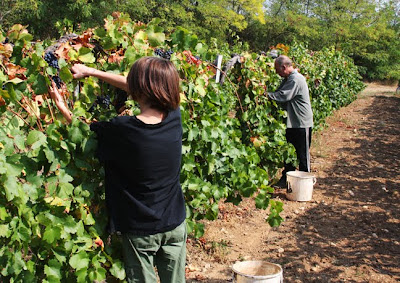
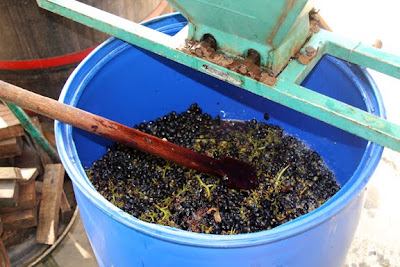
Hello, everybody! So, here in Hungary, it seems like everybody's got a farm, and coextensively a vineyard. My husband David and I don't, but we do have an incredibly kind old neighbor who's teaching us to make our own red wine. It's so much fun - picking our own grapes, grinding them, removing stems... Like so:
Naturally, in gratitude I've baked him lots of bread. We're not quite done, but in approximately two weeks we will have (for $50) 150 litres of red wine! Which leads me to my question: I've seen and read a number of beer bread recipes. But obviously, we've got plentiful wine... Are there any breads which call for a splash of wine in the dough? It seems like it would be possible, but I've never seen any; I'm still a student baker, so I don't know if there are any chemical or taste-related reason for this. Does anybody know, and if wine bread exists, any ideas? Thanks! Erzsebet Also, if anybody is interested in other pictures and a diary of our winemaking process, it's on my blog -http://erzsebetgilbert.blogspot.com
Submitted by Erzsebet Gilbert on October 1, 2009 - 4:51am A winemaker wants to be a wine-baker...Hello, everybody! So, here in Hungary, it seems like everybody's got a farm, and coextensively a vineyard. My husband David and I don't, but we do have an incredibly kind old neighbor who's teaching us to make our own red wine. It's so much fun - picking our own grapes, grinding them, removing stems... Like so:
Naturally, in gratitude I've baked him lots of bread. We're not quite done, but in approximately two weeks we will have (for $50) 150 litres of red wine! Which leads me to my question: I've seen and read a number of beer bread recipes. But obviously, we've got plentiful wine... Are there any breads which call for a splash of wine in the dough? It seems like it would be possible, but I've never seen any; I'm still a student baker, so I don't know if there are any chemical or taste-related reason for this. Does anybody know, and if wine bread exists, any ideas? Thanks! Erzsebet Also, if anybody is interested in other pictures and a diary of our winemaking process, it's on my blog - http://erzsebetgilbert.blogspot.com |
ALSO ON |