Submitted by cranbo on May 27, 2011 - 12:33am

Gluten development, window pane and lean dough video

To try to document dough development of a lean dough, I created a video of mixing some lean, 59% hydration dough in my KitchenAid 5qt mixer at speed #2 (the 2nd click). 

http://www.youtube.com/watch?v=jBZFYzeK1Vo

I'm trying to get a better idea of knead times for my mixer with respect to different doughs. Hamelman in "Bread" says 6.5 - 7.5 minutes for moderate gluten development for KAid stand mixer. He recommends 900-1000 total revolutions for moderate dough development, so with some info from fthec and KAid:

#1 (stir): 40 rpm 
#2: 54 rpm 
#3: 79 rpm 
#4: 104 rpm 

 This means:

Time (minutes)	Revolutions
0 0
1 54
2 108
3 162
4 216
5 270
6 324
7 378
8 432
9 486
10 540
11 594
12 648
13 702
14 756
15 810
16 864
17 918
18 972
19 1026
20 1080

According to the stats, I may still have kneaded for too short of a time (H. also says that doughs with hydration under 60% will take longer to develop, as will doughs that have high hydration). It really started smoothing out at about 8 minutes, even more substantially at ~13 minutes. I guess next time I'll have to push it further, and see what happens. 

Submitted by SylvaniaChris on November 25, 2010 - 5:39am

Need help with Gluten development


I was going to make some Italian bread loaves this A.M. using KA AP flour but my wife had used most of it for pies (go figure).  I used AP for the preferment yesterday, and I have KA Bread Flour on hand, but I've learned I like the softer crumb I get with the AP flour so I chose to use (In what I thought was a flash of brilliance) some White Lily light all purpose flour (essentially cake flour...I think it's about 8% protein).  I probably had about 1/3 KA AP and 2/3 cake flour.  First thing I noticed was how brilliantly white it was (forgot it was bleached), then after mixing for a reasonable time I realized how weak the dough was as it failed the windowpane test badly and wasn't as smooth as I'm used to.  Now I tried to decide what was the best fix, add bread flour (I didn't want to make it much stiffer and I was trying to avoid increasing all ingredients proportionately), or vital wheat gluten which I had on hand.  I decided to add wheat gluten, about 1 Tablespoon from the freezer, but it didn't seem to make much difference right away (I don't know if it should work immediately, or needed an autolyse, or much more mixing or what), so I then added about 2-3 Tablespoons of bread flour and continued mixing.  This time the dough looks like it should, and windowpanes much better.  It's fermenting now.  I'll let you know later how it turns out.  I'm just wondering what you guys would have done.  Thanks for the feedback.

Submitted by Mini Oven on November 16, 2009 - 12:27pm

Windowpane Crackers


Peter Reinhart's  Thin Wheat Crackers on p.291  in  Whole Grain Breads

My interpretation used Spelt Flour type 700 glatt (fine) with additional 30g flour to the recipe.

Twentyfour hour rest on the counter top before cutting into small shapes and making windowpanes.  Place on parchment and continue to thin out the crackers...  Keep a towel handy to wipe off oil.  If I do this again I will use two tablespoons less oil in the recipe.  I like mine without the salt wash, which does give the crackers a little more strength but the crunch is better without it.

1000 words:

Submitted by KipperCat on December 19, 2007 - 12:40pm

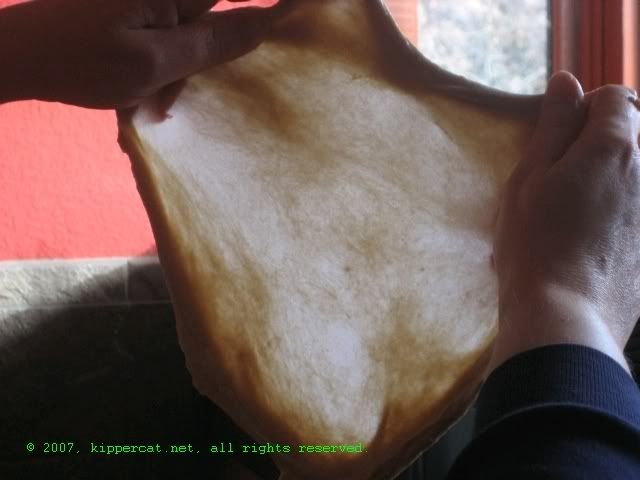
You can get a windowpane in whole wheat dough.


This picture is from a 100% whole wheat, rather high hydration dough. It had been kneaded for about 20 minutes at speed 2 in a Delonghi/Kenwood mixer. The lighting isn't that great, but if you look at the base of the left thumb, you'll see a fingertip behind the dough. The browner areas are simply dough that has not been stretched. This started as a piece of dough about the size of a golf ball And yes, it made nice bread - in this case a light sandwich loaf.


Submitted by mikeofaustin on November 19, 2007 - 11:08am

Troubleshoot my bread (newbie). Gelatin crumb vs. cooking times vs. inside temps = 'untasty loafs'.

So, last night, I tried another french loaf, but this time, incorporating some thoughts of how to fix my bread [proof longer, bake longer]. Here's the storyline...

-Bread flour (~500 grams)

-Water @ ~65%

-Salt @ 2% (table)

-Yeast @ 1% (active dry)

Submitted by Cooky on July 2, 2007 - 3:32pm

Alternative to the windowpane test

Just came across this suggestion for checking on whether your coarse wholegrain dough is properly kneaded, in cases when the traditional windowpane test won't work.

"Use your thumb and forefinger to pull up a piece of the dough about an inch above the dough surface. If the dough holds the pinch and stands in a little ridge without springing back, it is fully kneaded."

I don't believe I've heard this one before. Anybody else using this technique?