Submitted by roseyeskova on January 22, 2012 - 7:59pm

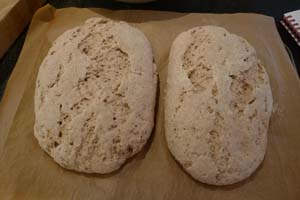
Yeast loaves losing shape during baking

Hello everyone!

I've been lurking on the site for about 18 months now (ever since I was given Peter Reinhart's Bread Bakers Apprentice and developed an obsession for artisan bread), and have finally plucked up the courage to ask for some advice from the wonderful community here.

I have been using a sourdough starter (he's called George) to make bread almost every day, and I'm generally really proud of my loaves.


But for the past few days I have been trying to branch out into regular yeast bread, and they just aren't coming out right. I just got a loaf out of the oven that went completely flat during baking- I don't think I have been getting enough surface tension into the dough while shaping them? This one was shaped freeform on a baking tray, but even when I do the final proof in a banneton my yeast  loaves tend to always go flat in the oven. I stretch and fold as I normally do for my sourdough loaves, and kneaded this one by hand for about 15 mins until the dough reached the windowpane stage. I shaped it according to Reinhart's instructions (usually I do my sourdoughs slightly differently- I flatten, fold the corners then the ends into the centre, bring one side in, then fold the other side over the top and pinch at the seam), and follwing his recipe I didn't slash the top as I usually would have.

The crumb structure is just passable, but the texture is too dense, and despite the shape it took too long to bake so the crust is quite hard and a bit thick imo. The strange thing is that I'm really happy with my enriched sweet yeast buns (lemon buns, Finnish cinnamon buns, cream buns)- they hold their shape well and have the right soft texture.

At a bit of a loss about where I'm going wrong- do sourdoughs and yeast loaves require a totally different technique? Or am I just making some stupid mistakes?

Thanks for your help. Rose


Note: I used Peter Reinhart's Multigrain Bread Extraordinaire recipe, but used a mixture of 300g wholemeal bread flour and 125g white bread flour (sorry for metric- I'm in Australia)

Recipe:

13.5 oz bread flour

4 oz milk

6 oz water

.38 oz salt

.33 oz instant yeast

1.5 oz brown sugar

1 oz cooked rice

1 oz honey


Submitted by gargoyle60 on November 30, 2011 - 7:57am

Mixed results from 3 attempts (beginner)

UK-based, electric oven, degrees Celsius temps.

Three attempts listed below, each with observations and results...

I reduced all the measurements because currently I only have a single small Pyrex dish. I also read somewhere that Pyrex can get too hot during the baking process and can scorch the dough and consequently oven temperatures should be reduced by about 20 degrees C, which is what I have done.

--- ATTEMPT #1 ---
100ml of warm water.
One miserly (less then level) tony teaspoon of treacle dissolved in the warm water.
100ml of cold milk.
Added approx. 8 grams of dried active yeast (Allinson).
Yeast mixture allowed to settle for 10 mins to activate the yeast and develop a head of froth (less than 1cm).
Sieved 250 grams of wholemeal bread flour (Sainsbury's own brand) into a warmed mixing bowl.
Two small pinches of salt added and mixed into the flour.
Left the bowl to warm the flour for a few mins.
6 grams of butter added that to the warm flour and mixed in by hand.
Added the frothy yeast liquid to the flour and mixed in using a wooden spoon to clump into one large ball of dough. This was then left to stand for a few mins to allow the flour to absorb the moisture.
Dough hand-kneaded for 10 mins.
OBSERVATION: the dough was heavy and VERY sticky.
Dough covered and left to rise for 30 mins (in a warm place).
The dough roughly doubled in size.
Knocked down and then kneaded the dough the second time for 10-12 mins.
Dough covered and left to rise for an hour (30 mins in a warm place, 30 mins at room temperature).
Dough placed in a Pyrex dish.
Dish placed in oven pre-heated to 210 degrees C for 15 mins.
Reduced the over temperature to 180 degrees C and baked the dough for 30 mins.
RESULT: loaf flat with a thick and heavy crust. The inside was softish but more like a crisp-bread such as Ryvita. It was tasty enough. Edible, but only just. Very hard to slice with a bread-knife, although slices did stay intact. Obviously over-cooked. Possibly "broken dough" syndrome from excessive kneading. Possibly insufficient water. Possibly insufficient yeast.

--- ATTEMPT #2 ---
50ml of warm water.
Added one level little teaspoon of treacle and stirred well until it had completely dissolved. Added 50ml of cold water. This made a total of 100ml of water.
Added approx. 4 grams of dried yeast (Allinson).
Stirred the mixture well and allowed to settle for 15 mins to activate the yeast and develop a head of froth (approx. 1.5cm).
100 grams of wholemeal bread flour (Sainsbury's).
Approx. 30 grams of slightly lighter Rye wholemeal flour (Dove's Farm Organic).
Sieved the combined flour into a lightly warmed mixing bowl.
One small pinch of salt mixed into the flour.
Left the bowl to warm the flour for a few mins.
Added 2 grams of butter to the flour along with a small slice of margarine and mixed in.
Added the frothy yeast liquid to the flour and mixed in using a wooden spoon.
OBSERVATION: dough VERY sticky again and I had to add a lot of flour to my hands. This made the dough quite "dry".
After a few mins the mix started to clump into one large ball of dough. This was then left to stand for a few mins to allow the flour to absorb the moisture.
Kneaded the dough for about 4 mins.
Dough left to rise for an hour in a warm place. The dough hardly rose at all.
Dough knocked down and shaped into two small clumps/balls.
Placed both dough balls side-by-side into a Pyrex dish lightly dusted with flour and baked for about 20 mins at 180 degrees C and then turned off the oven and left the bread in the oven for another 30 mins to cook in its own heat.
From an online source: I placed 5 ice cubes into a metal tray at the bottom of the oven when I first put the bread in to generate steam and help prevent a hard crust.
RESULT: much softer bread (more like soft bread rolls), although still a little flat but incredibly tasty. Thin and soft crust. Easy to slice with a bread-knife. Slices remained intact.

--- ATTEMPT #3 ---
One miserly (less then level) little teaspoon of treacle added to 50ml of warm water and stirred well until it had completely dissolved.
12 grams of dried yeast (Allinson) stirred in.
Yeast allowed to activate for 15 mins (head of froth 3cm).
110 grams of wholemeal bread flour (Sainsbury's).
60 grams of Rye wholemeal flour (Dove's Farm Organic).
Sieved the two flours together into a lightly warmed mixing bowl.
One miserly (less then level) little teaspoon of salt added to the flour.
Left the bowl to warm the flour for a few mins.
Added the frothy yeast liquid to the centre of the flour and lightly covered with flour, then left to sit for 10 mins ("Setting The Sponge" technique).
Added slice of margarine (equivalent to about one large teaspoon) to the flour and mixed in.
Mixed the ingredients using a wooden spoon.
OBSERVATION: the dough was VERY sticky again.
This was then left to stand for 5 mins to allow the flour to absorb the moisture.
Kneaded the dough for about 8 mins (the window-pane test didn't work properly because the dough was too heavy - I think?).
Left the dough to rise for an hour in a warm place (didn't rise much).
Punched down the dough.
Shaped the dough as before and placed the into a Pyrex dish lightly dusted with flour.
Baked for 25 mins at 180 degrees C and then turned off the oven and left the bread in the oven for another 30 mins to cook in its own heat.
As previously, I placed 5 ice cubes at the bottom of the oven for steam when I put the bread in.
RESULT: bread soft but barely rose at all. Tasty. Crust soft. Easy to slice with a bread-knife. Slices remained intact.

- - - - - - - - - - - - - - - - - - - - - - - - - - - - - - - - - - - - - - - - - - - - - - - - - -

POSSIBLE MISTAKES
I wonder if adding treacle (even a tiny teaspoon) is having the following effects:
- it initially makes the yeast clump together, which then separates before frothing
- it may be causing the dough to be particularly sticky and difficult to work with
- it may be causing the yeast to exhaust itself before it has time to work on the dough and hence the dough doesn't rise much

My attempts are based on a number of sources:
- a very basic recipe for white bread that was taken (and adapted) from the video at http://www.bbc.co.uk/programmes/b00zf9vd (by the chef Michel Roux Jr, broadcast on BBC2 at 19:00 on Monday 14 November 2011. See also - http://www.bbc.co.uk/blogs/food/2011/03/great-british-revival-the-lost.shtml)
- http://www.allotment.org.uk/allotment_foods/bread-making/baking-bread-home.php
- http://www.bakingmad.com/recipes/grainsandseedbreads/traditional-handbaked-wholemeal-loaf-
- http://www.deliaonline.com/how-to-cook/bread/how-to-make-white-bread.html
- http://www.thekitchn.com/thekitchn/tips-techniques/bakers-techniques-how-to-do-the-windowpane-test-when-kneading-bread-070784

I would appreciate any comments of where I might obviously be going wrong.

(NB. I shall be getting proper metal loaf tins this weekend)

Submitted by HokeyPokey on November 28, 2011 - 9:05am

Orange WholeMeal

Just a quick post - a basic wholemeal bread, lovely texture and mild sourdough flavour - that one is a keeper


As always, more photos and recipe on my blog here

Submitted by usank001 on September 1, 2011 - 3:38am

Soft Wholemeal flour

Hi

I am planning on making the Waterford Soda bread from Dan lepard's The Handmade Loaf. The ingredients say 'Soft Wholemeal Flour' which I know means not the Strong Bread flour. I have Stoneground Wholemeal flour (Allinsons) and need to know if I can use this as is or should I sift out the bran before using it? I have made so many Soda Breads, using the standard recipes, that could have been used as door stops that I am really keen on getting this one right.

Someone please help.
Regards
Una

usank001
 
Posts: 1
Joined: Tue Aug 30, 2011 8:41 pm

Submitted by Andy_P on July 25, 2011 - 1:39pm

Making a hash of it with Vitamin C

Hi all. I have a couple of questions about Vitamin C/Ascorbic acid powder.

The first part is a bit of a tale of confusion and woe....

I'm very happy with the "lift" on my white loaves, but my brown and wholemeal were a litle bit heavy,  so I bought some Vitamin C powder and started to use it.

Over the last few weeks or months, my brown bread has been getting worse and worse so I've been adding a little more and more of the Vitamin C powder (I'll admit to how much in a minute!)

I've now wbeen reading some previous topics about Vitamin C on here (such as this one:  Ascorbic acid) and I am now thouroughly confused about how much to use.

In that topic it says in various places:

1/8 teaspoon per "recipe"

1/4 gram or thereabouts for "a loaf" (I'm guessing a 1lb loaf?)

25ppm or so as an improver for white flour (i.e. 25 milligrams per kilogram- about a TENTH of the amount in quote #2)

And then it says "Dan Lepard proposes using 250mg to 450g of wholemeal flour. So that's almost 20x as much as routine addition to white flour."

So is 1/2 gram per kilo of wholemeal flour about right? Any idea of what that would be in fractions of a teaspoon?

(OK - time to confess now...  I'm sure I read somewhere that it should be a teaspoon per loaf, so I was being stingy and only putting in one full teaspoon per kilo of flour.

As they got flatter and flatter, I was slowly making it a bigger and bigger heaped spoonful!

I  think I was lucky the poor yeast was surviving at all!)


Second part of the question....

I can't remember where I found the Vitamin C powder and can't find it anywhere now.

But I can get Citric Acid powder. I know that citus fruits have citric acid and they are high in vitamin C, but is that all spurious? Could I use Citric Acid powder instead of Ascorbic Acid????


Very grateful for any help or advice.


Submitted by Salilah on June 19, 2011 - 10:53am

Another "cowpat" :-(

Oops - another failure

I was trying to make Daisy's Wholemeal Lemon Sourdough (original successful recipe here)

Not sure what particularly went wrong - my assumption is that
a) I left the preferment too long
b) I used slightly unripe starter
c) I left the mixed dough too long for bulk ferment
d) the S&F method didn't work so well for wholewheat as for white
e) I didn't knead enough
f) the gods were not smiling :-)

I shaped the dough into small loaves - 20mins into proofing and oops - disintegrating dough!

There was no surface tension when shaping...

I decided to pop them in the oven anyway - 30mins at 220C

They smelled great - and tasted OK - but pretty awful rise (i.e. almost none) - it's "back to the bricks", and just when I thought I was doing well...

So - not one of my best examples!  Never mind - I'm still learning!

Sali

Submitted by Daisy_A on August 19, 2010 - 4:33pm

Sourdough Wholemeal Lemon Bread: Adaptation of a Jan Hedh Formula


I was led to Swedish baker Jan Hedh's book Artisan Bread by Dan Lepard's recommendation on TFL. I owe him thanks for that as it full of great formulae and beautifully photographed by Klas Andersson. There is lots in it to inspire.

One of my favourite Hedh breads is a lemon bread flavoured with lemon zest and green olive oil (pp.126-7). Created by Hedh when lead baker on a Swedish cruise ship, this aromatic bread was designed to work well with fish dishes. It can be made in the shape of a lemon-shaped, small dinner bread or a more traditional round roll. The breads are dusted in yellow semolina flour during the second proof, to make them even more lemon-like.

Hedh's recipe gives enough for a small batch,  In fact this is one of the few breads that I can batch bake in an hour after preheating my small domestic oven, baking 3 dinner breads in the first firing and 4-6 round rolls in the second.

The bread has a great texture. It is moist but remains firm even when sliced thinly. It takes savoury toppings well without bending or getting soggy, making it also ideal for open sandwiches and canapés.

We have enjoyed it with fish dishes and also topped it with tomato, oil and vinegar or tangy cheese and pickles. It is also good dipped simply in olive oil. However one of my favourite ways to eat it is sliced thinly with no accompaniments, so that the subtle and delicious lemon taste can be enjoyed to the full.

Even before recent discussions on TFL about copyright  I had been trying to contact Hedh's British publishers to get permission to reprint the recipe. I have had no success so far as it looks as though they have gone into receivership.

This means also that Hedh's book will become harder and harder to find.  Large sellers like Amazon and Smiths are logging it up already as out of stock. The bakery that Hedh co-owns - St. Peter's Yard in Edinburgh  - still had around 60  copies of the book when I rang them a couple of months ago. They don't post out; however if you have friends in Edinburgh do sweet talk them into getting a copy for you as it could be your last chance to get your hands on this great book!

Hedh's original lemon bread is a yeasted bread made with a preferment of yellow durum wheat flour (grown traditionally on the Swedish island of Ven), and light rye flour with stone ground, strong wheat flour added to the final, machine-mixed dough. The version I am writing up here is my adaptation, a sourdough made with semolato, whole rye flour and wholemeal flour, which is hand mixed.

Some pictures of the different stages plus a chart of the adapted formula and process follow:

Sourdough Wholemeal Lemon Bread: Adaptation of Jan Hedh Recipe

This bread is flavoured with lemon zest rather than lemon juice. This results in subtle highnotes in the final bread, rather than a widespread lemon taste. It is well worth getting organic and unwaxed lemons to zest if available. When grated and mixed with the flour the lovely aroma also fills the kitchen! The wholemeal, olive oil infused dough has a lovely, silky consistency and is good to work with.

I have baked this bread several times. The original instructions make no reference to scoring the bread. I made the first batch without slashes and they came out well. However the picture in the book shows a loaf with an open top. I later read in the Introduction that Hedh proofs and bakes some of his breads with the seam side upwards. The loaf then splits along the seam, giving it an attractive rustic look. My shaping skills are not yet so good that I can prevent an unscored loaf rupturing elsewhere. I now normally score the breads with one long stroke along the top and this has worked well to date.

I was concerned that a predominantly whole grain formula at lowish hydration might produce too dense a crumb and loaf. I imagine that the loaves might rise higher when Hedh's original formula is used. However the preferment seems to work well with sourdough as well as baker's yeast and I have been able to get quite an open crumb and good rise for the size of loaf and type of flour used.

My sourdough starters are quite feisty but the relatively low levels of starter in the preferment and final dough have meant that the overall fermentation has taken place without the dough losing elasticity. The amount of starter and fermentation times I give are relevant to my own situation. I am realizing more and more now that with sourdough starters any formula is just a guideline! Please feel free to adjust this to suit your own starters.

I hope that other TFLers might enjoy this bread. If you do try it I would be glad to learn from your feedback.

Daisy_A


The quantities below are for 4 dinner breads:

With this formula I used a wholemeal starter at approximately 66% hydration. I have made this bread successfully with wholemeal flours from Dove's Farm, Waitrose and Bacheldre Mill. Bacheldre Mill was the most fruity and aromatic. I used Dallari semolato because it was the only one available locally at the time but would prefer to use DeCecco, a brand that is sometimes available, also recommended by nicobdv.

I estimate overall hydration including starter hydration at 530/945 = 56% but I'm always open to correction!

Total Formula Weight  
Wholemeal flour 695g  650+45
Semolato or other yellow durum wheat flour 150g  
Whole grain rye flour 100g  
Water 530  250+250+30
Green, virgin olive oil 50g  
Sea salt or other salt 20g  
Zest of 2 medium lemons, preferably unwaxed, organic Approx. 10g Will weigh next time!
Total 1555


Preferment Weight  
Semolato or other yellow durum wheat flour 150g  
Whole grain rye flour 100g  
Whole meal starter at approx. 66% hydration 30g  
Water 250g  
Total 530g  
Final Dough Weight  
Wholemeal flour

650g

 
Water 250g  
All preferment  530g  
Wholemeal starter at 66% hydration 45g  
Green, virgin olive oil 50g  
Sea salt or other salt 20g  
Zest of 2 medium lemons, preferably unwaxed, organic Approx. 10g  
Total 1555  
Method  


Preferment

Make the preferment approximately 12 hours before baking, normally the evening before:

Mix a small amount of starter with water to form a paste

Add the rest of the water to the starter mixture

Combine the flours and pour the water and starter over the flour.

Mix for 8-10 minutes in preferred fashion. (I 'air knead' in the manner of Andrew Whitley in order to incorporate the starter fully)

Cover and leave in an oiled container in the fridge

 
Mixing of final dough

Wash and zest lemons, mix into flour

Add preferment to flour

Dissolve second lot of starter in second lot of water and pour over flour

Mix by preferred method for 3 minutes

Add oil and salt and mix by preferred method for 8 minutes. (I air knead for 8 minutes then perform one stretch and fold on the bench). 

Make sure that all new starter and preferment are mixed in well.

Mix for another 7 minutes if needed, to form an elastic dough.

Place in a lightly oiled, covered container

 
DDT C26  
First proof Approx. 90 minutes with 1 S&F at 45 mins. Adapt as needed.  
Preshaping Quarter, form into balls and leave covered for 10 mins.  
Shaping Shape dinner breads into tapered, lemon-like rolls and smaller rolls as small rounds. Brush with water and dust with polenta or other yellow flour.  
Second proof Proof on a floured couche for 60 mins. or until doubled in size  
Preparation Preheat oven to C250 and prepare to steam. For steaming I preheat 2 small fajita trays and pour boiling water onto them as soon as the bread is in the oven.  
Baking

I bake the dinner breads for 10 minutes at C250 with steam, open door to releas steam and turn the oven down to C230 for the rest of the bake

Check internal temperature after another 12 minutes, bake for further increments of 3-5 minutes, if needed, until internal temperature of around C90 is reached and crust is an attractive light golden colour.

Jan Hedh recommends baking rolls for around 12 minutes


Submitted by jennyloh on May 1, 2010 - 11:18pm

Olive Bread

I'm back from more than 2 weeks business trip and couldn't wait to start on the Jeffrey Hamelman's challenge.  Well,  it didn't quite happen.  With my failed attempt of the Jeffrey Hamelman's Baguette with Poolish,  and failed attempt to make my own malt flour,  still looking for high gluten flour for my Jeffrey Hamelman's bagel,  well,  I adhered to my son's appeal for Olive Bread.  He simply loves olives.  

At least my Olive Bread turns out as expected, although I thought for a moment, that I lost my touch on shaping the dough as the olive started spilling out,  making it difficult to fold the dough without affecting bubbles.  

It turns out surprisingly soft and chewy on the inside.


See recipe - click here. Olive Bread


Submitted by jennyloh on March 7, 2010 - 6:37am

Wholemeal Roll - Another attempt using the Water Roux Starter

2 bakes in a day.  This wholemeal roll is a mixed of bread flour and wholemeal.  Wanted to try something else for a change  small rolls using the water roux starter,  with 2 bites and they are gone.  I didn't expect it to turn out so tiny,  measured carefully at 40g per piece.  Anyway,  the most difficult I find is try to shape this.  I read the instructions and 
after the 5th ball, I think I got it.  Shape the ball into a cone shape,  roll flat into triangle,  and roll it up from the bottom (wider part of the triangle).  Give it a few roll to tighten it a little. Let it proof for about 1 hour, until it is puffy.  I always wonder if I proof enough?  Well, it had a good oven spring,  and certainly the taste is pretty good,  soft and sweet and a little salty.  To read more:  here's the link.  

Submitted by ronb on January 18, 2010 - 11:34am

Wholemeal seed & grain flour

I have been using Allinsons Wholemeal seedd & grain flour trying to make a 2lb loaf in a Murphy's Bread Maker. I have been following the recipe for a brown loaf using the afore mentioned flour which suggests 4 cups. When I have added all the ingredients, the dough seems far too wet and sticks to the bottom of the bread pan.

As a new chap on the block so to speak, would anyone be kind enough to send me a recipe which will work if I continue to use Allinsons Wholemel Seed & Grain flour plus my Murphy's bread machine?

Look forward to hearing from you,

Kind regards,

RonB