Submitted by davec on March 10, 2009 - 2:21pm

Why are wheat berries so expensive?

Where do those of you who grind your own flour buy your grains?  I have only found one source who doesn't charge more for wheat berries than for flour ground from those same berries, and that source was 2000 miles away, so the shipping costs are prohibitive.  Just this week, I got another price list from a buying club I can join locally.  They have several brands of stone ground whole wheat flour at around 40 cents a pound in 50# quantities.  The best price they have on wheat berries in bulk is nearly twice that.  Even their King Arthur fancy bakers' flours are cheaper than the plain old wheat berries.

Does this make any sense?

Dave

Submitted by plnelson on February 13, 2009 - 7:54pm

Sticky Newbie

I'm a beginner at breadmaking and I like to eat hearty whole grain and multigrain breads.   When I try to make my own they come out hard and dense.  

Today I tried a new recipe -  the "Loaf for Learning" from the Laurel's Kitchen Bread Book.   It actually came out better than any other attempt I've made so far!  So that's the good news.   

The bad news is that when I was kneading it it was the stickiest stuff I ever touched!   I don't mean the stickiest dough -  I mean the stickiest stuff of any kind!   You could PATENT it for its stickiness -  you could stop a runaway freight train by throwing a glob of it on the tracks!   The book showed nice pen-and-ink drawings of a pair of hands kneading it - MY hands looked like they were wearing dough mittens!   I couldn't see my fingers!   And it didn't get MUCH less sticky as I kneaded it.

So my beginner question is whether good bread dough is supposed to be this sticky to rise well.  I had an urge to add more flour to it but the book warned that if you do it might come out like a brick, and anyway, it didn't seem runny-wet, just sticky.

Thanks in advance.

Submitted by Stephanie Brim on January 25, 2009 - 7:10pm

7 Grain Sourdough Sandwich Bread

I'm wanting to start working with whole grains more.  I'm going to be working up to the lovely 5 grain that gaaarp posted.

The bread I baked today was thrown together out of need for a sandwich bread for the week that would go well with ham, our choice of lunch meat.  It needed to be relatively soft with a soft crust, as that's my boyfriend's preference, and needed to be slightly sweet to complement the salty ham.  The other thing I wanted was some sort of higher fiber whole grain flour thrown in.

Last night I had to feed my hungry beasties at around 10:30.  I pulled out my discard, fed my 100% starter as normal, and added 1/8 cup water and a little under 1/2 cup flour to the starter.  This produced a very nice, very firm starter, which measured about 166 grams.  I let that sit overnight.  I also measured out 125 grams of my 7 grain flour blend and mixed it with 100 grams of water in the bowl that I was going to make the bread in the next day. I covered that and let it sit overnight as well.

The next morning I was greeted by the sight of a very active firm starter (it had almost grown out of the bowl) and a very nice soaker.  I had set the stages for a very good bread.
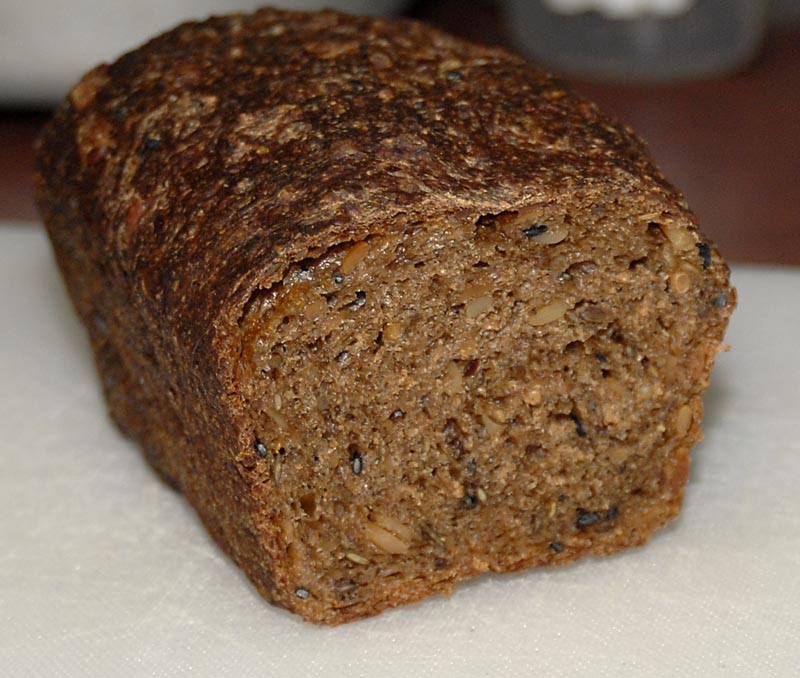
We eat a lot of sandwiches so I needed a larger amount of bread.  I added to the starter and the soaker 265g of milk, 355g of flour, 2 tablespoons of butter, and 2 tablespoons of honey.  This made a total of slightly over 1000g total dough.  I kneaded it all together and let it sit for about 45 minutes, at which point I realized I forgot the salt and kneaded in about 2 1/4 teaspoons.  Then I stretched and folded once an hour for...3 hours or so?  The dough was pretty wet and sticky.

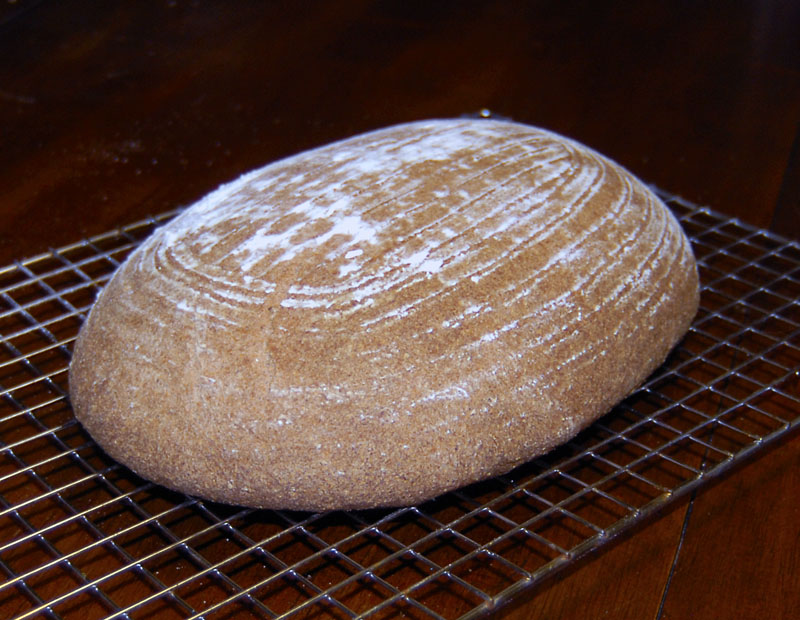
I proofed for an hour before putting it in the oven in a makeshift brotform: a wicker basket lined with a floured tea towel.  I put it on my stone in a slightly warm (but not fully preheated) oven for 45-50 minutes.  400 for the first 30, then down to 375 for about 10 minutes.  I left it in the oven after turning it off for about 10 minutes as well.

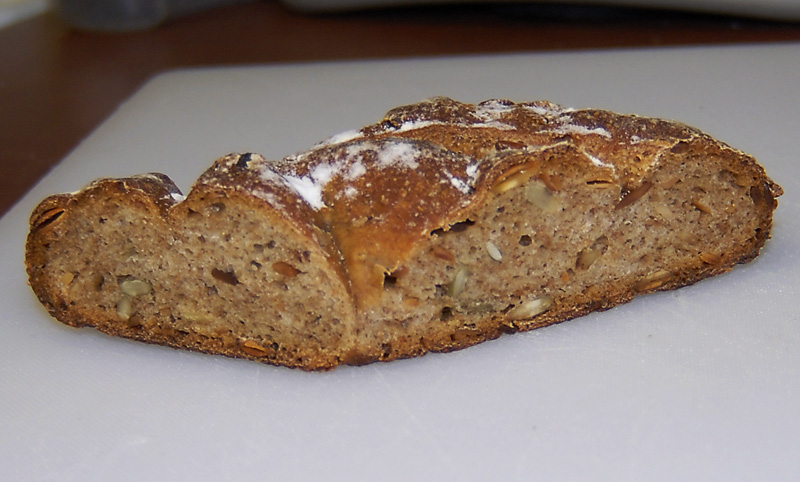
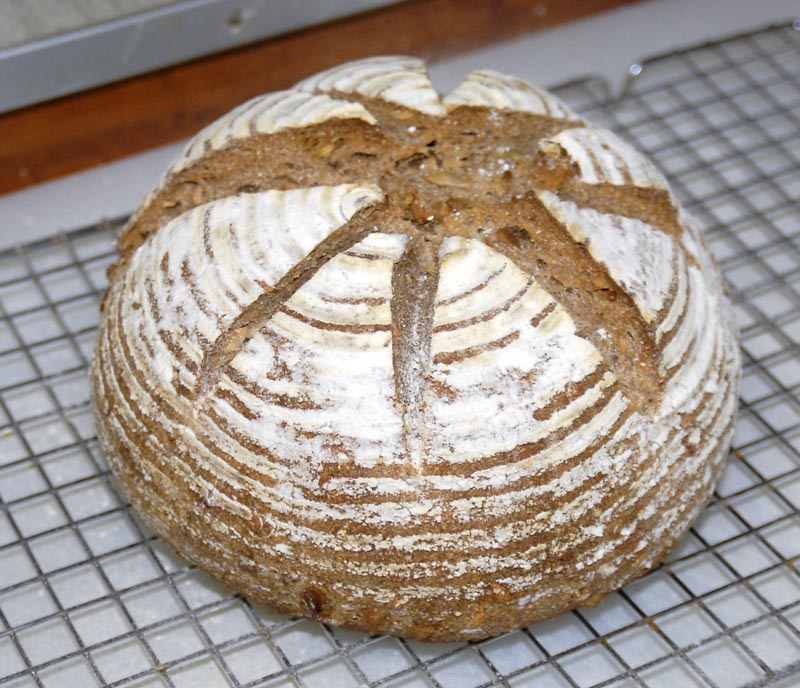
I pulled this out.

7 Grain Sourdough

7 Grain Sourdough Crumb

I'm very happy with how things went.  I'm really getting some good results with my sourdough.

Thanks again, gaaarp!

Submitted by Rosalie on November 19, 2008 - 5:20pm

Whole-Grain Bread for Children for Thanksgiving?


I've been invited to my niece's for Thanksgiving. I'll be travelling next Tuesday by Amtrak bus/train, 200 miles. I reminded her that I love to bake and what can I bring, and she cavalierly said nothing, we'd bake what we needed on Wednesday.

Well!!

So I decided not to bother with pies (which I have never made anyway) or cookies, but to stick with bread. Trouble is that I like 100% whole grain (fresh-ground), and she has two boys (about six and seven, I think) and a white-bread husband. So I'm looking for compromises.

I thought of white whole wheat, but I don't have any, my local natural foods store doesn't carry it, and I won't have the opportunity to go into town to get it there (if I could even find it there). What do you think I can make that they might like (going with the odds, that is)?

Marion Cunningham's Fannie Farmer Baking Book has a Brown-and-White Braided Bread that looks interesting. Each loaf has two brown braids and one white. The brown braids are colored with ww flour, molasses, and Postum (2t per loaf). I don't want to use Postum or coffee. I'd rather use cocoa.

She has another loaf, Raisin Nut, that is a flour blend and made like raisin bread but without the cinnamon.

Any suggestions would be appreciated. I plan to do the baking this weekend.

Rosalie

Submitted by MommaT on August 25, 2008 - 7:06pm

Feedback regarding PR's whole grain struan

Hi,

I commented in the recent thread that I'm experimenting with the Whole grain Struan recipe in PR's Whole Grain breads book.  

I have now made the recipe twice:

  1. using a soaker that I cooked "to order" for the bread:  Bob's Red Mill 5-grain cereal and barley, plus some uncooked rolled oats.  Used buttermilk in the soaker
  2. using the same soaker he details in the next recipe for the transitional struan, but with pre-cooked white basmati rice instead of brown rice.  Also used buttermilk.

In both cases, I'm using a wild yeast starter, from the same book.  The starter seems lively enough and the dough is rising in the times suggested in the book.

In both cases, the loaf baked for the same amount of time (20 min, turn, 25 min more).  I keep a pan in the bottom of the oven and pour 1/2 cup or so of boiling water just after loading the loaf on the stone.  I'm baking on parchment.

In experiment #1, the dough was SO loose I ended up adding a bit more flour, but really working with a very wet dough through the process.  It made a nice windowpane after ~7 minutes of kneading.  I had to use the french fold method, because it was impossible to knead in the standard way.  The result was an awesome tasting bread with a few nice holes in the crumb, moist but very flat (I shaped a batard and baked on a pre-heated stone).  I believe the barley was a very nice taste addition.

Experiment #2 was looking much better - the soaker had the consistency of the picture in the book.  The dough, without any extra flour was firm and kneaded well in a similar amount of time.  I was slightly worried about it being too dry - what a change!   The loaf was pretty high (for a batard) in the couche but immediately upon hitting the stone, it spread out and became even flatter than the original loaf.  Sigh.  The crumb was closer/denser and the bread (though good) was not as nice tasting as the one made with the loose dough.  It seemed a little dry, even 4-5 hours after taking it from the oven.  

I have baked very successfully from Dan Leader's "Bread ALone" for quite some time and have never encountered this problem, despite having much less yeast in the recipe (I'm always surprised by the 2.5 teasp. added in the final dough of PR's whole grains - in addition to the starter).  The boules are generally firm and rise well. 

While I know that we'll have some awesome toast in the morning (especially coupled with my freshly made Saturn peach jam)....

BUT I really love the whole grains and taste of the breads from this book so would like to learn what parameters may be causing this incredible spread, even when the dough itself seems to be firmer.  

 Any ideas?   

 Thanks in advance for your thoughts....


MommaT 


Submitted by Lilandra on August 11, 2008 - 6:16pm

whole grain book recommendation?


I think I need a whole grain book.

I have no clue what to get. The books I currently have are Reinhart's BBA and Beranbaum's Bread Bible.

I was wondering about King Arthur Flour Whole Grains Book or even Reinhart's. Or any other suggestions other people have?

And yes, I did busy myself searching but oh...I'm sooo confused. I don't know if I can afford both but who knows.

I haven't even really started using Beranbaum's Bible yet so...I'm a veritable newbie.

 maybe i should get this (laurel's kitchen)

Submitted by tamraclove on May 21, 2008 - 1:28am

Newbie Artisan Bread Maker


Hello!

I've just joined this group and have spent the past several hours reading through the forums - what an amazing bunch!  I'm excited that I've found you all, and I know you'll be able to help me get started.

First, a bit of history, then my questions:

I've been baking bread at home for the past several years.  Mostly "Betty Crocker" recipes, which have served me pretty well.  The bread is tasty, and my husband doesn't seem to think that I should change a thing.  However, in my quest to become a better baker, I've recently branched into sourdough - using a yeast-based starter.  After more research, I've started a wild-yeast starter - hoping to switch to that one fully once it's ready.

My goal is to produce 100% whole grain sourdough breads with few added ingredients.  From browsing the forums, I've gathered that this type of bread is more "dinner" style bread, and that sandwich bread needs ingredients like white flour and dairy to be light enough to stuff with sandwich goodies.  I'm ok with that.  I'll try that type too.

I've also just been reading up on stretch and fold (which is a bread-new concept to me!) 

So... here are my questions:

I need a good recipe to start with.   A basic, simple, preferably whole grain sourdough recipe that I can learn on.  I have read that WW breads are a bit tricky for beginners because of the sharp grains (is this right?) but I'd rather jump right in with a few flops.  It can't be worse than the sunken-topped bread with pores so open that honey leaks through that I've been feeding my poor husband for months now! (In my own defence, it does taste good and its moist... :-p)

After I get a handle on a basic loaf, I think I'll feel more confident in trying other, already posted recipes.  When my hands know how to stretch and fold, how tight WW bread needs to be formed - stuff like that.

Oh... I don't have scales.  I know, I know... I've just read the heated debate about them.  I'm now instantly aligned with half the members of this group, and the other half will tell me that scales should be my first purchase.  I can't make that purchase right now, so volume measurments would be appreciated. 

Am I totally off base here?  Am I asking the impossible?  Do I need to start with plain white bread with eggs, milk and honey to get a good idea of what bread should be??  I hope not...

Thanks in advance for any help you can give.  I look forward to your responses!! 

Submitted by kmp on April 25, 2008 - 10:30am

Peter Reinhart's Whole Grain Question

Hi all,

 I've been baking from Peter Reinhart's Whole Grain cookbook for about a month now. I'm not an experienced bread baker, but I've slowly been increasing the hydration of my dough, learning to shape slack doughs, and improving the crumb of my hearth breads. 

I'm having a bizarre issue with my pre-doughs (the soaker and the biga in Reinhart's terminology); both the soaker and the biga tend to develop a greyinsh-brown film on top. If I leave the soaker out at room temp, this film becomes pronounced and very hard (I lose a good portion of the dough by trying to pick it off).  It's diminished by storage in the fridge, but still noticeable as a darker coloring, only on the top of the dough that is exposed to air.  This seems to happen whether I use water, buttermilk, whey or milk as the liquid in the recipe, and it happens both with yeast (biga) and without (soaker).  It seems to get worse with time (if I leave the pre-doughs in the fridge for 2 or 3 days it is more pronounced than after 24 hr).

Does anyone have experience with this?  It doesn't seem to always happen; I've been using the same batch of flour (25 lb batch of organic, freshly-milled hard red wheat flour from a local farm); I haven't gotten around to buying a different source of flour from the store and checking it out.

Anyone know what this is, or have ideas as to how to prevent it? 

Thanks much,

Kaela

Submitted by JMonkey on April 19, 2008 - 4:58pm

Recent bakes -- I'm back!

I've been absent from TFL recently, as work and home have eaten up just about every waking minute, and there have been far too many waking minutes in the past couple of months. I could have stood for a tad more sleeping minutes.

Nevertheless, a family has to eat, so I've still been baking. One thing I learned: Don't double the amount of salt in a bread recipe. I did this by accident, doing the math for 2% in my head and adding 20 grams instead of 10 grams. Not even the birds would eat this stuff. Yuck.

I have had some nice loaves come out of the oven, however. Last week, I made the same doubling error as before, but with the starter. I used a 40% innoculation instead of 20% for this largely white flour sourdough (I added 10% whole wheat). All in all, the loaf was fine, though it wasn't as flavorful as I'd have liked. Rose quickly though, and looked beautiful.


I also revived my rye starter to make a 40-30-30 rye to whole wheat to white flour loaf. I didn't add caraway, and missed it, actually.

Starter is amazingly resiliant stuff. I'd not fed it for months (probably three at least ... maybe even four), and it had acquired a nasty black crust that could have been mold, could have been hoochy gunk (the rye is kept at 100% hydration, but it's still pretty pasty rather than liquid). In any case, it started right back up and made a wonderfully sour rye loaf. The shaped dough stuck a little bit to the baker's linen, so I had to slash it strangely to incorporate the rip and avoid a blown out side. Turned out OK, though, in the end.


And, of course, I regularly make my standby overnight whole grain sourdough hearth loaf (60% whole wheat, 30% whole spelt, 10% whole rye. The secret to getting a good "grigne" I think is not to proof it too long. Two to two-and-one-half hours seems to be just about right.


Mmmmmm. Grilled cheese sandwiches on whole grain sourdough hearth bread.

Submitted by bwraith on March 5, 2008 - 9:55am

Reconstituted Whole Grain Mash Bread


Reconstituted Whole Grain Mash Bread