Submitted by MNBäcker on December 4, 2011 - 12:34pm

No decent crust on French Bread


So,

I finished my WFO earlier this fall and am baking in it now. Breads are great and sell faster than I can bake them, but I encountered one particular issue:

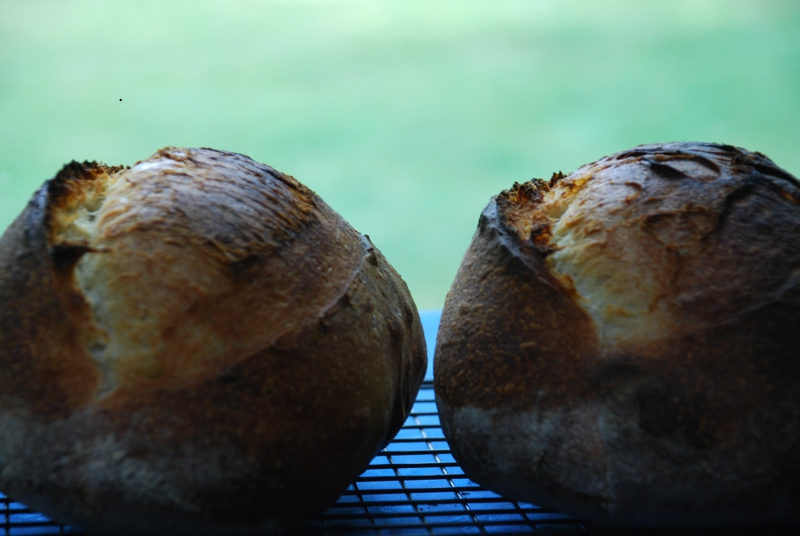
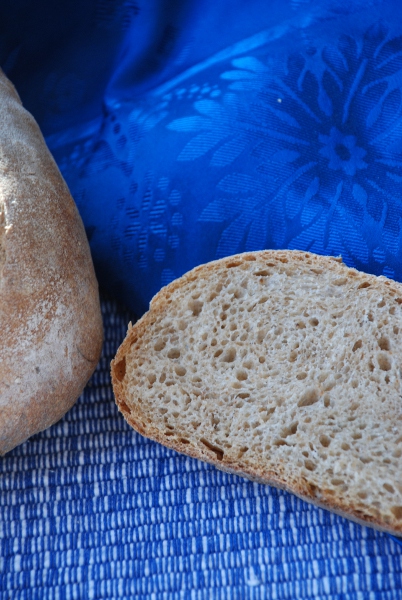
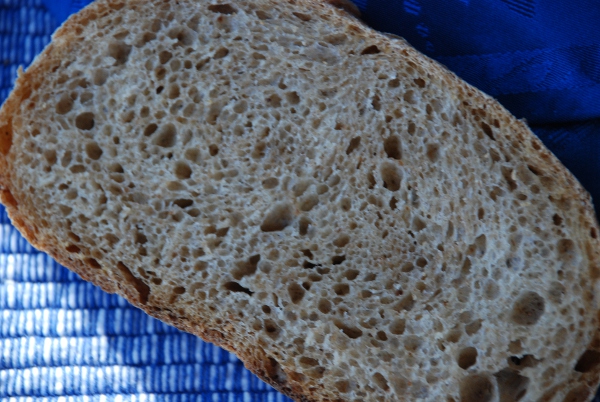
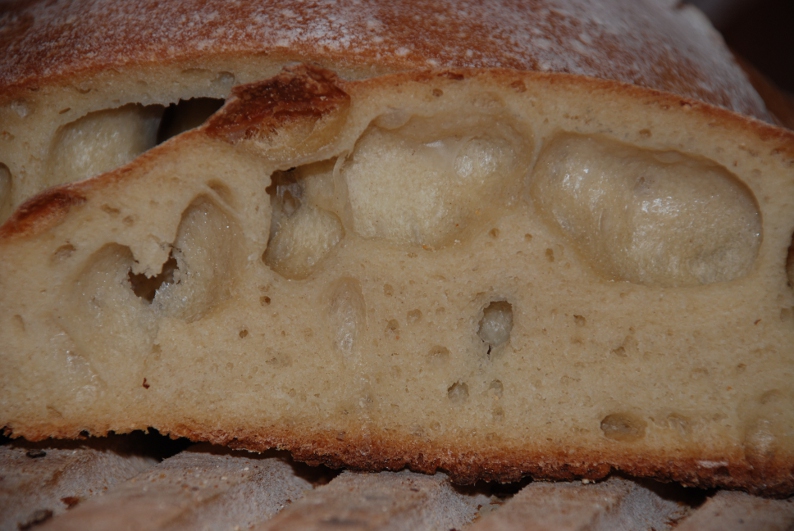
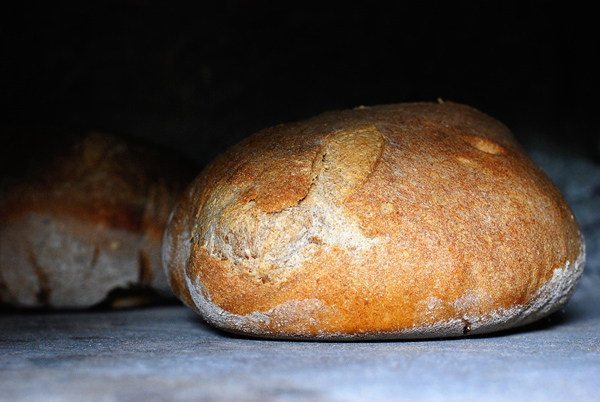
I seem to have a problem gettin that nice, crispy crust on my French Bread. I am told that with my Whole Wheat or even Whole Wheat mix, the crust usually gets softer after the loaves cool off, but I'm a little disappointed that even the French Bread (Reinharts recipe, made with Sam's Club high-gluten bread flour) gets soft after it cools off.

I bake at around 550 degrees, give the loaves a good 5-8 seconds of steam with a brass-nozzled sprayer, and the crust is awesome immediately after baking. Once the loaves cool off, the crust gets soft.

I'm used to the baguettes we made in Germany (where, admittedly, we could add steam very easily and "remove" it after a few minutes) - those loaves would come out crisp and then shrink while cooling off, causing the crust to "fenster". It would crack and splinter.

Is there anything I can do differently to get better crust?

Thanks in advance,

Stephan

Submitted by OldWoodenSpoon on October 28, 2011 - 10:45pm

Long Time Away

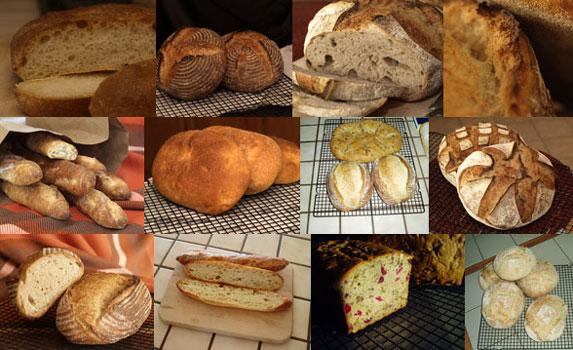
I have been quiet on TFL, mostly, for several months, posting a comment in a thread only rarely, and not taking/making/having time to post any of my baking.  Life has been good, but very busy, and so has work.  Good, and very, very busy.  What time I've had free I've not wanted to spend in this same chair, and at the same computer, where I make my living all day (and night too, sometimes), but I have still found some time to bake.  Not a lot of time, especially last spring and summer, but some.  I can proudly say, however, that no "store bread" has come into this house in two years.  :)  I'm not going to recap  it, or even describe it, but this collage of selections from the last  6 months or so fills in some of the gaps.

There was more, but the evidence all disappeared.

In addition to some baking, one of the things that has soaked up much of my free time has been the completion of my wood fired oven (Denzer style), which has reached a successful near-end milestone.  I have the oven completed, and everything left to do is for looks.  Well, looks and protection.  After the bad outcome from my 2010 effort, which you can see in my blog posts here I put it under wraps for the winter, and took up the project again this summer after things dried out.  I finally was able to get it successfully completed, except for the final finishing strokes, earlier this October.  Here is another collage that tells an abbreviated version of that saga too.

 I've been able to bake in it three or four times so far, and the first fire and first bake are both at the bottom right of the collage.  Based on my limited experience at it so far I know it is going to be a challenge to get to where I can reliabely and predictably produce quality bakes from it.  Heat management and timing are everything, as those with much more experience than I will confirm.  I am hoping that it will not get so wet around the oven this winter that I cannot get to it to bake.  I really hate to think of having to leave it wrapped again all winter when it is so nearly completed, and fully capable of sustained baking.  

I am really looking forward to a little more personal time this fall and winter, and hope to be able to post some of the lessons I expect to learn about managing a Denzer-style oven.  There is much more information available on this topic for an Alan Scott oven, but even then there is not an overabundance.  I'll at least be able to share my mistakes in hope of saving others from making them!

It feels good to be coming back, and I look forward to sharing with you all.  Until then, thanks for stopping by.
OldWoodenSpoon

Submitted by varda on August 20, 2011 - 1:38pm

Yeast water bread - Wood Fired Oven


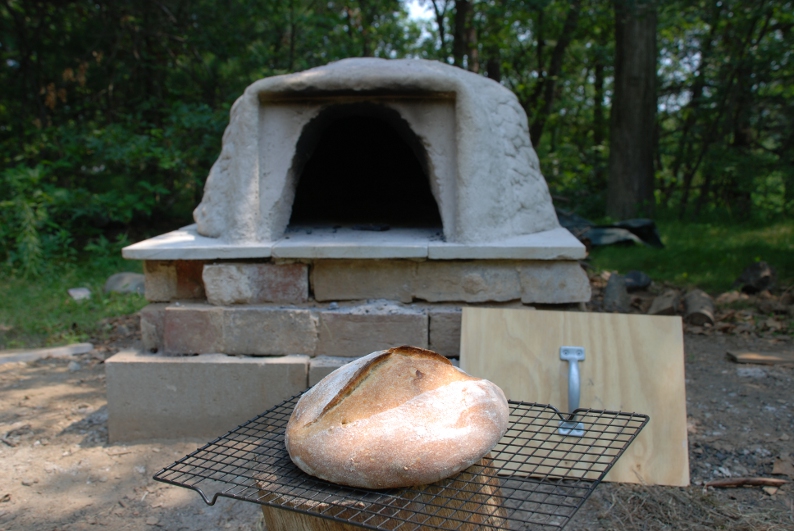
Over the last few months I've been trying to bake bread with yeast water and found it challenging to say the least.   However the taste of these breads is so wonderful and the prospect of lovely open crumb so enticing that I keep coming back to it.   I have made a number of adaptations to keep the yeast water from consuming the dough before baking (from aggressive enzyme activity) that seem to be working.   At the same time, I've been trying to learn how to use my WFO.    For the first many bakes, I was plagued by pale doughy crust.   At first I attributed it to the tight seal on the oven door which wasn't allowing the crust to develop.    But tipping open the door for the last half of the bake didn't help.   Then I got an infrared thermometer, and finally realized that I wasn't getting high enough temperature in the oven to start with.    So the bread was baking at a low temp that wasn't high enough to finish the crust.   I insulated the top of the dome which had the highest heat loss, sharpened my fire building skills and went back to work.   Yesterday I was  successful beyond my wildest dreams.  Ok.   Not really.   I incinerated two loaves of whole wheat Pain au Levain that never did me any harm.   Too hot.   Way too hot.   It's one thing to have a good thermometer.   It's another thing to know how to use it.   Today, I made a number of adjustments and got only a too hot oven - rather than a way too hot oven.   And baked a yeast water loaf.   Since the oven was too hot (floor at around 650F) it expanded too fast for its own good and baked too rapidly.   But I did start to see a hint of the crumb I've been looking for.    Onward and upward. 

Yeast water loaf with oven in the background. 

Not like Akiko's yet, but I'm getting there (I hope.)

I prefer charred crust to the pale doughy stuff I've been getting but I'm still not the master of oven temp.

Updated with formula and method:

8/19/2011        
         
Yeast water 93 62%    
KABF 150      
         
8/20/2011        
  Final Starter Total Percents
KAAP 500   500  
KABF   150 150  
Yeast water   93 93  
Water 362   362 70%
Salt 12   12 1.8%
Starter 243     23%
percent yeast water       20%
      1117  

Night before mix yeast water and flour and leave on counter overnight (around 10 hours).   Next day mix all ingredients but salt and autolyze for 1 hour.   Add salt and mix for 4 minutes in stand mixer at medium speed.  Bulk fement for 2.5 hours with first stretch and fold in the bowl and second on the counter.   Shape into boule and place upside down in lined basket.   Proof around two hours until soft.   Slash and bake in WFO for 20 minutes at high heat (over 650F)  - crack door open after first 10 minutes.  Leave another 5 minutes in oven with door open to bring internal temperature up to 210F. 

A few points:  I used King Arthur Bread Flour in the starter to have enough gluten strength to counteract the high enzyme activity of the yeast water.  I also used a fairly low hydration starter (62%) for the same reason.   The dough was quite wet after the mix and required an aggressive in the bowl stretch and fold to develop.   That worked.   For the second stretch and fold I was able to stretch it out on the counter.   When I removed it from the basket it sort of flopped out in all directions.   However when it went into the oven it sprang up immediately - probably due to the high heat.  I did not use steam in the oven and perhaps if I had the cuts would have opened up better.  

Submitted by varda on July 20, 2011 - 1:03pm

First bread in rebuilt WFO


Last year, I built a WFO platform and hearth,  and a dome out of sandy dirt that I dug up from a pile in my yard.   I had hoped (and convinced myself) that there was enough clay in the dirt to make the dome hold together.   That was not the case.   The dome slowly crumbled over the course of the summer.   I patched it up and patched it up again and finally wrote it off in the fall.    Amazingly the platform survived intact through a very difficult winter.   This summer I decided to build a new dome using real instead of imagined clay.    So I bought fire clay from a potter's supply and with help from my husband mixed up 600 pounds or so of clay, sand and water and built a new dome.   Then my husband, who finally took pity on me taking on a project like this with no building skills whatsoever, decided to make me a good door.   He built an offset with the leftover clay/sand mix which perfectly fit a door made of thick plywood.   This morning after waiting forever for the oven to dry, it was time.   I fired it up (and up and up and up) and finally loaded it with a loaf of bread.   After 30 minutes, I checked it, and the loaf was pale, so I closed the door and let it bake for 15 more minutes.    

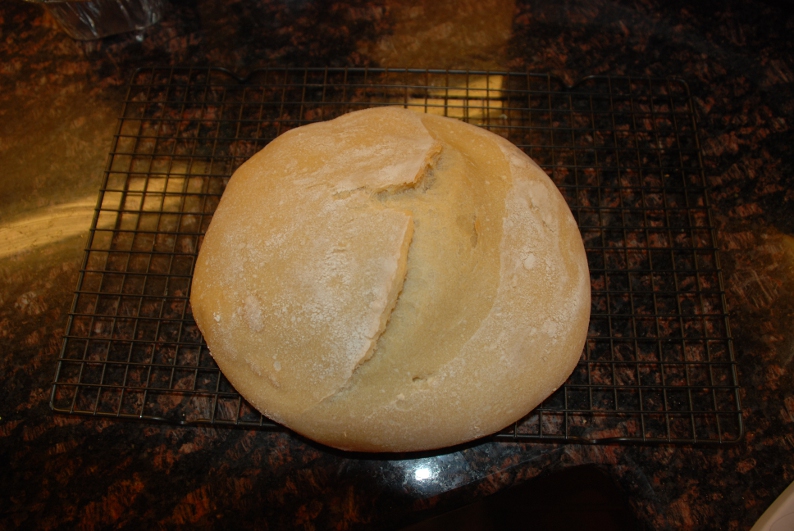
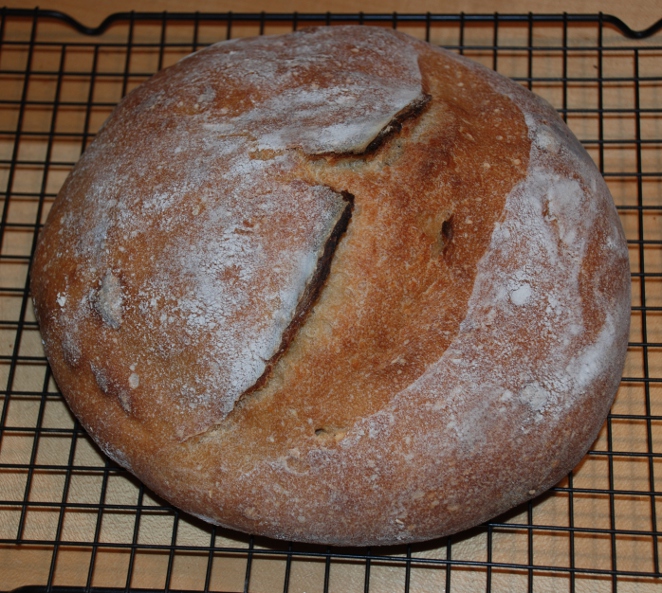
The loaf was still pale, but I checked the interior temperature and it was 210degF.    Then I paced around in the yard pulling weeds and thinking this over, and finally figured out that the door was so carefully fit that no steam was escaping from the oven at all (I didn't add steam but there is plenty of moisture in the dough) and the crust simply hadn't baked even though the bread had.   By that time I had opened the door so much that the heat was way down, so I took the loaf inside and baked it for 15 minutes at 450 to brown it up.    I certainly didn't have this problem last year, when the door was just a piece of plywood leaned up against the opening with plenty of room for steam (and heat) to leak out.   Fixing this isn't as easy as you would think - the door is fit so tightly (and the bottom beveled so that it's flush with the hearth) that you can't just move it over a bit.   Undoubtedly a precision venting system is now on the drawing board.

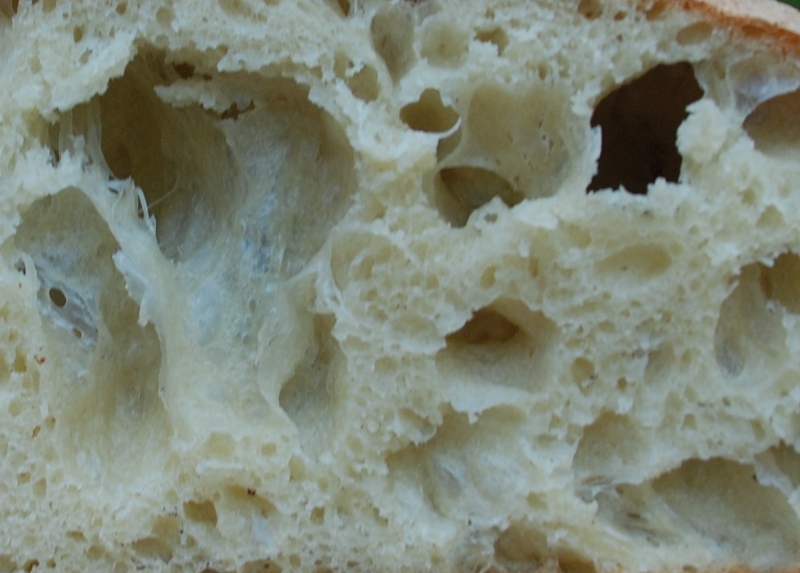
But anyhow, the bread.   I decided to go back to yeast water, since I didn't think I had much chance for success today, given that i was just getting to know the oven.   I continued reducing both the hydration of the yeast water based starter and decreasing yeast water as a percentage of total water.   I also interpreted an earlier post by Andy (on enzyme issues in high ash content flour bread) pointed out to me by Juergen Krauss and added salt with the first mix instead of autolyzing.  All this seemed to get the enzyme problems I've been having with yeast water doughs under control.   But perhaps not completely so, as you can see below.   But (as seems to be a feature of yeast water) this is a delicious bread and more successful than I expected under the circumstances. 

Submitted by sortachef on May 16, 2011 - 4:58pm

Baking Bread in a Woodfired Oven: the Basics


I baked some lovely loaves in my oven the other day, and as I slid that smoky, crusty bread out and onto cooling racks, I couldn't help thinking of those old European bakers, who've been baking with fire for hundreds of years. The limited size of my oven, however, has led me to adopt some measures that may or may not be part of that tradition. They work for me, and they might work for you too.  

To make it simple, I’ll break it down.

Overview: To bake 4 loaves in a 40” diameter woodfired oven, you'll need about 7 pounds of dough. The free-standing loaves will bake in a semi-circle around a hot but barely flaming mound of coals pushed to the back. Key to success in this kind of baking is to have the floor evenly heated before the loaves go in. I have a loose-fitting metal door for my oven, which acts as a damper and which I close when the loaves are baking.

The Dough: Unless you have a complicated steam-injection system as some French bakers have for their brick ovens, you won’t be able to get enough steam into your oven to make much of a difference in the bloom. Either the masonry will absorb the humidity almost at once, or you will be splashing on water, which can crack the hot base. Instead, in order to get a big round loaf, a good crust and a soft, well-textured crumb, you need to create a dough that is wetter than we Americans think is normal.

I’ve been working with wet doughs in the 65-70% range for longer than I’ve had a WFO, ever since I saw a Roman baker literally throw the dough out of a bucket and onto a long wooden peel at Forno in the Campo dei Fiori. While I don’t recommend a dough quite that wet (it had to be 80-85%), I do recommend bumping up the hydration a bit for woodfired baking.

Joe Ortiz in his book The Village Baker has some excellent tips (page 55) on how to do this. Making a sponge, letting the dough sit overnight, and using less yeast are all good advice. I would add to this letting the dough hydrate for an hour before kneading and having a good dough scraper handy for bench work. For one recipe that follows this technique, see Lago di Como Bread.

Slow Rising: Once you’ve made a wet dough, you need to let it rise for an ample time. I’m being deliberately vague, because temperature and time become fluid at this stage. With less yeast or a starter, at 50° the first doubling can take 5 hours or more. I let this part happen in its good time, and then slowly warm the dough for the next phase, because once the dough is active, it’s very important to have the oven heated to the right temperature at the right time.

Gradually raise the dough temperature to 70° in the second rise, giving the dough a fold after an hour or so. Now is the time to get your oven hot. In another hour, once the dough is showing springiness and a few big bubbles, you can make the loaves.

The Loaves:  Bannetons are lovely to work with but are expensive. Instead, I use plastic bread baskets lined with cloth napkins or dish cloths, with a coating of coarse flour rubbed into the fabric. These work beautifully as proofing baskets for my finished loaves.

Once the dough has nearly doubled in size again, turn it out onto a floured surface. Deflate about half of the gas out of it and cut it into 4 pieces. The perfect weight for me based on oven size is 27 ounces per loaf, which allows some leftover dough for another day. Form your loaves and put them into the cloth-lined baskets to rise. At 70° this will take 45 minutes.

When ready to bake, turn the loaves out onto floured peels.  Shape lightly, tucking edges under without deflating the dough and slash a design with a lame if desired. 

The Fire:  There are so many variables inherent in making a fire in a woodfired oven that I’m loath to give specific directions. Atmospheric conditions, the length of time since your oven was last fired, the type of wood you’re using and how it was cured all play a role. If your oven is outdoors, as most are, you’ll want to baby it when the weather is cold. See Moderating Heat in a Woodfired Oven for more on this.

Generally speaking, though, your fire should be at least 2 hours old with a good base of coals by the time you put in the bread. In the last hour, push the fire around from side to side to make sure the base of the oven gets heated evenly, adding small branches and an occasional wrist-thick log as necessary to keep a good fire going. During this time, using a set of bellows to fan the flames is optimal.

The Oven: As the fire pulses and flames, you should be paying attention to the oven walls, floor and door. I check the heat of the door handle, the amount of flame, the amount of whitening ash on the ceiling and walls and the floor temperature about every 10 minutes after the fire is going full force.

In the first hour, if the fire is raging and throwing flame on the oven ceiling, I slow it down by closing the door all but 2” to stop it ‘overfiring’. Otherwise, I leave the door off as the fire matures, and put it in place cocked about 4” open toward the end of the first hour. By then, the door handle should be warm to the touch but not hot, there should be a small amount of whitening on the ceiling, and near the doorway the floor of the oven should be warm to the touch.

In the second hour, move the fire side to side so that the floor heats evenly. Toward the end, the door handle should be quite hot, the ceiling of the oven should be half white and the floor of the oven near the doorway should be too hot to touch for more than a second. Now you’re ready to bake.

Push the mature coals to the back center of the oven, near the wall, and brush the ashes off of the floor.  There should be 6 to 8 fist-sized chunks of glowing hardwood coal and a good bed of embers, but little or no flame when the loaves go in.

The Baking Procedure: Make sure each finished loaf can ‘slip’ on its peel. Slip each loaf into the oven to have a long side parallel to and 10” from the coals. Close the door. Use this rough timeline for baking:

  • After 20 minutes, turn loaves so the other side faces the fire.
  • After 20 minutes, turn loaves so one end faces the fire.
  • After 10 minutes, turn loaves so the other end faces the fire.
  • After 15 minutes, remove loaves to a rack to cool.


Trouble-shooting: Besides the obvious problem of getting the oven and the dough ready at the same time, I’ve encountered two main difficulties in baking perfect loaves in my woodfired oven: a stubborn fire and a cold floor. Often they coincide.

When the atmosphere is damp and heavy, the fire is stubborn as a result. I counter this by keeping some ultra-dry wood on hand inside my house, adding it to give my fire the extra boost it needs. Even then, under certain conditions, it can be a real challenge to maintain a good fire.  

The other is when the oven hasn’t been used in a while and the floor is slow to heat. In dry conditions, you can usually overcome this with a bit of extra time. However, if this happens when you’re dealing with a slow fire as well, the floor may not get hot enough to put a firm base on your bread. Be very careful when turning your loaves in this condition. To counter, warm some quarry tiles or a pizza stone to 450° in your indoor oven to finish off the loaves for 10 minutes after WFO baking. It may not be the ‘purist’ thing to do, but it works!

Suggested reading:

The Village Baker by Joe Ortiz, Copyright 1993 by Ten Speed Press, Berkeley

The Italian Baker by Carol Field, Copyright 1985 by Harper Collins

Also see www.woodfiredkitchen.com for more tips, techniques and recipes. Flame On!

Submitted by MNBäcker on January 31, 2011 - 6:35pm

Hello from Minnesota


Hi, all.

I'm very excited about just having joined this forum. I was born and raised in Germany and learned the craft of a Baker as a teenager there. After 4 years of school and apprenticeship, I am proud to call myself a "Journeyman". Married a gal from Iowa and moved to Rochester, MN in 1995. Worked for a year at a local bakery until I realized that the night hours of a baker simply don't agree with a newly wedded wife who is a nurse. Different job for me then. After quite a few years later, we built a house in Zumbrota, just 30 minutes North of Rochester. After moving in, we found out we (and by "we", I mean my wife) found out we'd have a baby. After the first year, I decided to quit my job and stay home full time with the little guy. That allowed me to delve into Baking a little more again. I had been using my Zojirushi for our everyday bread, but then we decided I should get more serious: I'll be taking an Oven Building Class at the North House Folk School in Grand Marais, MN in May. See http://www.northhouse.org/courses/courses/course.cfm/cid/328 for details. I'm planning to build next Spring and then hopefully be able to bake and sell at local Farmers Markets - mostly for fun and bragging rights; I realize this isn't going to be a full-time job (and I don't want it to be).

Looking forward to learn from and share with all of you!


Stephan

Submitted by dantortorici on October 3, 2010 - 1:00pm

Baking bread in a WFO with a fire still going

I have a Mugnaini WFO and find that after all the heating, when I pull out the coals, mop it down, I can usually only get about 2 bakes in before the temp gets to low (~400 or so).

Of course, I'd like to bake more so I am wondering about baking while there is a fire going on one side of the oven. I did find an interesting post in this forum that talked about putting a large angle iron in the oven as a stop with the fire going on one side of it, and there was a suggestion to prop it up with washers so a draft would go to the bottom of the fire. This all sounds good but I am wondering if anyone has tried baking bread with a fire still going and what I should watch out for.

Any sage advice out there?

thx

Dan


Submitted by varda on July 16, 2010 - 4:27pm

More baking in the WFO


I continue to bake in my mud oven - in fact I haven't baked any bread at all in my "indoor" oven so far this summer.   It is a steep learning curve.   Since I last posted, I have added a thermometer and a door (essential) a peel (helpful) and have started to use parchment paper to keep things cleaner.   I continue to make my slow progress through Hamelman's Bread.   Today I tried Semolina with a levain.  (page 171)   I split it into three small loaves which are a bit more manageable.    Here they are. 

and the crumb

When I finished baking, I put tonight's dinner (chicken and vegetables) in a dutch oven into the oven and let it cook with the "leftover" heat for several hours.   And served with bread of course.

Submitted by Sinon on May 17, 2010 - 9:17am

Help with a WFO foundation question

Rookie builder question.

I am starting to plan out the build of my WFO and have a construction question for the more knowledgeable builder members:

Off the back of the house we have a wooden deck, which steps down to a brick paver patio, which steps down to the grass and my wife's (foreman's) flower beds. The rear of the property has a gentle slope to it, so when we put in the patio, we built up to 'level' with an aggregate and crushed stone base. Unfortunately, the 'approved' (foreman's, not municipality's) position for the WFO would currently leave it cantilevered (say half on / half off) the patio with a 1.5 foot drop down below it. I see a number of alternatives and have not a clue as to which is the better (easier, sounder, aesthetically pleasing) approach:

Approach 1

Extend the patio under the WFO with crush, aggregate and pavers so that the area is homogeneous, and float the WFO's concrete pad on top of the pavers. (Is floating a pad on pavers sound / stable?)

Approach 2

Rip out the full footprint of the WFO from the existing patio, pour the pad and build up with concrete block. (Feels like a good way to screw up the patio and my wedded bliss in pursuit of a WFO.)

Approach 3

Pour a pad off the edge of the patio for the overhang, build up with concrete block to patio level and then pour a pad that floats on the patio pavers and concrete block build up.

Approach 4

The right approach which is not even a twinkle in my eye.

Thanks in advance,

Sinon

PS...I'll create a blog so that all can laugh along with my foibles as this build out goes along.

Submitted by ClimbHi on August 18, 2009 - 6:07am

One fire -- Many foods


One of the things I'm having fun with is learning how to use the oven to bake a variety of foods. With a WFO, this is not as easy as it may seem. There's no temperature knob on a WFO, so you can't just turn the heat up and down like in the typical kitchen range. Instead, you have to plan your baking to take advantage of the heat that you have available. This means getting the oven to a high temperature to start, and cook various things as appropriate as the temperature naturally falls.

One trick I've been working on is to cheat a bit and keep a small fire going even after the oven has reached it's baking temp. (Usually, you rake the fire and coals out of the oven once it's heated.) This does two things: It allows me to hold the temp a bit higher a bit longer, and it lets me add smoke to the mix. Here's last weekend's foray into the world of wood-fired cooking. It was hot, we had invited some neighbors over for dinner to celebrate his birthday, and thought we'd do the whole meal in the oven outside so we didn't heat up the kitchen with cooking.

First, there have been several questions about how much smoke a WFO produces. Unfortunately, I thought of this after my fire was already going pretty well, so I didn't get a shot of the smokey first 10 minutes, but here's a shot of the fire so you can see it's going hot & heavy, and a shot of the chimney top. Notice, no visible smoke.

Once the oven is hot enough that the soot burns off the bricks, it's time for bread. This dinner party was kind of a last minute thing, and I didn't have time the night before for the typical sourdough preferment routine, so I elected to build some Pain à l'ancienne per PR's BBA. That only takes a few minutes to put together on day one, then it's directly into the fridge until the next day, when it only takes minimal work to complete. We decided to make it into a focaccia this time, with a topping of EVO, basil, rosemary, garlic salt. The bread went in with an oven wall temp of around 550° for about 20 minutes. Here's the finished product:

Once the bread was out, the oven was still around 500° wall temps, so in went some fresh tomatoes and new red potatoes, cut up for later making into potato salad. I also tossed some oak chips/sticks onto the coals that I had kept in the oven to maks some smoke to flavor the veggies.

Wood-Roasted Potatoes:

Wood-Roasted Plum Tomatoes:

(These were added to some other veggies that we grilled later, but I didn't get pix of the final medly.)

Here's a shot of the WFO-roasted potato salad:

The oven wall temp had now fallen to about 450°, so in went the desert - another peach/blueberry cobbler. I didn't get pix of this one, but I posted pix of one last week. You can see the very edge of the pan in this photo. You can also see how I maintain the coals during this process. I have a steel angle that I slide into the oven to make a box to hold the coals. I add small pieces of wood on top of the hot coals to maintain them and to generate smoke when desired.

Once the cobbler was done, I left the door open for a bit until the oven wall temp fell to around 400°. Then I built the fire up just a bit and added a bit of additional wood, to get things really smoking. Then I loaded some dry-rubbed ribs, and sealed the door almost tight so the fire would continue to smoke without either heating the oven further or going completely out. Left them cook for about 4 hours in the falling oven. Fifteen minutes before dinner, I mopped them with some Jack Daniels BBQ sauce (I gotta learn how to make sauce that good!) and here's the final product -- fall off the bone, don't-care-how-messy-you-get-eatin'-'em good, ribs.

Everything was very tasty, and we never went near the kitchen stove.

I'm gonna wind up fat as a house. ;-(

ClimbHi
Pittsburgh, PA