SearchUser loginBread BooksFavorite Recipes
|
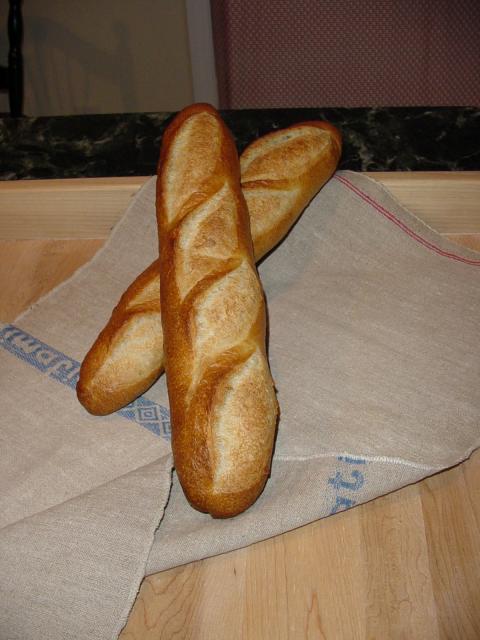
Submitted by arguros on February 4, 2012 - 3:06am Baguette dough, final bread textureHi, This is my first post in this forum. I have been following it silently for quite a while and I was impressed with the quality of bread other forum members post here. I also recently bough a Kenwood Major KM020 and I wanted to try it out with a baguette dough. While I have been living in Dublin for more than 10 years, I am originally from Italy, where there is a long artisan bread tradition, which means I am kind of found of good bread. I followed the Hamelmann baguette with poolish recipe , with a final round shape I must admit that I tried to do my best to get a good result 1) Poolish was 100% Flour, 100% Water, 0.2% Fresh yeast, 21 degree fermentation 2) Bulk fermentaion around 23-24 degree This is a video of the poolish after 12hrs
However the final bread texture did not come up well, as you can see from this picture.
Dou you have any idea of what went wrong? Many thanks arguros
Submitted by shanenian on July 7, 2011 - 4:52pm need help for sandwich bread textureHello, everyone
I try to bake sandwich bread but can't get the right texture. There are various sizes of holes in my bread and the structure of the sliced bread is quite loose, when I sliced the loaf, there are many little bread crumbs falling from the surface of the sliced bread. My recipe are 400g white strong flour, 240g water, half teaspoon of yeast, a little bit of salt and olive oil. I knead for about 15 to 20 minutes and the dough can pass windowpane test. First rise for 2 to 2 and a half hours and second rise for 1 hour.The bread texture I want is uniform little hole and the bread structure would be stronger than what I have now. Does any one have any idea how can I do it.
Looking forward to your replys.
Thank you!
Submitted by rm1211 on June 30, 2011 - 9:42am Rubbery bread textureHi, I have been experimetning with sourdough for a wee while now and I feel I'm doing quite well. I can now bake a bread that rises and has the crisp crust I'm looking for, it has a nice open crumb and good flavour. However, the texture leaves something to be desired. I'm not sure how to describe it - it's slightly rubbery or spongy. Not unpleasant, but not quite right. The loaf is airy enough. I've been experimenting with some factors and just wondered if anyone could point me in the right direction? Could I be over or under kneading the dough? Could I be over or under proofing it? One clue that may or may not help - I checked it in the oven after about 25 mins and it appeared larger than when I took it out (ten/fifteen mins later). This may have just been my imagination. The method I use (alternatives welcome) : First I take 4oz of 100% hydrated starter and add to it 2oz flour and 1 oz water. I mix and leavfe on the counter overnight. This gives me a bubbly mixture in the morning to which add 8oz flour, 4oz water, a hefty pinch of salt and a good glug of olive oil. I then mix and knead until smooth and elastic (by hand ten minutes - maybe fifteen). I place this in an oiled bowl and leave in the fridge overnight. I then remove from the fridge and gentle form (in this case into a boule). I don't have a proofing basket so I use a floured cloth in a colander (seems to work). I leave until the dough appears to have doubled in size (around 2 hours today). I then place onto a baking stone in a relatively hot oven (400 degrees), bit of ice in the bottom for steam and cook for around 40 minutes. As above - the crust is crisp and perfect, the crumb is airy with large holes but the actual 'flesh' is a bit chewy/rubbery/spongy/something. Any thoughts? I think it may be in the proofing stage but I am getting abit out of my depth. Thanks for any help you can offer. Submitted by sustainthebaker on December 20, 2010 - 1:34pm Crunchy Bits in my ChallahI recently made a loaf of Challah for my family. It was my first Challah and it came out with great flavor. It was a six-braided loaf which I did not let proof long enough, which lead to a bit more oven spring than you'd want from a Challah. The texture was light and fluffy, with a bit of creaminess to it. However, at the end of most bites there would be a gritty crunch to the bread. Any ideas? I have two thoughts: 1. I used honey, which had crsyallized. I did however, warm the honey back up to a liquid state before adding to the dough. 2. I also made Sourdough Rye and I had a bowl of flour set aside for dusting. And some rye flour may have mixed into the bread flour. Thus may have found it's way onto the the strands as I rolled them out. Any ideas on this texture?
Thank you. Submitted by Nickisafoodie on December 16, 2010 - 1:24pm Sourdough Rye with Seeds – cast iron bakeSourdough Rye with Seeds – cast iron bake First, thanks to Eric Hanner for this post providing inspiration to explore covered cast iron cooking recently: http://www.thefreshloaf.com/node/21006/my-combo-cooker-experiment. This is my second bake with cast iron and I like the results! Flavor and texture were awesome! I already owned a 5 qt Wagner Dutch oven with a glass lid that has been in the family as long as I can remember. The diameter is the same as the 3 qt. Lodge combi cooker - the higher capacity of the Wagner being due to taller height. So I had vessels that would allow two similar sized loaves to be baked at once- albeit with one having glass and one having cast iron cover. Both loaves came out identical
Sourdough Rye Recipe for two loaves (2,066gr or 2.3 lbs prior to baking) Overall Formula: 60% bread flour (697gr) 25% fresh ground whole wheat (293gr) 10% fresh ground whole rye (114gr) 5% Oat bran (I tend to add to all of my breads for health reasons - 58gr) 23 grams sea salt 20 gr molasses (approx 2 tbs) 10 gr malted wheat powder (approx 2 tbs) – sprouted, dried and ground into flour (malted barley would substitute) 40 gr mixed seeds: Flax, charnushka/black caraway, sesame, poppy seeds (approx 4 tbs) 72% hydration ratio: 834gr water including starter build up. Build Stages: 1. Stage 1 - build rye starter (100% hydration) to 228 grams (11% of recipe). This uses all of the rye flour. 2. Stage 2 – add 293gr of whole wheat, 58gr oat bran, 38 gr white bread flour, all of the seeds, 389gr water. This approximates 39% of the total formula. When combined with Stage 1 equates to 50% of the total recipe. Let proof 8 hours at 78° (oven off light on gets works well). 3. 6pm: incorporate remaining ingredients other than salt. 40 minute autolyse. 4. Add salt, mix 6 minutes on low speed. 5. Stretch and fold 3 times at 45 minute intervals. Keep at 78° between folds. 6. 10:00 pm: Preshape loaves, rest 25 minutes, shape into final loaf and place in floured banneton (actually: $1.50 colander from the dollar store lined with a microfiber dinner napkin and lightly dusted with flour- micro fiber wicks away moisture and releases fine with modest dusting) 7. Place in plastic bag, leave overnight in refrigerator. 8. Preheat oven 1 hour at 500° - include Dutch ovens and lids 9. Plop dough into hot vessels, spray with water, score, and cover. In they go. 10. Reduce heat to 450° after 5 minutes 11. Remove cover after 30 minutes 12. Baked another 5 or so minutes until internal temp is 195°. Shut oven until internal bread temp was 202°. Note: While the loaves came out nice, the crust is not rock hard as Eric was striving for and as was pointed out in his post/link above. While my crusts were not rock hard after a 30 minute cover, I am still happy with the outcome. Perhaps next time I will leave the temp higher and in the oven longer to see what impact that has on the crust. And not spray dough after putting into Dutch ovens? Or perhaps shut the oven sooner and leave until 210° or so internal? Any suggestions on that elusive crust would be appreciated!
Submitted by GregS on October 20, 2010 - 10:04pm How do I get a shiny bubbly outer crust?I'm reasonably happy with the interiors of my recent sourdough boules, but the exteriors are depressing. They are brown to dark brown, flat, dull and smooth. No golden glow, no little bubbles under the surface. Looking at the photos on TFL makes me afraid to even photograph mine! What variables contribute to an attractive crust on a white flour, French-type boule, batard or baguette? Thanks, as always GregS Submitted by GregS on September 24, 2010 - 6:02pm Stuck to the WallI'm a bit embarrassed to post this, but there are no fellow artisans within reasonable reach, so here goes. I'm trying to build up a 60% sourdough starter based on Maggie Glezer's book. It is supposed to be 10% old starter, 60% water and 100% flour. The rising is coming along ok, but the tackiness of the risen active starter exceeds the finest library paste! It sticks to the jar, my hands, the utensils, and anything else it contacts, with a deadly tenacity. I am using a quality electronic scale and measuring very carefully. Is a "proper" 60% starter supposed to be this gluey? Can I just increase the flour somewhat? How should I judge if I have a proper "firm" starter by eye or by touch. Another thing I find strange, is the process of dissolving the active starter in water to start a recipe or another refreshment. It is a very long and tedious process to chase those little gluey gobs around with a fork until they are completely dissolved. Am I missing a better way, or is just partially dissolving the starter OK? Thanks for any comments. I'm about ready to go back to 100% starters. Would I lose much if I did? Greg S Submitted by Ziege on February 19, 2010 - 7:57am Frightening textureFrightening texture. I am not talking about cottage cheese, nor tapioca pudding, but rather the 100% whole wheat sourdough bread that has been having a good old time disgusting me with its texture of late. I have used the tactics that I have found here on the Fresh Loaf site- stretch and folds at 30 min /1 hour intervals, autolyse, and the great slap and fold technique. Yet my sourdough bread remains stubbornly dense except for a sprinkly of yeast tunnels scattered throughout the bread, and each slice of the bread results in wheaty streaks on the knife. Argh. I know that I am capable of making bread that doesn't knock a hole through the wall when you hurl it in frustration:
the above bread is 100% whole wheat (with some seeds added), but contains yeast. Here would be my attempts at 100% whole wheat sourdough:
and worse yet:
and here's the knife after cutting into these fiber nuggets:
frustrating. typically my procedure mimicks that of a post I found on this site: an overnight levain consisting of 90 g flour, 7.5 g levain (100% hydration), and 73 g water and an overnight soaker of 375 g flour, 302 g water, and 9 g salt. "Flour" refers to whole wheat flour, or more specifically type 150 flour as I am in France and flour is sold by its "type" ranging from 45 to 150; 45 resembles baby powder and 150 contains the most bran. In the morning (~7h30) , I mix the soaker and the levain and perform stretch and folds every hour until 11h00, when i shape the bread and then let it rest about 3 hours. Into a 425 F/220 C oven for a few minutes it goes after the rest- and after a few minutes i lower the temperature to 375 F/190 C and let it bake for 45 min. I would be overjoyed if someone had some advice on what I can do to improve the texture of my sourdough. My hypotheses are that my dough is too hydrated (it can get pretty gloppy at times- in my head is the chant "wetter is better!" that I have picked up from multiple posts on this site. wetter may be better, but a swamp is well, a swamp), or that the flour's high bran content is slicing up the gluten, although I doubt that as my yeast bread comes out fine. I look forward to your responses, Claire- a longtime Fresh Loaf lurker who has finally decided to step into the light and create a post Submitted by DakotaRose on August 26, 2008 - 5:09pm Flours and their textures.I have been baking bread for years, but have only recently gotten more serious about it. I must admit that all the terms I read about on the form have gotten me totally baffled. I have no idea what many of them mean. Can anyone suggest a good book that would go in depth about terms and the science behind bread making without going over my head. One of the things I have been wondering lately is whether or not the different wheats on the market will make a huge difference in the bread produced. I prefer the hard white wheat, but the white wheat white flour seems to be so dense. I don't get the lift I always use to get from using Dakota Maid bread flour. I believe the bread flour was always hard red wheat. I want a more open bread like I use to get. I know I need to start using my scale for all my bread making so I can get a consistant bread, but right now I am wondering about the flour and if it makes for a great difference in texture. Thank in advance. Blessings, Submitted by HokeyPokey on September 18, 2007 - 11:59am I dream of fluffyHi all Have been reading all the latest posts, and I have GOT to try CB miche - looks absolutely amazing. Back to my post - I bought a loaf of white sourdough (shock! horror!, but its the first time in the last couple of months) - and the texture on the loaf is wonderful - small, consistent bubbles inside, light, thin crust and really soft and fluffy inside. All the loaves that i've been baking are really tasty, but tend to be a bit heavy and dense inside. How to I achieve that fluffy texture? Thank you HP |
Advertisement |