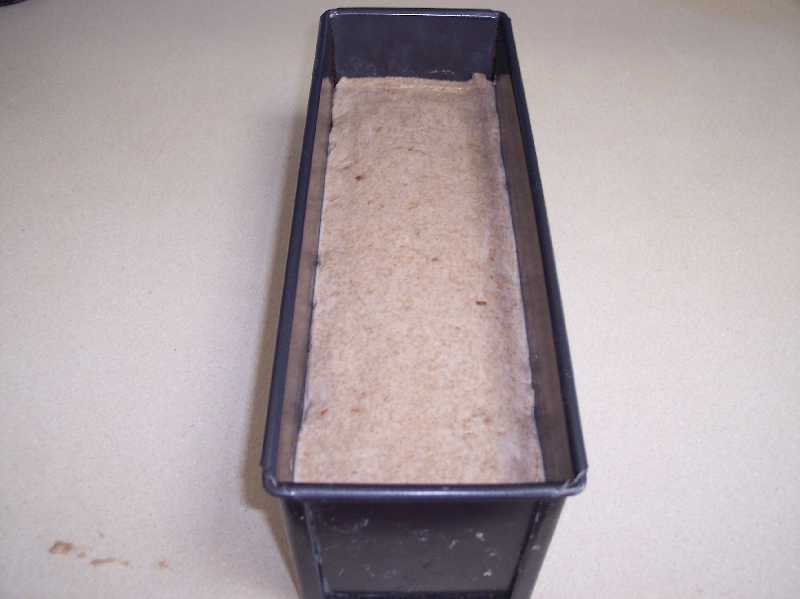
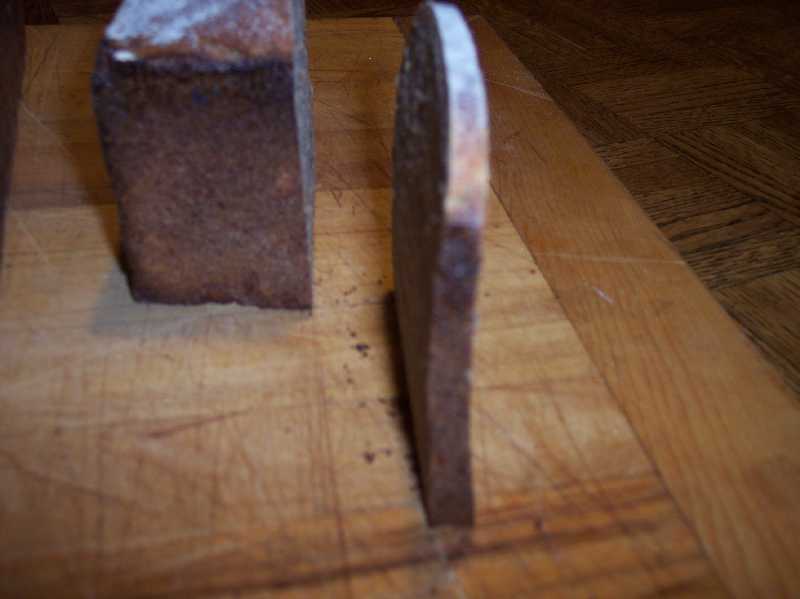
We were struggling with our normally robustmRye sour and Desem mixed SD starter. It had been left for dead after its last feeding and storage about a month ago. I had baked 4 loaves of bread from the 80 g stored and had 40 g left and it was looking the worse for wear.

We tried building a levain using 5 g and 1:10:10 but after 20 hours there was no visible change. The kitchen temperature was 65 F and we though the low temperature might be the problem. So, we added 5 more grams of starter, put it in a 78 F environment that the microwave provided with one of Sylvia's steaming cups.

Sure enough 6 hours later, the levain and finally nearly doubled. You for get how nice the AZ summers are for over proofing just about anything and everything. Now with winter temps of 65 F yeast just doesn’t like to be aroused and put to work.


We took the remaining 30 g of starter and fed it but kept it on the counter to double which it nearly did in 24 hours. We decided it and feed it again to get it back up to speed and saved the other half for some panettone bake possibly for Christmas but more likely for New Years.

We decided to use our revived starter to make a variation of one of our favorite breads; fig, pistachio, sunflower and pumpkin seed bread. But, we decided to try and bake it like you would pumpernickel - long, slow and low and see if the crust and crumb would turn a dark brown color like pumpernickel does baked this way.

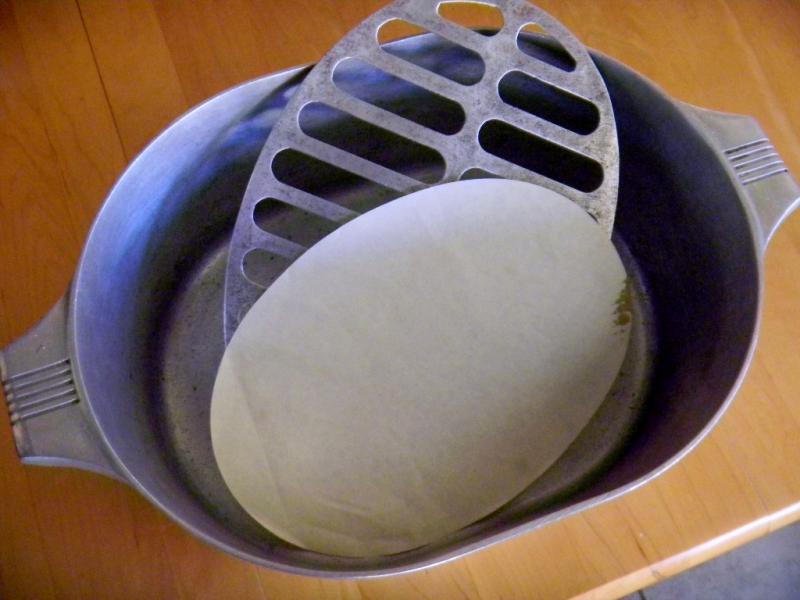
The question was which way to do this; the Norm Berg way, the Andy way, the Mini Oven way or the Jeffrey Hamelman way - or some combination which could be a dangerous meeting of the ryes. My apprentice wanted to use our Wagner Ware Magnalite Turkey roaster since nothing puts a dark brown crust on bread like it does – nothing even close.

The trivet on the bottom allows extra water to be placed in the roaster so that it doesn’t touch the bread itself. We hoped that the steam in the roaster with an oval shaped chacon would substitute for the aluminum foil covered tins normally used for pumpernickel.

It was worth a shot and, if it wasn’t turning out right, my apprentice could always save the day, as she has taught herself to do in out kitchen, by taking the lid off and bake the bread to 205 F on the inside at a higher temperature – none the worse for wear - if you are like my apprentice and will eat anything.

The levain was build with one build over and agonizing 26 hours. Everything except the levain, barley malt syrup, figs, pistachios, seeds and salt were autolysed for 2 hours. Once the levain, barley malt syrup and salt were added to the autolyse, we did 10 minutes of French slap and folds which were nice to do at 75% hydration.

The dough was rested 20 minutes in an oiled, plastic covered bowl when 3 sets of S& F’s were done on 20 minute intervals. The figs, pistachios and seeds were added in during the 2nd set of S& F’s. Half the seeds were held back for a ringed topping around the knotted roll.

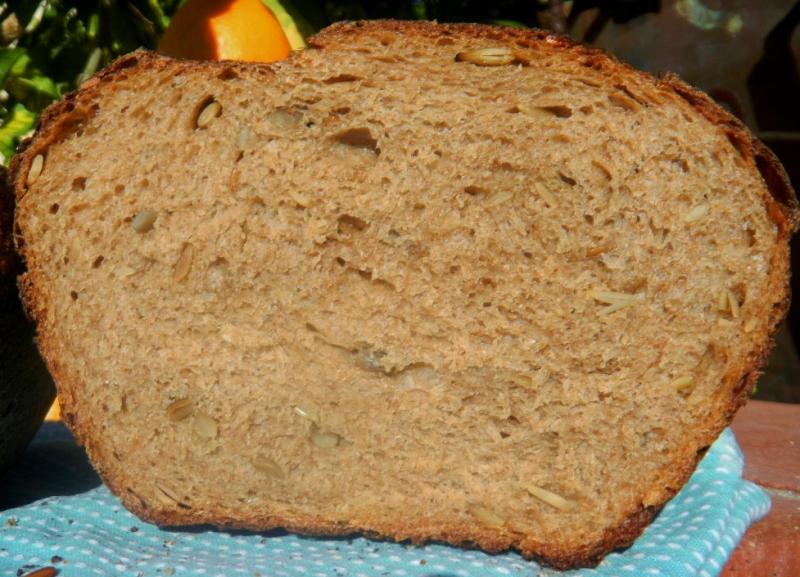
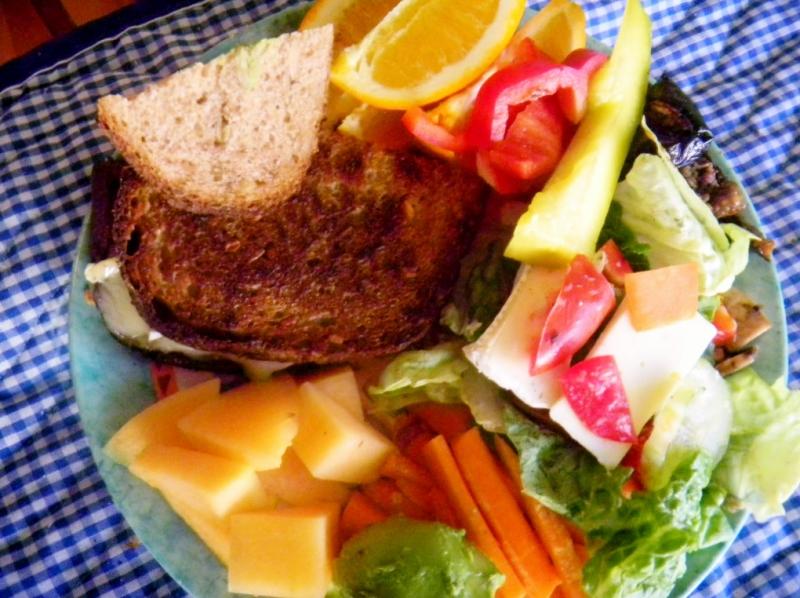
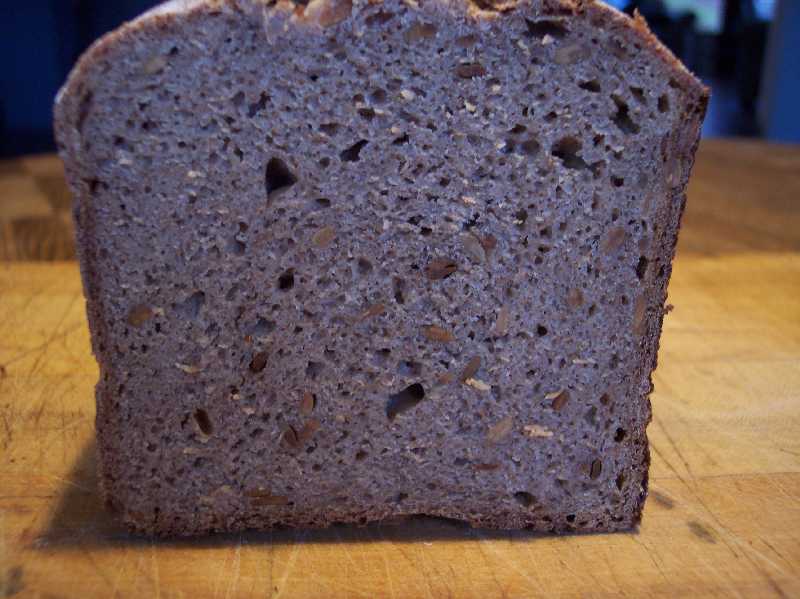
Inside at the crack of dawn you can see the holes in the crumb better. Haven't had lunch with it yet but the sunset was nice.

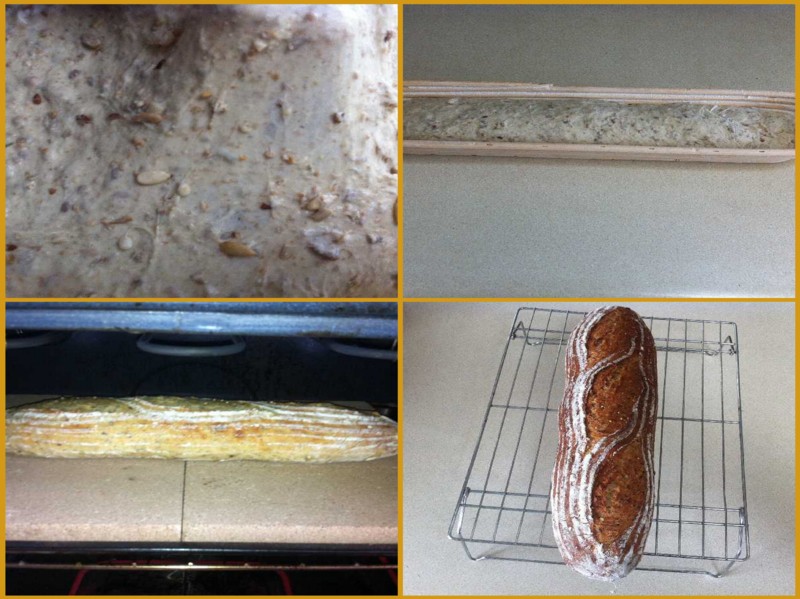
Once the S&F’s were complete, the dough was allowed to ferment and develop on the counter for 1 hour before being shaped into a single knot chacon and placed in a rice floured basket. The basket was placed in a nearly new trash can liner and allowed to develop for another hour before being retarded in the fridge overnight for 8 hours.
The next morning the dough basket was retrieved from the fridge and allowed to come to room temperature and final proof for 4 hours when it had doubled. Now came the time to decide which way to bake it – what turned out to be a difficult decision.
After much thought, careful deliberation with my apprentice and talking to rye experts worldwide we decided that Mini Oven’s way of baking it was the way to go. Baking in the specialized turkey roaster at 320 F until it registered 205 F on the inside was the simplest most efficient way to go in order to have the oven empty by 2 PM when the girls needed it to bake Christmas cookies.
After a half and hour the bread has spread out rather than up probably due to the low temperature but it was a slightly darker color. We put it back in the oven for another 50 minutes at 320 F. When we checked the temp was at 203 F and the color was still pale.
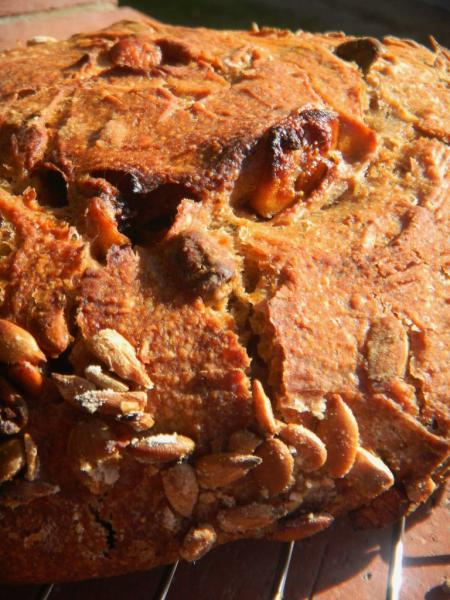
So we cranked up the oven to 425 F, convection this time and took the bread out of the turkey roaster and baked it directly on the oven rack for 15 more minutes. At that time it registered 205 F and it was a blistered weird brown color not usually associated with this kind of bread. So off went the oven and we let the bread crisp on the oven rack with the door ajar for 10 minutes.
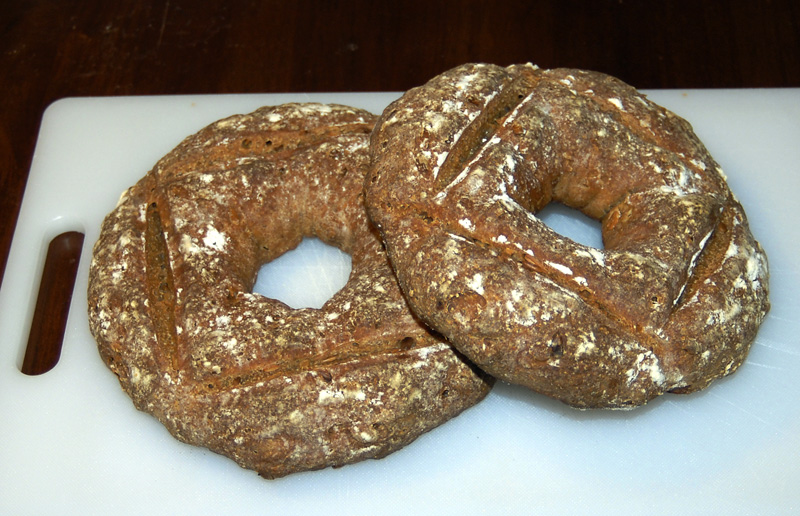
This has to be the strangest and longest way to make a Frisbee that my apprentice has ever managed. Thank goodness she is a professional! Can’t wait to see what it looks like on the inside. Hopefully it will be a darker brown color than it would otherwise be and taste way better too - or this bake will go down as total and complete apprentice failure, if well meaning.
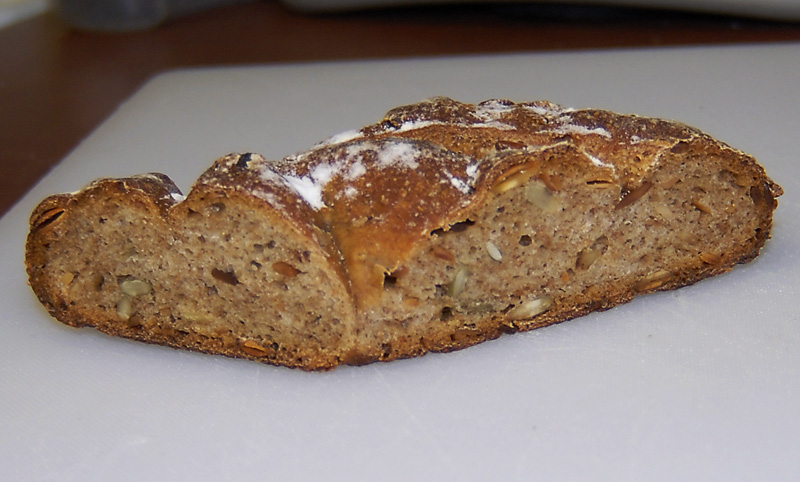
The bread, while flat, had a nice open crumb for so much stuff in it. The crumb was much darker than normal and it was moist and soft. The taste was enhanced like a light caramelization on anything will do. I was really shocked how deep the flavor was and how nice this bread tasted - toasted it was outstanding. Can't wait to try some pate on it. When we do this again, we will start the bread baking at 450 F for 20 minutes so it wouldn't spread out and spring instead. Then turn the oven down to 230 F like Andy does for his pumpernickel and get in the low portion of the bake until 205 F registered on the inside.
You learn from each bake, like we did this time, so this one was not a total loss - and the bread that came out of it was quite unlike any we managed to bake to date.
Formula
SD Levain | Build 1 | Total | % | |
Rye Sour and Desem Starter | 10 | 10 | 2.72% | |
WW | 5 | 5 | 1.63% | |
Spelt | 5 | 5 | 1.63% | |
Kamut | 5 | 5 | 1.63% | |
Dark Rye | 13 | 13 | 4.25% | |
AP | 28 | 28 | 9.15% | |
Water | 56 | 56 | 18.30% | |
Total Starter | 122 | 122 | 39.87% | |
| | | | |
Starter | | | | |
Hydration | 100.00% | | | |
Levain % of Total | 15.66% | | | |
| | | | |
Dough Flour | | % | | |
Spelt | 14 | 4.58% | | |
WW | 14 | 4.58% | | |
Dark Rye | 26 | 8.50% | | |
Toady Tom's Toasted Tidbits | 10 | 3.27% | | |
Red Malt | 2 | 0.65% | | |
White Malt | 2 | 0.65% | | |
Kamut | 14 | 4.58% | | |
Potaoto Flakes | 10 | 3.27% | | |
Oat Flour | 10 | 3.27% | | |
AP | 204 | 66.67% | | |
Dough Flour | 306 | 100.00% | | |
Salt | 7 | 2.29% | 1.91% | Total Flour |
Water | 209 | 68.30% | | |
Dough Hydration | 68.30% | | | |
| | | | |
Total Flour | 367 | | | |
Water | 270 | | | |
Total Dough Hydration | 73.57% | | | |
| | | | |
Hydration w/ Adds | 74.93% | | | |
Total Weight | 779 | | | |
| | | | |
Whole Grains | 34.06% | | | |
| | | | |
| | | | |
Add - Ins | | % | | |
Figs Adriatic and Mission | 50 | 16.34% | | |
Pistachio, Sunflower & Pumpkin | 75 | 24.51% | | |
Total | 135 | 44.12% | | |