Submitted by jennyloh on September 30, 2011 - 5:54am

Quest on Baguette Making

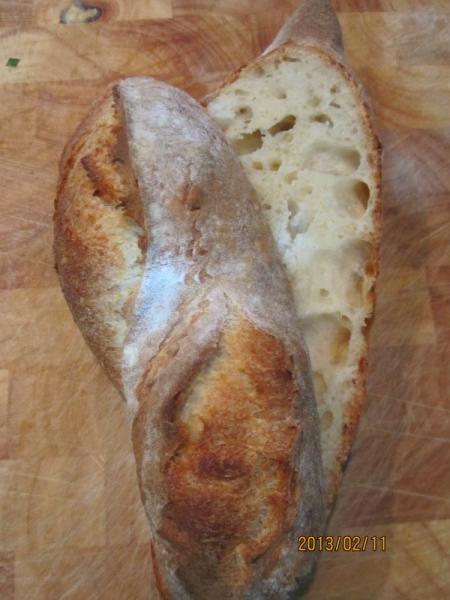
I've on a quest to make baguette,  fluffly,  thin crust,  light, open crumbs.  My baguettes so far has been on a thicker crust,  not so open crumbs and a little too chewy. I'm not sure when I will be able to to achieve what I want to achieve, but I'm starting to keep track of this records in my blog.  https://sites.google.com/a/jlohcook.com/jennycook/latest-postings/baguette-experiment2

So far,  I've done 3 experiments,  they are still not ideal at all.  I'm looking to improve my techniques before I go for taste.  Currently,  I'll stick to a recipe from Peter Reinhart on french loaf. I'm going to continue trying until the day that I can consistently achieve what I'm looking for.

Perhaps I'm so used to having Asian baguettes, especially the Japanese bakeries here.   Actually I have no idea how a french baguette looks or taste like,  only from the local french bakery here,  not sure if it is authentic.  Anyway,  we like the taste of baguettes that are really light,  crusty, flaky crust,  open crumbs and doesn't quite fill your stomach even when you eat up a full loaf.

I'd be happy to hear from anyone who has suggestions for me on my techniques.  Here are also some pictures to show you what I've done so far.


Submitted by houstonwong on December 2, 2010 - 12:07am

Buns/rolls made with French bread dough


My sister loves dinner rolls/buns. So I figure I'd use it as a chance to really try out French folding. My previous attempts have been somewhat half-hearted. But this time, I thought I’d really do it right, focusing on stretching and trapping air.


For the formula:

Strong Canadian white flour 13.3% protein

75% hydration

0.5-0.6% instant yeast

2% table salt


French folded for 10 mins till smooth (funnily, wasn’t that sticky even at 75% hydration!), then lightly flour the top/counter and form into a ball. Put in floured bowl and rest for 1 hour, 1 fold and rest another 45 mins before shaping (65g balls) then give it a 30-40 min proof. Baked till internal temp reached 208F (around 22-25 mins at 450-500F).


As for steaming, 2-3 mins before putting the buns in the oven, I put in a (loaf) pan of boiling water (about a cup or cup and a half) on the top rack, which I removed about 8-9 mins into the baking stage (didn't mist oven because I lost my trusty spray bottle).


Et voila! It’s night and day compared to my previous breads (using same formula) that were rather dense probably due to my pathetic kneading skills :P Or, maybe I’ve been underbaking all this time? Plus, they snap-crackled and poped while cooling for something like 10 mins. I could hear them at 10 feet away!


Anyway, here are photos.


I'm really surprised what a difference the French fold method made for me with high hydration dough. Thanks to everyone here who have given links and hints on it. For the sake of curiosity, next I will try the exact formula and method with a poolish to see what difference it has on the fluffiness and aroma of the crumb.

Submitted by PMcCool on January 10, 2010 - 11:03am

Testing... testing...


After several not-so-happy outcomes, and one pleasing outcome, it was obvious that I needed to get better acquainted with the South African flours that I have.  Previous bakes seemed to indicate that the flours' absorbency was different than I was anticipating, based on my previous experience with U.S.-produced flours.  The only way to find out what was going on with any certainty was to do side-by-side bakes of identical breads, adjusting only one variable (hydration, in this case) at a time so that I could compare the outcomes.

For this bake, I decided to use a 50/50 mix of brown bread flour (protein content in the 12%-12.5% range) and bread flour (protein content in the 11.5%-12% range).  Although the label isn't altogether clear, I think that the brown bread flour is either whole wheat, or possibly de-germed wheat.  It contains large particles of bran.  Note that the same miller also produces a "Nutty Wheat" flour that they describe as white flour with the bran mixed back in.  I used 2% salt and 1.6% yeast (IDY).  Hydration levels ranged from 55% to 80%, in 5% increments.  Each dough contained 100g flour, to make the math easy.  (It also makes a pretty decent size roll for sandwiches.)  The dry ingredients for all of the doughs were premixed in one batch, then weighed out for individual mixing with the selected quantity of water.  These are straight, lean doughs; no preferments or enrichments were used.  This was to eliminate the potential for other ingredients masking the effects of differing levels of hydration.  Autolyse was not used for any of the doughs.  All mixing was by hand.  No bench flour or water was used.  Room temperature was 75ºF-77ºF.  The temperatures of the ingredients and the finished doughs were not measured but are assumed to be within 3ºF-5ºF of room temperature. The water came straight from the tap, compliments of the City of Pretoria.  All doughs were fermented on a lightly oiled granite countertop and covered with oiled plastic wrap.  Each was preshaped after the bulk ferment, then given 15-20 minutes to rest before final shaping.  Breads were baked for 25 minutes on a sheet pan in a 400ºF oven, with light steam.  

Observations are as follows:

55% hydration - this dough was very stiff and did not want to come together in the bowl.  The dough was dumped out on the countertop to finish mixing/kneading.  All flour was incorporated and after several minutes of kneading, the dough smoothed out and became pliable with almost no tackiness.  This dough was the slowest to rise.  Due to an interruption in the process, this dough had approximately 2 hours of bulk fermentation and barely doubled in that time.  The finished bread was the smallest of any in this test bake, having risen less after shaping even though it had the longest final fermentation duration.  The crust was thick, hard, and tough; the crumb very tight and dense and slightly gummy, even though the bread was thoroughly cooled before slicing.

60% hydration -  This dough was also somewhat stiff, although it was fully mixed in the bowl, unlike the 55% dough.  Pliability was better than the 55% dough and the dough was just slightly tacky at the conclusion of kneading.  The bulk ferment was slightly less than 2 hours and the dough was a bit more than doubled in that time.  The finished bread was only slightly larger than the 55% hydration bread, exhibiting a similarly hard/tough crust and dense crumb.  However, the crumb was not gummy in the finished bread.  

65% hydration - Early in the mix, this dough was sticky, although that improved to being moderately tacky by the end of kneading.  The dough cleaned the bowl with all flour being absorbed.  The bulk ferment was approximately 1:20 and the dough inflated to about 2.5 times its original volume in that period.  The finished bread still has a tight crumb, but the crust is thinner and less resistant to cutting.  Size is slightly larger than the two preceding breads.

70% hydration - This dough was noticeably stickier during mixing and kneading than the previous doughs.  It did clean the bowl during mixing.  I wound up using a combination of standard kneading and stretch and fold to manage this dough (not easy with such a small sample).  I don't think it would have come together without the stretch and fold technique.  At the end of kneading, it was still more sticky than tacky, with some sticking to my fingers.  It had about a 1 hour bulk ferment, during which time it nearly trebled in volume.  This bread also rose more after shaping, and was significantly larger in volume than the preceding breads (and, consequently, felt "lighter" because of the reduced density).  The crumb was the most open of any the breads made to this point.

Intermission - a co-worker stopped by to drop off some things just as I was finishing kneading the 70% hydration dough.  That inserted about an hour's delay between the 70% dough and starting the 75% dough.  All of the first four doughs were baked on the same sheet pan at the same time.  The last two doughs were baked on a separate sheet pan.

75% hydration - This dough never stopped being sticky.  It did not entirely clean the mixing bowl.  Standard kneading techniques were not working, so I switched to using the French Fold.  Kind of a challenge with such a small quantity of dough.  This bulk proofed about 45-50 minutes, easily doubling in that time.  Slashing before baking was problematic because of the dough's stickiness.  The finished bread was larger than its predecessors, felt "lighter" still, had a thinner crust and a more open crumb.  

80% hydration - This was an extremely sticky dough.  It had to be scraped out of the bowl after mixing and repeatedly scraped from the bench while kneading.  The only kneading technique that worked was the French Fold method.  Even that took several minutes (not several cycles) before the dough started to exhibit some structure.  This dough expanded the fastest during the bulk ferment and grew the largest after shaping, even though it had the shortest times in both ferments.  The knife dragged a trench in the dough, but did not actually slash it.  The finished bread had the thinnest crust and most open crumb of any of the breads in this test bake.

Follow-up thoughts:

1. One of the notions going into this test was that the city water might be a culprit in some of the former bakes.  Based on the results of this test bake, I think I can get good bread using city water, without going to the effort of running a similar test using bottled water.

2. For this blend of these particular flours, a hydration of approximately 70% seems to offer the best dough handling traits and a pleasing finished bread.

3. None of the doughs experienced much oven-spring.  I would attribute that to handling during shaping that was not gentle enough (too much degassing) and to baking on a cold sheet instead of on a hot stone.

4. It appears that the jury is still out on my starter.  Most (not all) of the previous bakes that experienced problems were sourdoughs, rather than yeasted breads.  This starter may be too acidic or too enzymatically active, either of which might be leading to gluten attack.  I'll see how it behaves after a few days of rye feedings.

5. I'm still not sure how much effect, if any, altitude is having on the results (I'm at approximately 4200 feet elevation in Pretoria, compared to having been at about 800 feet elevation in Kansas City).  I can't control for that, so I'll use the results of this test as an indicator of what to do with future bakes.

6. Weather today was mostly sunny, with outdoor temperatures nearing 80ºF while I was running this test.  I didn't think to check the relative humidity while running the test.  It's now 47% at 75ºF, about 7 hours after starting the test.

7. Since this is a whole wheat blend, I'll be interested to see whether I can get better results at either the 65% or 70% hydration levels by utilizing an autolyse step in the process.

Front row: right, 55%; center 60%; left 65%.  Back row: right 70%, center 75%, left 80%.  The 75% and 80% doughs have just been mixed and kneaded.  The others have been on the bench anywhere from nearly 2 hours (55%) to just over an hour (70%).  It's a good illustration of how hydration affects the fermentation rate.

Right to left, finished breads, lowest (55%) to highest (80%) hydration.  Note that these were initially shaped to be the same size.  Growth occurred during final proof and baking.

Crumb of, right to left, lowest (55%) to highest (80%) hydration.  I think the crumb of the three higher hydration breads (70%, 75% and 80%) ought to have been more open than this.  That they aren't is probably an indication that I was too forceful during shaping and degassed the breads too much.  An autolyse step might also help.

That's today's effort.  It's one datum, not a trend, but I can use it as a benchmark for future bakes for gauging how much hydration is required and to make some educated guesses about the effects of added fats or sweeteners for enriched doughs.  Now I suppose I should do something similar for panned breads...

Paul


Submitted by rainbowz on September 19, 2009 - 9:45am

Confusion over "straight dough"


I've been doing a bit of looking around and I'm running into contradictory information on what is meant by the term "straight dough"

In some instances, this is said to refer to the "flour, water, salt and leavening agent" mixture, i.e. NOT enriched bread.

In other instances, it is claimed to be the term for commercial yeast bread as opposed to sourdough bread.

Then you run into terms like "standard dough" which muck things up even more.

So, if I said "I made a straight dough", what would YOU presume this to be? 

This detail isn't addressed in the Handbook's glossary section.

Submitted by MommaT on July 19, 2009 - 12:53pm

Bagels - tried BBA recipe and have questions

Hello,

Having had a very successful experience with boiled pretzels, I was convinced bagels were a walk in the park.  The recipe in BBA seemed approachable enough -- doesn't take too long, doesn't require lye (I know...point of contention) and is ready to bake for breakfast.  I had a mediocre experience, however, and am looking for pointers from those of you who have had great success making "true" bagels.

The good part:    The dough was easy to mix up, the shaping instructions using classic wrap method were a piece of cake and everything looked just right.  I even found malt syrup in my local Whole Foods.  My only difficulty was the baking time.  In the foreward to the recipe, Reinhardt says total baking time is 15-20 minutes, but in the recipe itself it only describes 5 minutes plus 5 more.  I think this is a typo and the second, cooler baking time should be 15 minutes.

BUT...the real reason I am writing is to ask about the crumb and general texture/mouth feel.   I found the outside to be pleasantly and acceptably chewy, but the inside was a bit to "bread-like" for me.  The bagels were almost fluffy with a fair number of air holes inside.  I am used to a denser, chewier crumb and a bit more flavor.

Is success with the chewy crumb better achieved using a starter instead of yeast?  I suspect this would go a long way toward generating the right crumb.  Is there anything else that I'm missing?

All pointers are appreciated and I'm looking forward to Bagels:  Round 2

Thanks!

MommaT

Submitted by dmsnyder on May 17, 2009 - 9:06pm

Crackley crust achieved! (Baguette surprise, continued)


I made another batch of the baguettes described previously in http://www.thefreshloaf.com/node/11925/baguette-surprise-and-challenge.

The only significant changes in the procedure were:1) I did not add the salt until after a 50 minute autolyse, 2) I was more meticulous in gently pre-shaping and shaping and 3) I let the loaves proof more fully. 4) I also poured about twice as much water over the pre-heated lava rocks to steam the oven.

Well, there's good news and bad news: The bad news is that I seem to have over-proofed the baguettes a bit, resulting in my scoring not opening up real well. The good news is, first, the flavor of this batch is equal to the first. I'm ready to conclude this recipe is reproducible in my hands. Second, the crumb is significantly more open. And third, I have finally achieved the crackley (rather than crunchy) crust I have been seeking on my baguettes! I am really delighted.

The crust is thin and it sang loudly for a long time while cooling. Cracks developed in the crust. It breaks off in thin, sharp-edged flakes when you bite it! Woo Hoo! I am pretty sure the cause was the extra steam created by the combination of lava rocks and extra water.

Now, I have to test the steaming enhancement with other baguette formulas.

David

Submitted by dmsnyder on May 5, 2009 - 10:27pm

Baguette surprise and a challenge.


Hi,

I baked the second best tasting baguettes ever tonight, to my surprise. I would like to invite other baguette questing members to test my hypothesis as to why they are so good tasting.

This afternoon, I had the urge to have fresh baked baguettes with dinner. I've been out of town and very busy since returning. My starter needed feeding. I hadn't made a poolish or pâte fermentée. I was stuck with making a straight dough baguette that could be ready to eat in 4-5 hours.

I looked at the formulas in several books and decided to use Leader's formula as a basis, but with a different mixing approach, slightly higher hydration and different flours. Here's what I did:

Ingredients

Giusto's Baker's Choice flour 450 gms

KAF White Whole Wheat flour 50 gms

Water 350 gms

Sea salt 10 gms

Instant yeast 4 gms

Method

1. Mix all ingredients in a large bowl until the flour is hydrated.

2. Let rest, covered, for 20 minutes.

3. Stretch and fold in the bowl for 30 strokes. Repeat 2 more times at 20 minute intervals.

4. Transfer dough to an 8 cup glass measuring cup, cover tightly.

5. Stretch and fold once at 45 minutes.

6. Proof until 1.5 times the original volume (another 45 minutes).

7. Divide dough into 3 equal pieces, pre-shape as rounds and rest, covered with plasti-crap, for 10 minutes.

8. Shape into baguettes and proof on a linen couche until 1.5 times their original size.

9. Bake on a pizza stone at 460F with steam for 20 minutes.

10. Turn off oven but leave the loaves on the baking stone for another 5 minutes with the oven door ajar.

11. Cool and eat.

The crust was nice and crunchy. The crumb was not real open. But there was absolutely no smell of yeast, just a  wonderful, wheaty aroma. The flavor was delicious! Not the sweet flavor I look for in baguettes with longer fermentation. There was no recognizable flavor of whole wheat, just a deeper, more complex flavor than I generally get with an all white flour bread.

Why was it so tasty? The only thing I can think of is the flour mix I used. I would love for some one else to try this combination and let me know if they get extraordinary results. I will be trying this again myself, of course.

Oh. What was the best tasting baguette I've made? Gosselin's "original" formula (not Reinhart's revision). But this involves an overnight cold retardation and secondary mixing of added ingredients afterwards. Not a 4-hour project.

Any takers?

David

Submitted by beenjamming on August 28, 2007 - 8:30am

Better Bread, Better World, Week One: Baguettes, etc.

So for the first time this week, I got together some people would had expressed interest in starting up a bread baking club and we crowded into my tiny kitchen and baked a dozen baguettes!

Submitted by PMcCool on April 16, 2007 - 7:12pm

Clayton's Buttermilk Whole Wheat Bread


Since the breads I made most recently were both sourdough ryes, I was looking for something different this time around that would work well for sandwiches. My first inclination was to haul out an old favorite, a honey whole wheat bread. While flipping through Bernard Clayton's New Complete Book of Breads, I happened across a buttermilk whole wheat recipe that I had not tried previously. Since I had all of the necessary materials on hand, I thought that I would give it a try. The recipe follows [with my notes]. I'll also include additional comments at the end

Submitted by breadnerd on April 1, 2007 - 1:46pm

Plain Ol' wheat sandwich bread

There was a comment in the "you know you're a bread baker" thread about feeling like you're "cheating" when you make a yeasted dough.

But... there's something awfully nice (and FAST!) about a comforting loaf of sandwich bread