Submitted by Amy7777777 on September 23, 2011 - 3:44pm

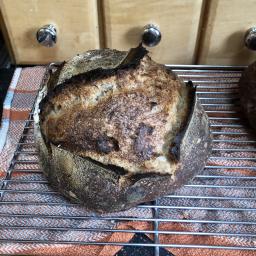
Too-slack dough. Could the culprit be a cross-country move? Or my stand mixer?

I had been baking pretty successful sourdough loaves using Maggie Glezer's recipes for a while now. I recently moved to Berkeley, Calif. from Pittsburgh, Pa., and now I'm finding my loaves are way too slack. I also recently started using a stand mixer I got as a gift, when I used to knead by hand. Could either of these changes be responsible for the difference?

The recipes in the Glezer book are by weight, and I never added extra flour, even when I was kneading by hand (didn't flour the counter or my hands). The bread still tastes good, but it all looks like ciabatta even if I'm trying to make a nice round boule. Help!

Submitted by Boulanger D'anvers on April 25, 2011 - 1:17am

How long to mix with a stand mixer?

Hi all,

I have recently bought a Kenwood stand mixer, not just for mixing my bread doughs but also for other kitchen tasks. I am quite chuffed with my purchase but I am having some trouble with the timing of the mixing of bread doughs and am looking for some advice.

For my last three bakes I have used the stand mixer but the final breads have not turned out well. Last night I made some mini boules but the crumb has turned out quite dense with little air bubbles. Now I am not seeking large holes in these rolls but these were so tiny and dense that I wouldn't call them succesfull. The taste was quite alright but the overall feel when eating them wasn't what I was expecting.

The instructions that came with the machine state not to mix above setting 1, which is a moderate speed. As I have hand kneaded my doughs and have used stretch-and-folds I am having some trouble with the timing. I have tried to go by the generic instructions from Peter Reinhart's BBA of machine kneading for about 6 minutes but at 6 minutes the dough's consistancy doesn't seem right. Now I know that a dense crumb can be the result of a lot of things but can anyone please advise whether underkneading is one of them?

This morning I have put together a quick dough and initially mixed for 5 minutes and let it rest for a couple of minutes. The dough definitely hadn't come together yet, so I mixed for another 5 minutes. I repeated a couple of times and ended up with a total mix time of about 25 minutes. This seems extremely long compared to the times mentioned in the BBA. The only comparison I have when it comes to mixing times is an old bread baking machine I have used in the past. The machine would initially mix for 20-25 minutes depending on the weight of the dough. As the dough paddle in the BBM doesn't compare to the dough hook in my stand mixer I am unsure how to the mixing times compare.

To make a long story short I am looking for anyone who could give some advise or guideline on mixing time. Any input is much appreciated.

Thanks,

Peter

Submitted by gvz on March 5, 2011 - 7:19pm

Viking stand mixer revolutions

Hello,

A few weeks ago, I acquired a Viking 5-quart stand mixer.  So far it's been working great.  However -- though maybe I am blind, I could not find in the included documentation from Viking, any reference to the revolutions per minute at different speed levels.

Sorry if this has been posted before, but I found a handy online reference that lists the RPMs for the various speeds, and thought I'd post it in case any other Viking users would find it useful.

http://www.vikingmixer.net/speed.html


Cheers, and happy bread making!


Submitted by cranbo on March 4, 2011 - 5:18pm

mixing technique - clearing the bowl?

So I've been baking breads for some years now and experimenting with various recipes. 

Today I've been working on these English Muffins as well as my version of Theresa Greenway's Griffin's Bread.

The versions I'm making are 62% and 68% hydrations respectively. 

Most of the time I use a KA mixer with C-hook to knead.

Both doughs clear the sides of the bowl reasonably well, but neither of these totally clear the bottom of the bowl. I ran them both for maybe 1 minute at KA speed 2 to combine, then about 3-4 minutes at speed 3. 

In the case of the muffins (which use about 70% preferment), there was about a 2.5" diameter circle at the bottom, and I added some additional flour (about 10g) and it shrank to about 2". 

In the case of the sourdough (which uses about 82% preferment), it stuck to a large circle at bowl bottom, probably 5-6" around. I had to add probably 30g of flour to make it clear the sides better, leaving about a 2-2.5" diameter circle at the bottom of the bowl. 

My questions are about hydration and mixing to clear the bowl: 


  1. Am I correct to assume that all 62% and above hydration flours will never totally clear the bottom of the bowl? 
  2. What hydration typically will clear the bowl bottom? 
If I was more accurate with my starter maintenance, I'm sure this would be less of an issue (I think my preferment hydration varies anywhere from 60-85%, because I eyeball it). I just want to get a better feel for the behavior of hydration and my mixing machine, so that I can make adjustments as necessary. At least I've learned not to add more flour to sticky ryes, I've ended up with quite a few bricks over the years. 


Submitted by basbr on January 26, 2011 - 2:22am

If stretch and fold is not an option

A lot of experienced bakers on this forum sing the praise of stretch and folds for gluten development, workable wet dough and open crumb. I understand the concept, and I think it's pretty darn smart. Problem is, I cannot do it because of my handicap.

I have this brand new KitchenAid Artisan stand mixer that easily kneads a high hydration dough for a long time, without heating up. I followed the discussions in the forum, but most focus on S&Fs as an alternative to extensive mixing.

My question is: Can the KitchenAid be a viable alternative to S&Fs for great French bread or baguettes?

Can I get a workable wet dough and open crumb by only kneading in the stand mixer? How long would you recommend? I began noticing a real difference in Peter Reinhart's focaccia dough from BBA when I mixed it for 20 minutes. I didn't S&F it afterwards and it came out pretty good; light and fluffy, like eating a piece of cloud! 

But how would French bread do under the extensive handling by the stand mixer? Thanks!

Submitted by delta on December 23, 2010 - 4:58pm

Good mixer for gluten free single batch loaves + extras

I have been searching and researching a new stand mixer.  I never needed one until we went gluten free and then my mother in law had an old Hamilton Beach Model K that she gave me and I used, however, the gluten free dough jams the double beaters constantly.  So I have been on the hunt for a new one. 

I have looked at the Bosch but most everywhere says that it can't handle small batches.  No where can I find though, how small is small.  A loaf is typically 3 cups of flour, including starches.  Is that a small batch?  I'd have to imagine it is but not 100% certain, if it can do a single eggwhite, why is 3 cups to small? 

The other thoughts I have are that gluten free breads aren't the same and don't act the same as regular gluten bread.  So do I use a dough hook or the beaters?  (probably a question for another section)

So I guess my big question is, which is the better bet for doing single loaves, occasional cookies and cupcakes and mashing potatoes and cauliflower, etc.  We like attachments and want a grain mill,  if anyone has thoughts on that for either the Bosch or KA, as well as the sausage stuffer and meat grinder.  We looked at the Cuisinart, but the lack of those attachments pushed it out of the running.


Thanks

Submitted by SaraBClever on November 21, 2010 - 10:23am

Hamelman: adapting instructions to a stand mixer (Kitchenaid)

I really am enjoying Hamelman's bread, but I am not sure how to apply his instructions to my home Kitchenaid stand mixer.  He typically asks you to knead for a time on "first speed" and on "second" in a spiral mixer.  In contrast, Leader and Reinhart often ask you to mix at medium speed for a time.  I do get that Hamelman prefers to underknead (no windowpane) and rely on autolyse and stretch and fold to develop gluten, but my loaves are coming out much flatter and without as much oven spring as my recipes from Leader and Reinhart.  This makes me think I am not kneading enough in that initial phase.

For those who use their kitchenaid to make Hamelman's breads, what speed(s) do you use and for how long?  I have mainly been making Vermont Sourdough and Levain breads, and while I have been tinkering I am not getting it quite right.

Thanks!

Submitted by eat.bread on September 22, 2010 - 9:01am

Large Stand Mixer

Hi!

I am in the market for a larger stand mixer.  I currently have the standard smaller kitchen aid and am looking to upgrade.  KA recommends this one:


Viking VSM700SG 7-qt Stand Mixer - 


anyone have any experience or suggestions?


Thanks

emily

Submitted by jTrimbee on January 18, 2010 - 6:14pm

Morphy Richards Food Fusion Kitchen Machine

  • Brand new, un-opened box. It was a Christmas present. I don't do enough baking so i would prefer to sell it to someone who will enjoy it. It sells for up to $300 and is sold out most everywhere. I would like to get $175obo.
  • •Classic design with heavy-duty diecast body
  • •700-watt motor
  • •10-speed with pulse
  • •4.6-liter stainless steel mixing bowl with side handle
  • •1.25-liter glass jug blender (attached to top if needed)
  • •Kneading blade
  • •Cake beater
  • •Whisk
  • •Splash cover for bowl
  • •Easy cord storage
  • •Recipe book
  • •2yr warranty
The machine is in Barrie, ON and can be picked up in Toronto if preferred,
Call James,
905-717-4080

Submitted by davidinportland on October 26, 2009 - 1:54pm

Cuisinart 7 Quart, 1000 Watt, Silver Mixer for Sale -- I'll entertain a best offer!

Hi All, 

I'm moving to NYC to a small (but great) loft. My kitchen is going to be much smaller and I need to sell certain things that I don't have room for. First to go, sadly, is my 7 quart Cuisinart, which I love. But, I simply won't have room for it and am going to be able to keep only my smaller KitchenAid. I bought it 6 or so months ago, have posted here about how great I think it is, and it is in perfect condition.

I use all my equipment very gently and carefully. The mixer will include:

1. Mixer body

2. Whisk

3. Paddle

4. Dough hook (has slight "tarnish" which Cuisinart told me is normal)

It does not include to "splash guard," which I disposed of, as I've never used one with any mixer.


Thanks and let me know!

-David

davidleaton@gmail.com