SearchUser loginRecommended BooksFavorite Recipes
|
Submitted by LeahM on July 14, 2009 - 3:18pm baking with a new starter--help!Hello all, I am 5 days into making my first sourdough starter (using the directions from this post: http://www.thefreshloaf.com/node/10251/starting-starter-sourdough-101-tutorial) and all seems to be going well (fingers crossed). However, I haven't been able to figure out exactly what the process is for using the starter in a bread dough recipe. I plan on refrigerating it and baking weekly. So, I remove the starter from the fridge, feed it, and wait a few hours. Can I remove a part to bake at that point, or should it go back in the fridge for a few days? Does the bit I remove have to be fed again or prepared in any way before using it in a dough? (I was thinking about starting with the Norwich sourdough from the Wild Yeast blog) Thanks so much for the help! Leah Submitted by Mebake on July 11, 2009 - 5:09am 95% Sourdough Wholewheat batard, and a sandwitch loafYesterday, I decided to venture into batards. I shaped one, and a loaf. Both were Sourdoughs with a 24 hr old liquid preferment. The final dough undergone its first proofing in a refreigerator for 24 hours (i was out). Yesterday, i deflated the cold proofed dough, and knead it until it became somewhat warm. I left the dough to rise for 3-4 hours, and cut it into equal halves. I shaped one as a batard. and the other into a loaf. However, this time i had bought an oven thermometer! When i preheated the oven, i was striked by the misconception i had about my oven temperature. It turned out that i often baked at lower temperature than recommended for Home-made artisan breads, i.e. 425 - 470F. Therefore, i swung the dial into no.7 or 400F and waited. The breads cooked well, crackled when done, and had an eye pleasing golden finish to them. THAT IS WHAT I WANTED and have missed all along in my previous loaves. THANK GOD. The crust is the best i have ever achieved so far. Next target... 70% Rye bread adventure.. be on the lookout. :P Mebake Submitted by rowejd on July 9, 2009 - 11:26am Quick Help Needed to Save My Sourdough Loaves!I'm making the regular sourdough from the Bread Baker's Apprentice book. I've made it several times, but this time I forgot to let the dough rise after the final mixing. You're supposed to mix, let it ferment for 3-4 hrs, then shape & proof for 2-3 hrs. I skipped that first firmentation and my bread is now proofing. Any advice on how to save these loaves...IF they can be saved? SHould I just bake them after 3-4 hours? Should I try to let them ferment, degas them by gentle handling, then let them proof again? Oh, I forgot to mention. I shaped them into 2 baguettes and one boule. Thanks for any help...the bread is on the rise, so let me know as quick as you can to save the bread! ;-) Submitted by davidg618 on July 7, 2009 - 12:33pm Building a Formula-ready levain (starter)I think one of the biggest differences between commercial artisan bakeries, that bake every day, and the amateur that bakes once or even twice a week is how each handles levain day-to-day. From my reading I've gleaned the commercial baker keeps his or her levain (starter) at room temperature, and feeds it on a periodic schedule every 8 or 12 hours. (I'm an amateur, so, experts, please correct me if I'm terribly wrong). on the other hand, most amateurs keep thier starters at refrigerator temperature (~40°F), and feed them once weekly, or less often. I am less certain how commercial bakers maintain their starters' hydration, I assume, however, that perhaps as little as one day earlier they prepare a chosen amount of their maintained starter by feeding it an amount of flour and water that adjusts its hydration to the target for a days baking. Amateurs keep their maintained starters at a fixed hydration, and, although some amateurs maintain their starters very dry (50%-60%), or very wet (~200%), the usual maintenance hydration is ~100% to ~125%. The challenge for us amteurs is, "How do I convert an alive, but nearly dormant, relatively cold starter to a formula ready starter, i.e., the correct formula specified starter weight and hydration?"; one might also add, in a reasonably short time. Some recipes intruct a single feeding, without changing the starter's hydration, followed by a fermentation period--usually 12 hours--and adjusts the dough's flour and water weights to achieve the desired dough hydration. Some amateur bakers convert their maintained starter in one feeding to the target starter weight and hydration, and then feed it an additional one to nine times over a period of one or more days. Both these approaches work, and each have subtle secondary consequences, usually effecting the final bread's flavor. It's not my intent judge the merit of those consequences, merely note they occur. What I want to do is describe the process I use, explain why I use it, and show some results. First of all, I have two primary goals for creating formula-ready starters the way I do. One is related to the final dough. I want to achieve a very active starter, strong enough to produce two strong proofs, in moderately short time, i.e., 2-3 hours each; and with sufficient reserve to provide strong oven spring. And, I want to build this formula-ready starter in no more than 24 hours. The second goal: I want to maintain only a barely necessary amount of starter, e.g., around 200g, 100% hyddration, and fed every two or three weeks. I've succeeded in reaching both goals using a 3-build approach that triples the amount of starter with each build, and adjusts the hydration by one-third of the difference between the maintained starter's hydration and the formula specified starter hydration. A couple of definitions, and a little math: seed starter: the weight of maintained starter that when tripled 3 times yields the formula-specified starter weight. Intermediate starter: the building starter, i.e. the starter at any time between the beginning of Build 1 and the end of Build 3. formula-ready starter weight = seed starter weight x (3x3x3) = seed starter weight x 27; therefore: seed starter weight = formula-ready starter weight/27. But, I always lose some--it sticks to the stirrer, and the its container's walls, so I add a little more, e.g. 20g. intermediate starter hydration = seed starter hydration +(formula-ready starter hydration - seed starter ready hydration)/3 x # of last build. An example: Formula specified starter: 480g, 60% Hydration Seed starter hydration: 100% Added to make up loss: 20g Hence: Seed starter weight = (480 + 20)/27 = 19g (rounded to nearest whole number) Intermediate starter's hydration = 100 +(60 - 100)/3 x 1 or 2 or 3 = 100 + (-40)/3 therefore: during Build 1 the Intermediate starters hydration = 86.7; during build 2 73.3%, and during build 3 60%. Intermediate starter weights are: Build 1, 55g, Build 2, 167g, and Build 3, 500. (all are rounded to nearest whole gram.) Now, I'm not going to do the Baker's math to calculate the flour and water weights added each build. I built a spreadsheet to do that for me, but it is possible by hand using Baker's math, and the intermediate starter weights and hydrations. The results: Below are a series of five photographs that visually document the example above. Why do it this way? I reasoned that adding more than twice the weight of the seed starter (or the intermediate starter weights) would dilute the density of the yeast critters beyond a "strong" density, i.e. each build should peak within eight hours or less, Yeast have little or no motility, so after a time, they are surrounded by their waste products: carbon dioxide and alcohol, not food, so production slows down or stops. Stirring , kneading dough, etc. all redistribute yeast, by-products, and food, but I don't want to be burdened with stirring. Furthermore, my goals focus on yeast production, not bacterial growth. (There are other things one can do to develop flavor contributing starters.) 1. Seed Starter: 19g of my refrigerator maintained starter.
2. Build 2. at its peak 16 hours after starting. I didn't photograph build 1, even at its peak it didn't cover the bottom of the container.
3. Build 3 at zero hour, I'd just added its flour and water additions and spread it out in its container.
4. Build three after only 3 hours (19 hours from the beginning); I consider its growth a good subjective indicator of its strength.
5. Build 3 after 7 hours (23 hours from beginning). You can see evidence it's peaked by the slight deflation around the edges. Immediately after taking this photo I made the dough...
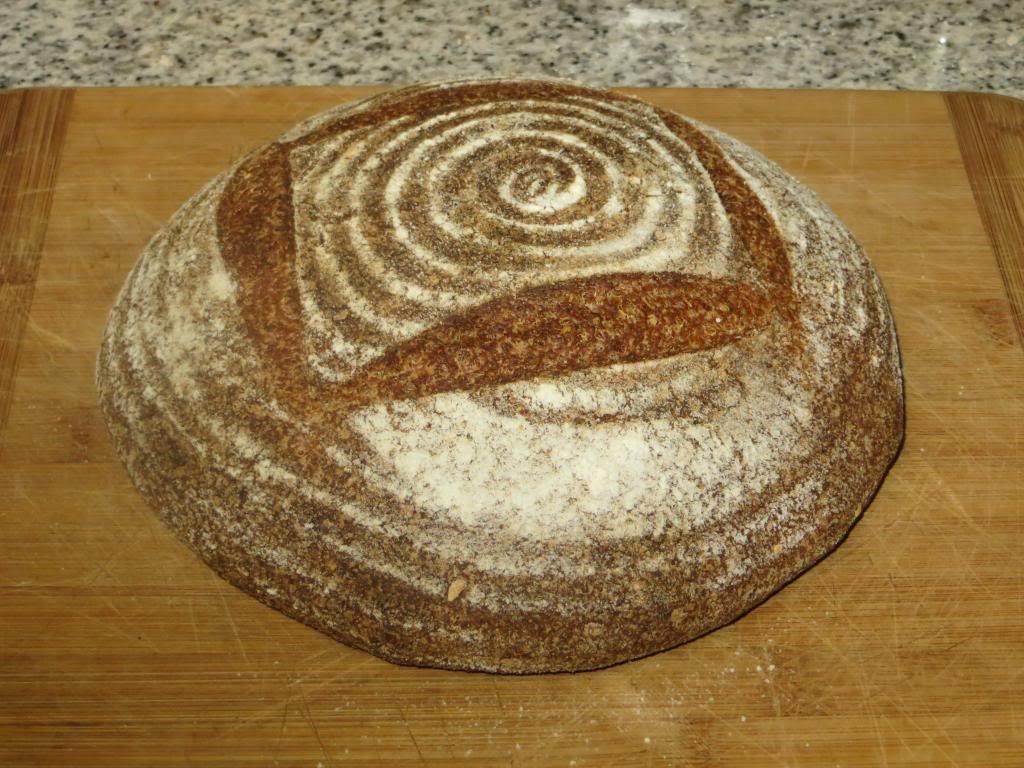
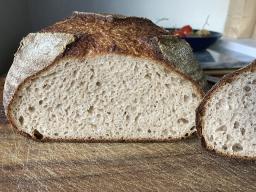
...for this bread. This is D. DiMuzio's San Francisco Sourdough au Levain (firm starter) formula, but I used it for a Thyme-Feta Cheese-Toasted Chestnut vehicle, so it probably doesn't exhibit all the oven spring it might have in an uncluttered dough. Nonetheless, I think it stands a good example of my goal.
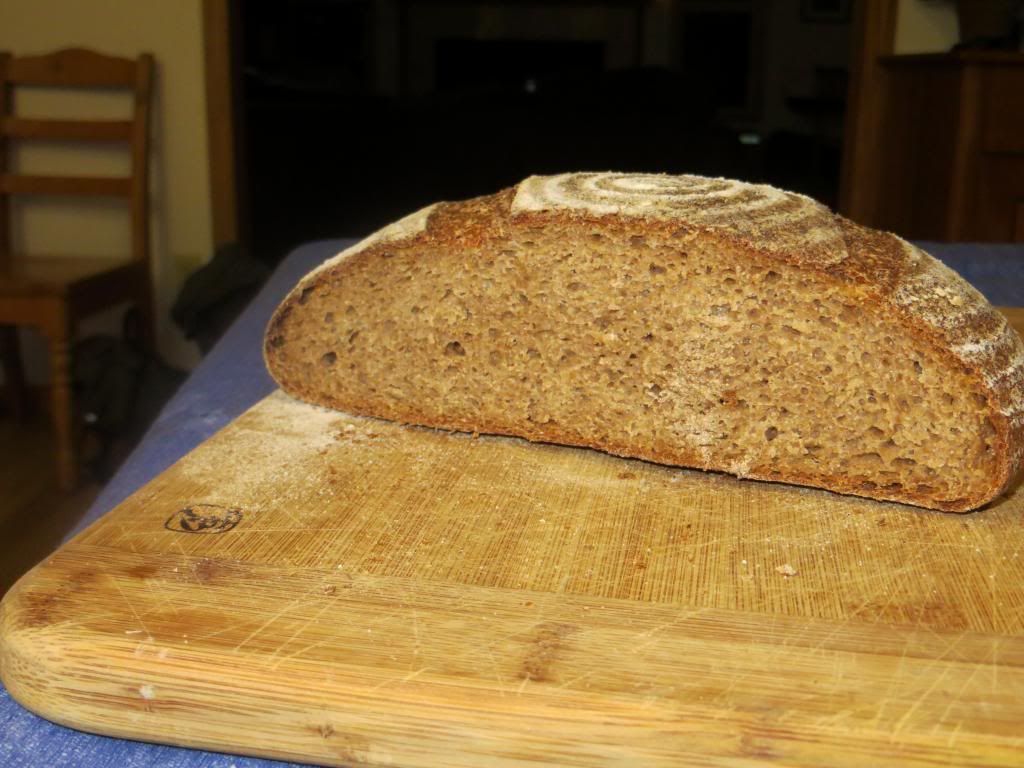
Crumb
Submitted by Mini Oven on July 5, 2009 - 11:19pm Seoulful German Farmhouse RyeYes I did it. I found rye flour in Seoul, South Korea, in the Bangsan Market between wall paper shops and packaging tucked into the alleyways kept cool in the winding shadows from the burning sun. I found two different ryes, that with my third, and my unending curiosity can only lead to one thing.... a comparison. I have already gathered that there might be some flavor differences evidenced by the interesting additives in North American recipes... So I decided to use Daniel Leader's Soulful German Farmhouse Rye in Local Breads combining all the ingredients except for added yeast (don't want it) and final 70% rye flour. That way the only difference in flavor will be the flours. All three doughs will be handled alike. The Rye:
I mixed up the recipe and divided the liquid into thirds, added 117g rye flour to each bowl moistening the flour and covering for one hour. I had already started noticing differences... Bob's is a slightly coarser flour, has more speckles, is darker (but not by much) and not as sticky as the other two German 1150 has two mosts: lighter color, and stickiness Austrian 950 has dough color between the two but in the picture they look all look alike. All mixed well, all sticky (typical rye) so I use a wet silicone spatula to fold the doughs twice. After 3 hours the loaves were gently shaped with wet hands patted with oatmeal flakes and set over cutout bread letters to mark the bottoms. (4 o'clock is Bob's, 12 o'clock is German) They were rising nicely (not a whole lot) when they went into the oven. (tip, it is very hard to judge rising in a flat round bowl shape)
As you can see, I'm having a little trouble lining everything up here...(someone please send me a note on how to do this!) The picture below of the top shows Bob's Red Mill at 10 o'clock, Austrian 950 at 2 o'clock, German 1150 at 6 o'clock. The doughs seem to rise in relationship to fineness of the flour. Bob's is the heavier and coarser so it rose slightly lower than than the other two. 1150 and 950 were pretty close in height but the 950 rose just a tad more. The darker color of Bob's is even darker after baking. Now to squeeze in another picture, the crumbs. Austrian is on left, German right, Bob's is the darker of the three, first on the bottom then on the top.
All have a moist heavy crumb (We like it that way) but the differences are slight but mostly in color and texture of crumb in the mouth. 1150 feels smoother in chewing, 950 is more stick to your teeth smooth, Bob's tend to be more stick in between the teeth which gives it a longer taste in your mouth. After two days the sour is growing but I still can't tell one from the other as far as taste goes. The Austrians at the office yesterday could also not tell any flavour differences. They just wanted more. So I've been baking and playing. I keep in mind that Bob's won't rise as high as the 950 (or peaks sooner having more whole grain). I made a loaf yesterday with Bob's and gave it a longer steam in the oven, 10 min instead of the 6 minutes in the above bread. It came out lovely rose higher and being consumed as I write. It also went into a banneton, tall and narrow. I also use more spices than the recipe but far from overpowering the rye. So. I Guess I blew the top off that urban legend if there ever was one. They all taste pretty much the same. Thanks for waiting patiently for the results. Mini Oven
Submitted by davidg618 on July 5, 2009 - 9:03am Bread Machine Sourdough Light Whole Wheat Sandwich Loaf.My wife makes three loaves of light whole wheat bread, alternating every other week with an all-white flour version of the same recipe. Two of the loaves are our "daily bread", the third routinely goes to a neighbor. She uses our bread machine, a Zo, on the "Dough" setting, and does a 2nd bulk fermentation, panning and proofing, and baking outside the machine. The machine does a one hour bulk proof; her second bulk proof is usually 2 to 2-1/2 hours depending on the dough's behavior. The long bulk proofings allow the doughs, expecially the whole wheat version, a chance to develop good flavors. Curious if I could convert the recipe to a sourdough, i scaled it to produce the same dough weight and hydration as the original recipe, but replaced some of the white flour and water with 240g of active sourdough starter at 60% hydration, built using the 3-build approach I use for all my sourdough formula.
The photo answers my curiousty with a firm yes. However, the experiement taught me the question I should have asked: "Is it worth the additional time and effort?" This bread is all one would ask for in a sandwich bread: excellent flavor; closed, but light and slightly chewy crumb; and a soft crust--even before I brushed them with butter. But I can say the same things about my wife's bread. Here's a photo of her all-white version I took a couple of weeks ago.
From my point-of-view we're going to stay with the tried and true Yvonne has baked for the last six years. Doing the sourdough was fun, and we will certainly enjoy eating the result. Sometime in the future I'm going to see if I can be successful baking a single sourdough loaf entirely in the Zo. I think it's possible, in the programmable mode, using a very active starter, and removing the paddles after the knead step. This will allow up to a four hour bulk fermentation step. But that's for another day. Submitted by kranieri on July 4, 2009 - 2:10pm 100% Whole Wheat Sourdough Rolls
second endeavor after coming back to my electric oven after a month of wood fired brick oven adventures. delicious little rolls for pretty much anything, for me it was a dinner roll. pretty good rise for a 100% whole wheat, but that seems to be the standard since switching to natural leaven, open crumb, super moist. i was quite pleased. the crust was pretty good too even for the electric oven, although my heart still has a brick oven sized hole...
Submitted by ardent on July 4, 2009 - 1:42pm First Attempts at Semolina Country Bread, Light Rye, and Buckwheat Sourdough....Hello,
I'm new to the forums but am learning lots already from the posts. Wanted to share with you my baked bread of the week. All three made Friday in Hawaii. Buckwheat Sourdough Rolls
Light Rye -- with my first attempt at dusting (I did it by hand, I now realize I should have sifted it on)
And lastly, Semolina Country Bread. This dough was amazingly soft. I decided to braid it.
Submitted by LeadDog on July 1, 2009 - 10:04pm Lemon Rosemary Sourdough
I saw a post here on The Fresh Loaf by someone looking for a formula for a Lemon Rosemary bread. This combination sounded really good to me so I decided to give it a try. First I had to decided how much Lemon Zest and Rosemary to put into the bread and I decided to try for about 2% for each of them. Then I decided that I would use up the last of my bread flour and use some fresh milled whole wheat and rye. I figured on a hydration of 70% and that the percentage of the sourdough preferment would be 20%. It is summer time here and the temperatures have been hot so I figured less preferment would slow things down a little bit. I now had a plan on how I was going to make this bread now I'll tell you how it went. The first night I made my first build of the preferment.
The next morning I add more flour and water to the preferment for the 2nd build.
When I got home from work the afternoon I mixed the dough up as follows.
Submitted by davidg618 on July 1, 2009 - 12:26pm Dan DiMuzio's baguettes with liquid levainI'd planned to do yet another bake of classic baguettes ala Hitz' formula, but after seeing and reading Pamela's blog entry a week ago, and after comparing Dan's formula with what I've been doing--they are very similar except for the liquid levain--I gave into my temptation and made the DiMuzio formula. The only change I made was to scale the formula to 1000g final dough weight (four 250g small baguettes) which isn't really a change, merely a diminuation. The DiMuzio formula calls for instant yeast, in addition to the liquid levain. I considered not using it, ultimately deciding to be faithful to the formula. I prepared the liquid levain from my starter cache, using the 3-Build process I've made my own, over a nineteen hour interval. I mixed all ingredients together in my stand mixer for five minutes--bread hook, on lowest speed--then 3 minutes on second lowest speed, rested the dough 30 minutes, did a stretch & fold, and started to chill the dough for overnight retarded bulk fermation. I did two more S&F at 45 minute intervals before I was satisfied with the dough's development. Left to ferment overnight in the fridge, approximately 12 hours. Next morning, I divided the dough, and returned half to the refrigerator. I let the dough rest for thirty minutes. It didn't reach room temperature, but it had doubled in volume so I divided it again in two, preshaped, rested 20 minutes, shaped, and proofed for an hour. Baked for 10 minutes, with steam, at 480*F, cleared the steam as much as possible, dropped the temperature to 450°F and baked further to 208°F internal temperature. I had decided to do the bake in two two-loaf batches. The one time I baked four baguettes simultaneously, despite the convection oven, I experienced uneven baking among the loaves. Meanwhile, I'd removed the remaining dough from the refrigerator. I was pleased, with the first batch's oven-spring, but one of the two loaves had a minor blowout. I'm still not confident my shaping and slashing is what it should be, and the visual results of the first two loaves didn't boast my confidence even an iota. I prepared and baked the second two loaves like the first batch with two planned changes--and one mistake. Planned: I allowed the shaped loaves to proof 15 minutes longer, and I slashed approximately 1/4 of an inch deeper than the first batch. Unplanned: In a senior moment, I forgot to lower the temperature to 450°F after the first ten minutes. I think this only effected the crust thickness and color. The second two loaves are on the right in the picture below. I removed the loaves, like the first two, at 208°F internal temperature. The crumb is all I could ask for, and the flavor, in my perspective, not surprisingly, is better than the poolish initiated baguettes I've been baking. Let me hasten to add, I love their flavor as well, but the sourdough levain adds complexity absent in the classic baguettes. I especially like the crust's nutty flavor bursts, and the chewier crumb. Furthermore, the flavor is only mildly sour. So, I'll claim a conditioned success: Taste: A, Visual: C. Procedures: C+; I got a lot of them right, but not all of them. I've watched shaping and slashing video's and read shaping and slashing instructions ad nauseum, but my hands haven't yet developed the muscle memory to be able to do it rightly, without thinking about it. More practice, practice, practice. At least I've got lots of mouths that love to eat my bread, regardless of how it looks. I did, however, see one neighbor close her eyes while chewing a mouthful. I had assumed it was a gesture of ecstasy, and felt flattered, but maybe, that wasn't the real reason!
|
ALSO ON |