SearchUser loginRecommended BooksFavorite Recipes
|
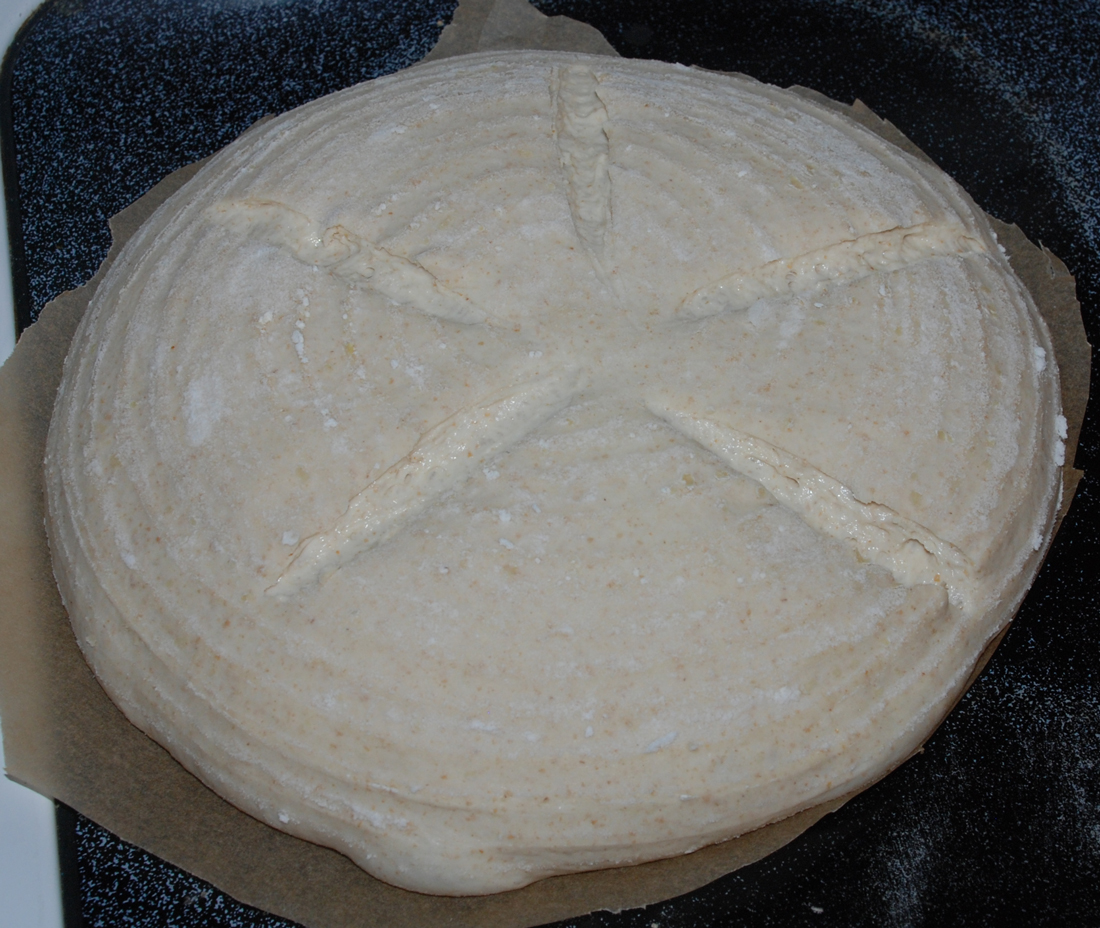
Submitted by KittyKat on November 8, 2009 - 2:28pm Sourdough, San FranciscoHello All, Am new in town and was hoping to find a recipe for "San Francisco" Sourdough like my mother used to make. I'm not sure if she made "true" SFSD, but I recall that it had a lovely, wide open crumb and thin but crisp crust and rose like a dream (she may have used a combination of sourdough starter and active yeast). She made boules which had lovely oven spring and held their shape, without proofing in any kind of basket or pan. Am sure she used all white AP "Robin Hood" brand flour from the US, but am not sure that's essential. Can anyone help with a good recipe? Also (and this is the embarassing bit), I live in Rotterdam, Netherlands, and it is hard to find decent "hard" flour here with a high gluten content. Can anyone recommend the some decent hard flour which I can readily find here? Ironically, even though the best bread I have ever eaten was in France, I haven't produced a good loaf since I arrived in Europe! Average Europeans do not tend to bake anything these days and flour in the supermarkets comes in one varierty -- low-gluten and in small bags. Does the origin of the flour even matter? Are European-grown flours OK? I do have access to ONE decent French-style bakery here (the Netherlands is not France as far as the food is concerned), but $5 a loaf is killing me and the stingy baker won't even disclose the name or origin of the flour he uses. If anyone is familiar with European breads, I have to admit I'm not overly crazy about Poilane (too big, too barnyardy, too sour for me) but I do like Paul's pain de compagne as an every day loaf. Unfortunately the only Pauls in the Netherlands is at the airport! So...I'm reduced to my baker's blackmail or trying to perfect my own loaf at home (and my LITERAL "Dutch oven" is so small I at first thought it was a microwave!). Any advice on how to circumvent stingy bakers and tiny "Dutch" ovens appreciated. Thanks, KittyKat
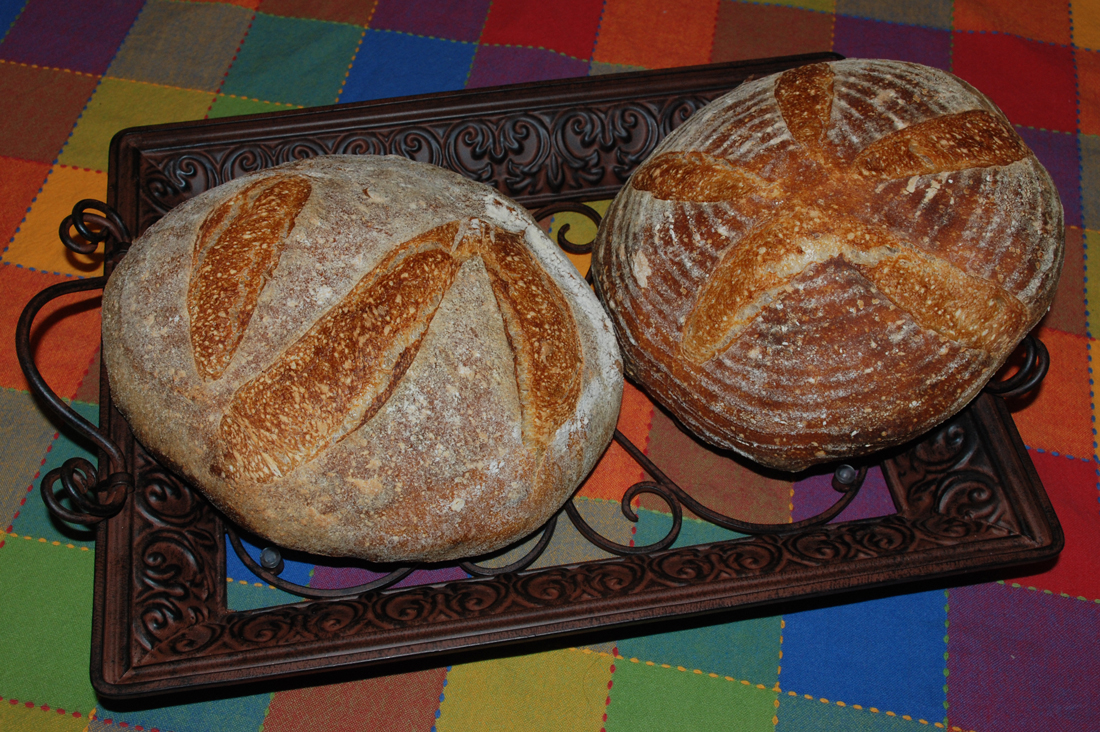
Submitted by xaipete on July 9, 2009 - 3:19pm Two SourdoughsI baked two sourdough's today. The first, David's Pain de Campagne is rapidly becoming one of my favorite breads because it's so easy to make, is practically foolproof, and has such a wonderful flavor and crumb. I use Guisto's Baker's Choice instead of KA French style flour for this bread, and my own home-ground wholemeal rye. (I think Guisto's Bakers Choice has about 10.5% protein, so it is softer than KAAP.) The second was kind of an experiment with Dan DiMuzio's SF Sourdough. I wanted to see if I could bake baquettes out of the dough instead of the more normal batards. I mixed both doughs up by hand using a throw and slap method. (I had just finished watching a video by Richard Bertinet and thought I would give his technique a try.) http://www.gourmet.com/magazine/video/2008/03/bertinet_sweetdough I put both doughs through four of the throw and slap sessions allowing about 20 minutes in between. It was kind of a fun procedure, and I really enjoyed getting down and dirty with the dough. I think this method help to incorporate air into the doughs and probably contributed to their open hole structure.
The hint of rye in this bread really gives it a spectacular flavor and crumb.
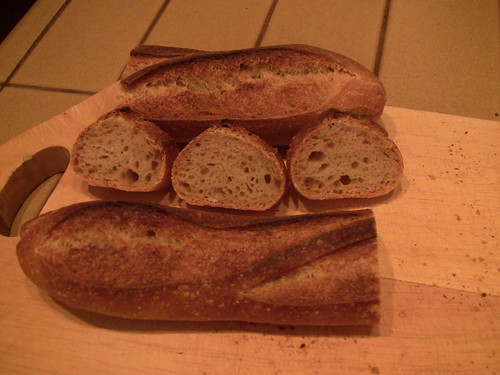
I couldn't get my scoring to open up very well on these baguettes. I'm not sure why except that the dough really got a lot of oven spring.
I cut the baguette horizontally for a sandwich. I was very happy with the large holes in the crumb. I I retarded half of Dan's formula overnight in a banneton and baked it this morning. It was a little overproofed which didn't surprise me considering the amount of starter. Still, it baked up pretty well this morning. A little bit flat, but the flavor is very nice and the crumb isn't bad either!
--Pamela Submitted by xaipete on May 25, 2009 - 10:24am DiMuzio's San Francisco SourdoughHappy Memorial Day, Everybody!
I made Dan's SF SD bread yesterday, baked it last night (it got a lot of oven spring), and let it cool on the counter overnight. When I sliced into it this morning, I was very pleased with its structure and open crumb. I would have liked a bit more tang but think that could be achieved by retarding the proof overnight in the fridge. I'm not sure if that would required reducing the amount of starter, but perhaps Dan will supply an opinion. Dan's formula for SFSD was both easy and rapid. Another benefit to Dan's formula (indeed all of the formulas in Bread Baking) is that you can use KA AP, which can be purchased is 25 pound sacks, instead of KA Bread flour. I was amazed that I could turn such a professional looking loaf in a mere day, not counting the time required for getting the starter ready. Dan's formula also incorporated a lot more starter in it than I'm used to! I think this was a very successful bake and I would definitely recommend it to anyone wanting to reproduce an authentic San Francisco Sourdough!
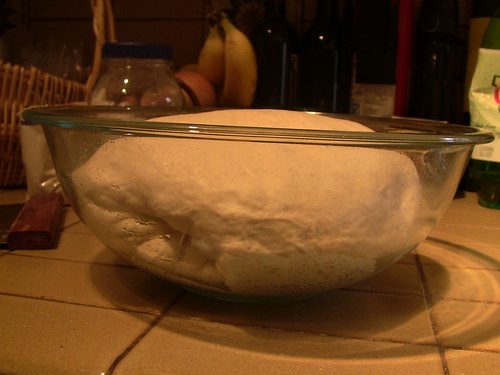
Formula for two loaves: 700 g bread flour (because KA bread flour is so strong, I used KA AP) 500 g water 20 g salt 480 g firm ripe levain (67% hydration) My method: mix the water and ripe levain together to combine, add the remaining ingredients and mix with the paddle on speed 1 for 1 minute. Turn off mixer and let rest 5 minutes. Mix with dough hook on speed 2 for 4 minutes. Let dough rest covered in mixer bowl for 20 minutes. Dump dough on lightly floured counter and do a stretch and fold. Put dough into an oiled dough bucket and let rest another 20 minutes. Do another stretch and fold. Let rise until double in the covered dough bucket. Form into two loaves and proof onto a well-floured linen-lined banneton until nearly double. Bake at 450º on a hot stone with steam until done, about 27 minutes. Let rest in a turned off oven for about 10 minutes to darken and harden the crust.
--Pamela
Submitted by xaipete on May 7, 2009 - 1:16pm Suas' San Francisco SourdoughI've been experimenting with various method of making San Francisco Sourdough for some time now. Suas' SF Sourdough loaf came out pretty well. I baked it with steam instead of under a cloche and didn't get as much oven spring as I hoped for. This loaf underwent bulk fermentation on the counter and was proofed in the refrigerator. It isn't quite as sour as I would like. I achieve the degree of sourness I'm looking for only when I do both the bulk fermentation and proofing in the refrigerator.
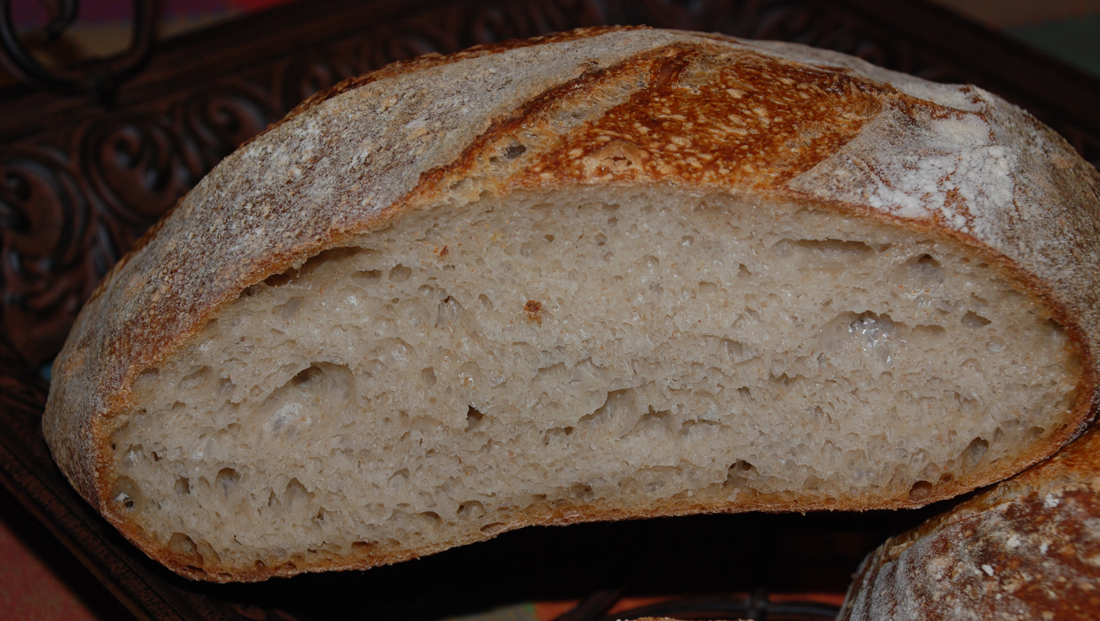
The crumb of this loaf is medium open and doesn't have a glisteny wet look about it. Levain: 2 1/2 oz. bread flour 1/8 oz. rye flour 1 1/4 oz. water starter (stiff) 2 1/8 oz. (50% hydration) Mix all ingredients until well incorporated. Allow to ferment 12 hours at room temperature (65º - 70º).
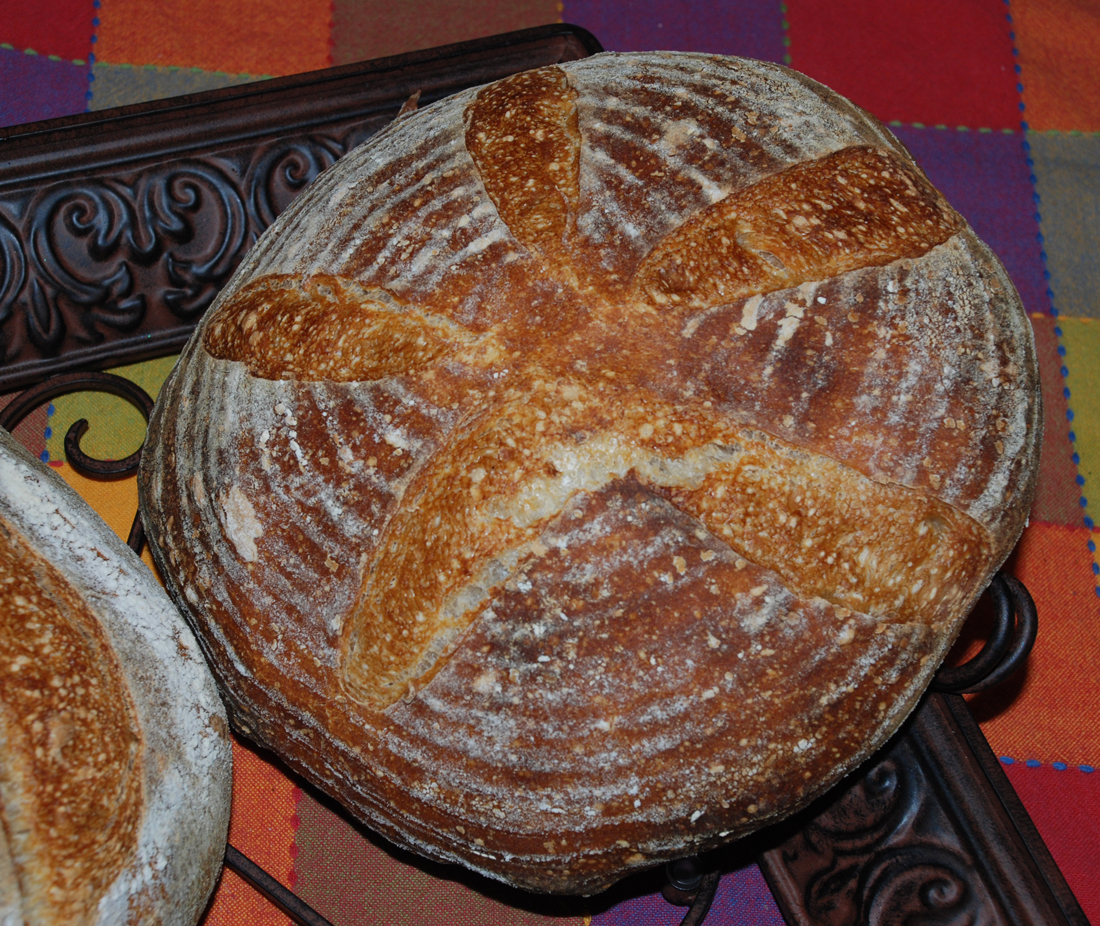
Final Dough: 14 7/8 oz. flour (I used bread flour) 10 7/8 oz. water 3/8 oz. salt 6 oz. levain (all of the levain) My Method: mix water and levain in mixer with paddle to loosen levain (about 1 minute). Add remaining ingredients and mix for an additional minute. Let mixture rest for 5 minutes so flour can hydrate. Resume mixing with dough hook for about 4 - 5 minutes to achieve a medium consistency (gluten structure is developed, but not fully--window pane forms but breaks upon stretching). Put dough into an oiled container with a lid. Let ferment for 1 1/2 hours at room temperature. Do a stretch and fold. Let ferment for another 1 1/2 hours at room temperature. Form into a ball and let rest 20 minutes. Shape into batard, put into a banneton, cover with a plastic bag sprayed with pan-spray and refrigerate for 12 to 16 hours. Turn out onto pan-sprayed parchment and bake on a stone in a 450º preheated oven for about 25 minutes with steam. Makes a single two pound loaf (weight before baking). Below is a picture of a loaf I baked several days ago. This loaf underwent overnight bulk fermentation in the refrigerator after the stretch and fold, overnight proofing in the refrigerator, and was baked with a cloche; it got much better oven spring and had better sour flavor. I'm sold that this is the way to go. I don't think it is so much the particular formula as the method. Additionally, in my experience, loaves that undergo this much refrigeration, tend to be pretty wet (slack, extensible, whatever you want to call it), but seem to bake up well in spite of this characteristic. I'm not sure how you go about successfully scoring such a wet loaf, but perhaps that isn't as important as the taste. Yesterday I read in Local Breads that wetter doughs have bigger holes. Based on my experience, I'm a believer.
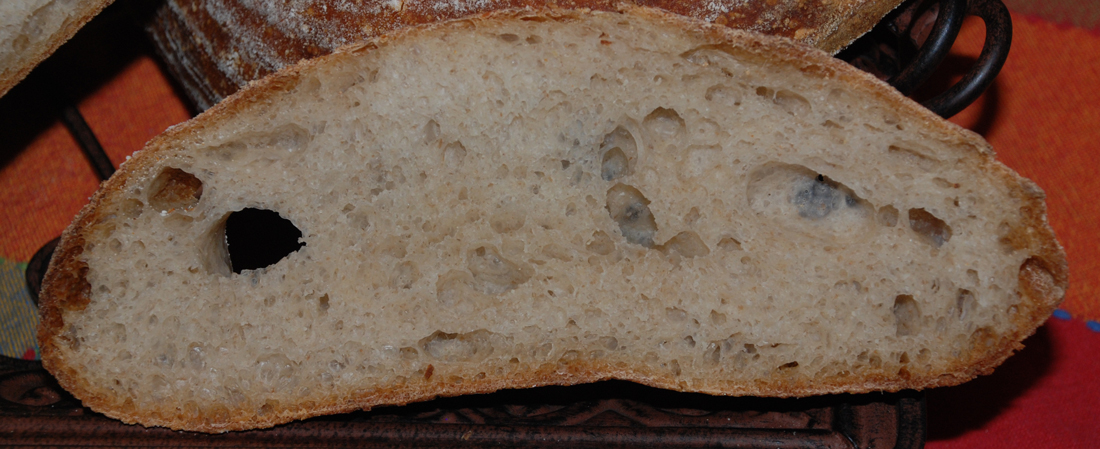
The crumb of this loaf is very open and has a glisteny wet look about it. --Pamela Submitted by rryan on March 2, 2009 - 8:28pm First San Francisco Style Sourdough Batard -- Tender and Delicious, but Soft CrustThis is my third sourdough bread-baking attempt. The first two loaves were baked as boules in a cast iron pot. The bread was delicious, and the crust was crunchy and chewy and had a bit of a shine to it. The scoring was a bit rough on the second loaf, but it was still a better loaf than I had expected. This time, I chose to try batards instead of boules. I once again used Mike Avery's San Francisco Sourdough recipe from his "An Introduction to Sourdough Baking" booklet (free sample), and followed the "mild" formula with a starter at 100% hydration. Rather than kneading, I used the stretch-and fold technique at 20 minutes, and then 3 additional times at 45 minutes and then an unplanned fold-and-stretch after an additional hour-and-a-half. The dough was light as a feather when I shaped the batards. I proofed them on lightly oiled parchment paper, and was quite happy they held their shape as well as they did. The loaves were baked on a stone that had been preheated to 475 degrees farenheit. After the loaves had risen completely, they were scored, spritzed with water, then transferred on the parchment paper to the stone. A cup of hot water was was poured into a pan that had also been preheated in the oven. The oven temperature was reduced to 450 degrees, and the loaves were baked for 15 minutes. At that time, they were nicely golden brown, and the crust sounded crisp and the loaves sounded hollow when thumped lightly with a wooden spoon. The internal temperature was 202, so I removed them to cooling racks. The loaves didn't have the shiny, slightly blistery crust that I had hoped for. After cooling, it was soft to the touch. On slicing, the crumb was soft and delicate, and the flavor was wonderful. It was mildly sour, and had an unexpected smoothness to it.. While I missed the crispy-chewy crust of my iron pot breads, my wife said that it was the best loaf I have made so far. She prefers the softer crust. Now that I can bake a loaf of bread that pleases my wife, maybe I could also learn to bake a batard with a crust that I also want. Any suggestions?
Submitted by dmsnyder on June 29, 2008 - 8:03pm Baguettes made with SF Sourdough dough
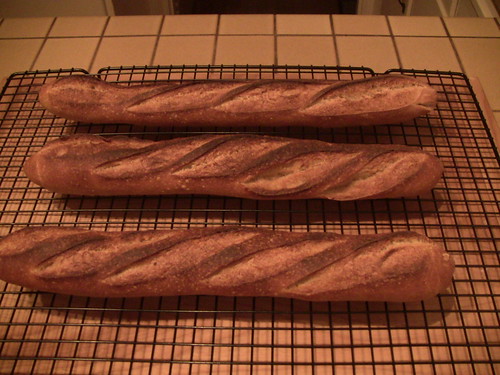
SF Sourdough Baguettes 6-29-08
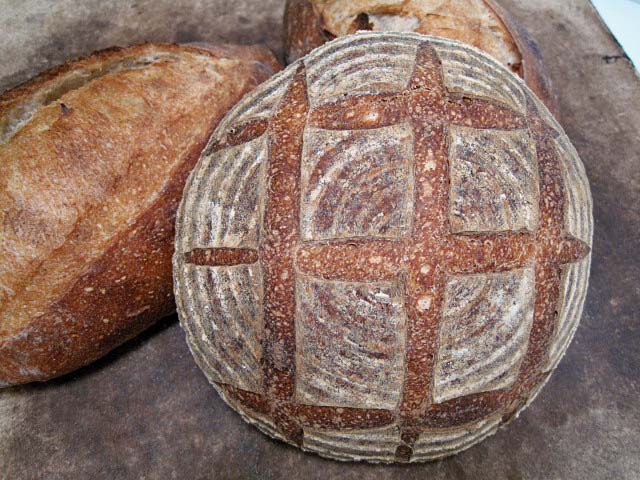
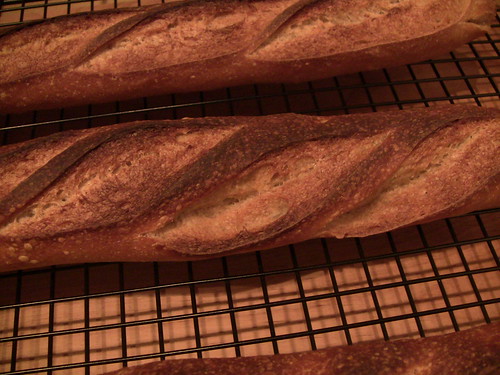
SF Sourdough Baguettes Crumb 6-29-08 These baguettes were made with the formula for San Francisco Sourdough from Peter Reinhart's "Crust&Crumb." The firm starter was made with a mixture of Guisto's Organic (whole) Rye and King Arthur Bread Flour. The final dough was made with King Arthur European Artisan Flour. The recipe makes 4-1/2 pounds of dough. I made two 1.5 lb. boules and these two baguettes. The dough was on the dry side, although I added about 1/4 cup of water during mixing. I cold retarded the formed loaves for about 18 hours. The baguettes were baked with steam for the first 10 minutes, then dry for another 15 minutes. The crust is crunchy, thicker than a traditional baguette. The crumb is less open than I wanted. The taste is typical of breads made with this dough - moderately sour and complex. A word about the scoring, since that has been a source of frustration for me: These results are as good as I have ever obtained. I think the factors that contributed to it were 1) The dryer dough is easier to slash, 2) I was careful not to over-proof. They were baked 2 hours after being taken out of the refrigerator, 3) I consciously attempted to implement what Proth5 calls "Mental mis en place." I take this to mean clearing your mind of any other thoughts, then reviewing the procedure elements and visualizing the procedure before starting to slash, then executing the slashes quickly and smoothly according to the chosen procedure. I did not achieve perfection, but I feel I have progressed. What's needed is practice, practice, practice. Here is one of the boules made with the same batch of dough:
SF Sourdough Boule 6-29-08 David
Submitted by dmsnyder on June 15, 2008 - 6:51pm San Francisco Sourdough variation Baguettes
SF Sourdough baguettes
SF Sourdough baguettes crumb These baguettes were made with the same dough I have described in http://www.thefreshloaf.com/node/7446/reinhart039s-san-francisco-sourdough-quotcrust-amp-crumbquot-some-new-variations. I have been trying various formulas and techniques to make baguettes that have "classic" crust, crumb and taste. This is not them, of course, but I have also wanted to see if the pain de compagne dough, which has such a wonderful taste in a boule, would also make a good baguette. Well, the crumb structure and the taste are essentially identical to the boule. The baguette just has proportionately more crust. The baguettes were scaled to about 10 oz. I preshaped them according to Hamelman's technique in "Bread," let them rest for 10-15 minutes, then formed the baguettes. I should have let them rest longer. The dough was very elastic. I attempted to be as gentle as possible in handling the dough. I proofed them for about 45-50 minutes only, until they were just swelled a bit, then baked with steam, starting at 500F and reducing the oven to 460F after 10 minutes. The total bake time was 25 minutes. They rested in the turned off oven with the door ajar for 10 minutes more.
The combination of the stingy proofing and the hot oven resulted in enormous oven spring. The bloom practically obliterated my cuts. For this "rustic" baguette, I'm not unhappy with the effect. A word about how I steamed the oven: Hamelman's suggested method of oven steaming for the home baker was used. The oven was preheated with a pizza stone on the middle shelf and a loaf pan and a cast iron skillet on the bottom shelf. Just before spraying the loaves with water and scoring them, I placed about a cup of ice cubes in the loaf pan. Just after loading the loaves, I poured about a cup of boiling water into the skillet. The door was opened briefly at 10 minutes to remove the loaf pan and skillet. I did not spray water into the oven. David Submitted by dmsnyder on June 12, 2008 - 10:21pm SF Sourdough: Another variation
SF SD Pain de Compagne
SF SD Pain de Compagne crumb
This came out of the oven this evening in time to cool ... almost cool ... for our obligatory bedtime snack. It is basically the same bread as that described in my last blog entry except that I built the dough directly from the starter rather than elaborating an "intermediate starter," and I made it with slightly higher hydration. As a result, it did not have the first clear flour, and it had proportionately more whole wheat and rye in the starter. This was a sticky dough that I avoided over-kneading. It fermented for 3.5 hours with one folding at 90 minutes. I shaped a single boule of about 830 grams. It was retarded in the refrigerator for 18 hours. The boule was proofed in a linen-lined banneton and baked on a stone, covered with a stainless steel bowl for the first 15 minutes of a 40 minute bake. It was left in the turned off oven with the door ajar for another 10 minutes. The crust was really crisp after 90 minutes of cooling. The crumb is tender but chewy, how I like it. The taste is medium sour with clear notes of whole wheat and rye which I expect to be more subtle by the morning. My next project is to use the same dough at a lower hydration to make sourdough baguettes. David Submitted by dmsnyder on March 16, 2008 - 9:27pm San Francisco Sourdough from "Crust & Crumb"SF SD with WW from C&C
SF SD with WW from C&C - crumb Having been raised on San Francisco Sourdough, if for no other reason, I prefer sourdough bread that is ... well ... sour. Peter Reinhart's formula from "Crust & Crumb" was the bread with which he won the James Beard prize, and it is my favorite SF-style sourdough. There are two overnight cold fermentations - One with the chef, which is a very dry levain, and the other of the formed and partially risen loaves. I have been adding some rye flour most times I bake this. This particular time, I left out the rye but used KA Organic Whole Wheat flour entirely for the levain. Then I used a mix of 1/3 high-gluten and 2/3 bread flour for the dough. There are two 690 gm boules retarding in my refrigerator, but I wanted to bake one loaf without the cold retarding, just to compare. I made this loaf into a batard, as you can see. I baked it at 475F with steam for about 7 minutes, then at 425F with convection for another 25 minutes. I think it could have come out a couple of minutes sooner. The crust is still crisp and crunchy. The crumb is quite chewy from the high-gluten flour. (I think I'll use less next time.) It has a lovely taste. I like what the whole wheat does to the flavor. I'll use more next time I bake this bread. The sourness is less than usual, probably because i skipped the overnight cold retardation. You know, I like it either way. This is just good bread!
David Submitted by wholegrainOH on September 23, 2007 - 7:56pm basil olive whole wheat sourdoughThis is a concocted loaf of whole wheat with fresh basil from the garden, chopped green olives, and leavened with San Francisco Sourdough starter from Sourdoughs International
|
Advertisement |