SearchUser loginBread BooksFavorite Recipes
|
Submitted by dmsnyder on February 5, 2012 - 10:21pm Pugliese Capriccioso, Take 2
Back in October, 2011, I baked a pugliese-type bread I enjoyed a lot. (See Pugliese Capriccioso) I gather from various TFL comments, a few other bakers have baked from my formula with good results. However, I wanted to bake this bread again using a more authentic biga rather than a liquid levain and at a somewhat higher hydration. Today, I did.
Note: The biga consists of 67 g flour and 33 g water. Thus, the total flour in the dough is 567 g, and the total water is 433 g. Therefore, the actual final dough hydration is 76%. Likewise, the actual salt percentage is 1.8%. Method
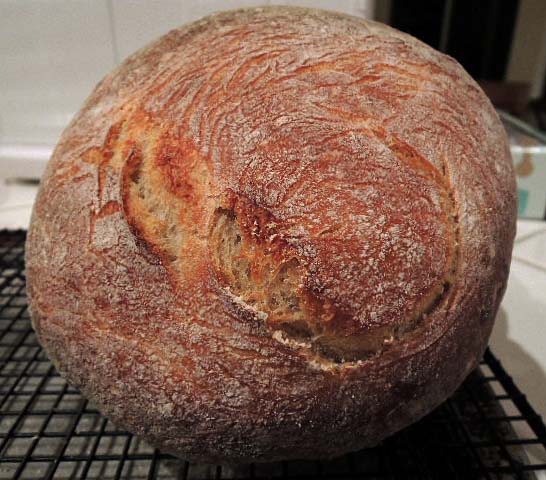
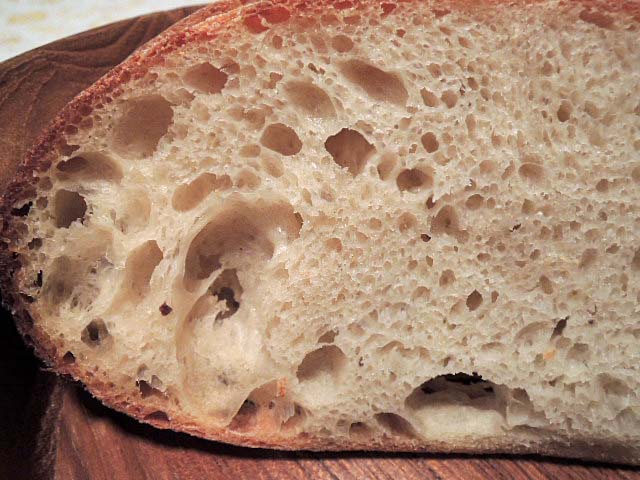
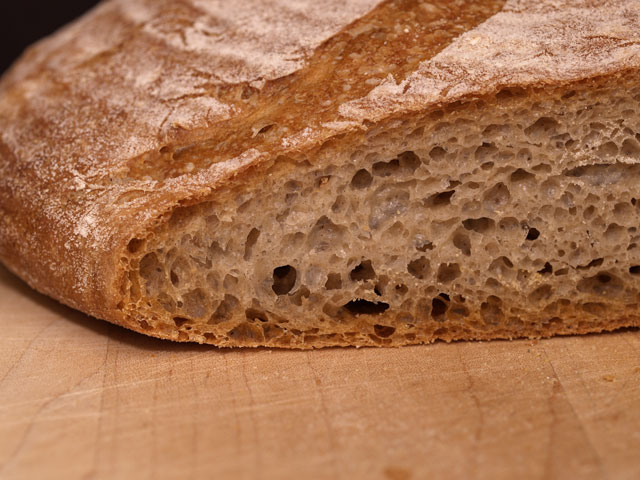
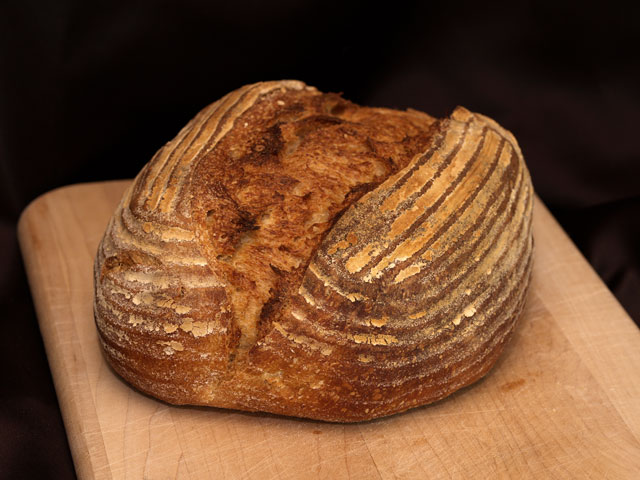
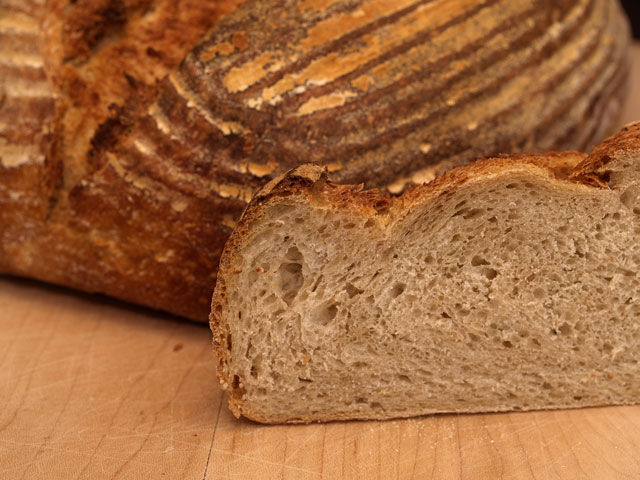
The dough was even more slack than the last bake, and it spread significantly when transferred to the peel. However, there was very nice oven spring. The boule ended up with about 4 times the height it started with. The folds did not open up like the last bake. This may have been partly due to longer proofing, but I probably sealed them too well in tightening the boule when shaping. I would describe the crust, crumb and flavor as essentially identical to my first bake of this bread: Crunchy crust, cool, sweet, chewy crumb. Perhaps a subtle nuttiness from the durum flour. Pretty darn delicious! This bread is a strong contender for the list of breads I bake frequently. David
Submitted by Salilah on January 28, 2012 - 5:59am Burns Night Baking...We are invited tonight to a Burns Night supper - long-running, we've been going for years! I thought this time I should try to take some bread (though I wasn't confident enough to stop them buying bread - must be more confident!) I recently purchased Bertinet's Crust, and Hanseata (I think) mentioned the Breton Bread, so I thought I'd give that a go, as unusually I had some fresh yeast. As this was a new recipe, I decided to also do DSnyder's Pugliese as usually that works really well for me. 18 people so it felt like a big quantity was required - so I did around 2kg of each, which was a fun experience in itself, as I've not done these volumes before! Ingredients - Breton Bread Pre-fermented dough: 3.6g yeast, 3.6g salt, 180g strong white flour, 126g water - 6 hours or so (it went a bit faster) Final dough: 10g fresh yeast, 750 strong flour, 200 buckwheat flour, 50 rye flour, 300g (all) pre-ferment, 15g sel gris, 700 water - total 2038g at 70% Ingredients - Pugliese 200g starter, 720 water, 590 strong flour, 160 "00" flour, 250 durum flour, 20 salt - total 1940 at 75% I thought originally the breton bread would be fairly quick, but the pugliese also went really fast - so I nearly ran out of proofing baskets! As it was, I ended up doing 3 Breton and 2 Pugliese - both the Pugliese in the La Cloche, two of the Bretons on a stone with metal lid and the other in La Cloche
The Breton didn't rise as much as I'd hoped, even in the La Cloche - but I guess there's quite a lot of buckwheat in there! I did bake it when I thought it was just about ready - so a bit quicker than planned... Quite a thick crust (this one was under the metal lid), pleasant taste, went well with eggs this morning... Not sliced the Pugliese as both are going down to the dinner, but it rose beautifully (as usual) and I hope will taste good
Challenges of timing - the Pugliese went a LOT faster than I expected - so rather than my usual proof overnight in the fridge, I baked them all the same day. Luckily I have two ovens, so one had the stone and the other the Cloche! Will see what the reaction is tonight Submitted by Juergen Krauss on July 7, 2011 - 3:16pm Baking with Italian flours, first experiencesInspired by the recent blogs about Pane di Altamura by Franko http://www.thefreshloaf.com/node/24102/pane-di-altamuramy-ongoing-project http://www.thefreshloaf.com/node/24172/first-success-altamura-project and David Snyder http://www.thefreshloaf.com/node/24139/pane-tipo-di-altamura-quotlocal-breadsquot, and by the then hot weather I decided to try out this intersting bread. In Britain I found three suppliers of Italian flours, so I ordered some. I got semola di grano duro rimaccinata (the semolina used for bread) by Divella, from near Bari. The grains seem to be a blend from European countries. I also got tipo 00 soft wheat flour "La Farina di Don Arcangelo", and durun semolina by the same make, both from Altamura. The semolina is coarser and makes wonderful pasta. Here a picture of the flours: No 1: TRS fine semolina (durum), which is availlable in Asian shops. Origin: EU countries (to compare) No 2: La Semola di Don Arcangelo, from Altamura No 3: Semola di grano duro rimaccinata by Divella, milled near Bari No 4: La Farina di Don Arcangelo, from Altamura (tipo 00) No 5: Shipton Mill No 4 organic strong white flour (my current standard flour, to compare) To try out the Italian flours I wanted to make a bread I knew well: I used the Pugliese formula I learned at the Lighthouse Bakery with two changes: 1. I used 20% semola rimaccinata and 80% tipo 00 (for biga and dough) 2. I found an interesting baking profile in Italian bread blog: Preheat at maximum temperature, bake for 60min with no steam and turn to 200C immediately. The result is quite amazing, my best Pugliese yet. The taste is not as sweet as the one made with English flour, but it has more depth, and an amazingly elastic yellow crumb. A good contrast to the thick crunchy crust. Next I tried an Altamura style bread, but I got rushed, and the temparature in our kitchen dropped. Not quite understanding the durum leaven I mixed too early. The resulting bread took a long time to raise, the crumb is uneven and it tastes very sour. But I am satisfied with my first attempt, I really like the consistency and feel of the semolina dough. Here a picture of the loaf: All in all it is great fun to work with these flours, and it is really wonderful to find so much inspiration here on TFL. Special thanks to Franko and David, Juergen /* UPDATE */ The inside of the Altamura bread: I think the main problem here was fermentation control: The temperature in the kitchen dropped by about 5C during the last elaboration of the starter, and the effect was more drastic than on wheat or rye starters. I used the starter far too early. Lesson learned The sources for the flours: http://www.mattas.co.uk for the Divella semolina http://www.mediterraneandirect.co.uk/ for the altamura flours - they seem to be out of stock now (as of 8 July 2011) DeCecco has an online shop (for European countries) where they sell Semola di grano duro rimacinata. They are based in Puglia,but like Divella they seem to use grains from all over the place. I didn't try that (yet). http://www.dececco.it/eshop/en/

Submitted by MadAboutB8 on April 10, 2011 - 5:11am Pugliese - the quest for durum flour was over...I finally found it!Somehow, durum flour eluded me. I thought that fine semolina was durum flour (given that they're both comes from durum wheat). I thought durum flour was called fine semolina in Australia. Thank to Sylvia (SylviaH) for pointing it out in her blog post together with pictures that they're totally different. I then just knew that I had made semolina bread all along with fine semolina thinking that I got the right ingredient (mind you, the breads tasted lovely and the crumb strucdture was fine with fine semolina as well). So, I was very excited when I finally found the durum flour at an Italian grocer. First recipe that comes to my mind was pugliese. I used the recipe from Peter Rienhart's BBA, with 40% durum flour. The dough hydration is 77% without considering mashed potato. I also included about 20% mashed potato in the recipe (recipe only calls for 12% but I got the more from the left-over). So, the effective hydration could very well be close to 90% if taking into account the liquid from mashed potato. This was the wettest dough I worked with so far. It was far too wet to knead, so I had to do the stretch and fold in the bowl for a number of times to develop the dough strength. It was fascinating to see the dough structure changed from pancake-like structure, to develop membrane and bond together. Ahh, the wonder of wheat!
The bread was lovely and chewy. Semolina tasted somewhat different from wheat, it's nuttier and sweeter. I also wonder what the flavour profile would be like if made using sourdough culture instead of yeast? For full blog post and recipe, you can find it here. Sue Submitted by gixxerrider21 on November 14, 2010 - 1:17pm First attempt at a puglieseI am rather new at making homemade bread but it is something I am growing to love. I come from a family of cooks and bakers, mostly from my mom's side of the family. Her father was an excellent cook and baker; I recently stumbled upon one of his bread recipes for buttermilk loaf bread. I have been making this loaf on the weekends for the past year or so. However, he kept the majority of his recipes in his head and didn't write many of them down. This has forced me to branch out on my own. This weekend I prepared a biga pre-ferment for a pugliese from "The Bread Bible" This recipe does not use Durum flour which is fine because I was unable to locate any at my local grocery. The biga was prepared with a mixture of all purpose flour and coarse rye flour, a small amount of commercial yeast and water. This mixture was allowed to ferment for about 18 hours at a cool temperature. I was pleased with the way the bread turned out, however I was hoping for a large sized boule compared to the one i was able to develop.
The crust was soft and the crumb was chewy with a medium distribution of holes.
Overall I was satisfied with the results. I currently have a sourdough starter in the making and cannot wait to make my first loaf in time for thanksgiving stuffing. I look forward to any comments and suggestions Cheers, -M Submitted by Avie93309 on June 22, 2010 - 9:15am My 1st PuglieseBeen looking forward to make this bread. Finally got my Durum Flour in the mail (not available at local stores). Followed the recipe from Rose Beranbaum's The Bread Bible. Flour (bread:67%, durum 33%), Water 80.4%, Yeast .79%, Salt 2.2%. Biga: 75 g Flour, Instant Yeast 1/16 tsp, water 59 g, optional: Malt Powder 1/2 tsp. Worried that I totally ruined the dough. I allowed the biga to ferment in a cool area for 24 hrs (recommended @ 55-65 F). I thought my storage room is that cool. When I checked the room temp it was 72%. Baked on stone: 5 mins @ 500 F; 20 mins @ 450, turned half way thru. Internal Temp. Target: 205 F, Actual 200 F.
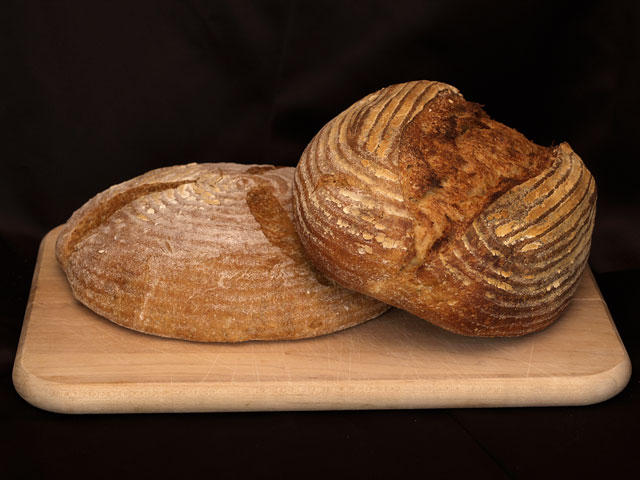
Submitted by OldWoodenSpoon on January 24, 2010 - 12:45am Pugliese resuscitation, and Sourdough redemptionSometimes you just have to admit it: you messed up. My turn! Again... This time it was this sad loaf of Pugliese, sitting along side the boule of sourdough that is my redemption for the day's baking. Here they are together.
Resuscitation: I had another go at Rose Levy Berenbaum's "Brinna's Pugliese" Friday night, but this time I tried it with a 20% substitution of semolina flour. I started the biga on Thursday night and let it ferment in a back room cupboard (about 60F) till Friday afternoon. Then I put all my things in place (Ha!) and prepared the dough. Everything was going along just fine until, about 90 minutes into the bulk fermentation I noticed... nothing. The dough had not grown at all. I had it in a warm spot, so I left it for a while, until I realized the truth: Except for the biga, I had not put in the yeast. I had gotten distracted with rechecking the flours after the semolina substitution, and never even got the yeast out of the refer. So much for "everything in place"! Oh, no, now what? I opened up the container and sprinkled the yeast (IDY) over the top, and folded it in. I got out my board and did several folds to incorporate it as well as I could, but this dough was wet, slack, super-sticky and gloppy. I had to continually wet my fingers to handle it at all without becoming part of it myself. I managed to get the yeast worked into it, and got the dough back into the bowl where it immediately took off. I could not believe it, but it nearly doubled in an hour. I formed it into a boule as well as I could and turned it upside down into a very well floured banneton. It filled the banneton and topped out in just another hour. I could not resist compounding my errors. The recipe says to bake on a sheet with steam added, but I had already baked the sourdough that follows below, and my La Cloche baker was in the oven already hot. I was determined to make this baby jump after having made such a mess of it. So I turned it out onto my superpeel ( a mistake), slashed it (another mistake since it was so fragile) and then "dropped" it off the superpeel into the preheated La Cloche (final insulting mistake for this poor loaf). It collapsed. It fell, flatter than one of my plain flour pancakes. As soon as I saw it I realized my error(s), and knew they were all my own. I put the cover on and baked it. The good news about baking for a hobby is that, most of the time, you can eat your errors. That will be the case with this pugliese. As you can see in the crumb shot here:
this loaf only turned out poor, not really bad. It forgave me more than I deserved here I think. The La Cloche pumped some spring into it so that it has a little bit of loft and a nice tender crust. The crumb is pretty dense for pugliese, but as you can see, there is a nice gelling of the starches, and it came out okay considering all the insults. The flavor is quite excellent, and the semolina addition has really had a positive impact on the taste. I will certainly be revisiting this loaf again with even more semolina in the dough. In the end this loaf resuscitated me after my near apoplexy at the glaring chain of mistakes. I'll learn from my mistakes and go on. After all, in a couple of days nearly all the evidence will be gone anyway!
Redemption: The sourdough loaf was actully baked first. This is another of "my" sourdough loaves, but this time I was determined to proof more fully than last time. This formula is one that I've been using to break in and get used to my new willow proofing baskets, and I'm quite happy with the results so far, considering the low 64% hydration. Here is the loaf:
As you can see, I'm still not doing a proper job of preparing the banneton before I put the loaf in for proofing. I'm hoping that as I use them more, things will level off. Right now there are sticky spots where lots of flour stays, and there are dry spots where very little to no flour at all will stay. I'm currently layering on AP flour first, then white rice flour lightly on top of that. The flour that remains on this loaf is dry in places, and pretty oily in others. The oil is from the initial spraying of Baker's Joy flour/oil spray I used to "season" the banneton initially in accordance with the instructions. Since then I've just been applying the flours, proofing the dough, then letting the bannetons dry out on the counter. When dry, I brush them thoroughly and put them away till next time. The crumb of this loaf is better than my last effort thanks to better proofing, and the loaf did not explode so much in the oven when baked. It was baked in La Cloche for 15 minutes covered, with the temperature at 500F for the first 10, then down to 460F for the rest of the bake. The cover came off at 15 mintues, effectively ending the steaming time at that point. I let this loaf bake a little extra long because I was trying to darken the crust. I got most of what I wanted, but ended up with an internal temperature of 209F when I finally gave in and declared it done. It is not the least bit dry though, and the crumb is very tender. Here is the shot:
There were really two loaves, and the crumb shot is of the "other" one. The cut loaf is already gone, and the uncut loaf was gifted to a neighbor. I'll just have to try again I guess. Darn. :) OldWoodenSpoon Submitted by Russ Simpson on January 3, 2010 - 1:15am Durum vs. KamutI got it in my head this weekend that I wanted to make a loaf of Pugliese (for the first time). I was working from the recipe in "The Bread Baker's Apprectice" and realized it called for Fancy Durum - but thought I would go the next morning and get some from Whole Foods or PCC (here in Seattle). But I didn't find it at either store. A few internet searches on my mobile phone led me to believe that I could substitute some Kamut for the Durum (which I was able to find at PCC). So, I used about a 40-60 Kamut-Bread flour mixture for the dough and proceeded. Picture of the results below. I will have to eithr mail-order some Durum or find a local supply for next time in order to compare/contrast - but I was fairly pleased with the results. There's sort of a question here. Is Kamut an acceptable substutute for Durum or is it just entirely different? The bread turned out to have a nice aroma and the crumb is very chewy and has a very pleasing texture. The crust is even more chewy. Thoughts?
Submitted by breadbakingbass... on October 5, 2009 - 8:16am Test Loaf #3 (Pugliese) – 10/4/09Hey Freshloafers, Long time no post. Just wanted to share with you a recipe that I have been working on. I have been on baking hiatus since summer as it was too hot to turn on the oven... This is my 3rd try in the past few weeks to bake something that is edible... Lemme know what you think and if the recipe works for you. Cheers, Tim Test Loaf #3 (Pugliese) - 10/4/09 Tools: A few days before starting: Day 1 - Start at 10:30pm Day 2 - 9:30am Place sheet pan on bottom of oven, place the 2 baking stones in oven as above and turn oven on to 500F with using the convection bake function. Place oven thermometer on top stone. When loaves are proofed, impression barely remains after poked with a floured finger, and oven reaches 500F, take oven thermometer out, using a flipping board (loaves will go onto stone seam side up), place 2 loaves directly onto top stone, and 1 loaf onto bottom stone, and them immediately place ½ cup of water onto baking sheet at bottom of oven, and close. Wait 1 minute and place another ½ cup of water on the baking sheet at bottom of oven and close. Bake for 20 minutes at 500F, rotate and shift loaves on top stone to bottom stone, and from bottom stone to 15 minutes, and lower oven to 425F. Loaves are done when the internal temperature at center reaches 210F. Let loaves cool completely before cutting, about 2 hours... Link to photos in Facebook: http://www.facebook.com/album.php?aid=108965&id=510844475&l=a97991a734 Submitted by SumisuYoshi on September 10, 2009 - 12:31am Hello All!I've been a longtime reader (lurker) of the The Fresh Loaf and haven't really had the chance to bake for a while, oven use when it was hot out just wasn't working, I was really busy with work, etc. But I recently jump started myself back into it with the BBA Challenge, and the realization that my girlfriend didn't care about me using the oven at her house! |
ALSO ON |