SearchUser loginBread BooksFavorite Recipes
|
Submitted by chyatt on September 21, 2011 - 8:44am Proofing basket volume vs. dough weightI hope I'm not repeating another thread, but I haven't found anything on TFL that quite answers my question. I recently purchased some proofing baskets from brotform (one round, one oval). Having no other information to go by on dough weight vs. proofing basket volume, I went by their recommendations, a 10.5" oval basket for 2 lbs of dough. The dough weight after bench rest is consistently between 2-2.5 lbs, but it seems that my boules in particular have spread out too much in the basket during proofing, and so are relatively flat in the bake. The batard is coming out better, though it still feels a bit on the larg side. I'm happy to admit this is due to troubles of my own making with regards to over proofing or poor scoring, but is there any rule of thumb on the optimal volume of the proofing container for a dough weight? Thanks,
chyatt
Submitted by dmflahive on May 17, 2011 - 6:17pm Pullman splitting during proofI'm posting this because I can't for the life of me figure out why I'm having this problem. I've tried punching-down, folding, not folding, long proof, short proof, rolling the loaf tight, rolling the loaf loose, bench resting, not bench resting, spray oil, pretty much everything I can think of and yet these pullman loaves always split on one side about an hour into the final proof. Any insight anyone can provide would be much appreciated. BTW, these pictures were taken just before the loaves went into the oven. From yesterday, with one turn at 45 minutes into the bulk fermentation.
Today, no turn.
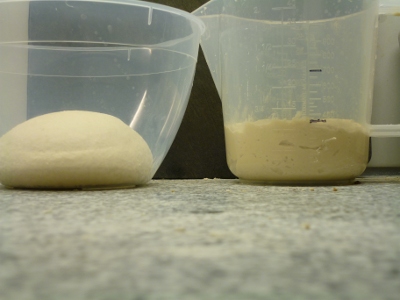
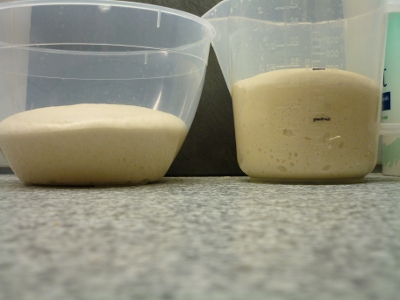
Thanks in advance. Submitted by Juergen Krauss on February 15, 2011 - 11:41pm Test Tube Baking [2]: Bulk fermentation, doubling in sizeHi, The famous "proof until double in size" is present in almost every recipe. I remember seeing some photos somewhere, but I can't remember. So, here is my experiment. I made a white dough according to RB "Crumb" (100% Flour, 70% water, 2% salt, 2% yeast), divided it after gluten development and proofed one half in a cylindrical measuring cup, the other half in a transparent pudding bowl. This way you can see what a doubling in size looks like in a non-cylindrical bowl. Ambient temperature was between 22C and 24C, it took about 90 minutes to get the doubling in size. Here are the pictures.
In this picture I simply combined the previous two, for comparison.
Thanks, Juergen Submitted by jrudnik on October 17, 2010 - 1:36pm AB&P Brioche HelpHi, This weekend I decided to try some AB&P Brioche. I have made Brioche from Tartine before, and assumed this would be fairly easy, as it appeared to be less labour intensive. So I mixed the dough last night, put it in the fridge and shaped around 11 o'clock this morning. The only problem is, they have risen just barely or not at all. I am making 1 loaf in a standard size pan with 2 lb. of dough. Should I let this keep rising? Criticism is accepted! Thanks! Submitted by majorvox on October 13, 2010 - 8:38pm Proofing proceedure questionSo what exactly is the best way to proof? Keep the loave moist with a spray of water once in a while or cover them with damp or lightly wet towels? Or just let the surface crust form? Help! Submitted by AnnaInMD on October 7, 2010 - 4:26am Rise your dough in the microwaveA quick proof hint for the microwave as seen in a magazine: Yeast doughs that normally take an hour or more to rise at room temperature can be proofed in the microwave in about 15 minutes. Place the dough in a very large bowl and cover with plastic. Place an 8-ounce cup of water in the back of the microwave with the bowl of dough in the center, and set the power as low as possible (10 percent power). Heat for 3 minutes, then let the dough rest in the microwave for 3 minutes. Heat for 3 minutes longer, then let rest for 6 minutes. The dough will double in bulk. Submitted by Peggy Bjarno on April 4, 2010 - 10:08pm Bread Flour vs All-Purpose FlourI’ve been working since September to produce my own “perfect” sourdough bread. Three weeks ago I was pretty much there, but you know, I keep tweaking, trying to make it more sour, and the recipe more reliable. Well, my tweak this time was changing flour. I’d been using KA Bread flour, but kept reading about people using KA All-Purpose flour and it was “just the same,” “worked just as well,” etc., etc. They never said it was just as good but different. . . I had promised to bring two loaves to the Easter Dinner party we were invited to, so I took my starter out of the fridge Thursday night and started feeding it: quarter cup of bread flour, two tablespoons purified water, twice a day. This starter is happy, vigorous, bubbly, and I’ve come to understand that the fault lies with the baker in this house, not with the starter. It’s been very patient with me as I’ve struggled to learn. This morning I started my bread, using about 1/2 cup of starter, along with some preferment, and adding those to 500 gm warm purified water. I added 750 gm flour (350 each of bread flour and AP flour, with 50 gm of rye flour) and 15 gm salt. It was very shaggy, much more than I remembered. Hm. Can’t be all that different, right? It’ll come along. I rolled it into a ball and put it into an oiled container in my rising area. Did hourly stretch-and-folds four times. The dough was so wet I ended up working on a floured surface, with floured hands. I cut it in half, shaped it into two loaves and put them into my floured couche. An hour into the rise I started to preheat my oven to 500 degrees. And put my cast iron Dutch oven in there as well, hoping it would be my life saver. (It was. . .) An hour and forty-five minutes of proofing and they were ready to go, but I could see that they were still soft and would not likely maintain their shape. The first loaf basically de-gassed as I rolled it onto the Silpat mat I use for baking. Bummer. I poured the other loaf into the heated Dutch oven, sprayed it with water, and covered it. I dropped the temperature to 470 and baked them for thirty minutes. The loaf was done, but pale and misshapen. I took the cover off the Dutch oven and gave it another ten minutes at 450. It was a glorious honeyed mahogany color, with a few surface bubbles and some shallow thin streaks of cracking (I’ll bet there’s a term for that that I don’t know. . . I never slashed the surface, but it did break open beautifully with these feathery trails.) I’d love to say that the pictures are here, but the loaf traveled to our dinner party on the cooling rack in the back seat of the car. It was consumed in total with oohs and ahhs, enjoyed by all. I’ll do it again. WOW! The flavor was full, nutty. Not “sour” enough, but probably sour to some. The crumb was grayish (the rye, probably) beautiful, with smaller holes than I had hoped for but lots of them, and that lovely translucence that some bread gets. So. . . questions and comments: Did the change to 46.6% AP flour make the difference in wetness? If so, I will go back to 100% bread flour. Is the success of Dutch oven baking more reliable? (I was desperate that at least ONE of my loaves “work!” and the Dutch oven did it with dough I thought was a loss.) With dough that wet, how could I have increased the flour after the first stretch-and-fold with any reliability, to something that would have worked as loaves. . . ? . . . and how do I make it more sour? I’ve been reluctant to go to the citric salt that I understand is used by many commercial bakers, but maybe it’s time. Thanks for any comments or suggestions – love hearing from the experts and hard-working wannabees on this site. It’s awesome! Peggy
Submitted by UnConundrum on December 16, 2009 - 7:42pm Banneton stacking and proofing questionI'm planning on baking about 60 loaves the day before Christmas. Since I do this pretty much by myself, I'm planning on mixing and shaping the dough on the Wednesday before Christmas, baking on Thursday. I lined up bannetons and was planning on letting them rise overnight in my enclosed proofing box. Unfortunately, the bannetons ended up being bigger than expected, and they won't all fit in the box (I was planning on 5 per layer and only two fit). My next thought is to lay them out on a table, but I'm concerned about them drying out too much as I don't have anything to cover them with. Should I wrap them in garbage bags or any other thoughts? Should I just let them sit out and not worry about it? I expect they'll be proofing about 12 hours until I can get the WFO up to temperature. Submitted by John Ambrose on November 15, 2009 - 4:12pm Optimum Proof TemperatureMy starter will celebrate his first birthday next month. It seems to be very robust, however two issues have plagued the process since starting. These issues are flavor and proofing, which may be related. Process overview: Flour (KA Bread) 100% Water 65% Starter 20% (have varied the hydration levels from 50% to 150%) Salt 2% Autolyse 20 min, add salt, first rise 2hrs, strech and fold, another 2hr rise, strech and fold, preshape, overnight in refrigerator, warm up then shape with final proof up to 3hrs. The kitchen is typically ~70 F for the proof. Loaves look good, but oven kick can be as much as 50% as displayed in the attached pics. Minimal SD tanginess. Any suggestions? Thanks, John Ambrose
Submitted by LeahM on September 30, 2009 - 12:38pm baguettes! and a slashing questionSo this weekend I went for another round of the Anis baguettes. I am loving the recipe--so tasty, so crusty! Plus the practice (and video tutorials posted around here--thanks!) are definitely helping me work on slashing and shaping. Which brings me to my current question. I thought I did a pretty good job (for me) with the slashing this time. And the cuts definitely opened nicely in the oven as far as shape goes. But I'm not getting any sort of color/texture/crust distinction between the slashed areas and the rest of the crust. Here's a picture, you can see that the loaf is springing and opening, but it's pretty much an even brown all over, like the cut is just a shaped ridge... This happens similarly with my sourdough, so I figure it's something I'm doing, as opposed to an issue with the dough itself. Any ideas?
|
ALSO ON |