SearchUser loginRecommended BooksFavorite Recipes
|
Submitted by LoganK on October 10, 2009 - 8:35am How to trick a thermostatI just got a hearthkit, and was very pleased with its inaugural run with a couple pizzas and loaves of pain au levain (margherita was beautifully cooked in about six minutes). However, it took much longer than expected to preheat all that mass because the oven kept cycling. The hearthkit's thermometer got up to the mid 300's relatively quickly, but at that point my oven thermostat, set at 500, started to cycle. It was well over an hour and a half before it was usable and I never did get it quite as hot as desired. I'm wondering if anyone has tried to trick their thermostat into leaving the element on continuously until the stone is ready? Or, can someone recommend a different solution? thanks a lot, Logan Submitted by maggiem on September 16, 2009 - 10:40am Cuisinart ovenI am wondering if anyone has any input on the countertop cuisinart ovens. They say you can roast a chicken in one or cook pizza, so I thought it might be a good choice for extra bread baking space too. Any thoughts are appreciated. Maggie Submitted by jeromethegiraffe on July 28, 2009 - 1:37pm Your opinions on the ultimate baker's oven please. My lemon must be replaced!Hello everyone!
I have had it with my Whirlpool self-cleaning convection oven.
I bought it two years ago for the sum of $1,500 plus tax - Not cheap. And yet, it has been problem-plagued ever since.
The trouble began when I started baking bread using the convection feature. The control panel would freeze up and not respond at the end of baking. It had a "touch-sensitive" glass panel, and no matter what I did, it would not turn off. Fortunately, I purchased a five-year warranty with the appliance. The repairman has come at least five times and has been unable to correct the problem. He replaced some electronic parts and even the entrire panel at one time. It would work okay for a little while and then act up again. I am convinced this is a design flaw with this model of Whirlpool convection ovens. This is likely due to the way the convection is vented through the back of the appliance in the same area that the electronic panel is. Extremely hot, humid air and electronic components do not mix, a fact that was somehow overlooked at Whirlpool. The responsible thing to do is issue a nation-wide recall... But that could affect Whirlpools bottom line of course. This is a dangerous flaw as it could leave the homeowner with an appliance that will not shut off and could potentially lead to a house fire. Luckily, I put my stove on appliance wheels, so I was able to pull it away from the wall to unplug it when this happened. The company that backs the guarantee notified me they now agree the stove is a lemon and will replace it with a new one of similar value. The question I have is - what would you recommend as a decent range (gas or electric) and why? I would prefer a quality appliance with none of the features which cause trouble down the road such as self-cleaning, convection, touch pad, control panels. Better off with real knobs to control the stove instead of a digital keypad that costs $500 or more to replace. I know many of you have had similar experiences and have had to dump an otherwise perfectly good appliance due to this built-in obsolescence. It's a real disgrace. So thank you for taking the time to read this and hopefully we can begin a lively discussion on which oven is the best value for the home baker!
Thank you and happy baking!
Jerome the Giraffe Submitted by PeterPiper on July 27, 2009 - 3:47pm Help, I need a new oven!Last Sunday, my most epic baking day yet (14 loaves, five types), my oven bit the dust. It's a less than five-year-old Kenmore gas oven. After preheating for 2.5 hours on Sunday, it only got up to 200 degrees. More broiling and preheating wouldn't get it hotter. The repairman came on Friday and said we needed a new main circuit board. And a new sensor. The total would be $320. We bought the oven used for $150. It is possible that the huge billows of steam did something to the board. Frankly, I don't see why you need electronic circuitry in an oven. It is possible that the last 6 months of intense baking with multiple stones in the oven caused a problem. I don't know, I'm not a mechanic. But I do know that one should be able to bake in an oven without melting down the circuits. So. My conundrum now is about oven types. Here in Southern California, there are tons of vintage ovens from the 40s and 50s around. They are tempting both for the reliability of mechanical and solid components, and for the possibility of a double oven (yeah, Wedgewood!). For all you bakers out there, which way should I go? Is it better to get a newer (and bigger) oven that may break down again with all the steaming and baking? Or should I go for a 50-year old model with a smaller oven but sturdier components? FYI, I'm looking at Wedgewood, O'Keefe and Merritt, and Gaffers and Sattler for vintage ovens. I have no idea what new oven brand would be good. Submitted by jesswin on July 12, 2009 - 5:42pm Review: Cadco Countertop Convection Oven - XAF-113
EXPERIENCE: I have only used it to bake two loaves so far since I just installed it yesterday. What I immediately noticed was that the oven heats up much quicker than my conventional oven and stone. Normally, it takes my oven 1 hour plus to reach 500°. With the Cadco, it took about 25 minutes!
The second loaf was Hamelman's Golden Raisin and Walnut bread. I had never made this before and figured this would be a good test of whether just following simple guidelines for conversion to convection would be sufficient to produce a good loaf. Well, I was more than satisfied with the loaf. It had a wonderful crispy, chewy crust and a beautiful, semi-open and very moist crumb. I had no problems with over-browning of the crust with just reducing baking temps by 25-30 degrees. In trying to be "fair and balanced", these are some of the negatives: -Pretty noisy although I have gotten used to it. Submitted by treelala on July 7, 2009 - 8:57am Brick Bread Oven WorkshopI Was thinking about how to bring health to a community and I thought about scripture about breaking bread with others. I decided to reach out to Cincinnati my home town. I am going through the community centers and reaching out to the directors to be involved in a brick bread oven workshop. I believe this will be a great tool for healthier neighborhoods. I wan to share this workshop with the fresh loaf community hoping that you will npass this tool along to people you know who are go getters when it comes to lifting up urban life. Blessing to all! Featured Site: Red River Gorgeous, Bread Oven Workshop Red River Gorgeous, Wilderness cabin retreat sponsoring a breadoven workshop hosted by Welsh timberframer, Don Weber. Interested parties please email cdourson(at)redrivergorge.com. The workshop will be held the weekend of July 24, 25 & 26, 2009. Stay tuned for details and get ready for two days of hands on experienceop and enjoyment. Submitted by themightytwix on June 30, 2009 - 7:17pm My Bread isn't BrowningHi Everyone, I have been a long time reader of this forum, but this is my first post, and I am in need of some advice. I have been baking for the past 2 years with good success, when it was time for me to pick up and move across province to go to university. My old stove was one of the smaller ovens, which was perfect for creating good steam, and my loaves were great, though I could not bake a long baguette!!!
So I was delighted when I arrived at my new apartment which had a brand new stove. It has a digital temperature gauge (this has to be good I thought), it is a larger capacity as well (also good I thought), but no... nothing. My loaves bake, but they don't brown!!!! I get no crust! Today I made my weekly Hamelmans Toast Bread (though I use an au levain), it was looking perfect, but it did not brown!!!! I left it in there for 20 more minutes and still nothing. No Browning, no crust.. I am devastated. This is the 3rd loaf that has been like this. Has anyone had any experience with this??? I believe that the problem might be temperature, but I don't have a thermometer at the moment and cannot test it, and I thought maybe someone here could think of something. Thanks in advance for any help or thoughts
The Mighty Twix
Happy Canada Day! Submitted by Edouard on March 18, 2009 - 5:30pm Wood Fired Oven finished
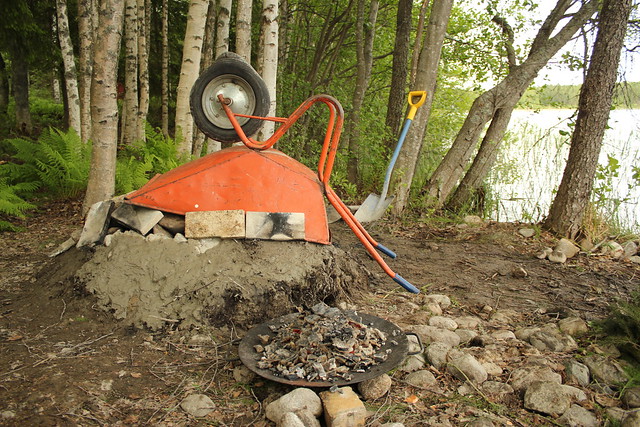
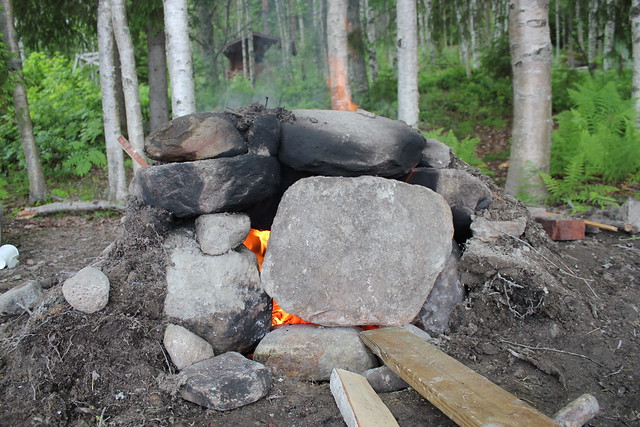
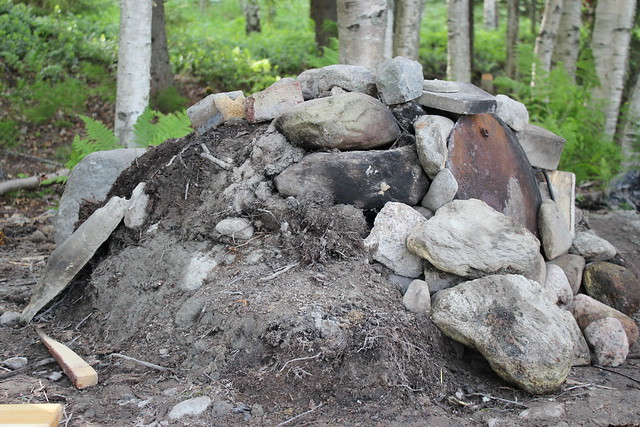
http://www.flickr.com/photos/technopeasant Trying again ... Let's see if the above works, first, before I continue ... Finished my wood fired earth oven project. Took about two months and change, and I spent around $150 total. At the same time, I enclosed a side yard and made a private courtyard for entertaining and relaxing. Total cost of that was less than $300 because virtually all materials came from salvage and demolition sites. Good quality materials, at at that. Major costs were half dozen pressure treated posts and Quickcrete and various nails, screws, hardware. Oven was built like this - foundation hole, sub-grade three feet to compensate for frost line. Built up a creek stone foundation to one and a half foot above grade, back filled with gravel. Top of this foundation wall leveled with mortar and salvaged brick to make a square and plumb foundation for the wood-form I used to pound out a rammed earth base for the oven. Rammed earth base is 52" x 52" and I expect it to be a superb heat sink. Made of clay and clay silt soils from my property (this is desert SW, four corners area). Mixed with what our local supplier terms 'quarter minus fines' a grade of finely sifted gravel and clay. On top of the base went 4" of sand, then a layer of firebrick. Brick and Navaho sandstone for a lintel make up the door to the oven. Built up a wet sand mold of the oven void on top of the leveled firebrick, then molded a heavy clay/sand mix around the sand-form to shape what would become the interior void of the oven. Oven is 27" x 20" Next, lots of cob. Cob are loaves of wet clay, sand, mud and chopped straw. Many many loaves to build up the mass of the surround to make up the mass of the oven itself. More mass, more heat retention. This thing probably weighs 2 tons, at least. Removed the wet sand and revealed the oven void. Finished the outside with a sandy wet clay-slip. A coating of linseed oil just in case. And there you have it. Lots of physical labor and a fine oven that burns hot as that hot place in the afterlife. Built a brick paver area around the oven for work space, all salvaged from a 1910 school being demolished. Roof panels and posts from a theater demolition and I have a dandy outdoor wood fired oven that works like a champ. I constructed two doors out of eight inch thick slabs of wood which I covered with sheet metal. One door for firing, which just fits inside the entrance, allowing smoke to exit the chimney, and a second door made the same way that's constructed to fit further in and occlude the chimney opening for 'soaking' the fired interior. Pictures of bread and pizzas will follow. Hope you like it. Submitted by brakeforbread on March 3, 2009 - 10:37am Experience with Oven malfunction?I was hoping some might have suggestions. I have a standard freestanding gas range/oven. Recently the electronic panel that operates the oven died. The gas range top still works. It's going to be close to $300 to replace the part on an oven that retails for about $550. I could upgrade to the same brand gas oven with convection for about $800 (good deal at a local place that sells scratch-and-dent stuff). But here is my concern, two different repairmen I talked to said that this just typically happens with these new electric control panels because they are not built to handle high heat and moisture. I of course am running my oven at very high heat (but come on, it's an oven) and high moisture (steam for bread). Has anyone else encountered this? Would I be safer with an electric oven? The gas oven has always steamed well and vented well and I've never blocked the vents. And, if I were to get a new oven, is convection worth the extra cost? How have other bakers liked the convection feature.
Thanks for your suggestions. Submitted by mcs on January 27, 2009 - 8:01am gas vs. electric oven usage costI know most people have a preference for using either gas or electric ovens. For those of you shopping for a new or used one to purchase, I thought I'd point out the basic costs of running them so you can weigh out the pros and cons using your local electricity or gas costs. I'll base this example on the two ovens I use; one is electric and one is gas (LP). Electric ovens are rated in watts used per hour or KWH (thousands of watts per hour). So an oven that is rated at 11,000 watts uses 11 Kilowatts per hour or 11 KWH. Propane and Natural Gas ovens are rated in BTU/hour (here anyway). My LP oven uses 60,000 BTU per hour. It takes approximately 1 gallon of propane to burn 90,000 BTU. So my oven uses (60,000/90,000) .67 of a gallon of propane to run for 1 hour. Since propane cost me $2.19 per gallon, my running cost per hour is .67 x $2.19 = $1.46 per hour. Of course these are approximates based on the manufacturer's specs, plus different ovens take longer to heat up than others and retain their heat more or less. -Mark |
ALSO ON |