Submitted by mizrachi on April 13, 2009 - 7:37pm

Using a FibraMent stone correctly

Two simple questions regarding my new FibraMent baking stone:


Does one place a La Cloche or other bread pan on top of this baking stone? 

Will steam crack a FibraMent stone?


Many thanks!


Miz

Submitted by mizrachi on April 13, 2009 - 7:36pm

FibraMent, La Cloche, Steam

Two simple questions regarding my new FibraMent baking stone:


Does one place a La Cloche or other bread pan on top of this baking stone? 

Will steam crack a FibraMent stone?


Many thanks!


Miz


Submitted by KAZ on December 5, 2008 - 6:17am

Funny Thing On The Way To A Loaf

So I'm really pumped about trying out my new cloche with dreams of the perfect crust dancing in my head. However my overriding thought is that I don't want to destroy what appears to me like an expensive version of clay flower pots that I have witnessed  becoming shards. First thing is to season with a light coat of oil and I apply what is to me a light coat over bottom and sides and preheat to 500 degrees and have my Sourdough ready to plop(you already know,don't you) into my new cloche which I do including some nice slash. Now, I hear the sizzle of my dough in way to much oil more akin to deep frying than baking. Seasoning/baking should have been a seperate process,but I'm all in so I let it roll. Out comes a beautiful 205 degree loaf that lifts right out leaving a nice seasoned bottom. Two hours later I slice off a nice chunk that has the perfect crust and the unmistakable aroma/taste of Vegetable oil infused  throughout as evenly as can be done. Now my cloche is seasoned/unbroken and in another 20 hours proofing I'll have another go at the perfect crust. Regards

Submitted by PMcCool on June 13, 2008 - 6:22pm

Levy's Real Jewish Rye


I had occasion to try several new things last weekend: Rose Levy Berenbaum's recipe for "Levy's" Real Jewish Rye Bread, one of my recently acquired bannetons from SFBI, and the Pampered Chef equivalent of a La Cloche (which has been sitting around unused for years).  This also marked the second time that I have made bread on the new soapstone countertops that were recently installed.

The recipe comes from RLB's "The Bread Bible".  The bread contains 3.3 oz of rye flour, vs. 8.5 oz of bread flour, so it is scarcely any more sticky than a wheat dough would be.  And with 2 tablespoons of caraway seeds, rye isn't the dominant flavor.  The bread begins with a yeasted sponge, which is allowed to ferment 1-4 hours.  It eventually bubbles through a flour layer that is placed on top of the sponge:

Fermented sponge 

Once the sponge has fermented, the flour mixture, oil and salt are stirred in.  The dough is then kneaded and left to ferment under an overturned bowl for a 20-minute rest:

Resting dough

After the dough has rested, it is kneaded again and then allowed to rise until it is doubled.  At that point, it is given a letter fold, then returned to the bowl until it doubles again.  After the second rise, the dough is flattened slightly and then shaped into a ball and allowed to rise until it has doubled.  Ms. Levy recommends that the final rise after shaping occur in a covered bowl.  I opted to use a fabric-lined banneton, dusted with rice flour, covering the exposed surface with plastic wrap to keep it from drying.

Ms. Levy suggests baking either on a baking sheet with steam, or in a cloche.  In both cases, she recommends having a baking stone in the oven as it preheats, then setting either the baking sheet or the (also preheated) cloche on the baking stone.  It seemed like overkill, but I followed the instructions as given, using the cloche.  The risen loaf was tipped out onto parchment paper, slashed, then placed in the cloche and covered.  I'll need to practice the technique a bit.  I was a bit gun-shy about burning myself on either the cloche base or its lid, so I wasn't as gentle with placing the loaf as I should have been.  It deflated slightly but recovered most of the loss with oven spring.

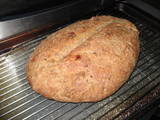
Based on the directions, I pulled the cover from the cloche about 10 minutes before the estimated completion of the baking time, expecting that it would finish browning during those last few minutes.  Instead, I saw that the loaf was already well-browned.  So, I stuck a thermometer in it, which quickly registered 210F.  At that point I declared it done and placed it on the rack to cool.  Here's how it looked:

Cooling rye bread

And a shot of the crumb, taken the next morning:

Crumb of Levy's rye

More of the color comes from the malt syrup in the recipe than from the whole rye flour that I used.  The crumb is firm and moist, the crust thin and chewy.  It makes a mean ham and Swiss sandwich. While I like caraway in a rye bread, the amount in this bread is more than I would use for my tastes.  Next time I make it, I will either cut back on the caraway, or substitute fennel or dill, which will be more to my liking. 

Thank you, RLB.  This is good stuff!

Paul

Submitted by Galley Wench on May 2, 2008 - 8:13am

Hello . . .from another newbie!


Hi Everyone:  

After lurking on this site for a week or two, I've decided it's time to get involved.    There's so much great information here!!

I've been baking for over 35 years.   Especially love the challenge of baking bread; sourdough is my favorite!    Guess you can say I'm a sourdough puriest . . . I shy away from sourdough recipes that add commercial yeast.  

I have a couple challenges with my baking . . . during the summer months we spend our time at our home in the mountains of Arizona where the air is VERY dry.   Baking at altitude (6,700 feet) certainly brings on it's own challenges too.   In the winter months we're on our sailboat on the west coast of Mexico, so my bread baking challenges are different there!

In addition to sourdough, I've gotten involved in the NKB . . . especially like the Cook's Illustrated Almost No-Knread 2.0; which works great while we're on the boat.     I've been baking in a cast-aluminum dutch oven on the boat, and a cast-iron here at home.  Today, I'm giving to try baking NKB in my Romertopf clay pot, have yet to decide if I'm going to use the whole pot or just the lid over a pizza stone.

Submitted by Trishinomaha on November 10, 2007 - 9:25am

Romertoph Clay Baker Question


Has anyone ever tried to bake bread in one of these clay cookers? I've had one stored away in my basement for years - used to use it for baking chicken etc. but it was so messy to try and clean. I just brought it upstairs (had been reading about La Cloches forever and finally ordered one from Eric at Breatopia - only $39.00 by the way! $10.00 cheaper the Amazon) Anyway, I got to thinking about trying to bake bread in the Romertoph - What say you all?

Trish

Submitted by BROTKUNST on June 28, 2007 - 9:45am

A simple suggestion ...

I use my LaCloche and my long "Italian" clay bakers with preference for the first 12-15 minutes of baking ...they don't work though for loaves that are simply larger than these shapes (e.g. 3lbs Batards).

I tried using the cover of our stainless turkey pan the other day and the result was just perfect. The cover fits in a diagonal on my baking stone and allows for the covered (ovenspring) baking of quite large or small boules, batards, baguettes.

Submitted by midwest bread on June 6, 2007 - 7:06am

La Cloche Questions

Hello everyone!