Submitted by dmsnyder on January 9, 2010 - 8:12pm

Greek Bread - Improved


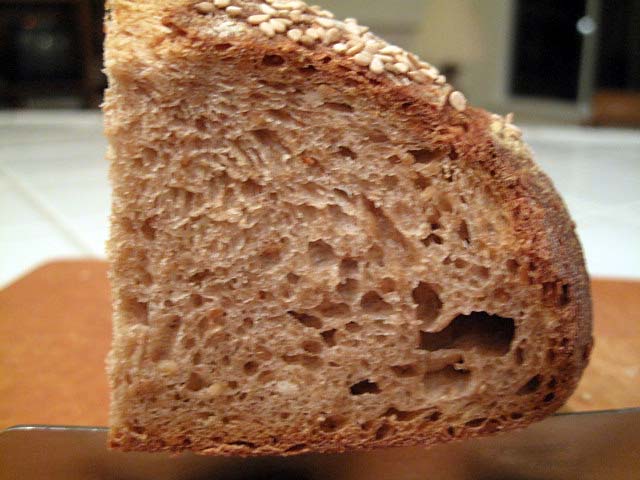
A couple weeks ago, I made Greek bread (Horiatiko Psomi) for the first time (See: Greek Bread - I finally make it with my Greek daughter-in-law). I based it on this recipe, which my Greek daughter-in-law said seemed closest to the bread she had had in Greece. It was good, but I felt it could be improved. I had intended to make the bread with some durum flour, but forgot to use it. Although everyone enjoyed the bread, I felt the crumb suffered from slight under-development of the gluten. Everything I'd heard or read said this was supposed to be a dense bread, but I felt it would be better, even if less authentic, with a more aerated crumb.

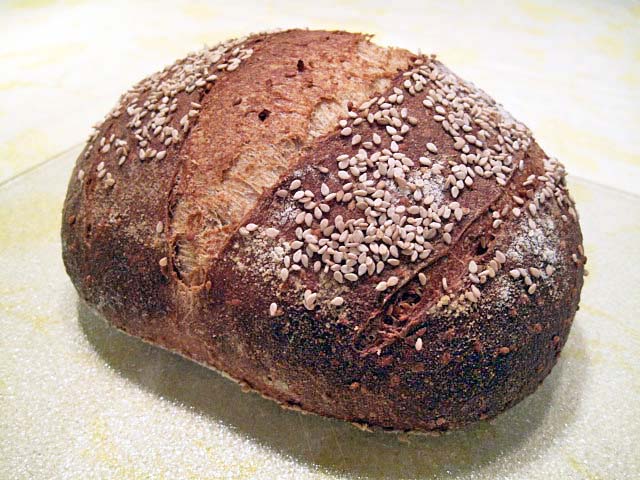
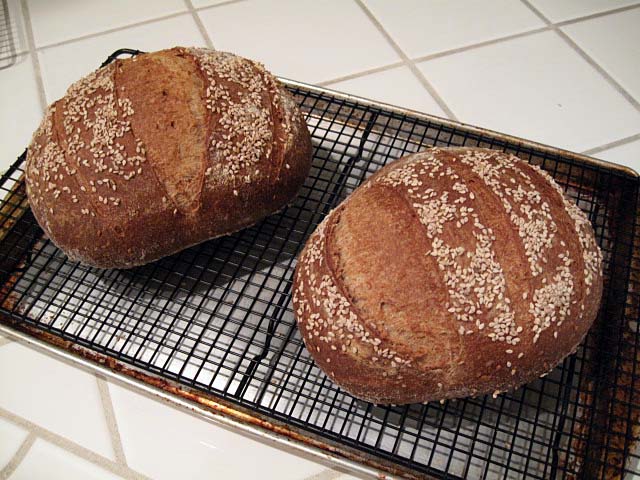
Today, I made another batch. I remembered to use some durum flour this time. I used a combination of mechanical mixing and stretch and fold to develop the gluten. I had planned on making it as a sourdough, but, because of time constraints, I did spike it with some instant yeast. I think it turned out well.

Horiatiko Psomi (pronounced hoh-ree-AH-tee-koh psoh-MEE)


Liquid levain


Ingredients

Amounts

Mature sourdough starter

28 gms (2 T)

Bread flour

85 gms

Water

113 gms


Final Dough


Ingredients

Amounts

Durum flour

200 gms

Bread flour

775 gms

Water

600 gms

Milk

2 T

Olive oil

2 T

Honey

2 T

Salt

1 T

Levain

All of above

Instant yeast (optional)

½ tsp

Sesame seeds

About 1 T


Method

  1. To make the liquid levain, in a medium bowl, dissolve the mature starter in the water. Add the flour and mix thoroughly. Cover the bowl tightly and ferment at room temperature for 8-12 hours.

  2. To make the final dough, mix the water, instant yeast (if used), milk, oil, honey and levain in the bowl of a stand mixer.

  3. Mix the salt with the flour and add 2/3 of it to the liquids. Mix until smooth. Add the rest of the flour and mix to a shaggy mass. Cover and allow to rest for 20-60 minutes.

  4. Mix at 2nd speed until you have an early window pane. (About 4-6 minutes in a Bosch Universal Plus mixer.)

  5. Transfer the dough to a lightly floured board and do one stretch and fold. Form the dough into a ball and transfer to a large, lightly oiled bowl. Roll the dough in the oil. Cover the bowl.

  6. Ferment the dough until doubled in bulk with one stretch and fold after an hour. (About 2-2 ½ hours)

  7. Divide the dough into two equal pieces and pre-shape as balls.

  8. Cover the pieces and let them rest to relax the gluten for 10-15 minutes.

  9. Shape the pieces into boules and place them in floured bannetons.

  10. Proof the boules until they have expanded to 1.5-1.75 times their original size.

  11. 45-60 minutes before baking, pre-heat the oven to 500ºF with a baking stone and your steaming method of choice in place.

  12. Pre-steam the oven.

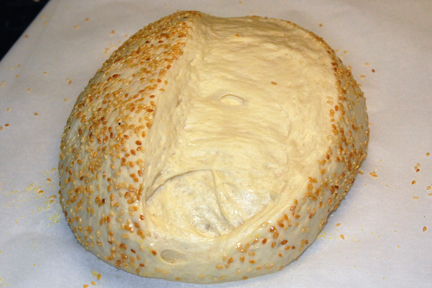
  13. Transfer the loaves to a peel or to parchment paper on a cookie sheet. Brush the loaves with water and sprinkle them with sesame seeds. Score the loaves with 3 parallel cuts about ½ inch deep.

  14. Transfer the loaves to the baking stone. Immediately steam the oven. Close the oven door, and turn the temperature down to 450ºF.

  15. After 12 minutes, remove the steam source. Continue baking for another 20-25 minutes. Check the loaves every so often, and, if they appear to be darkening too fast, turn the over down to 430-440ºF. (Note: I did not turn the oven down from 450ºF, and the loaves turned out a bit darker than I wanted.)

  16. The loaves are done when the bottom sounds hollow when thumped and their internal temperature is 205ºF.

  17. When the loaves are done, turn off the oven but leave the loaves on the stone with the oven door ajar for 10 minutes to dry the crust.

  18. Transfer the loaves to a cooling rack.

  19. Cool thoroughly before slicing and serving.

As noted above, the breads turned out a bit darker than I had wished. Next time, I'll bake at a lower temperature or turn the oven down a bit half way through the bake.

The crust was thin and chewy with a nice flavor from the sesame seeds. The crumb was quite open, considering the low hydration. It was very pleasantly chewy but did not have a dense mouth feel. The flavor was marvelous! It had a mildly sweet flavor from the honey and nuttiness from the durum flour.

I'm not sure I'd change anything, other than baking at a lower temperature and having my daughter-in-law here to tell me how far I'd strayed from Greek authenticity.

David

Submitted to YeastSpotting.

Submitted by dmsnyder on December 30, 2009 - 7:47pm

Greek Bread - I finally make it with my Greek daughter-in-law


My wife and I are spending a few (too few!) days with my brother and his wife at their get-away home near Fort Bragg, California. My older son, his wife and our grandson were able to come down from Portland. 

Our room with a view

I brought along sourdough starter and bread making paraphernalia, and three recipes for Greek bread. My daughter-in-law and I chose the recipe that seemed to her closest to the bread she remembered from Greece. We converted it to sourdough rather than a yeasted sponge, and I used mixing and fermentation techniques I thought would yield a better result than those in the recipe.

Did I say we made bread to go with a barbecued turkey and fixings for 11? Or that we had a Vermont Sourdough with Walnuts with the cheese and wine before dinner?

Stephanie had never made bread before, but she's a really good cook and a quick study. After watching me form one boule she proceeded to form one better than mine.

Stephanie with boules ready to proof

I had ordered a baking stone, kneading board and some other bread essentials from nybakers.com, and Stan shipped them directly to Fort Bragg, kindly arranging that they arrive at exactly the right day. We baked the loaves on the stone, with steam.

Greek Breads 

Greek Bread crumb

Stephanie said the bread was a pretty good approximation of bread she had had in Greece. (It would have been closer, if I had remembered to use the durum flour I brought along.)  It was a very good white sandwich bread flavor and texture with the added flavor of the sesame seeds. It was enjoyed by all, but, I think, most of all by the new bread baker.

Greek bearing Greek Bread

David

Submitted by ehanner on July 21, 2009 - 3:21pm

Greek Sesame Bread


The dough didn't spring all that much in the oven.

This is a light and easy to chew bread with good flavor

Slashed deeply and ready to proof

After 1 hour proof time, ready to bake

MommaT asked about a recipe for a Greek Bread that she had just had while in the Mediterranean on vacation. A common bread sold everywhere and wonderful to the nose and mouth senses. I suspect the view of the beautiful Greek villages with their white stucco buildings and red tile roofs, not to mention the sea air and fine wine might have an impact on the experience of eating a piece of artisan bread dipped in the most fragrant  Greek Olive oil. Ahhh, it takes me back.  So---

When DSnyder suggested a possible recipe after connfering with his Greek DIL, well I hopped right on it. I converted the recipe to weights for the most part, at least where it counts. I used 135g per cup for the flour weight and KA AP flour. My hydration came in at 73% counting the milk and oil as liquids.

I thought the dough to be a bit firm but the recipe does call it a stiff dough. I mixed it as per  suggested but I let it rest for 20 minutes and then folded and kneaded a bit. It was starting to become smooth but not fully delevoped when I shaped it into a round and covered it. About an hour passed annd the dough had doubled nicely and felt like a puff ball. I shaped it into a tight oval, brushed an egg wash over the top and sprinkled a generous topping of toasted sesame seeds over the loaf. I don't usually slash the loaf prior to proofing but that's what was called for so I made a deep slash down the top center as you can see. I covered the loaf with plastic, dusted the plastic with spray oil and flipped the plastic wrap over so as to avoid a mess after proofing.

I had pre heated the oven to 400F and heated a 1/2 C of water for steam. The bread was loaded, in with the water and after 15 minutes lowered the heat to 350F for another 15 minutes. Actually I didn't quite go to the full 30 minutes baking time. I thought I was done enough for the first try at 27 minutes. The bread feels very light and is soft enough on the crust it is just a little hard to slice. Perhaps just just a little more oven time to dry it out.

The aroma is wonderful. Toasting the sesame seeds is always worth while. My daughter approves, saying "this is really good" , that is a pretty tall hurdle. She is a tough critic.

I don't know if this looks or tastes like what MommaT was talking about or even what David's daughter in law Stephanie intended. Perhaps she will see this and comment. Thank you Stephanie and David for your interest in creating this bread. Please let me know what you think.

Here is my contribution to the recipe.

Greek Bread with Sesame Seeds

Luke warm water (80F) 1/2 Cup (118g)
2 Tablespoons Olive Oil (30g)
5 Tablespoons warm milk (74g)
1 envelope ID Yeast (6g (2-teaspoons))
2-1/4 Cups AP Flour (304g)
1/2 teaspoon Salt (sea salt, fine grind)

1 egg and 2 T milk for washing before seeds are applied
2-4 T Sesame Seeds, toasted

Hydration 73%

Method as called for in Davids post here
Mix, autolyse, knead and ferment till double. Punch down, shape, slash and wash with egg wash, seeds and proof for 45-60 minutes.
Bake at 400 for 15 minutes, reduce temp to 350 for and additional 15 mins.,steam as normal

Eric