After seeing David's post earlier this week about his experiment with using old dough vs a levain to make bread here "Old Dough" vs. Natural Levain ....... my apprentice just knew she hat to put her 4 cents in and replicate the experiment to see if we came out with would match David's bake. Plus it was going to be fun because we haven’t used old dough to make bread for a very long time and had forgotten how good a no fuss job it could do.
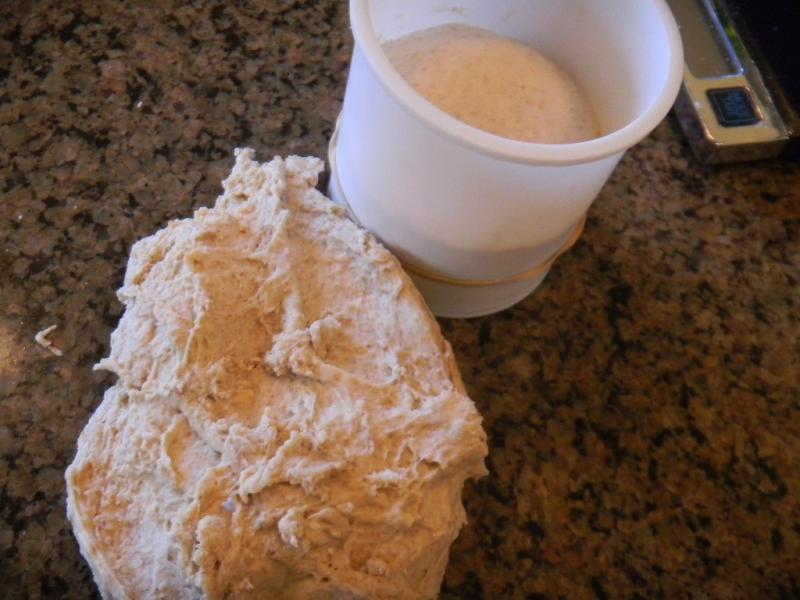

Old dough is the way commercial bakers, as opposed to home bakers that baked smaller quantities and used levain, made all of their breads before 1870 or so when the Fleischmann brothers perfected their first commercial yeasts.

We didn’t have any old dough after bulk ferment to use so we decided to make a 125 g old dough from scratch. We first did a formula that we would use for the levain dough and then scaled everything back from the larger dough weight to the little, what would become, old dough. Spreadsheets really helped in this regard.


Once we had everything together using the exact same ingredients that would be in the levain bread, we developed the little dough ball just like we would the larger one later. We did an autolyse of 3 hours, added the tiny whole grain starter, salt, other flours and water and did 3 finger one hand tied behind the back French slap and folds until the gluten was well developed and the dough satin smooth.


After a 15 minute rest we did (3) S & F’s on 15 minute intervals and then let it ferment on the counter for 1 hour before refrigerating for 12 hours where it rose very well by doubling. The next morning, while the old dough and the 125 g of the same levain were coming up to room temperature, we autolysed the dough with the salt, flour and water for the levain bread exactly as we had done the little old dough the previous day.

Then before the levain went in we cut off half the autolyse for the old dough. After that each dough was treated the same, together at the same times, yet separate . The same - yet separate would make a good book title for a story about twins separated at birth. Back to baking.

After the 10 minutes of French Slap and folds and the 15 minutes rest, the (3) sets of French slap and folds were done between 15 minute rest increments. The Janet inspired bulgar and flax seed scalded mash was incorporated on the 2nd fold and fully distributed by the 3rd fold.

Each dough was allowed to ferment on the counter for an hour before being bulk retarded in a 38 F fridge for 18 hours. After removing them from the cold, the dough balls had doubled in the fridge, they were allowed to come to room temperature for 1 ½ hours on a heating pad set to low. Each was then formed into a boule and placed in like sized baskets even though one was more of an oval shape.

The baskets were placed in a nearly new trash can liner and placed back on the heating pad for a 78 F proofing. After 2 hours, Old Betsy was fired up to 450 F with two DO inside, one a CI Martha Stewart and one was the Magnalite MagnaWare Turkey roaster. Since the turkey roaster has a trivet insert that allows extra water to be put in for steam, we used the bottom of our spring form pan to raise up the bread off the bottom so extra water could be placed in it too.


Once the baking temperature was reached we un-molded each from the basket, slashed them and placed them into the hot DO’s with a parchment sling. These smallish 525 g breads were baked 18 minutes with steam then the lids were removed and the temperature turned down to 425 F, convection this time.


The bread was baked another 5 minutes before being removed from the DO’s and rotated 180 degrees on the stone now. The darker bread was done in 5 more minutes at 205 F on the inside and it was removed to a cooling rack, The lighter colored bread was baked another 3 minutes before it too hit 205 F and we left this one on the stone with the oven off and door ajar for 5 minutes.

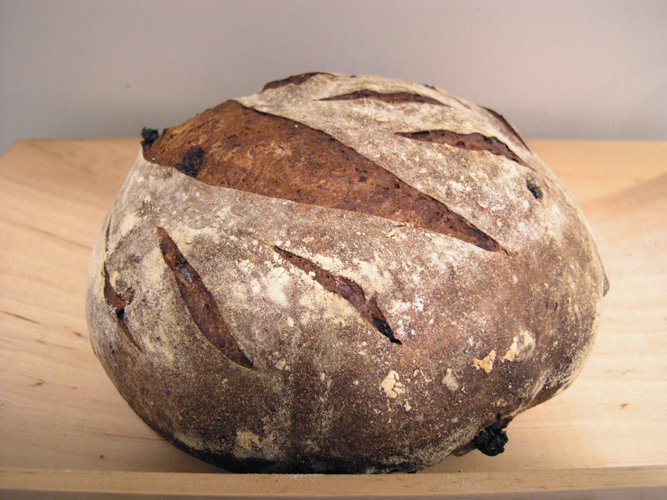
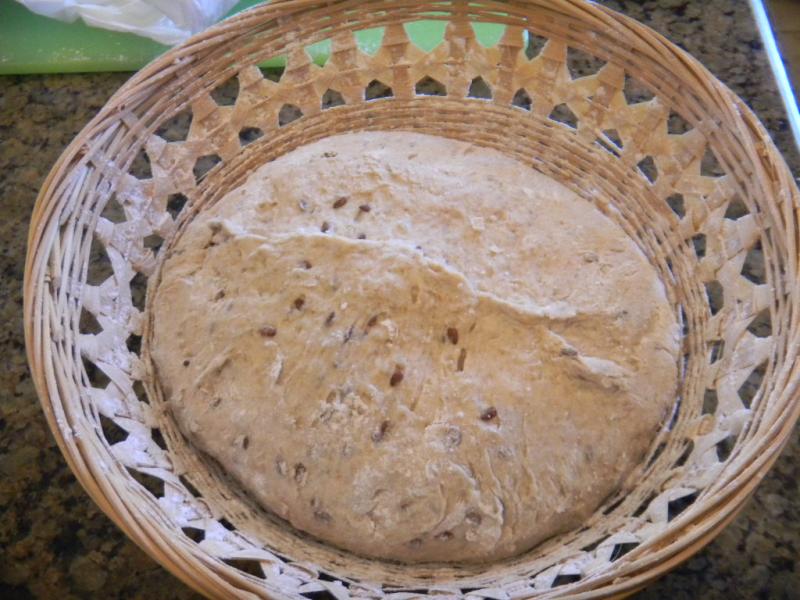
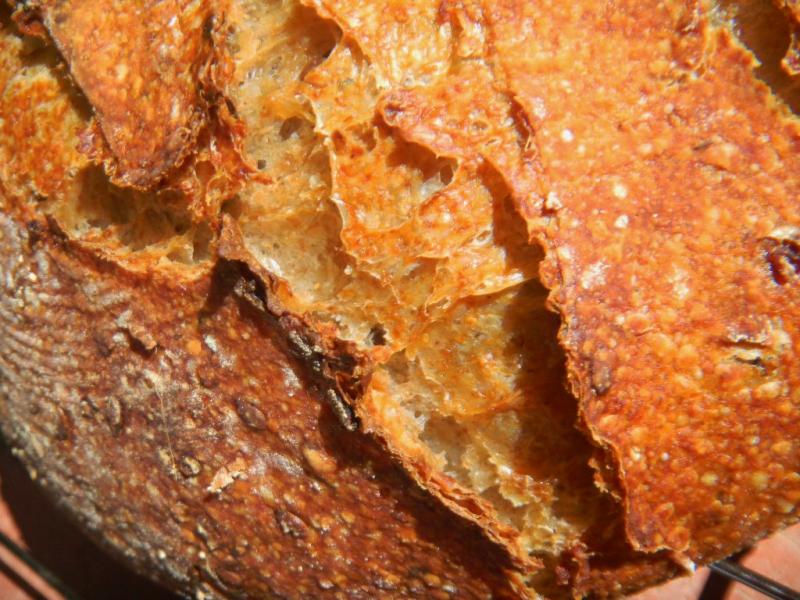
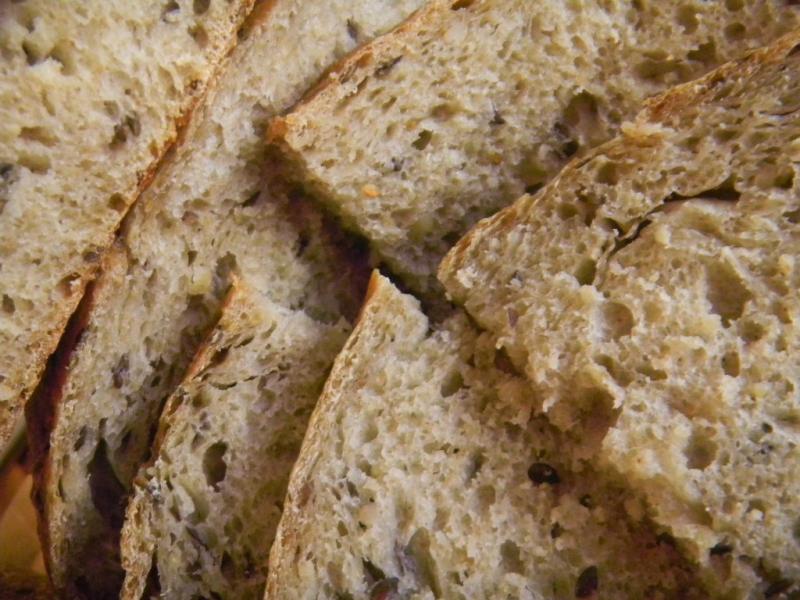
The darker colored boule spread more the lighter oval one. The lighter oval rose and sprang higher and had a slightly softer and less open crumb but they were very close crumb wise. The darker bread had more and bigger blisters. The one in the WagnerWare turkey roaster was the lighter bread and we do not know why because nothing has been able to put crust on bread better than it does – except this time.

There is no question that one had a better more complex and deeper sour flavor just like David's bake and it was the one that used old dough too! The difference in taste was definitely there and easy to decipher. I’m would be using this old dough technique on bread from now on…… except that I forgot to hold back from this bake - darn…..typical the apprentice didn’t bark out a word of warning either!
So which one is old dough? It’s the one that tastes the best and they both are great breads - some of the best we have made to date. Let’s see who can guess the taste winner by looking.
Formula
Old Dough VS Levain Multigrain SD With Bulgar and Flax Seed Scald | | | | |
| | | | |
Starter | Build 1 | Build 2 | Total | % |
SD Starter | 25 | 0 | 25 | 9.26% |
Spelt | 8 | 9 | 17 | 8.19% |
WW | 8 | 8 | 16 | 7.71% |
Rye | 8 | 9 | 17 | 8.19% |
Water | 25 | 25 | 50 | 24.10% |
Total Starter | 74 | 51 | 125 | 60.24% |
| | | | |
Starter | | | | |
Hydration | 100.00% | | | |
Levain % of Total | 23.63% | | | |
| | | | |
Dough Flour | | % | | |
Dark Rye | 12.5 | 6.02% | | |
Whole Wheat | 12.5 | 6.02% | | |
Potatoe Flakes | 10 | 4.82% | | |
Spelt | 12.5 | 6.02% | | |
Oatmeal | 10 | 4.82% | | |
AP | 150 | 72.29% | | |
Dough Flour | 207.5 | 100.00% | | |
| | | | |
Salt | 4 | 1.93% | | |
Water | 155 | 74.70% | | |
Dough Hydration | 74.70% | | | |
| | | | |
Total Flour | 237 | | | |
Total Water | 217.5 | | | |
T. Dough Hydration | 91.77% | | | |
Whole Grain % | 41.35% | | | |
| | | | |
Hydration w/ Adds | 76.99% | | | |
Total Weight | 529 | | | |
| | | | |
Add - Ins | | % | | |
Red Rye Malt | 1.25 | 0.60% | | |
White Rye Malt | 1.25 | 0.60% | | |
Toadies | 2.5 | 1.20% | | |
VW Gluten | 7.5 | 3.61% | | |
Total | 12.5 | 6.02% | | |
| | | | |
Scald | | % | | |
Flax Seed | 12 | 5.78% | | |
Bulgar | 13 | 6.27% | | |
Total Scald | 25 | 12.05% | | |