SearchUser loginRecommended BooksFavorite Recipes
|
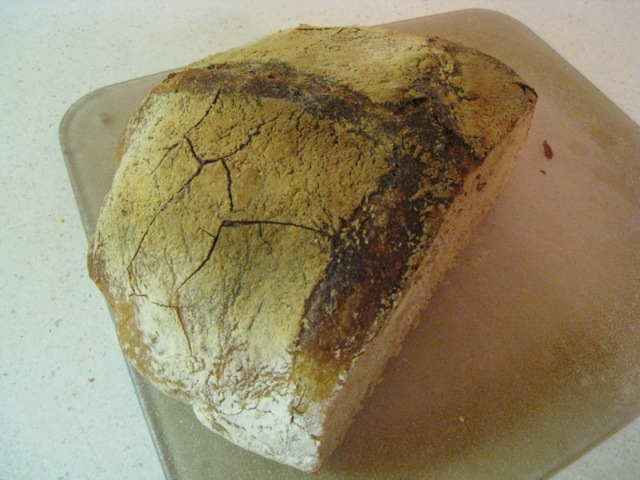
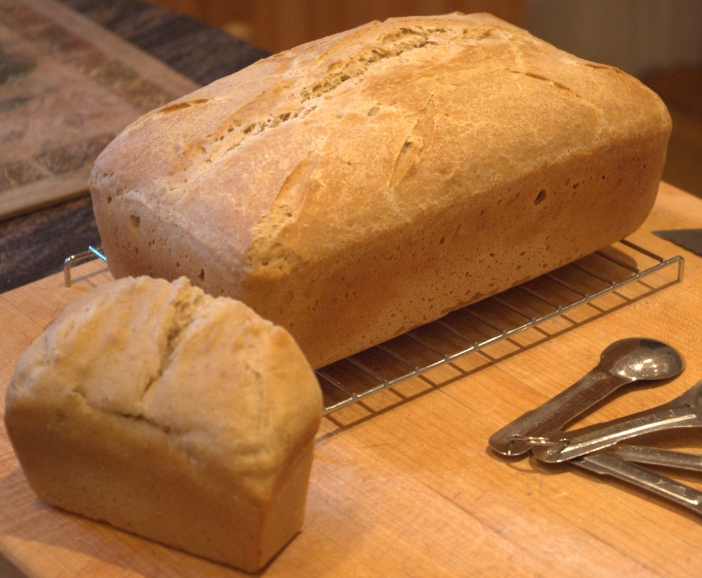
Submitted by liseling on March 18, 2010 - 8:21am My starter's first produce... MehSo I decided (with help from people here) that my starter was ready to bake with (link to that discussion: http://www.thefreshloaf.com/node/16928/my-starter-ready-baking). And I decided to try Peter Reinhart's 'basic sourdough' in BBA. I think the starter itself was fine, but for one reason or another (or more than one reason) I got so so results. The bread was tasty and not a complete disaster, but the crumb was definitely denser than I think it should be and the loaves were a little flat. The crust was very nice and crispy though. For a first attempt I think this is pretty good but something definitely needs to improve and I was wondering if anyone could give me any suggestions. Here are the loaves I produced:
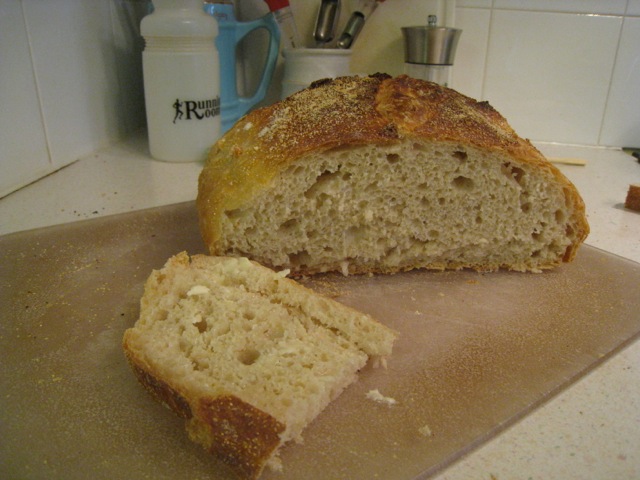
And here is a crumb shot. As I said it's not a disaster, but how do I get those nice big holes? If anything the dough was wetter than the recipe called for. I thought wetter dough made for bigger holes? Do you think I didnt ferment the shaped dough long enough? Too long?
And here's one other problem I had. I used this thingy pictured below. I dont know the real name for it but I used it to ferment the shaped dough and then put this whole thing with the dough on it into the oven right onto the baking stone. I use this because when I try to imagine myself sliding those very messy wet loaves into the oven and onto the baking stone I just can't convince myself that they'll slide nicely off of the sheet pan and onto the stone without sticking or getting misshapen, or falling off the stone onto the oven floor, or any number of other possibilities, no matter how much cornmeal I lubricate it with. The problem I have though is that although the loaves I made were not very big, as they fermented, the side of each loaf started spilling over the side of the pan, and the problem became much worse after they were put into the oven. I managed to tuck the side of each back up into the pan, but I cant imagine that that helped the bread rise properly in the oven. Am I missing something here that I need to know about these things in order to prevent this from happening, or is the only solution to make smaller loaves? I'd be willing to try to learn how to put the loaves directly onto the baking stone if anyone has any good advice on how to do that without a tragedy occurring. Anyone? It is so frustrating to spend more than a whole day of preparation to bake and then turning out something mediocre.
Submitted by utahcpalady on January 21, 2010 - 8:59pm Beautiful Crumb not Sour though
So I have been messing with my non acidic starter to see if I could correct that and get some sour to my sourdough. I added 1 tsp of cider vinegar to one starter and fed it after 12 hours, then 1/2 tsp to another starter and fed it 3xs (every 8 hrs), and then made a control loaf that was with the original starter. Now I don't have proofing baskets so when I put them in the fridge they were in greased glass bowls, so I think I can correct the shape. The one loaf that had the best shape I just plopped out of the bowl onto the stone and didn't try to gather up the bottom before placing it on the stone, like the others. Live and learn, and hope for baskets for Valentines day. Submitted by zoniguana on January 17, 2010 - 9:28am want to improve the texture of my sourdough.So, I've made several loaves of sourdough from my starter, and the flavor is all there. Sometimes a little less sour than I would like, but usually all there. So far, I have just been making a very basic bread (KAF White Wheat, starter, water, salt), and have sometimes branched out to adding some rye flour into the final loaf, but nothing more exciting than that. I let my sponge sit overnight in the over with the light on, and it rises up nicely. The next day, I build up the final dough, let that rise until it is doubled (an hour or two) while I go to the gym. When I get back, I punch the dough down, knead it some more, shape into a ball, and let it rest half an hour. Then I punch it down, shape again, and let it sit another half hour. Then I divide in two loaves, shape and stick in the respective proofing containers and let rise about an our. I proof my boules in a banneton, and my loaves, I proof in a clay baking dish. About half an hour before baking, I soak my baking stone for 15 minutes, stick the stone in the oven, and start the preheating to 450. I then turn the boule onto the stone, give it a slash, and stick the clay pan beside that, after giving that a couple slashes. The end result of this longwinded yammering is that I have a very dense loaf, with a very stiff crust, that has a nice tang to it. I'd like to lighten this a bit, and get more of those nice air pockets. I'd also like to get the crust more crisp than hard. Thinking if I knead longer, and maybe add some more water for a wetter dough, I'll get those air pockets, and, if I add some fat, I'll get that crispy crust. Can anybody confirm/refute that, or offer other advice? More important to me is getting that nicer crumb than what I have, at present. Thanks! Submitted by leafmuncher on December 16, 2009 - 4:00pm Failing miserably at big holes/open crumbI have been baking bread for about six months now, so I'm still a complete noobie, but really enjoying myself. I've been making Reinhart's San Francisco sourdough a lot, and I've recently tried his Ciabatta (in the Apprentice book) a few times. I cook in an electric oven, weigh all my ingredients, have used KAF and most recently the high gluten Giusto's. The main problem I'm having is that I want my bread to have a really open crumb with big, irregular holes. I've tried increasing the hydration on Reinhart's SF sourdough recipe with a bit of improvement, but nothing major, and tried the Ciabatta recipe with 9 oz of water and 4-5 folds and I still can't get it to look like his photo. (My latest theory is that perhaps I didn't flatten the dough enough, mine went into the oven about 3-4 inches high.) Anyway, I would appreciate any tips you might have that would help me accomplish my dream of yummy sourdough/artesian bread with enormous holes. I've seriously tried varying proofing time, oven temperature, quantity of steam, mix time, all without any luck. Any sort of tips in terms of the factors that play into big holes would be much valued. (Also, just in case it matters, I live in a tropical climate (Hawaii) which is pretty hot and humid most of the time.) Thanks in advance! Submitted by mariacuellar on November 29, 2009 - 11:52pm Burnt loaves: Good or bad?Hi baker friends, I have a question for you. How do you feel about burnt loaves? I read a quote in Dan Lepard's The Handmade Loaf said by Johan Sorbergs, a baker in Stockholm, saying that "Today burnt crusts are viewed as deadly at worst... But without the penetrating effect of the browning and charring, the crumb flavor is thin." Is it true that to get a better crumb flavor the crust has to be nearly burnt? Or does the burnt crust ruin the whole bread? I asked this question in my blog when I tried out one of Jim Lahey's recipes: http://mariasgoldenoven.blogspot.com/2009/11/walnut-cinnamon-bread-pan-co-santi.html Thanks for your sharing your knowledge! Maria Submitted by blackhorse16a on October 25, 2009 - 3:17pm Undone CrumbI’m having a problem with undone inside with very done crust. I’ve been baking PR’s basic sourdough formula and using dmsnyder’s steaming method. For my last and best effort, I pre-heated for and hour up to 515º (by thermometer), pre steamed, then inserted dough and lowered temp to 450º. I used convection bake. The crust was quite brown at about 30 minutes, but the internal temp was only 165º. I went another 3 min., as more would have totally ruined the crust. Got it up to about 185. My sense is to use an even lower temp. What do you think? BH Submitted by ericjs on October 24, 2009 - 12:45pm Meaning of "creamy" wrt crumbI've often read the term"creamy"used, talking about the quality of a good crumb in certain breads. This word has never really made a lot of sense to me, but I assume it's a metaphorical descriptive, like when people talk about wine having "structure". I'm wondering if some one can take a shot defining the qualities of "creamy" crumb in more literal, physically descriptive terms. I've on occasion gotten a crumb in some breads that was qualitatively different that what I usually get, and it has gone hand in hand with a bigger hole structure. I would describe this difference as springier, stretchier, and the insides of many of the holes having kind of a sheen to them. Is this creaminess? Submitted by norco1 on October 18, 2009 - 3:30pm crumbmy bread's crumb is too dense for me. how do i lighten the texture? Submitted by ensee1@juno.com on September 13, 2009 - 9:50am creating a lighter breadhow can i create a lighter crumb? all my breads have a denser and heavier crumb than i would prefer. even the crust is harder and not as light as the bought versions. please advise Submitted by AKAlicious on May 16, 2009 - 10:26am A question about crumbI hope I've put this post in the most appropriate section... After reading posts on this site for over a year, I finally got around to joining so I could ask a question that has flummoxed me for years...What is meant by "crumb?" I've been cooking and baking for 20 years but only started baking bread about a year ago. I know that the word "crumb" is used in reference to cakes as well as breads, but I've never understood what it's referring to and never bothered to ask anyone--until now. So bakers, can any of ya'll enlighten me? Thank you and happy baking! :) >AKAlicious |
Advertisement |