It's been quite a long time since I've actively participated on this forum, but I have the flu this week and am cooped up inside with plenty of time to bake and web surf, so thought I'd provide an update on how I think I've improved on some of my old sourdough techniques, as well as show some fun results with brioche.
French Fold on Sourdough
After all these years, I still find that my favorite sourdough formulas are either the Columbia or the Thom Leonard boules from Glezer's Artisan Baking. I always return to them over again, and often make some of each in a given week, as they have some different qualities that I like in both.
I've posted the formulas for these breads here a few years ago, but I've since changed my methods a bit. For quite a long time, over a year, I abandoned my KitchenAid Pro 600 stand mixer and started using the no-knead technique as many here have used, extending the bulk fermentation to overnight at room temp, and giving 3 good stretch-and-folds the first 90 minutes into the first bulk ferment before going to bed at night. That sure made things easy, and I was able to fit it into my busy summer schedule especially, but it didn't quite give me the open and flavorful crumb I really wanted. I think the dough just wasn't getting quite developed enough via that method.
I don't think my dough hook on my stand mixer, however, was really doing such a great job developing the gluten as well, so recently I began really studying the French Fold in more detail, and I really find Richard Bertinet's video extremely helpful for this, thanks to people on this site pointing me there when I lurked earlier this Fall. To make my sourdough I now continue to do it all by hand, relatively quickly, with really superior results to what I got before using no-knead or even stand mixer.
Here's my long-ferment adaptation of the Columbia Sourdough from Maggie Glezer's Artisan Baking:
Makes two 44-ounce (1250 g) round boules or four 22-oz batards (original recipe doubled)
Time: about 36 hrs. with 20 minutes of active work
This method works well if you are busy with work during the week and don't want to be baking all day Saturday either. I begin this process on Friday Morning. Once you get comfortable with it, you could even begin it Thurs. evening and make the final dough before work on Friday morning, letting it rise while at work and shaping as soon as you get home.
Approx. 30 hours before baking (e.g. Fri. Morning) make the Levain as follows:
90 g ( 2 oz) fermented white/wheat-flour sourdough starter refreshed 8-12 hrs before (I use a batter-like starter made with equal weights water to flour, not a firm starter.)
140 g (6.6 oz) lukewarm water
320 g (10.6 oz) unbleached all-purpose or bread flour
Dissolve starter in the water, then add flour and knead this stiff dough until smooth. Place in covered container and ferment at room temp (@70F) until doubled, 8-12 hrs.
That evening (e.g. Fri. Evening) make the final dough as follows:
1200 g (42.4 oz) unbleached all-purpose flour
110 g (3.8 oz) whole-wheat flour, finely ground
30 g (1 oz) whole-rye flour, finely ground
40 g (1.4 oz) toasted wheat germ
40 g (1.4 oz) non-diastatic barley malt syrup (This is sold in most supermarkets or where home-beer-brewing supplies are sold.)
970 g (34 oz) warm water
all the fermented levain you made the night before (550 g or 23.2 oz)
32 g (1 oz) fine sea salt
Mix By hand: combine all 3 flours, wheat germ, and salt in large bowl, and mix thoroughly with rubber spatula or mixing spoon until all dry ingredients are perfectly distributed. Measure the warm water first and while it's sitting in a container on your scale, use a clean tablespoon to scoop a little syrup at a time into the water until the correct weight (40g) is added to the water. If you accidentally spoon in too much, just scoop a little syrup out of the water before it dissolves, stir well to dissolve. Pour the malted water over the ripe levain and mix well until dissolved, then pour the water/levain liquid over the flour mixture and mix with spoon, dough whisk, or hands until just combined. Cover bowl with plastic wrap and let dough rest 1 hour at room temp. (@60-70F).
So, my dough handling method now is:
1) mix all dry ingredients together in large mixing bowl: flours, salt
2) add water to the ripe levain to dissolve and mix in its own bowl
3) add watered levain to flours in large mixing bowl and mix until well-combined by hand with my trusty King Arthur dough whisk (or use spoon or hands).
4) cover bowl and let rest for 1 hour.
5) tip rested dough onto clean counter (no flour, no oil, no water) and begin the French fold a la Bertinet. I do this for at least 5 minutes before giving it a rest, scraping the dough together with a bench scraper, and continuing for another 5 minutes. It is amazing how well this works even for very wet doughs. The first minute or so, it is tough, you feel the dough tighten and not stretch yet still be sticky and you're ready to give up, but keep at it and all of the sudden, the dough starts to stretch while simultaneously becoming less sticky, you can really feel it change. By the second 5 minute stretch, it really starts to look like in the video andd tightens up really nicely, leaving almost nothing sticking to the counter.
6) After 10 min. of the French fold, place dough ball into lightly oiled container and cover, let rest 30 minutes, and then do a regular gentle stretch and letter fold after 30 minutes. Repeat this rest and stretch-fold 1 more time, then let dough bulk ferment overnight in cool location (50F-60F) until a little more than doubled in bulk.
7) Next morning, shape dough into loaves as desired and let rise until doubled again, around 4-5 hours in my chilly 60-65F house. Bake as usual.
This total 10 min. French fold develops the gluen just as well as traditional hand kneading with added flour for 15-20 min. and I think works better than my stand mixer ever did. The benefits are less time kneading, no added flour to toughen up the dough, but better gluten development, and easier to work with large batches that don't fit in my stand mixer anyhow.
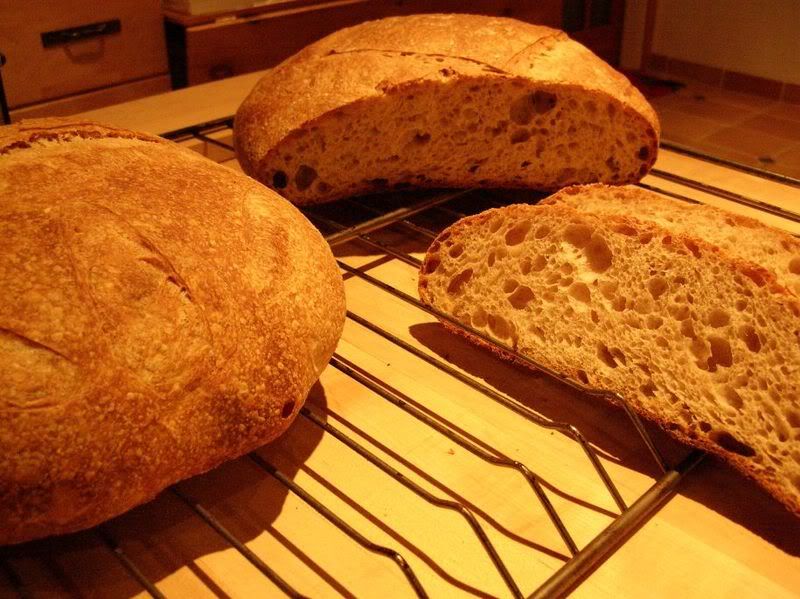
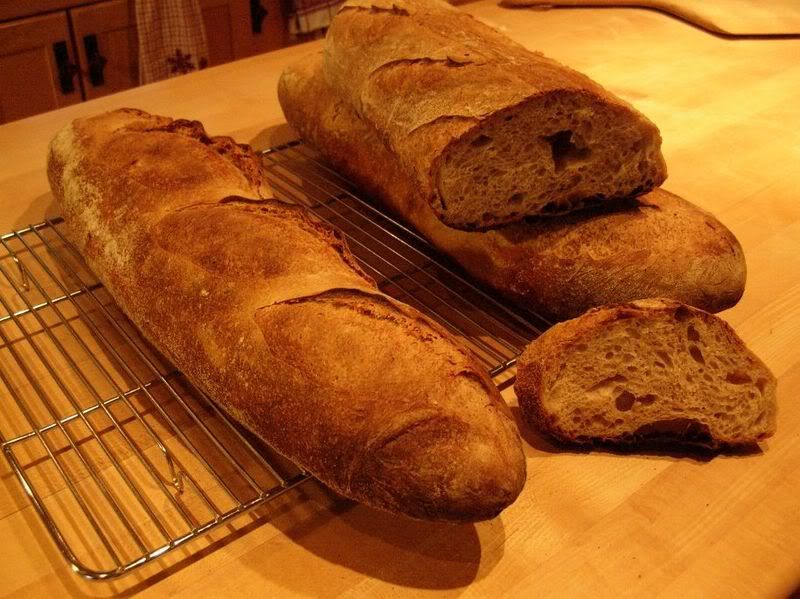
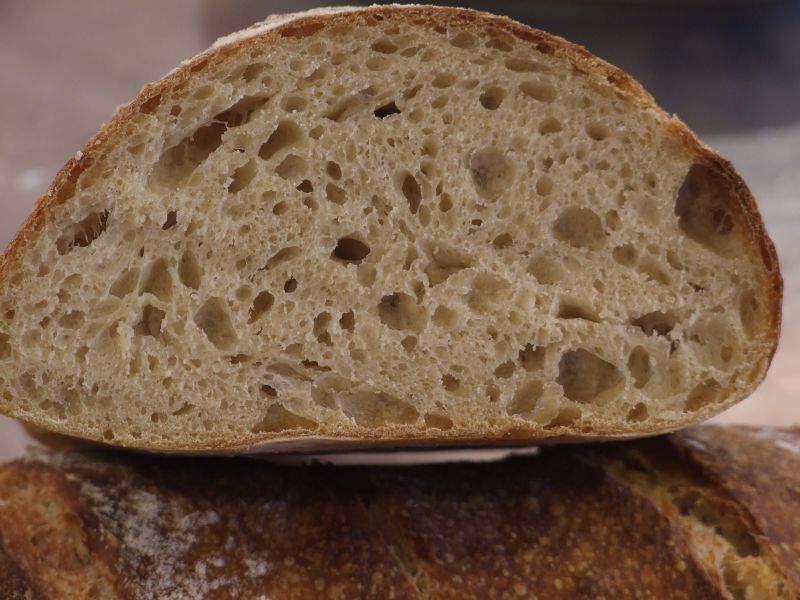
The Thom Leonard boule (above) crumb from the French Fold. This was a wet dough and I had not yet studied David Snyder's scoring video when I baked these. After seeing David's scoring tips, my Comunbia batards (below) turned out with better ears, even though those were also wet doughs. (Oops, my batard shaping still needs practice as I left a "baker's cave" in there).
FYI - my adaptation of the Thom Leonard boule (also from Glezer's Artisan Baking) is the same mehod as above for Columbia, just different formula and quanitity of dough, as follows:
Makes one 4 lb. (1.8 kilo) large boule or two 2 lb boules.
Time: about 36 hrs. with 20 minutes of active work
The evening before baking make the Levain as follows:
45 g (1 oz) fermented white/wheat-flour sourdough starter refreshed 8-12 hrs before (I use a batter-like starter made with equal weights water to flour, not a firm starter. If you are using a rye-flour starter, substitute the 30 g of the rye flour in the final dough with more white AP flour.)
120 g (3.3 oz) lukewarm water
140 g (5.3 oz) unbleached all-purpose or bread flour
Dissolve starter in the water in a small bowl, then add flour and beat this batter-like dough until very smooth. Place in covered container and ferment at room temp (@70F) until doubled, 8-12 hrs.
Next day make the final dough as follows:
250 g (8.8 oz) Whole Wheat Flour (If you like your bread a little darker add up to 350 g whole wheat here and use less white flour below.)
30 g (1 oz) whole-rye flour, finely ground (If using a rye-flour starter in the levain rather than wheat, substitute the rye flour here with 30 g more white AP flour.)
850 g (29.9 oz) unbleached all-purpose flour
780 g (27.5 oz) warm water
all the fermented levain you made the night before (305 g or 10.6 oz)
23 g (0.8 oz) fine sea salt or course Celtic Grey Sea Salt
Brioches a Tete
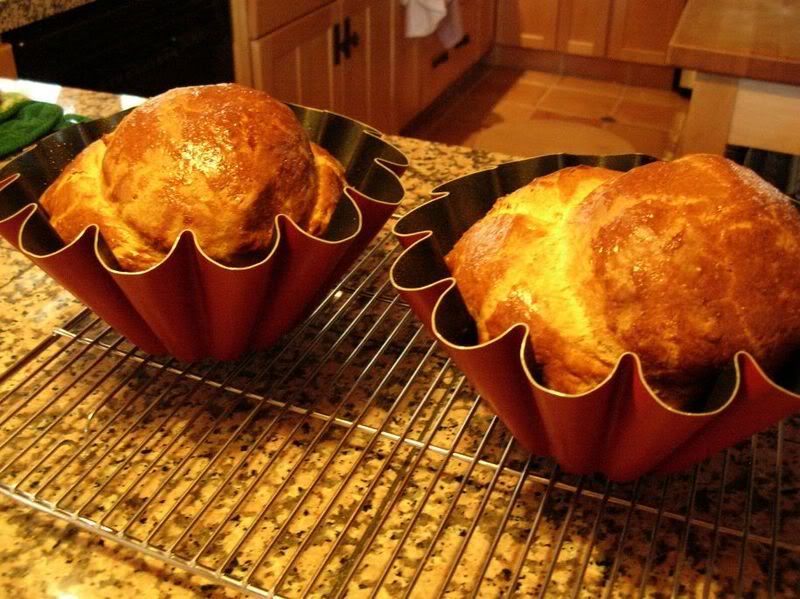
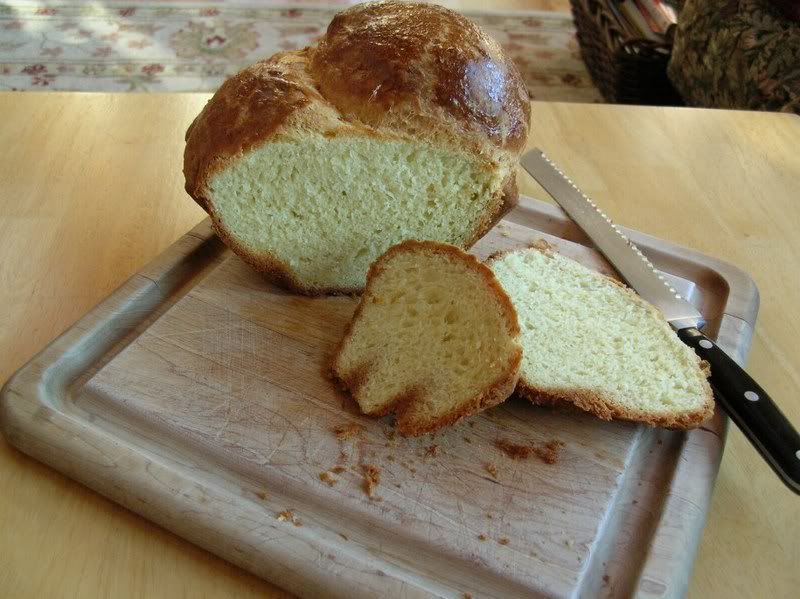
Since my husband's family are visiting here from France this winter, I decided to make some brioche, which I have't done in a long time, using some lovely non-stick molds they brought me from France. I made Peter Reinhart's Rich Man's Brioche from the BBA, and I also used Bertinet's French Fold method to mix and knead the dough, but this dough was really too wet and full of butter to do this properly (really like a cake batter), still, I persisted, and it eventually did come together a bit, and turned out nice and light, despite having a fine-textured crumb. I think next time I will try Peter's middle-class brioche, which has about half the butter. This version here was heavenly with a good cup of coffee on a cold snowy winter morning though :-)




 columbia


