SearchUser loginBread BooksFavorite Recipes
|
Submitted by KMIAA on February 3, 2012 - 2:34pm Chinese Cheesecake?Does anyone know what type of dessert this is? I asked someone at the China Star Super Buffet and they say it's cheesecake. It doesn't taste like any chessecake that I've had before. The inside is light and airy and I think a hint of lemon is in there but don't know what other ingredients could be there. The outside is Phyllo. I've looked all over the internet to find some sort of recipe but haven't found anything that resembles this. I hope the photos are ok. I sliced one in half and took a picture to show what the filling is like
Submitted by BellesAZ on October 14, 2010 - 6:41am Madame Meng's Soft Custard Bread with imagesThe other day a friend sent me an intriguing recipe and I just had to give it a try. This bread looks very much like Milk Bread, only it uses a "custard" as a base that is mixed with the dough. It is ultra soft and squishy.. and my family really went nuts over it. I did a ton of hunting on the web and only could find it is a Chinese recipe and came from a book that is roughly translated Madame Meng's 100 Recipe Book, or 卡士达超软土司 . She sounds very mysterious and exotic to me.. and this intrigued me even more! (When I first did the translation of the book title, I think I used the wrong linguistics tool. It translated the title to "Bangladesh's 100 Bread Loaves". Weird... but I laughed, imagining myself lost in China with only my handy dandy translator to get me on the right road!) I had a couple of concerns with the recipe because of the venacular for some of the instructions. It called for the bread to be baked in a Pullman Pan, but obviously from the measures, this dough wouldn't make enough to fill a pullman pan. So, I called a friend of mine who is Chinese and asked her if the term "pullman" could mean a standard bread loaf pan and she guessed it did. I followed her advice and it turned out to be just right. The other issue I had was this dough seemed a bit dry as it was coming together in the mixture. I had to add a bit more water and then all of a sudden, it became way too wet, with just a couple of tablespoons of water.. so I added more flour. I thought I really messed it up, but it actually turned out perfectly. The dough I was working with was quite sticky.. so you decide. It is not intended to be a high hydration dough, but the dough was so dry at first that it refused to come together. When it did, however, it was beautiful and silky to work with. Here is the formula. Would love your feedback on this. It was truly easy to make, with the exception of a few minor tweaks. It was a very fun loaf to put together and the taste and texture are outstanding. We had pot roast last night and it was the perfect accompaniment with the beef gravy. The rising did take alot longer than I'm used to and the dough is a tad sweet like a dinner roll. Even though there is 1 tsp of yeast in this small batch, each rise took at least 70 minutes. The second rise took a full 1.5 hours, but it was well worth the wait. Next time I think I will double and make dinner rolls or even cinnamon rolls. CUSTARD BREAD CUSTARD:
DOUGH:
To make the custard: In a small saucepan add egg yolk, flour, sugar and milk. Using a wire whisk, stir together all ingredients over medium low heat. Keep whisking until a paste forms and becomes stiff enough that it no longer drips off the whisk. Transfer the custard using a spatula to a small bowl and let cool slightly. Cover with plastic wrap and store in refrigerator for one hour. To mix the dough and custard: In a mixing bowl with a dough hook attachment, mix the custard and all dough ingredients except for the butter. Knead well, keeping an eye on hydration. Dough should be quite sticky, but pull clean from the sides of the bowl. When window pane test has been achieved, mix in the softened butter using the dough hook. Mix butter thoroughly. Transfer dough to a greased bowl and allow to rise for at least 60 minutes. Mine took about 70 minutes on the first rise. Shaping, rising and baking: When dough has risen, gently fold dough to remove air bubbles. Divide dough into three balls, dusting lightly with flour. Cover with plastic wrap and let rest for 10 minutes. Prepare a standard bread pan by lightly greasing and setting it aside. Using a rolling pin or your fingers, flatten out the first ball to an oval shape.. about 6-8 inches long. Roll up jelly roll style and pinch ends and seam together. Place first roll seam side down in pan on one end. Repeat with the second and third dough balls, placing each roll into the pan, spaced fairly evenly apart. Let rise, covered with a tea towel, in a warm place for at least 60 minutes. Mine took 1.5 hours, but dough should fill 90% of the pan. Set oven to 375 and if desired, brush with an egg wash before baking. Total baking time is 30 minutes. Check loaf after the first 20 minutes.. If it is browning too quickly, cover loosely with aluminum foil. Bake for 10 more minutes.
Above is the custard. Using a wire whisk makes it easy, cook over medium low heat - more low than medium. After a few minutes, it just seizes up like this.
Shaped dough... as you can see, very small!
Rolling, shaping and placing in a standard bread pan
Ready to rise
Not much oven spring, I'm afraid
Just out of the oven. A really cute little loaf!
And yes, it was THAT SOFT and squishy! Submitted by jleung on July 30, 2009 - 10:04am Baked red bean bunsBaked red bean buns
and this is how I like my red beans :) Molecular biologists love genes, and how different gene products interact with each together to generate many of the complex biological processes that keep our body in one piece (or in the case of disease, how all of this falls apart). Why does someone behave in a particular way? It's because of his or her genetic makeup, some say. Others say there is an equal influence from the environment, or what the individual is exposed to. I'd like to argue that this is particularly true with first impressions. As a young child in Hong Kong, there were certain smells and sights and sounds that flooded my senses: the freshly steamed rice noodles drizzled with soy sauce, peanut sauce, hoisin sauce and lightly toasted sesame seeds wrapped in paper from the street vendors, the dazzling array of colours from the fruit and vegetable stalls, the constant buzzing and honking from people riding bicycles, buses or taxis, and of course, the aroma of just-baked buns and loaves, wafting from the bakeries. I'm going to paint in broad strokes and say that Hong Kong bakery-style buns are, in general, very different from those that you can find in European bakeries. True, both place an emphasis on texture and flavour and shaping, but with Hong Kong style buns you're looking for more pillowy-soft crust and crumb, often flavoured with additional ingredients like coconut or sweetened pastes or cubed ham and shaped into individual serving buns. While I have been on a preferment/sourdough, blistering crust, multigrain kick lately, Shiao-Ping's recent TFL post on Chinese Po-Lo Buns (Pineapple Buns, or 菠蘿飽) evoked memories of these buns that I love so dearly. Some impressions just die hard. These baked red bean buns (焗豆沙飽) are for those who love Hong Kong bakery-style breads, and for those who sometimes complain that my loaves of bread are "too crackly and crusty." ("How come they don't taste softer, like cake?") Baked Red Bean Buns - basic sweet dough, like this one, this one or this one After bulk fermentation of the dough, I divided it into eight portions of ~45g each, and shaped them based on a great photo tutorial posted by hidehide here. Final proof: ~30-40 min. Brush with egg wash, sprinkle with sesame seeds, and bake in a preheated 350F oven for 17-20 min. until golden brown.
Enjoy! Full post here. Submitted by jleung on April 28, 2009 - 10:08pm Sausage BunsFull post here.
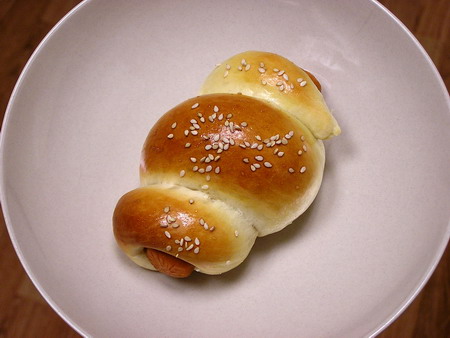
Ever seen something like this in a Hong Kong style bakery? The breads I loved as a child were not peanut butter and jam Wonder Bread sandwiches, but the assortment of breads made from Hong Kong style bakeries: cocktail buns (雞尾飽) , raisin twists (提子條), plain sweet bread (排飽) and pineapple buns (菠蘿飽), just to name a few. Baking yeast bread was a complete mystery to me until recently, but it always seems so magical - and comforting - to walk into a bakery and inhale the wonderful aromas of freshly baked, still-warm bread. Hong Kong style buns are often variations on the theme of a basic plain [semi-] sweet dough that is twisted, stretched, stuffed or topped with a number of different fillings. Sausage Buns - 腸仔飽, or pigs in a blanket (?) Dough recipe from Food For Tots - Sausage Rolls Ingredients -300 g bread flour (I used unbleached all-purpose flour and had to add a bit more to get the right feel to the dough) - 30 g unsalted butter, softened - 8 pieces of sausages (think hot dogs) - egg wash: 1 egg, lightly beaten Directions 1. Mix the flour, yeast, sugar and salt together in a large mixing bowl. Gradually add in the egg and milk, and combine, stirring until it comes together in a rough dough. 2. Knead with lightly floured hands for 3-5 minutes until you start to feel the dough coming together. 3. Add the softened butter and continue to knead until it is thoroughly incorporated into the dough. 4.Place the dough back into the mixing bowl, cover with a damp cloth, and let rise at room temperature for around 1.5 hours, or until roughly doubled in size. 5. Gently deflate the dough and divide into 8 pieces, one for each of your sausages. You'll want to roll these out into little logs, and then let them rest for 5 minutes or so to relax the gluten. 6. Roll out each log again and gently stretch them into thinner, longer logs. They'll need to be long enough to wrap around your sausage. 7. If you want the middle bulge of your bun to be bigger, you could also at this point taper the ends of your dough log by rolling the very ends a bit thinner until they form a point at each end. Wrap the log around the sausage and try to leave both ends on the bottom. That way, you can easily form a better seal by pressing the dough-wrapped sausage down on the ends. You'll want to place the shaped buns on a greased baking sheet, parchment paper or a silicone baking mat. 8. Cover the buns with a damp cloth and let them rise until roughly doubled again. When they start to look puffy, brush them lightly with the egg wash and sprinkle sesame seeds on top. 9. Bake on the middle rack of a preheated 200C (~400F) oven for 8 minutes, and then 180C (~350F) for 5 minutes or until they're golden brown. Submitted by teejtc on June 27, 2008 - 4:49pm Bauzi (Bau) Not fluffy enough and too shiny - Help!Can anyone help me make good bau? I'm talking about those gloriously light and fluffy, almost cake-like steamed buns that can be purchased at Dim Sum restaurants (and a new "fast food" place in Chicago that I had the pleasure of eating at a few days ago). Anyhow, I tried my hands at them AGAIN (I've tried a LOT) and they turned out better this time, but not nearly right. They're shiny on the top and not nearly fluffy enough. I'm not stuck on any particular recipe (I've tried several). Any suggestions would be helpful.

Grace and Peace, `tim Submitted by mrpeabody on March 13, 2008 - 11:18am Chinese steamed sweet pastry (Bok Hong Tay)OK, so I just posted a recipe for Mochi, which is a non-yeasted dough. This is "The Fresh Loaf," so I should also give a recipe that is at least yeasted. Here is my Mom's version of bok hong tay, a sweet steamed rice cake. Its name is literally "white sweet pastry" in Chinese. You sometimes see it in Chinese restaurants for dimsum. My Mom always made it on the thin side, but the restaurants tend to make a thicker version.
Wash the rice well and then drain all water. Add to it 4 c of water and let the rice soak overnight in the water (room temperature). The next day, put the rice-water mix in a blender and whip it smooth (hint: do this in small batches, with a rice-water slurry that is about 80-90% rice. This allows it to blend very smooth. Add the remaining water after it is all blended). In a separate bowl, combine 1/2 c of lukewarm water, the dry yeast and 1 tbsp sugar. Wrap bowl with plastic wrap and let stand in a warm spot for approx 1 hr. Then add the proofed yeast mixture to the rest of the blended rice/water mixture and let stand at room temperature for 4-5 hrs. In a separate bowl, mix 2 c water and 4 c sugar. If necessary, add heat to make all of the sugar dissolve. Be sure that the sugar syrup has cooled to room temperature before adding to the rice/water mixture. After adding the sugar syrup, let the mixture stand for another 1/2 hr before cooking the pastry. To cook: Pour some of the mixture into a well-oiled cake pan (approx. 1/4 inch deep. Again, my Mom prefered to make this on the thin side, but if you like, you can make it thicker, just adjust the cooking time). Steam the mixture for 15 min (be sure that the water is vigorously boiling). After the pastry is done, brush some oil on the top (note: if the oil had be previously heated to near smoking temp, and then cooled to room temperature, the resultant oil would taste better for brushing on the pastry. I don't know why this is true, but according to my Mom that the way she always did it.). When the bok hong tay has cooled down, cut out wedges of the pastry and serve. Enjoy, now I have to get back to work on my grant. Mr. Peabody Submitted by Floydm on July 1, 2007 - 8:39pm Almond CookiesChinese Almond Cookies are one of my favorite afternoon snacks. I often pick them up at the local Chinese bakery or keep a box of Amay cookies in the cupboard. I tried making them at home for the first time today. Not perfect, but they are pretty darned good.
|
ALSO ON |