Submitted by gcook17 on October 20, 2009 - 2:18pm

Kouign Aman


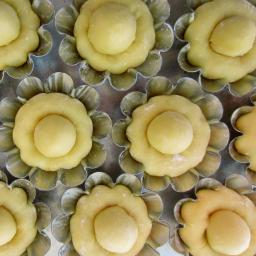
About a year ago my wife, Carol, and I went to my favorite coffee store, Barefoot Coffee in Santa Clara (California). Carol doesn't like coffee so she picked out a pastry from the pastry display. It was something I'd never heard of before called a Kouign Aman. It was crispy, crunchy, sweet and buttery. It was so good that we started making trips to Barefoot just to get the pastry. We eventually found out they're made at Satura Cakes in Los Altos. Now, whenever we're in the mood for a really good pastry we go get a kouign aman.

It seemed like it was a mystery pastry because it was hard to find any information on them and what we could find often seemed contradictory. I don't know if it's true but someone told us the name means "butter cake" in the Breton language.

Today I tried making them for the first time. It is a laminated pastry, like croissants but with a couple of twists. I made a basic croissant dough and laminated it with butter as usual, except the roll-in butter was SALTED butter and weighed 50% of the detrempe weight rather than the usual 25%. The other unusual thing was that on the 2nd and 3rd turns I laminated caster sugar into it. The roll-in sugar weighed 40% of the detrempe (dough w/o roll-in butter & sugar) weight. There seem to be a lot of different, acceptable ways to shape them. I just cut the dough into 6 inch squares.  For each square I folded the 4 corners to the center forming a smaller square. Then I folded the 4 corners of the smaller square to the center. After placing them on parchment I brushed them with softened butter and sprinkled them with more sugar. The kouign aman that Satura Cakes makes look like they're rolled up like sticky buns and I think they are baked in a baking dish that has butter and sugar in the bottom.

It was kind of difficult to laminate the sugar. After spreading sugar on the dough it didn't roll out as easily as croissant dough does. The dough tended to bunch up as I rolled it, maybe because sugar is rough and doesn't spread out like butter does. The other weird thing was that a lot of the roll-in sugar liquified. I think this was due to the long resting time between turns that were needed because I was rolling by hand. With a dough sheeter you could have a much shorter rest between turns and the sugar probably wouldn't have enough time to absorb so much water from the dough. I found that when laminating dough by hand I need a 2 hour rest between the 1st and 2nd turns, a 4 hour rest between the 2nd and 3rd turns, and an overnight rest between the 3rd turn and final shaping. The first hour of each rest is in the freezer, then it gets moved to the coldest part of the fridge. The final 15-30 minutes (depending on the temperature in the room) of each resting period in on the kitchen counter. I adapted the advice I got from hansjoakim and DonD on this forum and from Mark Sinclair while working as an intern at the Back Home Bakery to come up with this resting schedule. Normally for croissants I bulk ferment 1 hour at room temp. and another hour in the fridge (35-40 F). For the kouign aman I bulk fermented 1 hour in the fridge.

They're kind of rustic looking and very, very tasty.  The crusty ledges around the edges are caramelized butter/sugar that leaked out, baked, and hardened.


Submitted by hebakes on July 23, 2009 - 6:46pm

Where can I find dry butter?


Okay, so I’m slowly perfecting my croissants. I’ve found the absolute perfect flour (B&D) the perfect yeast (Red Star) but I’m wondering if I can find the perfect butter. 
Right now, they’re 99.9% like they were when made with French flour, but I’m wondering if dry butter will bring me to 100%.
I’m using a higher fat content butter, but if I don’t get it really cold, it can get too hot when I enrobe it, and that screws everything up. In France they use a dry butter, but I can’t seem to find it anywhere.
Any suggestions? 
It took me 2 years to discover B&D Flour, so I PRAY I get a decent response to this post soon.
All you bakers-HELP A GUY OUT!

Submitted by ehanner on March 28, 2009 - 11:48am

Butter problems


I'm in the middle of a home made butter project and I have bread fermenting for baking later today. I was hoping they would be ready together. I mixed the cream and yogurt last night and put it in the oven over night. I checked the temp this morning and it was 96F. I set it on the counter for a while to cool slightly about an hour. I beat it on high with a hand mixer and after about 5 minutes it started to separate. I dropped to low and it never separated any more. Now what I have is creme fresh. A smooth bowl of rich sour cream sort of. I did manage to drain some whey off but just a couple T. Is there any way to save this and continue into butter? At the moment it is setting at room temp in hopes it will separate.

Eric


Submitted by joenice on March 26, 2009 - 3:11pm

Cinnamon Roll Bundle

Cinnamon Roll Bundle

Starter Dough

  • AP Wheat flour (9,5% protein, i.e. nothing special)
  • Milk 250 ml
  • Sour cream 100 ml
  • Yeast, more than for your ordinary non sweet doughs.

Rest for 45 min

Then add

  • White syrup (or sugar, but white plain syrup makes it more moist)
  • One egg
  • Ground cardamom seeds. First roast them quickly on the stove until they crack open, then grind the black seeds inside.
  • Some more flour or any old white dough lying around.
  • Salt
  • 200g butter in cubes at room temperature is added slowly after 4-5 minutes of machine action.

Rest, divide if necessary and shape each to a smooth heap, rest again. Roll out to 0,3-0.5 cm thickness.

Spread evenly with a soft mix of:

  • Butter
  • Vanilla flavouring
  • Cinnamon

Roll together. Be careful not to roll to thin. Rolling "back" to a thicker size creates a less attractive end result. With QUICK cuts and a non-jagged knife cut the roll in around 3 cm thick slices. Place with minimal space apart on a baking sheet. Not totally together but tight together. Optional: Fill the small spaces in between each roll with raspberry jam.

Let it rise, possibly in a mildly heated and dampened oven, though careful not to melt the butter filling.

Brush with a whisked mixture of

  • One egg
  • 2 tbsp water
  • A pinch of salt 

Sprinkle over some chopped nuts or almonds.

Bake for about 15 min at 225 degrees C in the middle of the oven.

Cool as quickly as possible perhaps even outside to retain moisture.
When cool, garnish with some icing sugar, lemon juice or water mixed to form a thick paste. When half was used i dropped a few drops of Grenadine in what was left and got two colors.

The result from real butter, sour cream, white syrup gives a fantastic taste and moisture while the pre-dough procedure ensures a stronger gluten structure to form and support the rise without the interference of too much sugar initially. As you can see from the picture I only filled some of the gaps with raspberry jam, but the result was good and next time I'll fill them consistantly.

Submitted by mrosen814 on March 18, 2009 - 8:48am

Butter in Bagel Dough?


Beranbaum's bagel recipe calls for butter in the dough....have you done this?  If so, how do you compare it to bagels without butter included in the dough?  Thanks.

Submitted by Stephanie Brim on January 21, 2009 - 8:09pm

Back to the active dry: Maple Brown Sugar Oatmeal Bread

So my sourdough starter isn't ready yet. I've decided I'm going to baby it a little longer with three stirrings a day and lots of love. That being the case, I still needed to bake. This came about because I had oatmeal for lunch today. Strange lunch, I know, but sometimes you just have those cravings that must be heeded. I envisioned this as a soft-crusted bread with a dense but moist crumb and a decently caramelized crust. I wanted a little maple flavor, as well as the flavor of the brown sugar. I almost got it, but I think that this is still a work in progress. Not using instant oatmeal may be a start. It also needs a tad more salt than the teaspoon I put in. The only thing I'm lacking to make it completely from scratch is the maple syrup, which I'll get on friday, and I'll bake it again this weekend from old fashioned oats, brown sugar, and maple syrup. For anyone who still wants the recipe, it is below. I think I'm starting to get the scoring thing. These didn't blow out on the bottom. They were also better proofed than my last loaf. I let them sit for about an hour before baking. The real test of any bread making, for me anyway, is the appearance of the crumb. This is, by far, my best for a more dense loaf. I'm really loving what I'm learning here. I'm having a lot of fun baking (sometimes more than my boyfriend, our daughter, and I can eat, but it's proving to be very educational. Recipe: Maple Brown Sugar Oatmeal Bread - Take One Prepare the oatmeal: 1 packet instant maple & brown sugar oatmeal 1/2 cup water Mix and heat for 1 minute. It will be almost done, but not quite. Allow to cool to just warm. Assemble the rest of your ingredients: 3 1/3 cups flour 2 1/2 tsp active dry yeast 2 tablespoons of butter 1/4 cup lightly packed brown sugar (very lightly) 1 egg, lightly beaten 2/3 cup milk (lukewarm) 1 1/2 tsp salt Disolve the yeast in the milk. In your large bowl you use for mixing the final dough, mix together the oatmeal, sugar, and egg. Once incorporated, mix in the milk. Once all this is well mixed, add 2 cups of flour and the salt and mix until you get a thick paste. Add the rest of the flour in 1/3 cup increments until it's almost all in. If your cups are the same as my cups, it should take all but the littlest bit of the flour. If not, you want the dough to feel very sticky and barely hand-kneadable. Once mixed together so that there's barely any flour left in the bowl, rest for 10 minutes. After the resting period, turn the dough out onto your kneading surface and "knead", as well as you can, for a few minutes. 5 or so. Bulk ferment should be about 60-80 minutes. Mine was on the longer side because of the temperature of my kitchen. I stretched and folded the dough three times during this time. Got very good gluten development. Preshape and allow to sit for 5 or so minutes. Shape loaves, then proof for about 45 minutes to an hour, depending on the warmth of your kitchen. Score and bake in a 400 degree oven for 15 minutes, then turn down to 350 and bake until a thermometer reads 200 degrees or so.

Submitted by Tulip1 on November 15, 2008 - 10:16pm

Kosher

Hi everyone,

 What a wonderful blog.

There was an entry which said, I think, that kosher cake would not have butter.  I think this is inaccurate;  I have several kosher recipes which include butter--also butter substitutes, if the cake is to be eaten at a non-dairy meal (meat).

Tulip1

Submitted by Mini Oven on August 7, 2008 - 4:57pm

Stuck with salted Butter


The only butter I can find is salted.  Now what?  I've got a scales and now to figure.  I've seen some recipes that one "stick" of butter is 1/2 cup and that sometimes 1/4 teaspoon salt can be eliminated if salted butter is used.  I'm getting nervous...I would really appreciate some help. 


Q:  What is 1/2 cup of Butter in grams?  (Directly off the package, please)

Q:  And how many grams of salt are mentioned on the package for the test amount?  (usually 100g)


I thought I had a kilo of rye with me also but alas, I'm headed for withdrawal.  My baking world is stalling....help...

Mini off Oven 


Submitted by ChefEd Bethesda on May 26, 2008 - 5:05am

How much heat can a buttered baking croc handle?

In using the no knead slow rise recipes (Baggett, etc.) the recipes call for oiling the cooking vessel, say a cast iron Dutch oven. Vegetable oil imparts a taste my wife doesn't like. OK, how about oiling with butter? Will it handle to 400 -450 degree pre-heating OK?

Submitted by zhi.ann on March 14, 2008 - 9:31pm

butter v. oil


Does vegetable oil work as a substitute for butter in baking yeast breads? I use it (or applesauce) in baking other stuff. I don't have access to butter or shortening.