Submitted by SumisuYoshi on September 28, 2009 - 10:20pm

Another Sunday Bake

Multigrain Bread Extraordinaire

Sunday again, at my house this time. And once again I need a pan loaf for sandwiches! I started flipping through Bread Baker's Apprentice looking for my next target. The Multigrain Bread Extraordinaire caught my eyes, without so much as a picture! People who know me probably wouldn't be surprised by this, because as much as I love various artisan breads, whole wheat or multigrain anything will make me sit up and take notice. And no, I don't eat cardboard in my spare time.

The first step was to figure out what grains I was going to use in the bread. The recipe called for 3tbsp of either corn meal, amaranth, millet, or quinoa; 3tbsp of either rolled oats or wheat, triticale or buckwheat flakes; and 2tbsp of wheat bran. I decided to go with 2tbsp amaranth, 1tbsp millet, 2tbsp rolled oats, 1tbsp buckwheat cereal (not as small as flakes, but who's counting?), the 2tbsp of wheat bran, and 1tbsp of flax meal.

Grain Soaker

I'd also decided to deviate a bit from the recipe and make it sourdough. I already had my starter out to refresh (Friday night), and I had some leftover that I wouldn't be able to use for anything else, so why not right? I used the starter to make a small stiff levain (which I meant to build Saturday, and forgot). I wasn't particularly following a recipe for that part, so I wrote down the amount of flour and water I used so I could account for it in the recipe for the loaf.

Stiff Levain

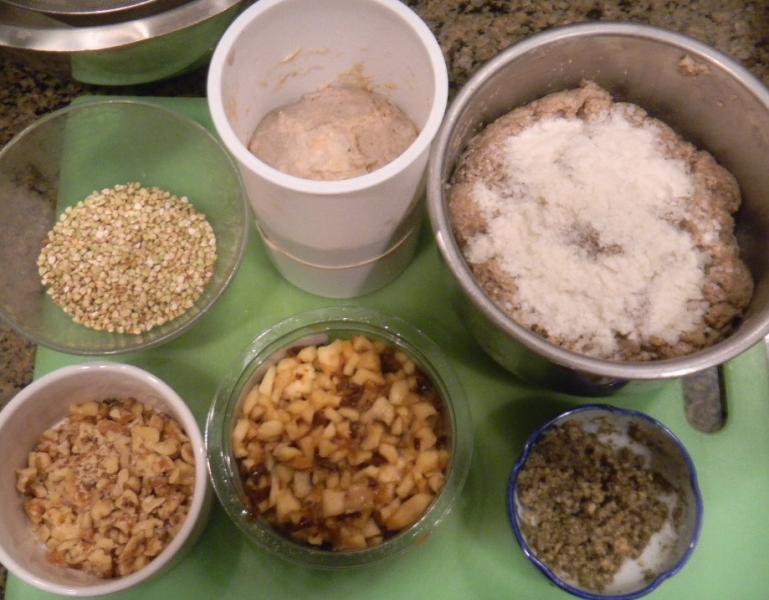
I gathered together the rest of the ingredients:

MilkFlour, Salt, Brown Sugar

And not shown here: honey, cooked brown rice, and water. They went in after the levain descended on the milk.

Attack of the stiff Levain!

Mixing time! The dough was much gummier and stickier than I was expecting. I think a lot of that gummy/stickyness came from the starches in the soaker. As I emptied the grains into the dough I noticed the somewhat stringy goop of starch conglomeration on the bottom of the container.

Mixing the dough

After a bit more mixing, adding a little bit of flour, doing some stretches and folds, the dough finally reached a point where I could actually handle it. It still was quite sticky and gummy though, definitely unlike other doughs I've dealt with so far.

Mixed dough

Folding the dough

As I mentioned, I forgot to do a build of the stiff levain I made for this loaf. So it took a very long time to rise, in fact, at one point I wasn't even sure it was going to rise. What made it especially hard is that my sourdough starter really doesn't do most of the rising until the oven. So, I gave the dough plenty of time and a few more folds, it had finally grown some and didn't spring back on a poke test, so I shaped it into a loaf and plopped it into a pan.

Ready to proof

In the loaf pan it didn't take quite as long for the second rise, but it was getting late and I really needed to get to bed, so that was all the rising it was going to do!

Proofed

Into the oven it went, it did get a nice little bit of oven spring (but not as much as I was hoping for, and nowhere near as little as I was dreading). I think next time I'll make it with regular yeast, or make sure I remember to have a build of levain before I start the loaf! It smelled really wonderful when it was baking, in fact it smelled amazing when it was rising too! Never had a loaf that smells that good during bulk ferment and proofing. It was a great combination of yeasty, sour, sweet, and grassy/grainy. I assume the aroma must have come from all the grains in the loaf, but I don't really know for sure. This is definitely one bread I want to make again, and soon! I'll probably experiment with switching it over to whole wheat too, if that turns out well I think I may have found my dream sandwich bread...

Multigrain Bread Extraordinaire

Bread Baker's Apprentice Challenge

YeastSpotting

Submitted by Salome on August 27, 2009 - 1:27pm

Buckwheat Apple Sourdough


We've got so many jars and tins and boxes and bottles in our house. I "digged" in our cellar and found an old jar of dried apples. Dried 1998, surprisingly still look alright. Found a bag of organic buckwheat flour which my parents brought home from the Bretagne, France some holidays ago. And found a glass with some kind of Estonian instant Buckwheat which our Estonian exchange student left here two years ago. Everything looked alright, smelled alright, felt alright, I decided: It's time to use it!

End of August - The fall is coming! What about an Buckwheat Apple Bread, that sounds good and seasonal. It just had to be created. That's where I came into play. I intensified the apple flavor trough some cider, which we had in our cellar as well, and added a little bit of pear honey as well. Rather easy, utterly delicious.

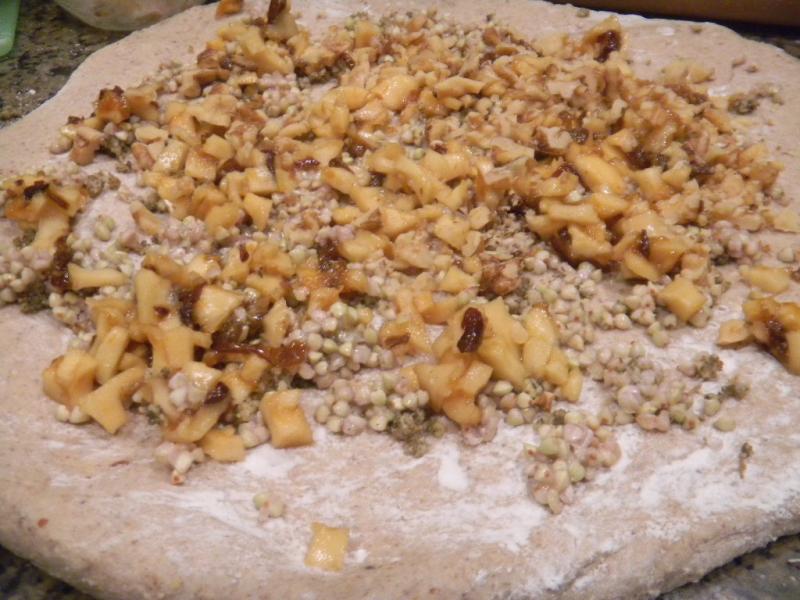
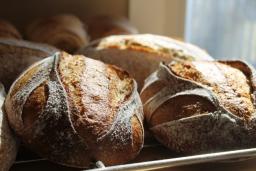
The apple and the buckwheat are not only on the picture a nice couple, I found that the light sweetness and the sour tang of the apple worked very well with the nutty buckwheat flavor. Especially the crunchy loaf had a very interesting mouth feel!

Buckwheat Apple Sourdough

Ingredients

liquid levain
100 g buckwheat flour
125 ml cider
15 g mature starter

final dough
385 g bread flour
15 g Vital Wheat Gluten
230 ml cider (start with 200 ml and add more cider as required)
12 g salt
a little less than 1 tsp instant yeast
1 tsp pear honey ("Birnel"), can be substituted by any sweetener
40 g dried apple rings, chopped
1/2 cup whole buckwheat


  1. Mix the ingredients for the liquid levain, put aside for 12 hours.
  2. pour some hot water over the whole buckwheat and let it soak for a while.
  3. In the meantime, mix the liquid levain, the flour, the Vital Wheat Gluten and cider and let it autolyse for some time. I let it sit for about 15 minutes, as long as it took to clean up after lunch. Watch out with the amount of cider added, I had to juggle a bit with some extra flour and extra cider until I found the right consitency, a tacky but not sticky dough.
  4. strain the buckwheat berries and let it drip off well.
  5. mix the final dough, but don't add the apple chunks and the buckwheat yet. Knead until the gluten is developed, then incorporate the apple pieces and about 2/3 of the buckwheat berries.
  6. Let the dough ferment for about 1.5 hours, with one fold after 40 minutes.
  7. Divide the dough into two, shape two boules. I rolled one in the leftover buckwheat berries and let it proof on the board, the other one proofed in a proofing basket.
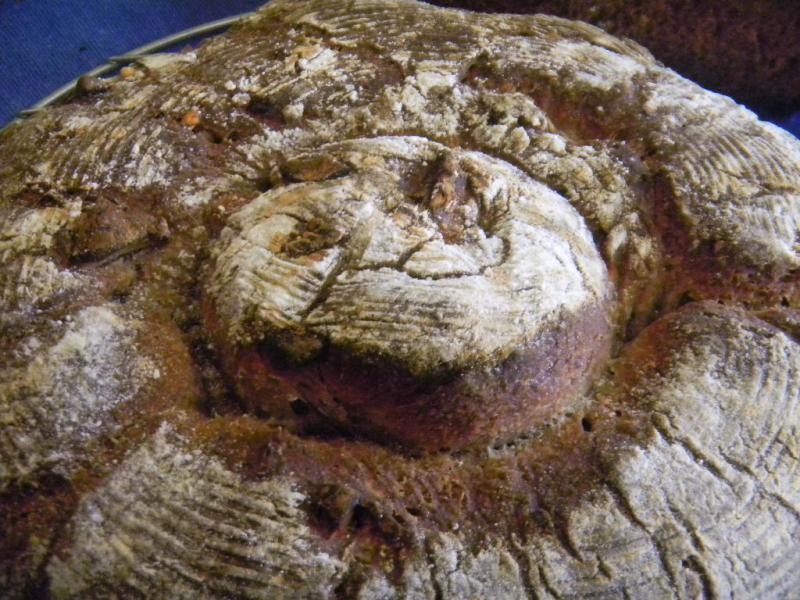
  8. after the proofing, I decorated the second boule with an apple sign (Cut out an apple out of paper, mist the boule, place the apple on the loaf and dust the loaf now with flour. Take the apple paper away and in the oven it goes).
  9. Bake the loaves on a preheated baking stone with steam at 430°F, lower the temperature when the loaves take on to much color. (I finished baking at 400°, after about 40 minutes of baking in total)
  10. let it cool on a rack and enjoy plain, with butter or with a mild cheese.

Simply autumn, doesn't it look like it?

No other pictures of the "sleek" apple loaf, I gave it away to somebody who has borrowed me her car for my driver's license preparation a couple times. Of course I couldn't cut into it. ;)

Salome

Submitted by ardent on July 4, 2009 - 1:42pm

First Attempts at Semolina Country Bread, Light Rye, and Buckwheat Sourdough....

Hello,


I'm new to the forums but am learning lots already from the posts.  Wanted to share with you my baked bread of the week.  All three made Friday in Hawaii.

Buckwheat Sourdough Rolls


Light Rye -- with my first attempt at dusting (I did it by hand, I now realize I should have sifted it on)


And lastly, Semolina Country Bread.   This dough was amazingly soft.   I decided to braid it.


Submitted by xaipete on May 9, 2009 - 3:51pm

Suas' Buckwheat Walnut Pear Bread


I've been on a buckwheat kick lately and wanted to try Michel Suas' Buckwheat Pear Bread. Suas' book, Advanced Bread and Pastry, poses some problems for me in that its recipes all assume the baker knows what he or she is doing. While I generally know what I'm doing, I don't always remember to do what I know.

I made the levain yesterday, soaked the pears in riesling wine for an hour this morning, and then completed dough. The recipe didn't specify whether to dice the dried pears, but fortunately I was able to find some information about it on the SFBI site and figured out they were suppose to be diced. Still, I didn't know whether the weight of the pears was before or after soaking. I used the before soaking weight, and that was probably a mistake. The final dough was pretty sticky, and although not unmanageable, I think I would have been better off if the dough had been a bit firmer. Another thing that the formula doesn't tell you is how to assemble the final dough. After I had dumped everything in the mixer bowl, I thought, "I should have mixed the water with the levain before putting in the rest of the ingredients." That was a good thought but unfortunately I thought it a little too late. Anyway, I mixed everything up as best I could, but had trouble getting the pears and walnuts incorporated during the final minute of mixing and had to work them in by hand; the final dough was pretty sticky. The dough took about 2 hours to double. I shaped it into 3 rounds and let them rest 30 minutes, then formed them into loaves for my mini pans. I wasn't interested in making my loaves into the recommended pear shape--I'm way too utilitarian for that. I let my loaves proof for 1 hour and then baked them with steam at 400º for 35 minutes.

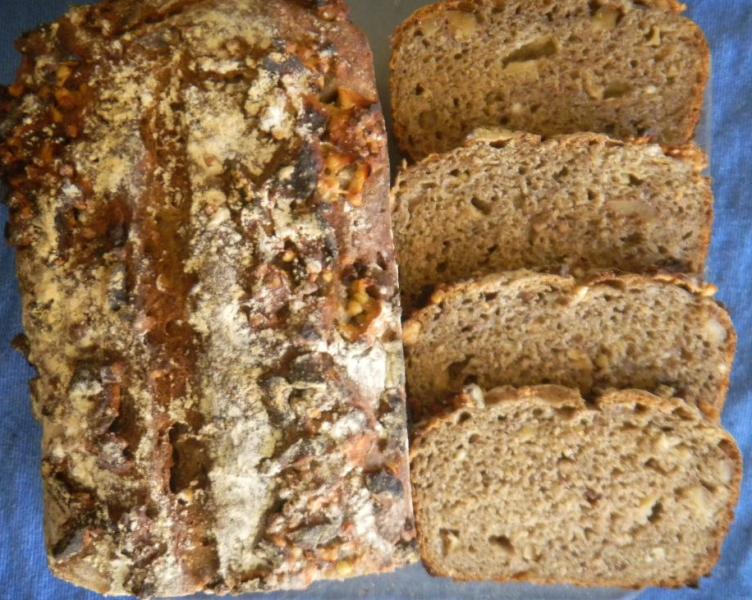
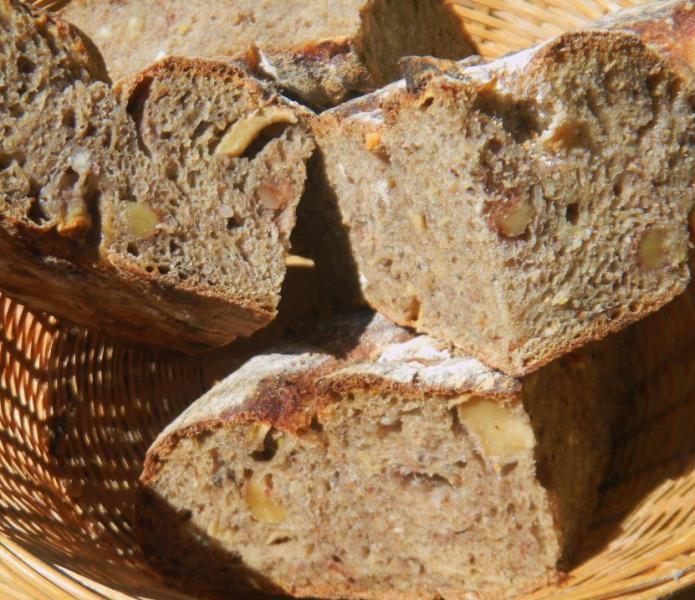
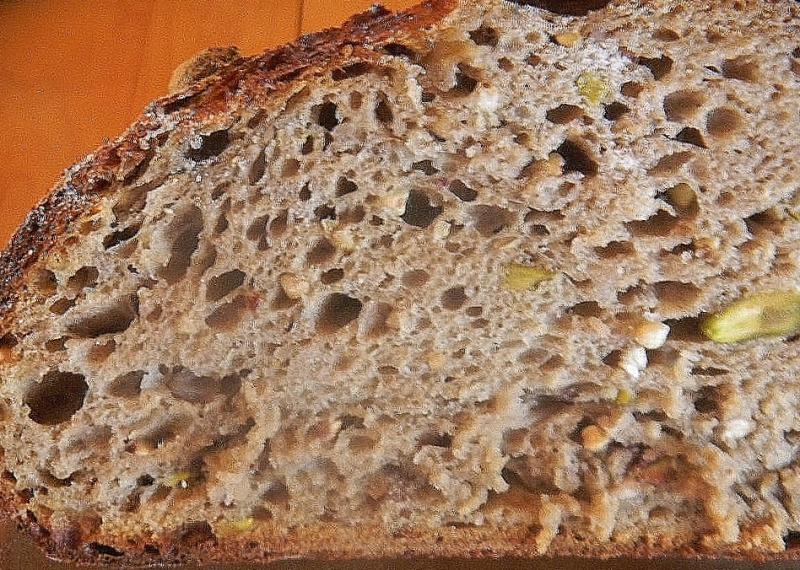
The crumb is a slightly spongy and a little wetter than I think it is suppose to be. Perhaps I under- or over-mixed the dough. You can see darker and lighter parts in the crumb; I think that is probably owing to my failure to incorporate the levain and water at the beginning. The pear taste is very prominent but not overwhelming; the buckwheat taste is very subtle. If nothing else, these little loaves will make great toast.

buckwheat pear bread

Levain:

39 g buckwheat flour

138 g bread flour

174 g water

1/8 t yeast

1/8 t salt


Final Dough:

280 g bread flour

135 g water

11 g salt

3 1/2 g yeast

39 g toasted walnuts

92 g dried, diced pears reconstituted for 1 hour in white wine


My interpretation of how to put this bread together:

Make the levain 12 hours beforehand. Mix the levain with the water for the final dough, add in the remaining ingredients except the nuts and pears, and knead on speed 2 until you achieve improved mix (window pane forms but breaks when stretched). Add the pears and walnuts on speed 1 after the dough has been developed.

Let ferment at room temperature until double, about 2 hours. Preshape into 3 pieces and let rest for 30 minutes. Form into mini-loaves and let proof for about 1 hour. Bake in a 400º oven with steam for about 35 minutes.

--Pamela

Submitted by xaipete on May 9, 2009 - 11:10am

Buckwheat Crepes (Crêpes de Blé Noir)


I've been lucky enough to travel to Paris a few times. One of the new foods I experienced there was buckwheat crepes or galettes. The little bistro I ate them in was just across the bridge from Notre Dame. These crepes were served flat with an egg and ham in the middle of them. You just break the egg on top of the cooked crepe with the heat on low and cook until the white is set and the yolk is very warm. (Quail eggs would be especially delicious here.) When you bite into the crepe, the egg yolk gets absorbed by the crepe. These were fun to make although I had to add some milk to the recipe this morning to loosen it up (it really thickened overnight). I found the recipe in the LA Times. I'm going to fill some of them with creamed spinach as a side dish for tonight's dinner.

buckwheat crepes

buckwheat crepes

1 cup buckwheat flour

1 cup all-purpose flour

4 large eggs

1 cup milk

1/2 teaspoon sea salt

4 tablespoons butter, melted
Softened butter for the pan

1. In the jar of a blender, blend the flour, eggs, milk, salt and melted butter with three-fourths cup water at high speed until smooth, about 2 minutes, scraping down the sides midway with a spatula. Strain the batter through a fine-mesh sieve.

2. Cover and let rest, refrigerated, for at least an hour, or overnight.

3. Heat a crepe pan or nonstick sauté pan over medium heat until a sprinkle of water sizzles when you throw it on the pan. With a paper towel, spread butter over the pan, being sure to wipe most of it off.

4. Using a bowl or a measuring cup with a spout, pour enough batter to just cover the pan (for a crepe pan, a little less than one-fourth cup), immediately swirling the batter around until it covers the whole surface. The batter may be thicker than basic crepes once it has been resting and may need to be thinned a little; if so, add up to one-fourth cup water and stir until blended. It will have a different consistency than sweet crepes (more like honey than pancake batter) and will cook slightly differently, forming bubbles and lacier edges. Adjust the heat, if necessary, to medium-low. As with pancakes, the first one or two galettes are usually experiments.

5. When the edges of the galette begin to turn golden and move away from the pan, about 3 minutes, lift the edge nearest to you using a spatula (an offset spatula works best). Flip the galette over. Cook the second side of the galette only long enough for it to set, less than a minute. Remove from the pan and start a stack of galettes, using wax paper to layer between each galette as you cook more. Add more butter when needed with a paper towel.

Each of 24 galettes: 71 calories; 3 grams protein; 8 grams carbohydrates; 1 gram fiber; 3 grams fat; 2 grams saturated fat; 41 mg. cholesterol; 65 mg. sodium.

Submitted by mcs on February 19, 2009 - 5:10pm

John and Jan's Hippie Bread


OK, I know you're out there.  Maybe those Birks are getting dusty or they're hidden in the closet along with your beaded vest and shrunken tie-dye, but you're really hankerin' for some good ol' fashioned hippie bread.  Just like the kind you used to eat while working on your macrame choker and groovin' to Cat Stevens before he became public enemy number one.  Here you go.
A friend of mine was looking for something all-too-healthy, and I came up with this recipe.  It is primarily whole wheat with buckwheat flour, flax seeds, toasted almonds, and other goodies.  It's not exactly airy like ciabatta, but it sure has a lot of flavor.  Plus, if you need to, you can put some loaves over your wheels in the bed of your truck in the wintertime to get some extra traction.  I've tried a few different shapes, and the boule seems to help the loaf out the most because you can give it some height in the shaping for a boost of confidence in the proofing stage.  Try it out and hope you like it!  This is a link to the recipe in PDF format.

-Mark

http://TheBackHomeBakery.com

PS, I'm about 2 weeks from finishing a couple of instructional DVDs. If you're interested, I can email you when they're ready, or you can stay tuned here since I'll be posting about it on TFL when they're done.


Submitted by dragon49 on January 3, 2009 - 5:22pm

Delicious Buckwheat Bread

This is the most delicious Bread that I have made so far:

Buckwheat Bread:

Normal 0 false false false MicrosoftInternetExplorer4

1 ½ Cups Water

4 Tablespoons Olive Oil

3 ½ tablespoons Brown Sugar

2 Teaspoons salt

1 ½ Cups All Purpose Flour

½ Cup Semolina Flour

½ Cup Brown Rice Flour

1 ¾ Cups Buckwheat Flour

2 ½ Tablespoons Vital Wheat Gluten

1 ¼ Packages Instant Dry Yeast


The bread came out moist and sticky.  It appears that I created a giant healthy pancake!


Submitted by dragon49 on December 7, 2008 - 7:50pm

Making Rye and Buckwheat Breads with less All Purpose Flour

I've been making some good Rye and Buckwheat Breads with my Bread Machine.  I need to use at least 60% All Purpose Flour, othewise the Bread does not rise and form well.  I want to make the breads with less percentages of All Purpose Flour.  Is it possible to use Vital Wheat Gluten to accomplish what I want, or will Vital Wheat Gluten only help form and rise Wheat grains?


If it is possible, pls reply with some formulas.


If not, what else can I use to make good breads with less percentages of all Purpose Flour.


Thanks


Submitted by subfuscpersona on December 6, 2008 - 3:27pm

article on buckwheat from the SanFrancisco Baking Institute

article on buckwheat from the SanFrancisco Baking Institute - Fall '08 newsletter

Renewed Respect for Humble Buckwheat

http://www.sfbi.com/FileUpload/files/SFBINewsFall08.pdf

Submitted by dragon49 on December 3, 2008 - 2:47pm

Delicious Multi Grain Bread

This is the most delicious Bread that I have ever made:


The 1/3 cups of water added noticeably more moisture to the bread than the recommended 1 1/4 cups for 4 cups of flour.  Breads with the recommended amount were a tiny bit too dry.


Mixed Grain Juniper Berry Bread:


1 1/3 cups Water

2 cups Spelt Flour

1 cup All Purpose Flour

1 Cup Buckwheat Flour

3 Tablespoons Extra Virgin Olive Oil

3 Tablespoons Brown Sugar

2 Teaspoons Sea Salt

4 Tablespoons Juniper Berries

1 1/2 Packages of Red Star Active Dry Yeast