Submitted by Bixmeister on June 11, 2009 - 4:51pm

Getting Ready for Club Night at HBC


Besides bread making, one of my other hobbies/interests is homebrewing.  I have brewed for over 15 years now.  I am an all-grain brewer which means I brew with grains rather than extract.  I am also an AHA beer judge at certified level.  You need to pass a test for this.  I am a member of a very fine beer club, QUAFF which put San Diego on the map beerwise by winning the National Homebrew Club of The Year award 6 years consecutively and several California titles.  You may ask yourself why am I telling you this when this is a bread oriented forum.

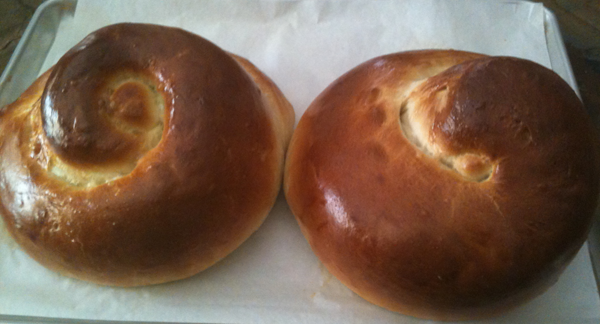
The answer is because I promised to bake bread for the National Homebrew Conference being held in Oakland, CA this year.  I promised four Ciabattas.  What I baked was 4 Ciabattas plus a bonus bread, my first attempt at a 6 strand braided Italian bread:


4 CIABATTAS


MY FIRST 6 STRAND BRAIDED ITALIAN BREAD


Comments and Suggestions Welcome

Submitted by Stephanie Brim on June 8, 2009 - 9:19pm

Simple Bread: A Tribute

I was inspired by David (dmsnyder) and his 5 hour baguettes. I needed a sandwich bread that was as lean as I could get it but was still very much soft crusted and soft of crumb. I've found it, I think, by slightly modifying the 5 hour baguette idea and adding one enrichment: olive oil.

Stephanie’s Simple Bread
Makes 1 small loaf

225g AP or bread flour
10g rye flour
15g white whole wheat flour
3/4 teaspoon instant yeast
1 teaspoon salt
1 tablespoon olive oil
170g water

Mix ingredients in the bowl for your stand mixer until you form a shaggy mass. Mix, on low, for 5 minutes, then increase speed to medium for 3 or 4 more. I left this in a clean bowl for 75 minutes for a first rise, folding at 25 and 50 minutes, and 60 minutes for a second rise. Shaped carefully and proofed for 40 minutes, scored, and spritzed with water. Baked for 30 minutes at 425 degrees.

I posted the recipe on my blog, too.

So thank you David. Thanks also have to go out to Susan of Wild Yeast for inspiration due to the fact that I was browsing the Wild Yeast Blog when I thought about how good a simple bread would be with the locally homemade ham salad I bought today.

Submitted by Steve H on June 8, 2009 - 6:54pm

Bread Shelf Life

So, my bread is drying out pretty quickly, which makes me sad.  As a single person with only one girlfriend, we can only eat so much at once, and I am running our of houses for housewarming gifts.  What's the best way to keep bread from getting stale?

Submitted by Steve H on June 7, 2009 - 7:35pm

Hamelman Oatmeal Bread

This was the Hamelman Oatmeal Bread using KA Bread Flour and Gold Medal Whole Wheat.  I was suprised how much spring I got on the scalloping.

Submitted by niagaragirl on May 26, 2009 - 12:28am

BBA Challenge - Castiello

I was given some great new Italian Sausage bu a new local vendor, so a great excuse to make Peter Reinhart's Casatiello fron the BBA book. Really a nice change. It was wonderful.

Here is some crumb detail

Related blog post here.

Submitted by littletemchin on May 17, 2009 - 7:49am

Sourdough Starter

I have a starter and it does not seem to leaven properly. It bubbles just fine when I feed it however whenever I try to bake anything out of it, it just doent leaven properly. Now whenever I try making sourdough bread I have to add small amounts of comercial yeast just to be sure that my bread will rise. Is there anyway to make my starter stronger? If so, how? If anyone has any suggestions I would be very grateful to hear them.

Submitted by angeliaw on May 13, 2009 - 1:33pm

Loaf Pans

I was talking with someone regarding the dimpled loaf pans and they don't like them because of the aluminum.  They only used stainless steel.

What are your thoughts about the metal for bread pans and what pans do you think are best?

Thanks for any input.

Angelia

Submitted by Stephanie Brim on May 4, 2009 - 9:55am

Baked Potato Bread, take 2.

Baked Potato Bread Photo

There'll be a better write-up on my blog,
mentalexperimental.org, but I wanted to thank Floyd for a good starter recipe. I'm still working on modifying this one. I think that I have the general consistency of the bread down that I want, but I want a bit more tang. I think that there may have to be a sourdough component to really get it where I want it to be. But that's a completely new bread.

This is Floyd's recipe with a few modifications. The first is adding a bit more sour cream. The second was adding cheddar cheese instead of chives. The third is the addition of half & half in the dough and the mashed potatoes.

I think that getting a stand mixer will help me with this type of bread the most. I mixed for 8 or so minutes on speed 2 and then folded twice during the bulk fermentation, giving it an hour at the end to come to full bulk. The crumb is light, fluffy, and very tender.

I'm writing the recipe on the blog now. I wanted to share the photo because I'm so proud of how this one turned out. :)

Submitted by Manang on May 1, 2009 - 6:24am

Maple Oatmeal Bread

This is one of the recipes that I sought to make because of available ingredients. My in-laws just made another batch of maple syrup for this year (they do around March) and gave us some. I still had some from last year's, so I thought I'd look for a recipe to use up the opened jar sitting int he fridge. I found one at KAF, but I modified the recipe. Reading their blog about the recipe, I learned that they originally made use of 1/2 cup maple syrup. and while they made use of water, maple syrup and maple flavoring to brush the top to save on the expensive ingredient, I did not have to do that.

Maple Oatmeal Bread
I had about 1/2 cup from a pint jar of maple syrup, and after pouring that off into a measuring cup, I had maple sugar sediment at the bottom, which I crushed with fork. This was what I used to brush the top of the loaf prior to baking. The blog author was right, the maple flavor was like creeping on you slowly...and toasting it (I do for 5 minutes) brings out the full flavor. Perfect for breakfast with my coffee, even plain or with jam.

And since I was using my bread machine, I changed the flours to bread flour and traditional whole wheat, both KAF brands, and the yeast to BM yeast. Of course, once these ingredients are changed, the method changes as well.

Ingredients:
* 3/4 cup warm water (80-100 deg F)
* 1/2 cup old-fashioned rolled oats
* 1/2 cup real maple syrup
* 1/4 cup butter
* 1 1/4 teaspoons salt
* 1/2 teaspoon cinnamon
* 3/4 cup King Arthur 100% Traditional Whole Wheat Flour
* 2 cups King Arthur Unbleached All-Purpose Flour
* 2 1/4 teaspoons instant yeast

Combine all wet ingredients and warm up to 80 to 100 deg F. Place in BM pan. (Don't forget the paddle!)

Combine all dry ingredients and place on top of dry. Start the dough cycle. Run a timer for 30 minutes (this will be the total time of kneading by the machine before it rests to rise for one hour), after which, transfer the dough to a lightly floured surface and flatten with your floured palm to a disk. Generously grease your loaf pan.

Roll the dough to a log and place seam side down in an 8.5 x 4.5 x 2.5 loaf pan (if you use a bigger one, your loaf will not have an overhang and will seem too small for the pan). Cover with cling wrap smeared with shortening on the side that will eventually touch the dough so that dough will not stick when you remove the plastic later. Let rise for 1-1/2 to 2 hours in a warm, draft-free, moist place or until the dough has doubled in size and has about 1 inch overhang.

Heat the oven to 350 deg F. Place rack at the middle.

Remove plastic and brush the top with maple sugar-syrup all over. (I placed the loaf pan on another shallow pan to catch syrup drippings.). Bake for 35-40 minutes or until it sounds hollow when top is tapped with finger.

Let cool down for about 5 minutes before turning onto a cooling wire rack. KAF advises to let it cool fully before slicing. I don't. I think the reason they advise that is that it is easy to compress and deform the loaf with the pressure of slicer. I have, in the past, even as a child, learned to angle the loaf in such a way that my slicer hits the bottom corner first. When done this way, versus hitting the loaf from the top or flat sides, the bread maintains its shape, especially if you are not hastening the slicing.

Submitted by Bixmeister on April 21, 2009 - 10:14pm

First Bread Since Joining The Forum


I recently retired(630-08).  One of my hobbies was baking including bread baking.  With all the distractions of married life and the job my hobby time was restricted.  I like to home brew, garden, cook, read, woodworking, general physical fitness-walking, hiking etc.  My time for baking was practically nil with all the other things taking their share of time.  Now that I am retired I have been reading up recipes, techniques etc. for bread making.  I purchased S.F. Sourdough Starter and 2 Italian starters from Sourdough International.  I have both starters active.  Although I have made French Bread before, I never shaped a Boule.


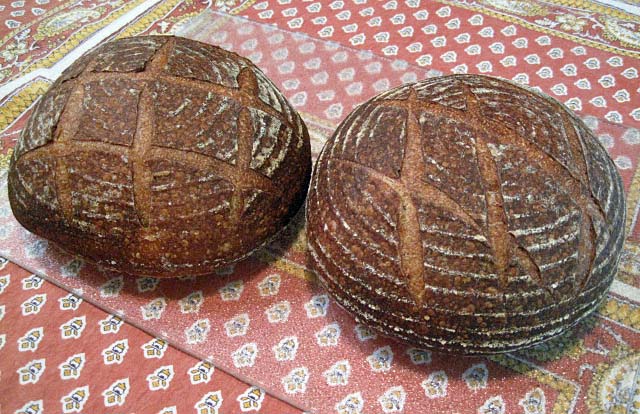
 Here is my 1st attempt at Boule: 


Notice the fine toothed serrated tomato knife to the right of the

bread.  I had trouble getting a clean scoring action with knife for

this bread.


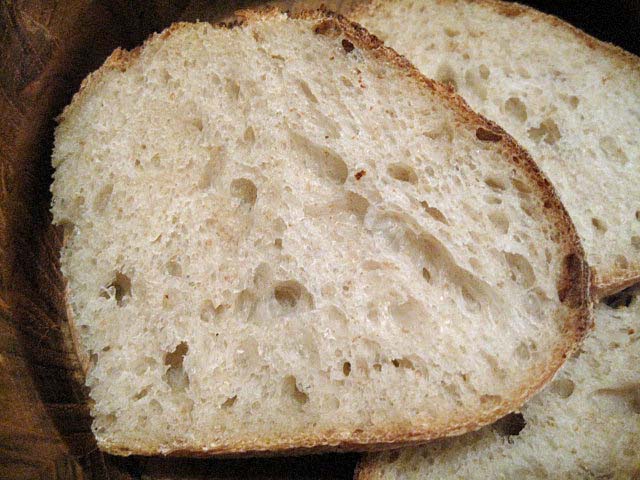
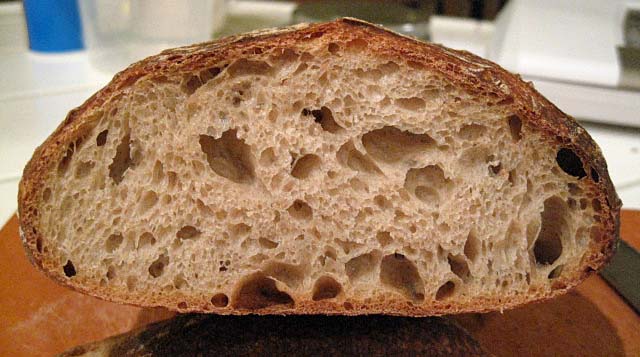
Here is the crumb for this 1st Boule attempt:


Used a bread proofing basket for forming shape.  like the small green basket from Pastry Chef Central: http://www.pastrychef.com/Proofing-Baskets_c_47-1-0.html

I wanted to try this bread shape again.  Here is my 2nd attempt:


Notice better scoring.  I used a different tomato knife with long large serrations and I cut less deep with a smoother action.

I think I am getting there.  Thanks D.M. Snyder for the scoring tutorial.  I didn't photograph the crumb this time, but is was similar to the first time.  The texture and taste of bread was excellent(medium chewy.

I employed some things I learned from previous baking.  I also used a technique suggested on the forum a few times previously.

For getting the bread onto a baking stone quickly I used a black teflon baking sheet that withstands high temperatures and can be used over and over.  This sheet is several years old and has been used in the oven for various types of baking including bread.  I used it on my Kamado which I use for all types of cooking, barbecuing and baking.  To see go to:http://www.kamado.com/

An example of the teflon baking liner is at: http://www.jlryan.com/main/product.asp?prodcode=C4033PP

I placed the teflon sheet on a cookie sheet.  Then I opened the oven and pulled the rack with the baking stone out so I could easily grab hold of the teflon sheet and pull it on the stone.  Parchment paper might work as well, but is not as strong as teflon.  

Here is my Boule baking on the aforementioned teflon baking sheet: 


The picture doesn''t show my next tip.  I place a 9X9 pan of

hot water at the bottom of my gas oven.  For easy quick addition

of water I turn a corner of the pan to face as far forward as the

door will allow.  This way when I preheat the stone and the hot

water at the start of the baking cycle I can slide the bread off a

cookie sheet onto baking stone, then push rack and stone back

into oven.  Next I pour the water I have standing by into the

exposed corner of the very hot pan and quickly close the oven.

I derived the recipe using the recipe converter on the forum

site.  It worked very well for me!  Kudos to the converter"s

creator.

My next bread attempt was a sourdough.  The recipe was found

at the following location: http://www.sourdoughhome.com/sfsd1.html

The photographs are as follows:


Notice the sort of flat top.  The top was puffed up more, before

I glazed the top with egg white.  ??.  The dough started when it

filled the bread pan about half way up.  What you see is after

15 hours of proofing per recipe instructions.  I used activated

San Francisco Sourdough Starter from my master starter that I

mentioned I made earlier.

Next is the baked bread that had an internal temperature of 

slightly over 200 º F. Here is the photograph of the baked

bread: 

I haven't cut or tasted this bread yet but will comment later

when I cut and taste it.

My apologies for such a long entry.  This is my first entry of recipe

descriptions and pictures since joining the forum.  I really like this

bread forum for its very informative information pictures, techniques

and tools.  This is a great way for us all to become better bakers.

I really like your editor on this site.  It is very intuitive.

Bix