SearchUser loginBread BooksFavorite Recipes
|
Submitted by Polish Babka on June 19, 2011 - 5:59pm Bread with a hump on the sideHello, Sometimes my bread grows a hump during baking. It comes out usually later during the bake and always from a side. It doesn't happy very often but I'm wondering what is the problem. Could it be underproofed or is it bad shaping, bad slashing? It happens only with batards, I proof them in bannetones or free form. Any ideas how to fix it? Thanks.
Submitted by dmsnyder on May 8, 2011 - 10:52pm A Bâtard of a weekendI think I know at least 6 different ways of shaping bâtards. I often choose how I shape them on impulse. This weekend, I decided to be a bit more reflective and consciously chose 3 variations to try. I think I gained better control over bâtard shaping as a result. I made two loaves of Hamelman's Pain au Levain from “Bread” and two loaves of my San Joaquin Sourdough. The first loaf was shaped using one of the methods learned from the San Francisco Baking Institute. I can't recall seeing this method demonstrated elsewhere.
Pain au Levain from Hamelman's "Bread," shaped using Method 1. Method 1
This method is suitable to make a bâtard with a fat middle and little tapering, as pictured.
Pain au Levain from Hamelman's "Bread," shaped using Method 2. Method 2
This method makes a longer, thinner loaf with more tapered ends.
The two loaves of Pain au Levain after shaping and scoring - ready to bake. Note that these loaves were of identical weight.
San Joaquin Sourdoughs, both shaped using Method 3. Method 3
This method results in a loaf similar to that from using Method 2, except a bit thicker in the middle. It solves a problem I have had shaping bâtards with higher-hydration doughs with excessive extensibility. They tend to get too long and thin as I shape them, even before the final rolling out. Starting with a round piece of dough, rather than a log, helps me get the shape I want.
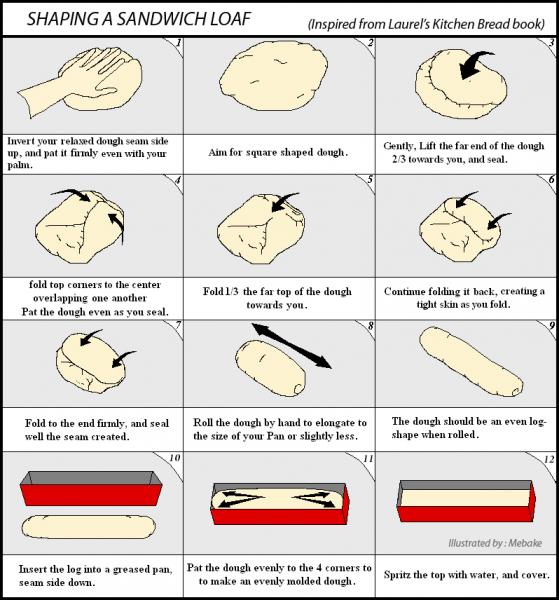
Thanks for listening. Happy Baking! David Submitted by Juls on February 8, 2011 - 6:23pm Rebellious batardsHi everybody. I'm new here, I'd like to request your kind help... does anybody know some foolproof method for shaping a batard loaf? I started baking with a sourdough starter a couple of months ago, my first baguettes and boules were a complete success, but now the batard shaping is giving me headaches -and tears of frustration... sometimes. I have tried two methods: a) make a rough rectangle, fold down the top, fold the corners in, rotate 180º, repeat the foldings on the other side and curl up the loaf, pinching the seam. b) make a triangle and roll up the loaf starting at the narrow end, as an inverted croissant: http://www.breadcetera.com/?p=82
I proof my batards on a couche, I try to get good superficial tension, I make sure that the seam is well closed, and I place the seam at the bottom... and yet, and yet, a horrible protuberance emerges from the sides of my loafs. What am I doing wrong? Any guidance will be much appreciated. Thanks in advance! Submitted by mcs on January 14, 2011 - 7:00pm more shaping practiceHey TFLers, -Mark
Submitted by joyfulbaker on December 18, 2010 - 2:37pm Olive fougasse, first timeI've been wanting to bake a fougasse for a long time and finally did it. I was baking Hamelman's olive levain and saw that one suggested shaping was as a fougasse. I saw that he also had a separate fougasse recipe, but I had already created the levain for the first bread. As I usually do when baking a recipe for the first time, I read at least 2 or 3 other authors, hope to find a photo of the finished product, and then proceed. (I guess I'm a careful person in general and pretty frugal as well.) So I realized, from reading others' fougasse recipes, that I had to add olive oil (mentioned in both Baking with Julia and Nancy Silverton's Breads from La Brea Bakery). So I added 4 TBSP olive oil and also 1/2 tsp. instant yeast to the final dough. I also reduced slightly the amount of olives, not very significant, but used 7 oz. instead of the 8 oz. in his recipe. For shaping, I had seen a color photo in Dorie Greenspan's Baking with Julia and used that as a guide. I was more than satisfied with the results, which yielded 2 large loaves, each weighing about 1 1/2 lbs. I brought one to my book club dinner, and people couldn't get enough of it. There's another in my freezer, soon to join me on a visit to friends in the L.A. area. Here's my update of Hamelman's recipe for Olive Levain (pp. 178-9): OVERALL FORMULA: Bread flour 1 lb, 12.8 oz Whole-wheat flour 3.2 oz Instant yeast 1/2 tsp Water 1 lb, 4.2 oz Salt .5 oz Olives, pitted 7 oz (I used Trader Joe's large Kalamatas, cut in half and, very important, dried very well.) Olive oil 4 TBSP extra-virgin Rosemary needles, minced, about 2 TBSP TOTAL YIELD: 3 lb, 11.7 oz plus olive oil
LIQUID LEVAIN BUILD Bread flour 5.8 oz (1 3/8 cups) Water 7.2 oz (7/8 cup) Mature culture (liquid) 14.2 oz
FINAL DOUGH Bread flour 1 lb, 7 oz (5 1/4 cups) Whole-wheat flour 3.2 oz (3/4 cup) Instant yeast 1/2 tsp Water 13 oz (1 5/8 cups) Salt .5 oz (2 1/2 tsp) Liquid levain 13 oz (all less 2 TBSP + 1 tsp) Olives, pitted 7 oz (1 1/4 cups, packed) Rosemary needles, minced, about 2 TBSP
LIQUID LEVAIN: Make the final build 12-16 hrs. before the final mix; let stand in a covered container at about 70 deg. F. (mine fermented overnight for about 14 hrs at 60 degrees; it seemed fine). MIXING: Add all ingredients to the mixing bowl, except for the olives [and the olive oil--my addition]. In spiral mixer [mine is planetary--K/A Pro 6] mix on first speed for 3 minutes, adjusting hydration as necessary. Turn the mixer to second speed, drizzling in the olive oil, and mix approximately 3-4 minutes more. Dough should have moderate gluten development. Add the olives, distributing them in by hand to keep them from getting smashed and coloring the dough purple (a little bit of purple seems OK). BULK FERMENTATION: 2 hours. (Remember, I have added instant yeast.) FOLDING: Fold once after 1 hour or, if the dough seems to need more strength, fold twice at 50-minute intervals. DIVIDING AND PRESHAPING: Divide the dough into 1.5-lb. pieces. Lightly round dough on a floured surface with seams down. Let dough relax for about 20 minutes. Shape the dough into an oval shape about 1 1/2-inches thick, using a rolling pin if necessary. FINAL FERMENTATION: About 1 1/4 hours at 67 deg. F. (You should adjust time to your ambient temperature.) SHAPING AND BAKING: Preheat oven with stone to 500 deg. F. Place a pan with about 2 inches of hot water on the rack below the baking rack; it will be steaming by the time you load the dough. When fougasse has risen, final shaping occurs. Pick up dough and stretch it gently so it's about half again as long as it was. Place it on baking sheet without sides or a peel lined with parchment. Shape it into a long "tombstone" shape, the base about half the length of the height. Using a pizza wheel or a good-sized paring knife, cut slits as shown in the photo, and cut into the perimeter to suggest a leaf shape, also as below. Next, widen the slits with your hands, which takes some time, so they won't close up when the loaves go into the oven. (I have only one oven, so I kept the second loaf, preshaped and covered with a plastic trash bag--puffed up with air inside so it wouldn't stick to the dough--in my garage while the first loaf was being slashed and baked; it was a cool day so the garage was about 55 degrees.) When done with the cutting, brush top with extra-virgin olive oil and scatter minced rosemary needles or minced herb of choice on top, lightly sticking it on with fingers if necessary. Steam oven before loading the dough onto the stone and again after it's in the oven (I sprayed with a garden pump sprayer every 2 minutes for the first 10 minutes, covering the window with a towel each time). After 10 minutes, remove the aluminum pan below the baking rack and turn down the heat to 460 deg. F. (I actually baked with convection setting, which is 435 deg. F. Either way seems to work fine.) Check doneness after a total of 35 minutes. You want a full bake but not overbaking, as the loaf is thin. Bake for a total of 35-40 minutes, again using your judgment and knowing how your oven bakes. When done, remove to a cooling rack. While loaf is still hot, brush again with extra-virgin olive oil. Enjoy!!
Submitted by northwoodie on December 8, 2010 - 10:14am Challah Bread, "Shaping"My wife and I love Challah and use it for a lot of sandwiches. My problem is the shaping. I would like to step away from tradition and just make regular loafs. The traditional braiding looks beautiful but it does not make good sandwiches or substantial pieces of French Toast. Is their any special steps that have to be taken to achieve my desired results without causing anyone to gasp? Submitted by kayemme on March 26, 2010 - 6:18pm lumpy loafwith my last couple of sourdoughs, i've been having that thing happen where during the final proof, there is separation so, technically, there is no need to slash, and further, it makes the loaf somewhat lumpy. what am i doing wrong? Submitted by JeremyCherfas on January 20, 2010 - 7:37am Rest after shaping: I don't really get itI've read all I can find about the need to rest the dough, generally on the counter, immediately after shaping, in order to let the dough relax. But I confess, I just don't get it, especially with wetter doughs. If I have shaped a round ball and I leave it sitting on the counter for 10 to 15 minutes, it spreads out and becomes a domed pancake. Well, I exaggerate, but you know what I mean. At that stage, I can round it up and try to tighten the skin by repeatedly stretching it down and around, but it doesn't seem to give noticeably better results than just putting the original rounded ball into my cloth lined bowl. Am I missing something vital here? Jeremy Submitted by cake diva on January 27, 2009 - 12:17pm how to shape boulotCan someone provide me with instructions on how to do the above? With one straight score along the north-south axis, it makes for one attractive bread; unfortunately, I couldn't find anything on the topic. I know how to shape boules; is this where one may start? Submitted by dwg302 on June 12, 2007 - 5:06am Pullman Loafcan someone describe how to shape a pullman loaf as opposed to a just a normal loaf pan? or if you have a good reference where i can look it up that would be ok too. i would like to make the Hamelman pumpernickel recipe but i can't find anywhere in his book that describes how to shape a pullman loaf. thanks, david |
Advertisement |