SearchUser loginBread BooksFavorite Recipes
|
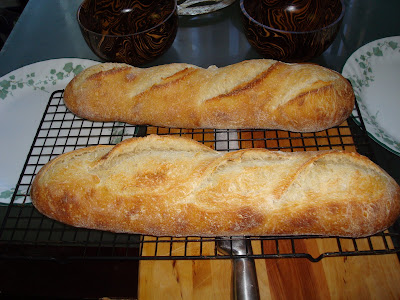
Submitted by householddutch on May 31, 2011 - 7:41pm Disagreement about scoring...So at work (a high volume bakery) we have this new guy who claims that nearly all the bread in his former bakery was scored before proofing. I'm fairly certain that's crazy talk, but are there any exceptions to this? There is one type of roll that we score before proofing, only because it's delicate and has a tendancy to deflate if done after proofing. I told him the cuts would look awfull/close up, but does anyone know exactly the benefit of waiting till the bread is just about to go into the oven? I can only vaguely recall that scoring before proofing is a bad thing. He was also going to make the cuts on a delicate boule with a gigantic bread knife. The horror! Submitted by dmsnyder on January 6, 2011 - 10:35pm What's your score?I've always held the lame a certain way when scoring loaves. I hold it so I score using the end corner of the razor blade closest to me. (See method 1., below.) But, at the SFBI workshops, both of my instructors held their lames so they used the end corner of the blade furthest from them to score loaves. (See method 2., below.) Now, Miyuki said it made no difference. It was a matter of personal preference. But I've wondered. I've reviewed the drawings and photos in books as well as various videos (You Tube, CIA/Calvel videos). I find that, among "the masters," some score one way and some the other. So, even though I think I've gotten fairly good results with "Method 1.," I thought I should give "Method 2." a try. Here are my observations, and I'd love to hear which method others prefer, especially if there is a reason other than habit: I made a double batch of Pat's (proth5) baguettes.
They were very yummy, as usual.
Scoring Method 1.
Scoring Method 2. (the method actually used on this batch of baguettes) What I found was that Method 2. felt more awkward to me. On the other hand, I also felt I was forced to score with the blade at a more shallow angle (the proper way to score baguettes), whereas, using Method 1., my hand kept pronating (rotating so the palm was facing down), resulting in a more vertical cut relative to the plane of the baguette surface. I'm hesitant to generalize based on scoring 4 baguettes. So, I'm eager to hear from other bakers regarding their experience, especially (but by no means only) from those who score hundreds of baguettes each week in commercial settings. Happy baking! David Submitted by dmsnyder on July 23, 2010 - 7:48pm Bec de Canard: I got it. Now what?"Bec de Canard" (Literally, "duck's bill.) is the name given to a sharply curved and hooked French lame. I've ogled these on French baking supply web sites and wondered how they would compare with a razor blade type lame for scoring breads. I recently found them from a U.S. source by following a link from another site. The price was quite modest, so I indulged my curiosity. If anyone else is interested, my source is Bridge Kitchenware (lames). So, now I'm the proud owner of a couple of these beauties:
I bet you can figure out why they are called "bec de canard." (But it actually looks more like a bec d'oie to me.) No one photo can provide a sense of this implement's true shape, so here's a more lateral view:
Pretty sharp angle, eh? Anyway, I want to try out this lame, but I have no firm idea just how to apply it to a loaf. I tried it on a couple bâtards made with a rather slack dough. I used the "bill" to kind of hook into the surface and pulled. Not pretty. If anyone has had instruction in and experience with this type of lame, please help me out! Thanks. David
Submitted by Ryan Sandler on May 4, 2010 - 9:16pm Success with scoring!I had a really great success in scoring the sourdough batards I made over the weekend, and wanted to share. They were made using the "experimental" sourdough baguette formula I concocted awhile back, although I screwed up in several places -- added salt to the liquid levain, and far too much water to the firm levain/pate fermente. I managed, though, adding more flour and omitting the salt from the firm levain. The dough was I think a little wetter than the 65% I intended, but everything worked out nicely nonetheless. The results were quite pretty, though the lighting in the picture doesn't do it justice: I think the higher quality results were more to do with improved shaping than improved scoring per se. Since I switched over from the Hamelman-recommended "fold over the thumb" approach to the Back Home Bakery "roll and tuck" approach, I've been getting much better results from my batards and baguettes. Taste, texture and crumb were also quite nice: Submitted by dmsnyder on April 13, 2010 - 6:27pm Lame from TMBBarbara Kraus asked a question about how to get a razor blade installed on the lame handle from TMB (SFBI). I thought some photos would be most informative.
Lame handle with double edged razor blade installed
Tip of handle on which the razor blade gets installed
Close up of installed blade, convex view
Close up of installed blade, concave view I hope this helps. David P.S. To get an idea of the range of lames available to the french baker, check out this web page (recommend doing so while seated): Meilleur du Chef - Lame de boulanger page Submitted by norco1 on February 7, 2010 - 9:13am scoringI appreciate the need for scoring and have always scored my bread. My problem with scoring is that at the point of baking my scoring tool (serrated knife and especially a razor) is usually hung up by the proofed dough and unable to make that neat quick cut. Any suggestions? Submitted by dcp740i on March 19, 2009 - 6:48pm GrigneI have only been baking for a few weeks, but thanks to personal guidance, good books, and this site, I am getting some great results all things considered. My family is happy. One odd thing: though I score deeply with a razor blade, I get no grigne or edges. The scores just pop open widely and crust over like the rest of the crust. You can see them, but they are basically flat. I am using a very wet 4-ingredient french-style dough made with poolish and scrap dough plus a little SAF yeast. Good crust, good crumb, some nice air pockets, good flavor, but a smooth surface. I have bene misting the bread before baking, as well as misting the oven and pouring boiling water into a pan just before baking. Oven is convection at 500, turned down to 425 after 10 minutes. Today I did not mist the dough, just the oven. Same result. I suspect the wetness of the dough is causing the scores to simply collapse. If I go with a drier dough, do I lose the great crumb and "big air?" Many thanks, folks! Submitted by ryeaskrye on January 5, 2009 - 5:42pm Scoring Homework Pics - Thanks David!Inspired by dmsnyder's excellent scoring tutorial post, I decided to try the C&C San Fran and see what I could do following his pointers. I didn't want to pollute his post with my amateur pics. I did 2 loaves that both look like they went in underproofed. Using a double-edged razor blade on Starbuck's stir-stick, I put 3 shorter slashes on one loaf and 2 longer ones on the other. I held the blade at less than a 30° angle and slashed quickly. I have not made this dough before, but it was a lower hydration than I usually create and seemed much easier to score. Here they are, before, after and long views:
Here's a close up of an ear:
and some strange blisters/bubbles, many that were 1/4" or more high:
And now I have to grind out the wait before cutting... Submitted by dmsnyder on January 2, 2009 - 3:48pm Bread Scoring Tutorial (updated 1/2/2009)
Scoring Bread
What is scoring? “Scoring” is the word used to describe the cuts made in a loaf of bread before it is baked. Some breads are not scored. For example many loaves baked in pans are not. However, almost all free-formed “hearth breads” are scored. When is scoring done? Scoring is generally performed just prior to loading the loaves in the oven. Why are breads scored? The purpose of scoring is primarily to control the direction in which the bread will expand during “oven spring.” Intentionally creating a weak spot on the surface of the loaf prevents the loaf from bursting at weak spots created during shaping. The pattern of cuts made, the angle at which they are made and the depth of the cuts also influence the rate of expansion and the formation of an “ear” - a raised flap of crust at the edge of a cut. The pattern of cuts also can create a pleasing visual pattern on the surface of the loaf. While there are some very traditional patterns, for example for baguettes, the baker can use the scoring pattern to identify the type of bread or to create an unique pattern that identifies the loaf as coming from his or her oven. The effects of scoring on loaf shape are discussed in more detail below. How are breads scored? Breads are scored with very sharp cutting implements. These may be straight or curved razor blades, which may be held in the hand or mounted on a handle. Scoring may be performed with other sharp, straight blades, even with a straight razor. Some bakers prefer serrated blades. Some examples are pictured below:
This is a “lame,” the French term for a razor blade used to score bread. This one is permanently mounted on a handle. Others are made with replaceable blades. This lame holds the blade in a curved position. Others hold the blade straight. The curved lames are generally used for long breads like baguettes which are scored with cuts parallel to the long axis of the loaf. The cuts are made with the blade held at a shallow angle to the surface of the loaf, about 20-30 degrees or so. The blade is held with the concave surface facing up (away from the loaf). A flap of dough is created that will lift up to create an “ear” as the loaf expands and, by lifting gradually, slows the expansion of the loaf. This prolongs the time during which new areas of dough are exposed to the direct heat of the oven and results in greater overall expansion – a larger “bloom.”
Serrated knife
Tomato knife These are examples of serrated, straight bladed knives. The first one is made expressly for scoring breads. The second one is manufactured as a “tomato knife,” but it is very sharp, holds its edge well and has been found to work very well for scoring bread. Straight bladed knives are preferred for cuts made with the blade held perpendicular to the loaf's surface. This sort of cut is generally used for round loaves (“boules”). However, they can be used for the same kinds of cuts described above as well. The angle the blade of the knife makes with the surface of the loaf is important in determining how the cut will open up. If you want the cuts to spread equally from the cut and to open quickly, the knife should be held vertically – at 90 degrees to the surface of the loaf. This type of cut is usually made ¼ to ½ inch deep.
If you want the cuts to spread more slowly and create an “ear,” the knife blade should be held at a shallow angle with the surface of the loaf, like this:
This type of cut should be shallower than the cuts made with the blade vertical to the loaf – about ¼ inch deep. A deeper cut will result in the flap closing from its own weight rather than separating from the surface of the loaf to form an “ear.” The scoring stroke should be firm, rapid, smooth and decisive. For the beginner, it may help to take “practice swings” or to visualize the movements and totally focus one's attention before making the cuts. Understanding the functions of scoring and the effects of the variables described can help, but there is no substitute for experience. In this respect, scoring bread is no different from an athletic skill or any other art or craft. (Tourist: “Please, sir, can you tell me how to get to Carnegie Hall?” New Yorker: “Practice, practice, practice.”)
The effect of scoring on loaf shape Michael Suas, in his book "Advanced Bread & Pastry," provides some information about how scoring patterns influence loaf shape. Scoring is not just to make a visually pretty design on the top of a loaf. It is also how the baker controls the direction in which the loaf expands. This impacts the shape of the loaf cross section (rounder or more oval), the height of the loaf and, for a boule, whether it stays round or ends up more oblong. According to Suas, long loaves like bâtards and baguettes are traditionally scored parallel to their long axis. This may be a single long cut or multiple cuts that are almost parallel and overlap somewhat (for ¼ to 1/3 of their length, generally).
Classic Cut – Single and multiple cuts However, for breads with high-rye content which have lower gluten and less oven spring, the traditional objective is to encourage a higher rise in the oven spring resulting in a rounder cross section. This is achieved by "sausage" or "chevron" cuts.
Sausage cut (on the left) and Chevron cut (on the right) Boules are scored in a variety of patterns, again with differing effects on how the loaf expands. The common "tic-tac-toe" pattern and a simple cross will direct the expansion upward. More complex patterns like diamonds result in a relatively flatter loaf.
Boule scored with “tic-tac-toe” pattern One of most interesting effects is that scoring a boule with multiple parallel cuts encourages expansion at a right angle to the cuts. This results in an oblong loaf shape.
What's the point of an ear? Controlled bloom! This topic is not about the auricular anatomy of elves (or Vulcans). It's about scoring breads. Scoring loaves creates a visually pleasing pattern, and it helps control the expansion of the loaf as it bakes. These San Francisco Sourdough breads illustrate a more "advanced" aspect of scoring that is alluded to by both Hamelman (in "Bread") and Suas (in "Advanced Bread & Pastry.")
San Francisco Sourdough Breads (from Peter Reinhart's "Crust & Crumb")
Detail of bâtard crust, with "ear," grigne" & "bloom."
What Suas called "the classic cut" is parallel to the long axis of a baguette or a bâtard. The cut is made with the blade at a shallow angle to the surface of the loaf. The cut should be shallow - about 1/4 inch deep. Paradoxically, this shallow cut results in the flap lifting better than a deeper cut would, thus forming a nice "ear." Hamelman (pg. 80) points out that "a deep cut will simply collapse from its own weight." The angle is also important. "If the angle is not achieved and the cut is done with the blade vertical to the loaf, the two sides of the dough will spread very quickly during oven spring and expose an enormous surface area to the heat. The crust will begin to form too soon - sometimes before the end of oven spring - penalizing the development of the bread. If the cut is properly horizontal, the sides of the loaf will spread slower. The layer of dough created by the incision will partially and temporarily protect the surface from the heat and encourage a better oven spring and development." (Suas, pg. 116.) The second photo, above, illustrates a fairly nice "ear," but it also shows that the bloom occurred slowly, as it should. Notice that the color of the crust in the opening has 3 distinct degrees of browning, decreasing from left to right. The darker part on the left obviously opened first and was exposed to the direct heat of the oven for longer. If the bloom occurred too rapidly, it would have a more even coloration.
This boule was slashed with the blade held at 90 degrees to the surface of the loaf. Note the even coloration of the bloomed crust. In summary, in order to achieve an optimal bloom in baguettes and bâtards, one must attend to 3 variables when scoring them:
Variable shading of the bloomed crust confirms that the desired slow but prolonged opening of the cut during oven spring occurred. Happy baking! David P.S. I have made a video version of this tutorial. It was my first attempt at editing a video. I am not delighted with the quality, but I hope I can show it and, maybe, get some help improving it. Here is the link: http://video.google.com/videoplay?docid=-4381896920195658969&hl=en (for slow connections) http://video.google.com/videoplay?docid=6866686363544546201&hl=en (for broadband, e.g., DSL or cable)
|
Advertisement |