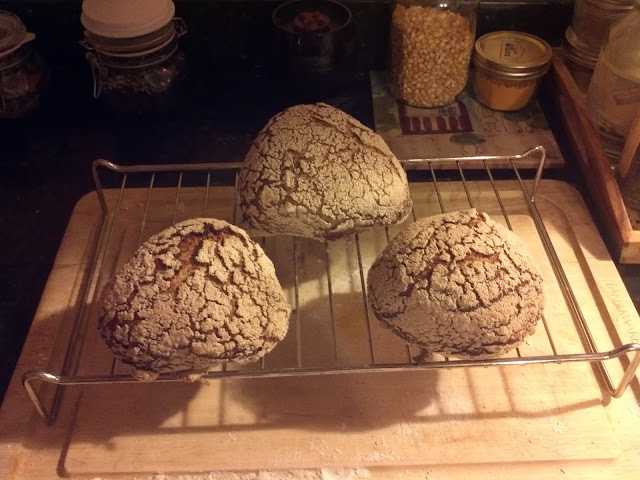
Hanseata’s wild rice bread looked so enticing we had to move it up to the top of the bake list. To her recipe, which hardly needed any changes at all if one of us was sane and not barking, we used high alcohol ice beer for most of the water and upped the hydration about 10 %. We didn’t use all beer for the liquid because it had to pass quality control to make sure it was not spoiled in some way. It actually took two or three tastings just to make sure, but it finally passed.


We also added hemp (since wild rice is a grass), anise, fennel and coriander seeds, as well as, some prunes for their sweetness, cleansing reputation and black color to go with the wild rice. For the balsamic vinegar we used a pomegranate flavored one. Last but not really last we added some rye, WW, spelt and barley sprouts to go with the beer. We also add some molasses and honey to go with the barley malt and some home made red and white non-diastatic and diasatic malts. Then we moved the salt to 2% or we thought we did after we remembered we forgot to add it. So, all in all, only a few minor changes were required.

The batard doubled in the proofing basket coming all the way to the top after it doubled in the fridge overnight too. The spring in the oven after a slightly deflating diamond cut was also good. The batard only sprawled 1” in length and ½“ in width after coming out of the basket.

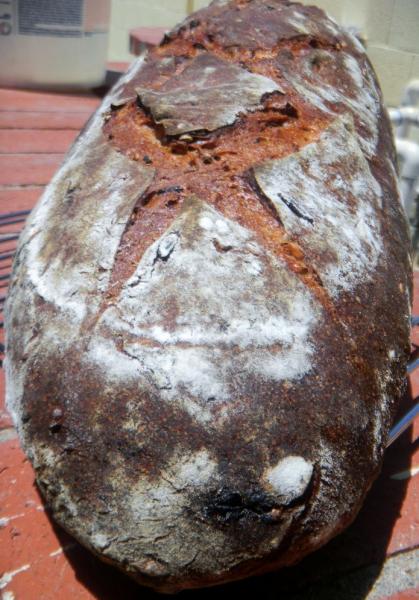
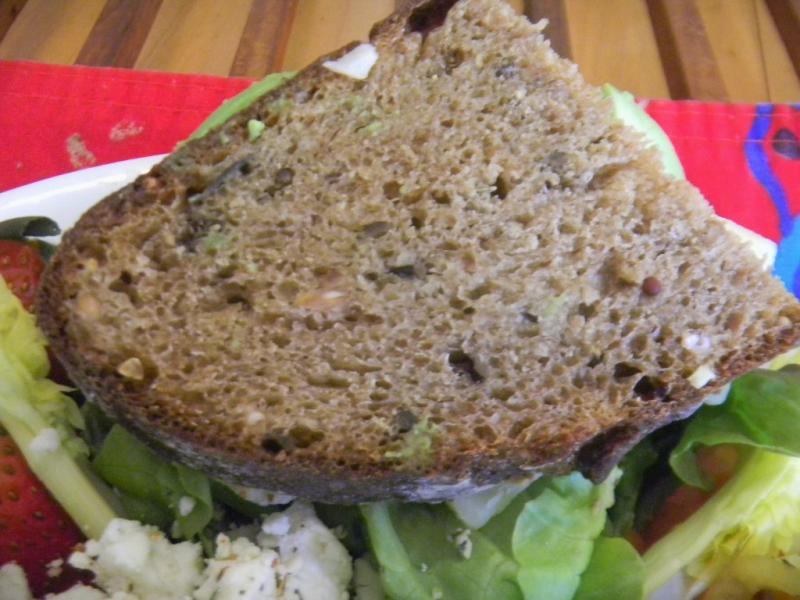
The crust took on a dark brown color as expected, the bloom was good and was still unexpectedly a little crunch after it cooled. This is the best slash job we have managed to date. The crumb was fairly open for so much stuff inside, very moist due to the YW and the texture was just the way we like it. The sprouts, wild rice and seeds gave it an nice nutty, chew and flavor but the hemp seeds were a crunchy contrast and unexpected. Don’t soak your hemp seeds for this bread!

One can’t really make out the prunes other than a very slight sweetness throughout. The anise, coriander and fennel smell and taste were muted, but noticeable, also way we like it. A medium SD tang was also there and very nice. Don't know what it would taste like without the beer. All in all, this is the best looking and tasting bread I have ever been fortunate to make. It is a delight to eat plain, toasted and buttered. I’m guessing it will make some kind of special sandwich. This bread takes 3 days to make but it is worth the waiting. It is an A+. Thanks Hanseata for the inspiration. Formula and method follow the pix's.


This bread made for a nice ham and cheese sandwich for a lazy Saturday lunch with some of favorite lunch sides.

Method
Sprouts - The first thing to get started are the spouts. Soak the seeds for 5 hours and them sprout between - damp paper towels covered in plastic wrap. Reserve unti;l needed about 24 hours.
Starter - Then get the combination YW and SD starter going in (3) 4 hour builds totaling 12 hours. It should double after the 3rd build between the 8 and 12 hour marks. Refrigerate overnight. This bread can be made with SD starter alone just double the amount of starter.
Autolyse - Take all the flour and add all the beer and water, less 25 g of the water, add the malts, honey, balsamic vinegar, molasses and the VWG mix well and refrigerate for 24 hours.
Cook - the wild rice on low for 1 hour in at least twice as much as water as rice. Reserve the cooked rice in the refrigerator.
Reconstitute the chopped prunes in 1 T of hot water and grind the seeds slightly in a mortar.
Then next morning combine the autolyse, the reserved 25 g of water and starter in the mixing bowl and knead with the dough hook on KA 2 for 5 minutes. Add the salt (donlt forget like I did) and knead on KA 3 for 3 minutes. Knead an additional 2 minutes on KA 4 for 2 minutes. Move dough to a well oiled, plastic covered bowl to rest for 15 minutes.
Do 6 sets of S&F’s every 15 minutes on a floured work surface putting the dough back into the oiled covered bowl each time. On the 5th S&F add in the sprouts, seeds, prunes and cooked wild rice. After the 6th S&F form dough into a tight ball, place into a oiled bowl, cover with plastic and let rest on the counter for 1 hour. Retard the dough in the refrigerator overnight.
In the morning remove the dough from the fridge and let come to room temperature – about 1 hour. Form into the shape you desire and let proof on the counter for 2- 3 hours in a plastic bag, or until it passes the poke test. Mine took 3 hours total out of the fridge I formed the dough into one large 17” x 6” batard.
45 minutes before the dough is ready, preheat the oven to 500 F regular with steaming method and stone in place. Bake the bread for 15 minutes with steam, the first 4 minutes at 500 F, then 11 minutes at 450 F regular bake and then for another 20 minutes at 400 F convection until internal temperature reaches 205 F. Rotate the bread every 5 minutes 90 degrees. Leave door ajar with the oven off and the bread on the stone for 12 minutes to let the crust crisp. Move to wire rack to cool to room temperature.
| Wild Rice Multi-grain with YW and SD Starters, Sprouts and Hemp Seeds | | | | | |
| | | | | | |
| Mixed Starter | Build 1 | Build 2 | Build 3 | Total | % |
| SD Starter | 25 | 10 | 10 | 45 | 6.50% |
| Yeast Water | 30 | 20 | 10 | 60 | 14.58% |
| Rye / Dark Rye - 50 | 40 | 20 | 50 | 110 | 22.92% |
| WW | 40 | 20 | 20 | 80 | 16.67% |
| Water | 50 | 20 | | 70 | 14.58% |
| Total Starter | 185 | 90 | 90 | 365 | 76.04% |
| | | | | | |
| Starter | | | | | |
| Hydration | 76.47% | | | | |
| Levain % of Total | 24.87% | | | | |
| | | | | | |
| Dough Flour | | % | | | |
| WW | 75 | 15.63% | | | |
| 6 Grain Cereal | 10 | 2.08% | | | |
| White WW | 100 | 20.83% | | | |
| Potato Flakes | 10 | 2.08% | | | |
| Dark Rye | 20 | 4.17% | | | |
| AP | 265 | 55.21% | | | |
| Dough Flour | 480 | 100.00% | | | |
| Salt | 10 | 2.08% | | | |
| Beer - 353 Water-67 | 420 | 87.50% | | | |
| Dough Hydration | 87.50% | 0.00% | | | |
| | | | | | |
| Total Flour | 692.5 | | | | |
| Total Beer / Water | 582.5 | | | | |
| T. Dough Hydrat. | 84.12% | | | | |
| | | | | | |
| Hydration w/ Adds | 84.90% | | | | |
| Total Weight | 1,508 | | | | |
| | | | | | |
| Multigrain Sprouts | | % | | | |
| Cooked - Wild Rice - Dry Weight | 23 | 4.79% | | | |
| WW | 15 | 3.13% | | | |
| Rye | 20 | 4.17% | | | |
| Barley | 5 | 1.04% | | | |
| Spelt | 10 | 2.08% | | | |
| Total Sprouts | 73 | 15.21% | | | |
| | | | | | |
| | | | | | |
| Add - Ins | | % | | | |
| VW Gluten | 15 | 3.13% | | | |
| Hemp -20, anise, coriand, fennel - 6 | 26 | 5.42% | | | |
| Honey | 15 | 3.13% | | | |
| Re-hydrated Dried Prunes | 35 | 7.29% | | | |
| Red Rye Malt | 5 | 1.04% | | | |
| White Rye Malt | 5 | 1.04% | | | |
| Balsamic Vinegar | 19 | 3.96% | | | |
| B. Malt / Molasses | 30 | 6.25% | | | |
| Total | 150 | 31.25% | | | |