Submitted by Jo_Jo_ on February 16, 2011 - 4:38pm

BBA Challenge 2011 Ciabatta


Well it certainly looks good! I baked it at 450* for 20 minutes, on my pizza stone. I really like the color of the crust both top and bottom. There weren't many surprises when I made this, except maybe that it was a lot easier to tell if it was ready to be baked. I am used to making sourdough versions of this, so they take a LOT longer to rise.
From BBA Ciabatta
Here's a picture of the bottom, which is a beautiful color. I always like how my bread turns out when baking on a stone with steam in the oven.
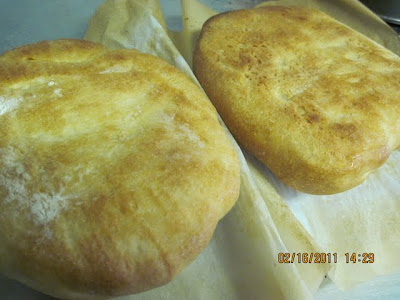
Here they are side by side on my cookie sheet, which I use like a peel. Haven't seen a need for a real peel yet, seems rather expensive when I have something that works.
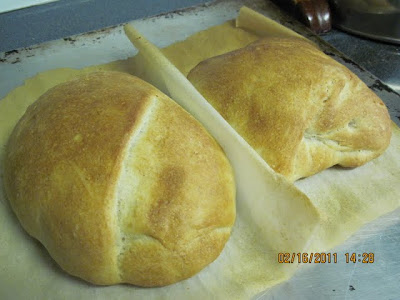
I used Peter Reinhart's baker's formula, and only made 1 pound of dough. I was already in the process of making sourdough loaves, so I figured that I wanted to have enough to try this recipe out. The only difficulty I had was that my mixer likes to make at least 2 pounds of dough, and smaller loads seem to be harder for it to really create a nice gluten structure.
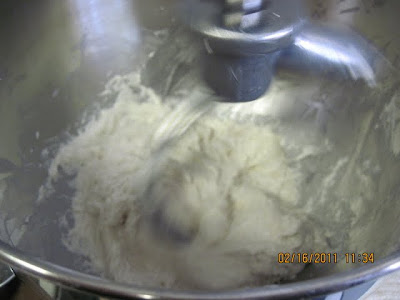
As you can see, it is quite wet and sticky even after it being worked for about 5 minutes.
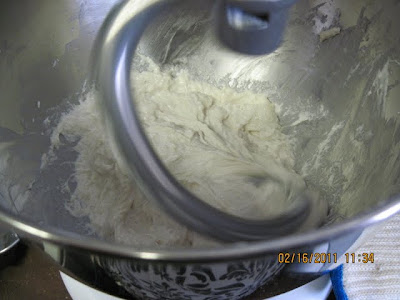
Here it is close to the end of the process, when I decided to just pull it out and do some stretch and folds to help build it up a little bit.
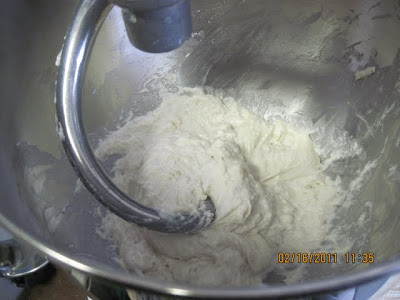
After second set of stretch and folds....
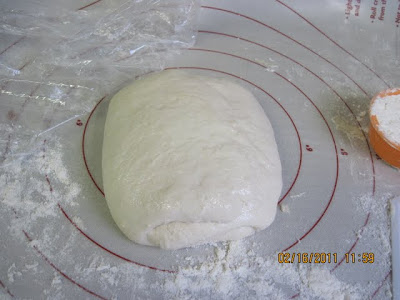
Ok, I missed a lot of picture opportunities with this one, totally forgot to take pictures of each step of the process.  I actually did three stretch and folds, one at the beginning because I felt it was underworked by the mixer.  I gave it a rest of 90 minutes after the stretch and fold process, then split it into two pieces.  I then did the final shaping and transferred it to a french bread pan I have, which I often use as a couch.
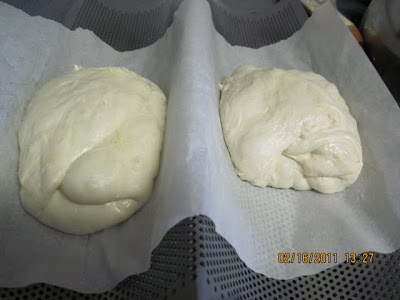
It's already starting to grow...
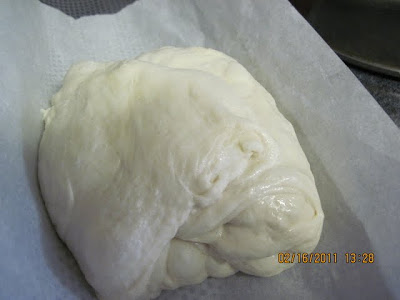
Almost ready to be put into the oven...
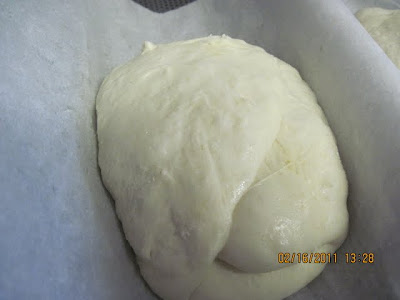
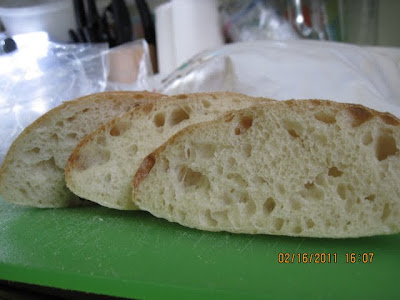
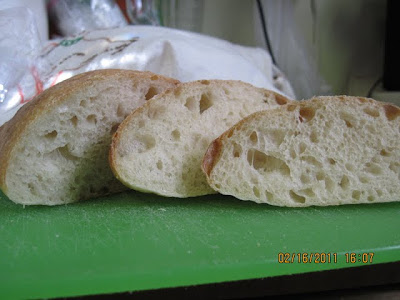
These rose a lot during the final proof, and for it being only a pound of dough it made two nice loaves. Ok, I have held off on showing the crumb shot till now, because I was so disappointed with it.  This dough was really wet, and I know that I didn't overwork it.  Possibly it was slightly underworked, but here are two pictures.
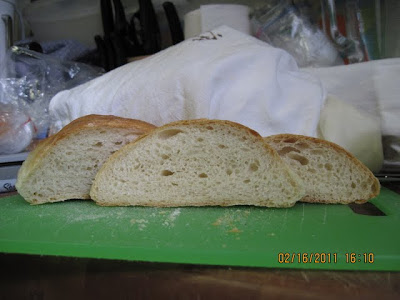
From BBA Ciabatta
I was really expecting a LOT more holes, especially when my sourdough breads are so much easier to work with and give me crumb like the next pictures regularly. Here are two pictures of the loaves I made today, and I wasn't even trying for a ciabatta like loaf.
And my sourdough was a lot easier to handle, and it tasted a lot better too. I find that most of the BBA breads seem to have too much salt in them for my taste, but this bread just seemed to be like a regular french bread to me and didn't have nearly the flavor that I expected.  My sourdough is usually made with a starter made from AP Flour, water, salt, bread flour for the main dough.  I used AP flour with the biga that I made for the ciabatta, then bread flour for the main dough.  The biggest difference in the recipes is that BBA adds oil, which I never use.  I just find this really interesting, when comparing the hydration percentages on the two dough, my sourdough came in at 70.4%, and Reinhart's was at 74.74%. 

Submitted by gixxerrider21 on December 20, 2010 - 2:22pm

Ciabatta


Hey all!  


This bread is turning out to be my go to bread.  I had a trip to see family on Sunday and decided to bring fresh rustic bread to a classic Italian dinner that evening.  On Thursday I made the biga pre-ferment.


for the Biga.

2.5 cups bread flour

teaspoon yeast

8 ounces water

this was allowed to sit at room temp to rise until doubled in size.  I put it in the refrigerator until sunday morning.


Sunday morning i woke up, turned on the coffee pot, removed the preferment from the refrigerator and cut it into several small pieces to help take off the chill for about an hour.  

meanwhile i started to add ingredients to my cuisanart for the final dough.

main dough

2 cups of bread flour

1 tsp of salt

2 cups of pre-ferment

about 3/4 cup of buttermilk 

no additional yeast

I realized I did not have additional yeast to add to the dough but I ran with it despite.  I mixed the dry ingredients together and then added the warmed buttermilk.  I mixed for a couple minutes and decided to increase the hydration a little bit by adding about a tsp of water at a time.  I oiled a bowl and scraped the dough into the bowl and covered with plastic wrap and allowed it to rest for a half hour.  After the first 30 minutes I uncovered and proceeded to fold the dough, covered, and repeated another 3 times in 30-minute increments.  The dough rose fine, despite no additional yeast.


  I pre-heated the oven to 500 F placed a iron skillet on the low shelf and then started to shape the dough.  I floured the counter and the edge of the bowl so the dough would not stick to the sides as it fell onto the counter.  I divided the dough in two with a sharp knife and liberally dusted the tops with flour.  I wanted a nice airy crumb so I was careful about degassing and working the dough as little as possible.  I shaped each portion of dough into the classic ciabatta shape and let them rest about 10 minutes.  I do not have a bakers stone so I have to make due with baking sheets.  I coated each sheet with corn meal and place one loaf on each pan, covered them with oiled plastic wrap and let them rest another 45 minutes for a final proof. 


The loaves went into the oven and I placed a cup of hot water into the skillet and shut the door.  For the first 1:30 I sprayed the oven walls with water in 30 second intervals and then decreased the temp to 450 F.  I baked for 10 minutes and then rotated the loaves for even baking.  The loaves remained in the oven for another 8 minutes, I turned the oven off and cracked the door while the loaves remained inside for about 5 minutes.  The loaves were allowed to cool for about 45 minutes and we had them with dinner that evening.     

My family loved the bread and it was the perfect addition to the dinner we had that evening.  Please leave any comments or suggestions you may have, cheers!


Submitted by venkitac on June 17, 2009 - 4:02pm

BBA Ciabatta (poolish version) hydration off?

Hi, I have a question about the BBA poolish version of ciabatta: it appears to me that the water ratio is quite off in the poolish version. The poolish recipe calls for 107 water (to 100 flour) (page 106),  and final recipe calls for 169 poolish, 100 flour, and 33.3 water. If I do all the math, it turns out that the hydration is just about 66%, which seem far too low. The biga ciabatta version seems much more reasonable at a hydration of like 75-80% or so, which is what I've seen previously.

Is the recipe off? Could it be that the poolish itself needs more than 107% hydration?

Thanks!

Ganesh