
Submitted by freerk on October 11, 2011 - 5:16pm

beechnut buckwheat bâtards (first ever?)


After spending a weekend at my sister's beautiful house up North, I came home with these:
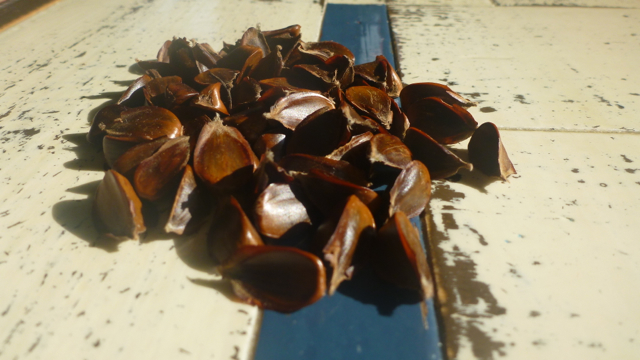
Beechnuts! As a kid I would spend half the autumn crawling around the base of the beech tree behind our school, looking for beechnuts, peeling them on the spot and eating them raw. Quite disgusting actually. Later on in life it became apparent that it wasn't all that healthy either; there is a minute dose of cyanide present in the raw nut. I never suffered any ill effects, and no one ever did probably, because to get really ill you'd need to eat quite a lot of them.

The beauty of it all is that when dried and roasted, all those bad elements evaporate. This afternoon I roasted the batch of nuts that I collected, and was instantly taken back to my childhood.

I told my better half about the "Fabeltjeskrant" children show I grew up on, here in the Netherlands. That was my first encounter with beechnuts, and most likely the reason why, for a number of autumns we would be collecting them whenever we could. Beechnuts were sort of a running gag in this puppet show, set in a forest, with a wide variety of animals that all seemed to love "beukennootjes" (e.g. beechnuts) They ate beechnut cakes, -pies, drank beechnut drinks, I think they even paid each other in "beukennootjes"

Putting two and two together, I decided to google for breads made with these forgotten tiny nuts. It came back with almost zilch (there was one "recipe" that classified itself as "total fail", so I didn't pursue that one...). Slightly puzzled I went to the TFL search bar... surely here I would find...something? Nope, nada, nothing! So, I went where no one went before, or so it seems... Since I didn't have a whole lot of beechnuts, I toasted them, and used them as soon as I could in the final dough. They were wonderfully fragrant. I decided to mix the nuts into a buckwheat bâtard (with buckwheat levain).

The levain was a little sluggish, for my schedule forced me to retard it, and it wasn't really back on track when my "baking window" came up, but nevertheless, they turned out quite nice. The outside is hardly spectacular, nor is the crumb, but the taste combination of buckwheat and beechnut is enchanting! The "blander" nuttiness of the buckwheat formed a perfect stage for the very specific beechnut to shine. Even with only two hands full they came through in all their glory.

My sister has received strict orders to save as many beechnuts as she can; I want to make this bread better than it is. I hope you want to help me get it really right! The taste is there, but I think the bread itself... I don't know, yet...it's just not right yet.


Freerk

Submitted by freerk on July 31, 2011 - 11:26am

happy baking accidents


Today I was planning to do a baking test (inspired by Varda) comparing a filone made with Atta and AP-flour against the way I usually make it; with AP and another durum flour that I have that is slightly coarser and pale yellow. The formula is based on Glezer's filone.

Did you ever measure out the water you needed for a formula and then left both measuring cups on the table during mis en place? You guessed it; by the time I got to combining the final dough for the "traditional" filone, I thoughtlessly poured in the wrong (way too much) water...

I decided to turn things around to save the situation so I dedicated the over hydrated dough to my Atta experiment and made another "traditional formula" filone.

The Atta that I added to the over hydrated dough became the main flour, together with a little AP and 250 grams of "fine durum" (by lack of a better term). I should have kept track of the numbers but I didn't... I went for roughly the same consistency as the normal filone.

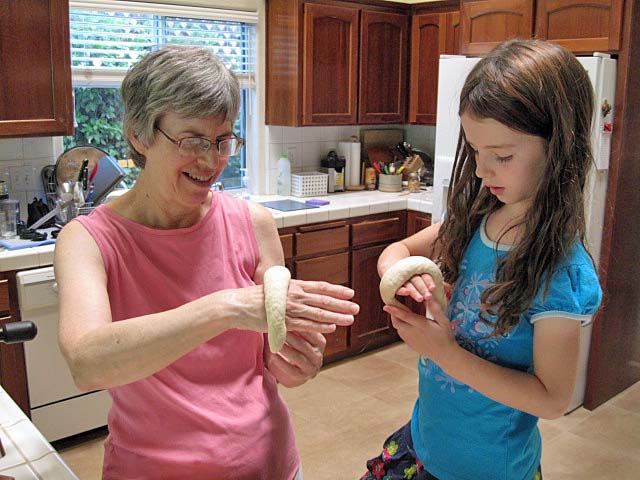
And, as I was already messing up my initial test, I also gave both Atta's the Richard Bertinet-way of developing the dough a spin... or rather a SLAP (in this case by what must be the cutest baker in the western hemisphere).

I felt like I was boldly going where probably most of you have gone some time ago. It was a blast! I felt like a kid in a candy store.

Durum should of course be handled with care. But once I got going and felt the dough developing under my hands faster than I ever experienced before... I went for it! As a matter of fact I was so happily slapping it around I woke up half the house... but it worked so nicely I couldn't resist, even it is a Sunday...

As a matter of fact I decided to also give the traditional filone a slap. That turned out to be not so good a decision. As much as the Atta didn't really seem to care being slapped around, Glezer's filone didn't really benefit from it but rather suffered.

So, after breaking all the rules, and just doing things by good ole intuition, I ended up with this trio:

Number one and two are the Atta's and number three (as usual going all slug on me) the traditional formula for Filone, with black sesame as a variation. The first Atta is decorated with a seed mix pretty much similar to the one that goes onto the pain aux céréales and number two is, as you can see... plain.

The taste of the Atta blew me away!

The black sesame filone ended up a bit more yellow than I'm used to (or is it because it stands out so yellow against the Atta?):

My filone crumb usually has bigger holes and is bit more chewy, but I'm perfectly happy with this.

Lesson learnt:  This last durum definitely wants to be handled with care, whereas the Atta seems to be more tolerant to this method of handling.

And!

Don't leave water jugs you don't need on the table during mis en place...

Happy Baking

Freerk

Submitted by diverpro94 on May 27, 2011 - 10:29am

Batards Tearing!?


I've been using the recipe for the European Peasant bread in 'Artisan Bread in Minutes a Day' and I've come across one problem. During my proofing stage, my outer membrane on my batard tears along one side.


I think this might be due to the higher hydration compared to my other breads, but I've been using this recipe for a while and it just started this. I have been using a baker's couche also, which might have caused it.

Submitted by Leandro Di Lorenzo on December 8, 2008 - 2:41am

Bâtard with poolish


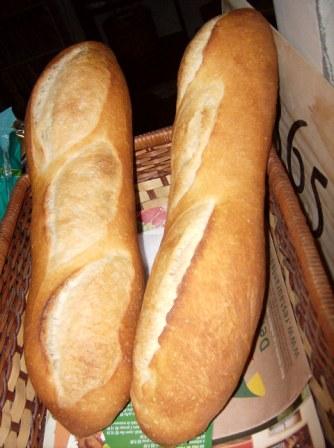
Hi!!! This is my first entry here... Though I've been following the fresh loaf for a while. First of all... I'm from Brazil, so you have to forgive my english :) Last night after read David's Ficelles article, and with a poolish fully developed I was in a mood for baking. So I tried to make some bâtards with high hydratation (about 77%) Here are some photos of the adventure!!! Hope you like!!!


Submitted by Eli on April 15, 2008 - 8:51pm

Batards and Pain de Provence


Here are the batards I did this morning. They were proofed 15 hours in the refrigerator last night and removed at 8:00 AM. Rise took about 4 hours. Considering they refused to release the couche they turned out really okay. REALLY SOUR, too!

My Pain De Provence- Turned out okay but I should have used more herbs. However, the crust crackled and hissed after taking it out of the oven. Then once it started to cool the crust crackled, little crackles all over as if it had been squished. Any thoughts on this one? What would have caused the crackling? I misted with water before baking and just after slashing. Did I mist too much?

Thanks,

Eli

Crumb Sourdough Batard


Pain de Provence


Batards

Submitted by holds99 on March 17, 2008 - 8:42am

EHanner...Help!


Eric,

I tried your recipe for the baguttes/batards (using starter) and I had some problems that maybe you can help me understand.  First I refreshed my starter at 6 hours intervals for a day and a half before I started.  It's the Nancy Silverton starter I made years ago and still use when making some of her sourdough recipes.  It was bubbling nicely when I started the recipe.  Anyway, following your recipe I used 167g starter, 375g K.A. French style flour (supposed to be the equivalent of French T55), 225g water, and 10g salt.  Mixed it all together, let it rest for 45 min. did a fold and placed it in a lightly oiled gallon size plastic container, turned it over (smooth side up), covered it and set it aside at room temp. for 12 hours.  After 12 hours I didn't have any rise to speak of in the dough.  So, i left it for another 3 hours, thinking maybe the room temp. was cooler than 78 deg. and after 3 hrs. still very little rise.  At this point I figured I better do something or I'm going to lose it.  So I stretched the dough out on the counter sprinkled 1 tsp. instant yeast over the surface and kneaded it for about 8 minutes giving it a good workout to fully incorporate the yeast.  Then let set it into the fridge for about 3 hours, removed it to room temp. and let it rise until doubled.  Removed it from the container did a couple of folds, returned it to the container for about an hour, then put it on the counter divided it in two and let it rest for 30 min.  I then shaped it and placed it in a well floured couche and let it rise for about 1.5 hours.  Flipped it from the couche onto my floured transport board, placed it on parchment lined pans, scored it and baked it.

The only thing I can figure is that my starter was not working properly.  Can you tell me what you do to your starter in this recipe to bring it up to speed and get the proper rise without having to resort to yeast?  The exterior of the loaves look o.k. but the interior, well it needs "big time" help because it sure doesn't resemble the interior of those lovely loaves you made.  I feel like the gods must be angry :-)    Seriously, I really want to understand where I went wrong. Any thoughts you have would be greatly appreciated.

Howard


Batards

Batard Interior

Batard Interior

Batards

Submitted by holds99 on January 17, 2008 - 8:55am

Batards - Danielle Forestier Recipe


I used Danielle Forestier's baguette recipe from her demo on Julia Child PBS video to make these batards.  My oven wasn't large enough to make baguettes so I opted for the batards.  She doesn't use a pre-ferment, only yeast. I didn't get the nice large holes in the interior that are characteristic of French baguettes/batards but I suspect it was because the dough should have been a little wetter and I wasn't gentle enough with the dough when rolling, pinching and shaping it, but they tasted very good.  I'll keep trying. 

holds99