Submitted by PiPs on November 10, 2011 - 6:32pm

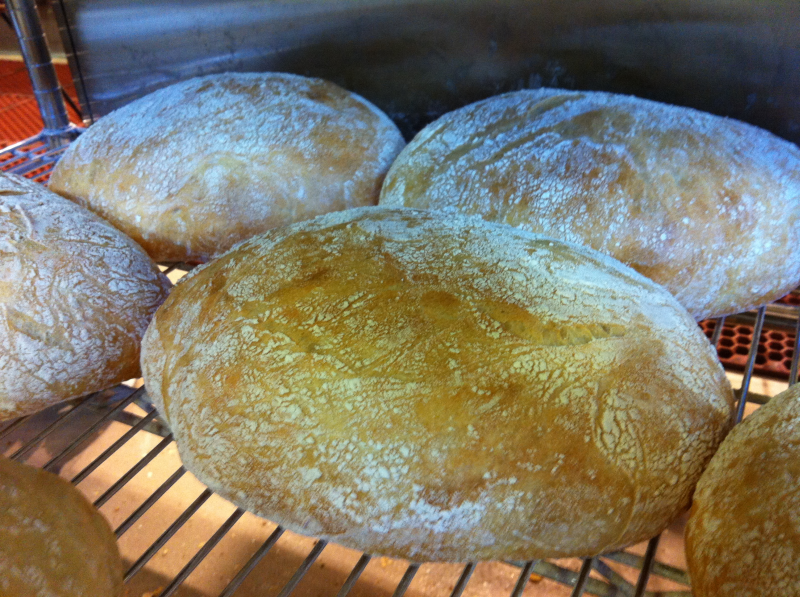
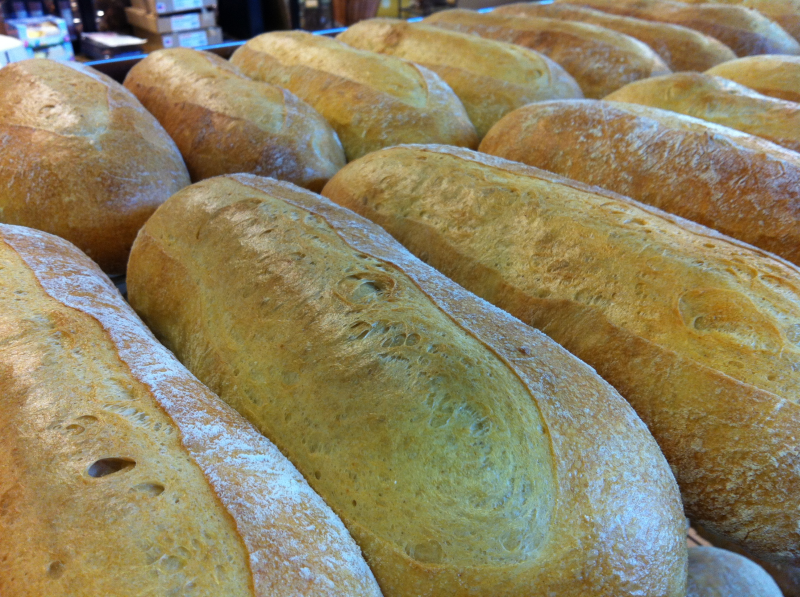
Micropost – Spelt experiment II (75% Spelt)


Formula

Overview

Weight

%

Total dough weight

1600g


Total flour

969g

100%

Total water

630g

65%

Total salt

19g

2%

Prefermented flour

242g

25%


Starter build – 8 hrs 27°C


Rye starter @ 100% hydration

50g

20%

Sifted Wheat

242g

100%

Water

121g

50%


Final dough 25°C


Starter

363g

50%

 Sifted fresh milled Spelt

727g

100%

Water

510g

70%

Salt

19g

2%


Method

  1. Autolyse 45 mins
  2. Knead 5-10 mins
  3. Bulk ferment 1.5 hours with stretch and fold at 45 mins
  4. Preshape and bench rest for 15 mins
  5. Shape and proof for 45 mins
  6. Bake in steamed oven for 10 mins at 250°C then 30 mins at 200°C

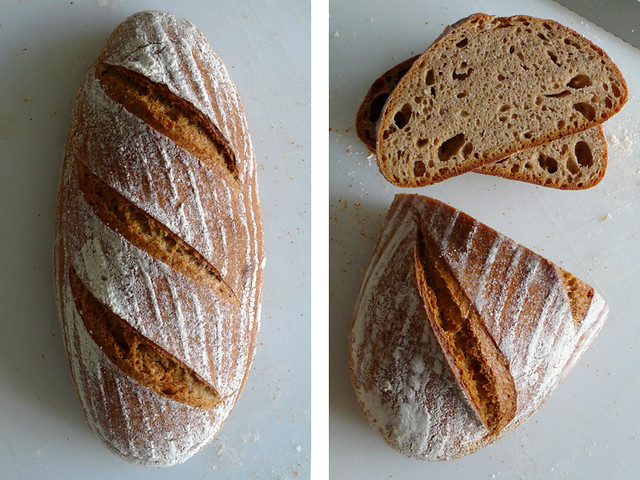
I have come to the realisation that I don’t enjoy working with large proportions of spelt flour in dough.  The flavour of the bread was ok, but considering it contained 75% sifted spelt flour I found it rather bland, left me wanting more from it. As the temperatures continue to climb here (yesterday was a hot and humid 32°C) I am finding the spelt breads ferment way too fast for my liking even when using cooler water.

I think I will stick with wheat breads and smaller proportions of spelt (30% is a favourite of mine)

… also looks like a busy weekend of baking coming up … and with Christmas fast approaching it seems just about all of our upcoming weekends have social events hopefully requiring bread :)

Cheers, Phil

Submitted by MarieH on September 8, 2011 - 12:25pm

Southern Vermont Sourdough

Hamelman’s Vermont Sourdough is one of my favorite recipes. It is so consistent in both flavor and texture. It’s hard to mess up this formula. It’s still pretty warm in Tallahassee, FL so paying attention to the Desired Dough Temperature (DDT) is important. Following Hamelman’s instructions I needed chilly water.

Desired Dough Temperature           76

Multiplication Factor                         4

Total Temperature Factor                304

Minus Flour Temperature                71

Minus Room Temperature               78

Minus Pre-ferment Temperature     75

Minus Friction Factor                       26

Water Temperature                          54

I started the levain build yesterday at 6:30 p.m. and started the dough at 7:30 a.m. today. I created a timing chart to help me along the way.

The finished batards...

Submitted by shaunsp on August 8, 2011 - 6:12pm

Whole Wheat Epi and Batard

Here's a Whole Wheat Epi and Batard I baked today after a 3 day fermentation in my fridge. I used Peter Reinhart's 100% WW Hearth Bread formula from Artisan Breads Everyday -

Submitted by freerk on July 31, 2011 - 11:26am

happy baking accidents


Today I was planning to do a baking test (inspired by Varda) comparing a filone made with Atta and AP-flour against the way I usually make it; with AP and another durum flour that I have that is slightly coarser and pale yellow. The formula is based on Glezer's filone.

Did you ever measure out the water you needed for a formula and then left both measuring cups on the table during mis en place? You guessed it; by the time I got to combining the final dough for the "traditional" filone, I thoughtlessly poured in the wrong (way too much) water...

I decided to turn things around to save the situation so I dedicated the over hydrated dough to my Atta experiment and made another "traditional formula" filone.

The Atta that I added to the over hydrated dough became the main flour, together with a little AP and 250 grams of "fine durum" (by lack of a better term). I should have kept track of the numbers but I didn't... I went for roughly the same consistency as the normal filone.

And, as I was already messing up my initial test, I also gave both Atta's the Richard Bertinet-way of developing the dough a spin... or rather a SLAP (in this case by what must be the cutest baker in the western hemisphere).

I felt like I was boldly going where probably most of you have gone some time ago. It was a blast! I felt like a kid in a candy store.

Durum should of course be handled with care. But once I got going and felt the dough developing under my hands faster than I ever experienced before... I went for it! As a matter of fact I was so happily slapping it around I woke up half the house... but it worked so nicely I couldn't resist, even it is a Sunday...

As a matter of fact I decided to also give the traditional filone a slap. That turned out to be not so good a decision. As much as the Atta didn't really seem to care being slapped around, Glezer's filone didn't really benefit from it but rather suffered.

So, after breaking all the rules, and just doing things by good ole intuition, I ended up with this trio:

Number one and two are the Atta's and number three (as usual going all slug on me) the traditional formula for Filone, with black sesame as a variation. The first Atta is decorated with a seed mix pretty much similar to the one that goes onto the pain aux céréales and number two is, as you can see... plain.

The taste of the Atta blew me away!

The black sesame filone ended up a bit more yellow than I'm used to (or is it because it stands out so yellow against the Atta?):

My filone crumb usually has bigger holes and is bit more chewy, but I'm perfectly happy with this.

Lesson learnt:  This last durum definitely wants to be handled with care, whereas the Atta seems to be more tolerant to this method of handling.

And!

Don't leave water jugs you don't need on the table during mis en place...

Happy Baking

Freerk

Submitted by varda on March 21, 2011 - 1:09pm

How to get a good gluten sheath on a batard


After struggling more or less unsuccessfully with Hamelman's written instructions for shaping a batard (which includes a prefold and a rotation) I switched over to Ciril Hitz's approach (see his video on Youtube -  http://www.youtube.com/watch?v=RgqPli_sLLM)   This video is fantastic (thanks LindyD) and at least for me gives the definitive approach to boule shaping.   However, I feel that when I finish shaping a batard using his method it is a little limp and doesn't have enough surface tension.  This comes back to bite me later when the dough expands in the oven.   Hitz does batard shaping by rolling the dough up from the back to the front.   I was just searching this site and saw a video from the Back Home Bakery where Mark does the exact same thing but from the front to the back.   I haven't tried this yet, but it looks like it would be a little easier to do the pullback motion that forms the gluten sheath using this approach.  http://www.thefreshloaf.com/node/21607/more-shaping-practice   So how do you get a tight gluten  sheath on a batard?   Front to back (back home) back to front (hitz) prefold and rotate (hamelman).   Something else?  I would love to keep using Hitz's method because it is very easy and intuitive but I think I must be missing some crucial element of it.   Of course the batards in his video look nice and tight.   Thanks! -Varda

Submitted by Ryan Sandler on March 20, 2011 - 10:37am

Saturday MEGA Baguette

This week I made the dough for Hamelman's baguettes with poolish yet again.  This time, instead of making three 11-13 inch baguettes, scaled at 250g, I made one 750g loaf.  Since the 250g baguettes would be called demi-baguettes, clearly this was a mega-baguette. Clearly.

Okay, fine, I made a batard and scored it like a baguette.  Still it came out pretty nicely.

Crust Crackles, too!

No bursting between the scores! Though on a batard that's kind of cheating.  Anyway.

No crumb shot this time--we had company over for dinner and I wasn't quite willing to beg their patience while I snapped pictures of the bread, the way I regularly do with my wife.  Moderately open crumb, comparable to my recent baguette efforts.  Good flavor, nice crust, though a little chewy.

It will be back to baguettes next week.  Happy baking, everyone.

Submitted by Ryan Sandler on January 30, 2011 - 12:11am

Super-Bread Saturday!

My family is not so much in to football, but we are into bread.  This post will give you an idea how much.  You see, my mom taught me the basics of making bread when I was a kid.  However, she never went much beyond a basic white bread pan loaf (although these were always excellent).  Although I got her The Bread Baker's Apprentice for Christmas a couple years back, she never got into the artisan baking thing, with pre-ferments and all, and found the whole process a little intimidating.  But this year, for Christmas, she asked for a baking lesson from me.  Today was the day.

The plan: to bake three types of bread in one day, making two batches of each so that I could make one and demonstrate, and then she could make one.  Limitted to her standard (but quite good, as I discovered) home oven, this required staggering the batches over the course of the day.

On the roster: Italian Bread (from BBA), Potato Rosemary Bread (also from BBA), and French-style rustic bread (Pain Rustique from Hamelman's Bread). All solid players that I can do in my sleep at home, and felt like ought to go fairly smoothly, while showcasing different flavors, shaping and slashing styles.

Let the games begin!

We showed up at my parents' place at 9am, bringing with us a pre-game miche:

Another Mighty Miche, ready for toasting

At 9:30 my dad took the baby, my wife went out shopping with her mom and sister, and my mom and I got to work.  First up was mixing Italian Bread--not much teaching there, although I demonstrated the power of the 5-minute rest for helping along gluten development

Italian Bread #1, in between the remaining biga and the poolish

From there, the day proceeded in an almost-orderly fashion, alternating mixing, stretch-and-folding, dividing, and shaping with one bread and then another.  Mostly things proceeded smoothly, although there was a moment of panic when we realized that I'd dumped out, pre-shaped and final shaped Potato-Rosemary Bread #2 instead of #1, while #1 sat happily bulk fermenting for an extra half an hour.  Some improvisation was required (we pretended batch #2 had never been shaped, quickly shaped batch #1 without a pre-shape and pretended it had already been proofing for 10 minutes.  It worked.)

Mom kneading Potato Rosemary Dough

Italian Breads Proofing - "Mine" are on the left. (All on my new TMB/SFBI couche!)


Potato Rosemary Breads in the Oven


Rustic Breads in Bulk Fermentation - "Mine" is on top (Also my lovely SFBI/TMB proofing board)

Italian Breads, Finished. Mine on the left (clearly under proofed!)


Rosemary Potato Breads (I don't even know whose are mine!)

Rustic Breads  (Mine on the Right)

The hardest part of the whole business (besides being up on our feet all day baking), was teaching the shaping techniques.  I had the principles clear in my head (surface tension, surface tension, surface tension), but conveying the actual physical motions (which are just plain tricky anyhow) was quite difficult.  Practice was useful -- except on the Italian bread, I had my mom shape and slash one of "my" breads after I demonstrated the technique so she'd have an extra chance to get the hang of it.  What proved invaluable, however, was employing a dish towel a la Mark of Back Home Bakery to demonstrate.  I already thought that video was great when it was posted, but now I'm really grateful to Mark for making posting it! I only wish I'd thought to do that before we'd already shaped the Italian breads, rather than after.

The other main challenge was the oven--it was just too good!  My parent's gas oven held it's heat remarkably well, which meant that turning the temperature up before was actually unnecessary, and indeed counter-productive since amidst the chaos I forgot to turn it down after loading the breads.

The fruits of our labors

The bakers and their breads


After we were done baking, we brought three choice loaves over to my in-laws for dinner (it was my father-in-law's birthday, by coincidence), and had a lovely meal.

Clockwise from left, Rustic Bread, Italian Bread, and Potato Rosemary Bread


It was a fun, busy, bread-ful day.  I'd do some things differently if I were to do this again (like use a bigger oven and do three batches instead of six!), but my mom and I had a great time.

Happy baking, everyone,

-Ryan

Submitted by freerk on January 12, 2011 - 10:49am

master shapers input needed (update!)


I visited "De Zandhaas", a working grain mill close to Amsterdam. Together with two fellow bread enthusiasts we had a one on one with the miller. He gave us loads of really useful info on the local, regional, national and European ins and outs on grain.

For some time already I suspected that my shaping problems originate right at the start; it's the flour we have acces to here. And the miller made it a fact! Our local grains aren't nearly as strong as the Northern American varieties. We also learned that American grain is hard to come by around here nowadays, so no need to go hunting for it. The differences are so big that all formulas that originate in the U.S.A need serious tweeking over here. My friend joked that "now we finally know that our water hasn't more water in it after all"  It certainly seemed that way every now and than with some formulas (especially this Filone that started this thread)


Loaded with information and of course the freshest of flours imaginable (the miller gave us some wheat germ to taste that was amazing) I returned home inspired. Whether it was a stroke of luck or a moment of genuine learning remains ro be seen, but I think I shaped, slashed my first more than average batard!

Meet my Golden Semolina Torpedo from the Bread Bible.


Thank you all for helping me get better. Sunday I'll post a wonderful recipe for a very local Frisian Sugar Bread that I think hasn't been posted yet here on The Fresh Loaf. Check it out!


X Freerk


---------------------------------------------------------------------------------------------------------------------------------------------------------------------------------------------------------------------------------

original post:


My latest Filone came out fine, but shape-wise it is just not what I'm looking for.

The mistake is consistent  though;  each time the loaf has a wonderful open crumb on the ends but gets denser in the middle part, and ends up looking more like a barbell than the nice sleek torpedo I'm looking for :-/

So; I 'destroy' the air pockets in the middle part of the dough during shaping, and leave the holes on the two ends intact, I guess.

After trying just about every possible way there is in shaping the filone, after watching numerous videos and studying breadbook pictures,  none of them seem to be working for me, yet...

I know that shaping is a 'hands on' type of affair. My question to all you master shapers out there is; which shaping method would you suggest me to commit to? My guess, after fooling around with them all, is that choosing and practicing one method is my best chance to get it right fast.

I am more and more gearing towards the wetter doughs :-) Which of the methods of shaping would be the most logic for higher hydration doughs?

Am I too sissy in "punching down" before shaping? I tend to handle the dough as carefully as I can manage. I expect to see some irregularity in the baked loaf, but mine just goes haywire on me during oven spring! The more evenly the holes are distributed in the dough, the cleaner looking the loaf comes out, right? Am I too careful?

Maintaining surface tension is also proving to be a challenge with wetter doughs. Any practical tips?

I have been tweaking the Glezer formula a little in my last attempt.

Like a lot of people here I have found the dough it produces rather "gloppy" and hard to work with. I also found out that the dough becomes a lot easier to work with after the first proof with three folds. I have reduced the water percentage (following Glezer's somewhat complicated way of measuring out as little yeast as humanly possible) by subtracting the yeasted water from the amount used in the final dough, so a total of 1 cup of water, instead 1 cup plus the yeasted bit.

After that the dough did everything the recipe promised, so my guess is I might have been misinterpreting Glezer's instructions.

The taste Durum flour produces in it's loaves is so close to my "dream bread" I want to try out more with it. If you can point me towards other formulas and recipes I'd be very grateful!

Thanks!!!


Submitted by EdTheEngineer on December 5, 2010 - 5:11pm

A beer barm wholegrain batard

Firstly, I have a new song to kneed along to. The lyrics are relevant - I can only assume the idea for the video was conceived under the influence of something stronger than fermentation fumes.

The rhythm is slightly faster than my usual kneading rate, but in the same way top athletes often run to music that has a slightly faster beat than they find comfortable to improve stamina, my quest to be a finely honed baking machine will not succeed without a little pain and sacrifice. 

Anyway, I wanted to make a bread for the table to go with a crunchy salad with a fairly weapon's grade french dressing and some cheeses. I made a 'bram' as described in Dan Lepard's The Fresh Loaf. This was done by taking 250g of strong bottle-conditioned ale up to 70 degrees C (I presume to boil off the alcohol) and then 50g of flour was whisked in. When cool, I added a tiny bit of pre-ferment from my sourdough starter (which is not quite ready at five days old but I couldn't resist). I left this mixture for 4 hours by which time it had doubled in volume.

Then:

 - 500g whole grain flour

 - 12g salt

 - 250ml water

 - 150g of the bram

 - A tiny pinch of fresh yeast (maybe half a gram) just because my starter is a little green still.

Mix and knead (to the anthem above) and then 20 hours in the fridge. Shaped into a batard and left to warm and prove for 3 hours, then into the oven. I didn't get a photo of it whole (mouths to feed) but here's a crumb shot:

It's a shame one can't upload flavours to the internet but it's got a really moist, fluffy crumb that has a lovely malty, nutty flavour. Great for soaking up the salad dressing and you can taste it along side fairly powerful cheeses. I'll make it again for sure. Pleasingly light for a 100% whole grain - I tried to be gentle during the numerous stretch and folds and shaping, and the long slow fermentation helped a lot. My sourdough starter will be one week old tomorrow so this week I'll do my first sourdough. I seem to have regressed to eight-year-old boy levels of excitement. I shall also try and find a slightly more high quality camera (with a flash!) as these grainy, blurry iphone shots are letting the side down.

Submitted by smarkley on September 6, 2010 - 10:10pm

Labor Day Weekend Baking

Heh heh... had a baking weekend, every morning. Friends are wondering if I am OCD now!


Started out with a fun Multi Grain Bread... Using Stone Buhr AP and WW flour, toasted sesame, toasted steel cut oats, toasted sunflower seeds, then a menagerie of rolled grains, oats, barley, rye, and wheat! This bread is very good, nutty and with lots of good grain flavors.

and the crumb shot....


Then I did some Pain de campagne... 

Finally finished up with 8 baguettes... 4 of them here, the rest were still proofing! Hat tip to SteveB. I used his recipe and method, which is wonderful by the way! Can be seen here at his Breadcetera site:

 http://www.breadcetera.com/?p=8


Very productive weekend... pass the butter please, and hold the electric bill! 

Steve