Submitted by tssaweber on August 20, 2009 - 8:15pm

St.Clair and SanFran


A week ago I came back from my camping trip to the Upper Peninsula in Michigan. It is not the first time that we are in Yooper country with our travel trailer, it was a little bit on the colder side but camping and fishing was great fun.

http://tssaweberusa.wordpress.com/thomas/sommer-trip-to-the-up/

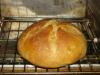
Before I left I forgot to feed my two starters (St.Clair, 100%, rye, and SanFran, 100%, AP) so all the tree weeks I was wondering if the two would survive and forgive my negligence. Coming home both had still a good smell but looked a little shaky. I started feeding them twice in 24 hours. The rye starter rebounded immediately and after four feeds I put it back in the fridge. SanFran took a little bit longer and after it tripled again as I was used too, I decide to bake some bread to make sure it is ok again. I was very pleased with the result and also SanFran went back in storage.

Thomas


Submitted by xaipete on May 25, 2009 - 3:51pm

DiMuzio's Baguettes with Liquid Levain


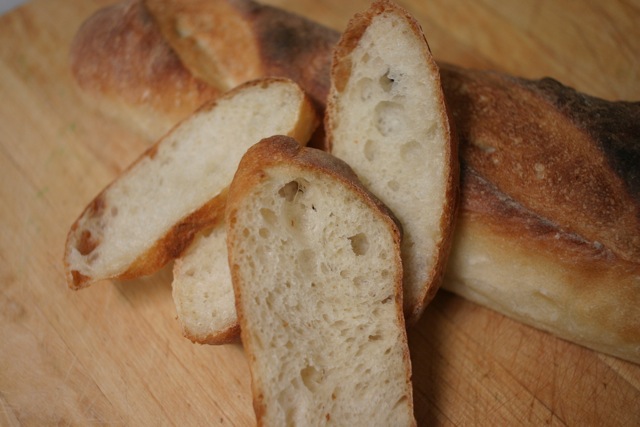
These baguettes turned out surprisingly well in spite of a number of recipe mishaps--I improperly jury-rigged some ripe firm levain into an instant liquid levain, made two large loaves instead of three smaller, and left the oven at 500º. The crumb was somewhat open and had a nice buttery flavor, but the loaves lacked a crispy crust owing to their too high and brief bake. I really owe this one another try before deciding on its merits!


450 g KA AP flour

290 g water

10 g salt

3.5 g instant yeast

100 g liquid levain

Put together in the usual fashion.

--Pamela


Submitted by ryeaskrye on January 24, 2009 - 11:44pm

Pâte Fermentée Sourdough Baguettes


I'm not sure why, but the flurry of Anis Boubsa and Pain á l'Ancienne entries a short time back made me want to try baking baguettes...with the added stipulation of using straight sourdough and no baker's yeast.

I developed a recipe from Hamelman's Baguettes with Pâte Fermentée. This is what I came up with...

On Thursday night, I created the fermentée as follows:

  • 140g SanFran Starter at 100% hydration
  • 161g warm water
  • 280g KA bread flour
  • 7g Kosher salt
Mixed this by hand, covered, let ferment for 1.5 hours and then stuck in the fridge. This creates 588g at 66% hydration.
Two days later, on Saturday morning, I mixed the following for 4 minutes in a KitchenAid (dough hook, speed 1):
  • 580g Pâte Fermentée (note: 8g less than the above)
  • 140g SanFran Starter at 100% hydration
  • 600g warm water
  • 955g KA bread flour
[ETA: I first dissolved the starter in the water, mixed in the flour and pulled off chunks of the pâte by hand and added as the mixer was running. I also let the pâte fermentée warm up at room temp for 1 hour before using.]
After a 30 minute autolyse, I added:
  • 21g Kosher salt
...and mixed another 5 minutes on speed 2. I then bulk fermented for 4.5 hours, folding at 45 minutes and 1.5 hours in. This made 2303g at 66% hydration.
After the bulk ferment I scaled out 4 portions of 420g each and stuck the remainder (about 620g) back in the fridge as pâte fermentée for later this week. I pre-formed 4 baguettes and benched for 10 minutes, rolled out to 18 inches, put in a couche and covered.
After a final proof of 1.5 hours, I removed 2 loaves from the couche and placed in a 500°F preheated oven, covered with a hotel-pan lid and steamed for 15 seconds. I steamed a 2nd time for 6 seconds 3 minutes later. After 15 minutes, removed lid, lowered oven to 460°F and baked another 15 minutes rotating the loaves every 4 minutes or so for even browning. Internal temp ended at 202.5°F (at high-altitude).
I then reset the oven for 500°F and put in a steam pan. At 2.5 hours I put the second pair in. As a small side experiment, instead of using the hotel-pan cover I normally do for steaming, I sprayed the loaves liberally with a spray bottle and poured 1/2 cup of hot water in the steam pan, following the same baking time/temps above.
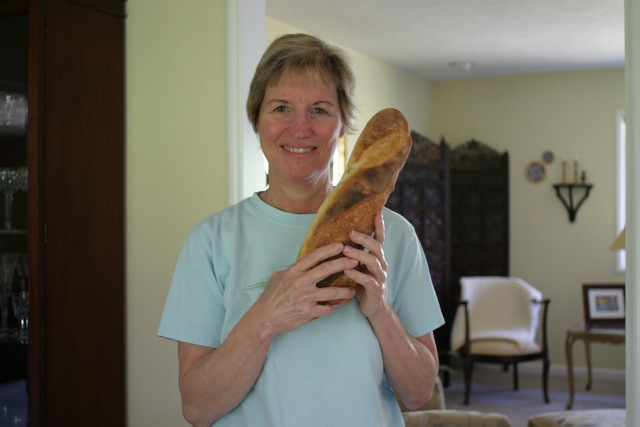
I am incredibly happy with how this came out. However, if any of the more experienced bakers here have any suggestions for tinkering, I'd like to hear them. I make things up as I go along and I'm not always sure what I'm doing. (For example, does the autolyse really do that much in this recipe since there is already salt in the old dough?) I've been very lucky in my baking outcomes, but need to improve in many areas.
I have to say that TFL has been a major contribution to both my luck and improvement.
Notes:
  • The hotel-pan setup is my homemade version of the SteamBreadMaker. It is hard to tell in the photos, but the covered loaves are a deeper brown, although subtly so, and they have a thinner, crispier crust and are, in my amateur opinion, much better
  • 1st loaves were a bit under proofed, 2nd ones a little overproofed...not my forte to be able to recognize dough readiness yet
  • I might do a longer bulk ferment next time
  • Normally I use a SuperPeel, which is too small for the baguette length, so I'm not adept at shaking dough off a peel/pan...that's why my loaves are a bit bent like me
  • Just when I think I have a handle on scoring, I have to think again
  • The crust and crumb both had full flavor...although I'd like to try some of Janedo's french flour
  • The crumb texture was perhaps one of my best outcomes yet..airy, not overly light, not gummy...just right
  • For the anal-impaired, the scaled dough was 420g (14.8oz) and baked down to 336g (11.8oz)

Pics:


Submitted by ryeaskrye on January 22, 2009 - 5:30pm

Sourdough vs. Yeast rise times?


I need some help with a rising time question.

I am going to try an experiment this weekend and bake baguettes using sourdough only and no baker's yeast. I am basing this on Hamelman's Baguettes with Pâte Fermentée and just built my sourdough fermentée.

Hamelman's yeasted recipe calls for a bulk fermentation of 2 hours and a final fermentation of 1 to 1.5 hours. If I understand correctly, when using sourdough versus baker's yeast, rise times increase.

Is there a general rule of thumb to follow in converting a yeasted recipe to a sourdough version? Any suggestions?

John

Submitted by proth5 on December 15, 2008 - 9:48am

I seldom post bread photos

I am not much of a photographer and well, I am never exactly "happy" with anything I bake. I can always outline the flaws or specific things that could stand some improvement.

But  I decided to show this week's bake - come what may - and here are the results:

Batch 1: Baguettes

I emphatically do not use the Bouabsa technique.  My primary reason is best kept to myself, but to put forth some other reasons, I don't have the timeline or the space to do the cold retarding. Also, it could be (and has been) argued that by pre-fermenting a portion of the flour in the levain build, that I achieve the benefits of the retarding and that the retarded final fermentation is redundant. I do an overnight levain and then bake the things the next day.  No commercial yeast and 65% hydration.  Here's one intact and one cut in half to show the crumb:

I seem to have slipped back in technique to getting less pronounced grigne than I have in the past, but although the photo does not show it well, the slashes did show small ears.  The slashing is uneven as is the shaping and I need to buckle down and get that straightened out.  I recently got a new blade holder and I think that I need to get used to it.  I really can't fault the crumb (or the taste.) This is nothing extraordinary - this is what I get every week.  Some would bake these more "boldly" but I prefer this coloring. A tartine with house made cultured butter and a good salame - that's good eating...

Batch 2: Fougasse

Since this is the time of year that I need to render lard, I always get a lot of cracklings and it seems a shame not to use them somehow.  So this week I made a fougasse with cracklings:

This is just a standard fougasse recipe made with a levain base - 68% hydration, 10% whole wheat flour with .8 oz of cracklings for a 1 pound fougasse.

Yes, I got a thin spot on the large cut.  Darn.  Usually I have some restraint with my bread eating, but I had to tear into this one.  It had a crackly surface and a tender interior lightly flavored from the fat and studded with little bits of piggy goodness.  Very nice.

Batch 3: Home Mill

And then there is the home milled whole wheat levain loaf:

This is the most variable of my breads as I contend with variations in both the milling and bread making process.  This was made with hard white wheat milled the same day as the bake. This is a fairly typical loaf although it has spread out more than I would like and I think that it would benefit from a tighter shaping.  The loaf is made at 74% hydration and the crumb tends to vary at different spots on the loaf, although from my point of view there is nothing really wrong with the crumb.  This is my lunchtime sandwich loaf and I prefer the fillings not to drop through. The taste is...delicious.

All breads were baked on a stone with steam - some water in a pan on the floor of my oven and much water sprayed with a pressure sprayer on the stone.  After reading the Suas book's section on steaming I am ever more convinced that in my dry climate and the relatively low hydrations of my doughs that just retaining the moisture by covering my baking breads would not achieve the objectives.  Due respect to the people who use this method, but with my old oven (It will be replaced only when I find "the one.") and no more effort than it takes I'm sticking with steam. Record cold yesterday in the Mile High City - I didn't mind the oven having to preheat.

So, not a bad output for a day after I have finished my seasonal cooking (and shipping) and was determined to take it easy.

Hope you-all enjoy the photos and Happy Baking!

Submitted by foolishpoolish on June 30, 2008 - 1:38pm

Recent Baguettes

[DELETED BY AUTHOR]