SearchUser loginBread BooksFavorite Recipes
|
Submitted by dmsnyder on January 22, 2012 - 10:22pm My San Francisco Sourdough Quest
Progress is being made! After my disappointment with the Kline, et al San Francisco Sourdough method, I re-read and re-digested what I know about time, temperature, ingredients and the care and feeding of sourdough flora. I suppose the principal new concept to sink in was that the fermentation temperature matters a whole lot, and what's best for yeast growth is not best for lactobacillus growth, and what's best for lactobacillus multiplication is not what's best for acid production. In a way, I rediscovered something I found out several years ago but neglected to pursue. (Reading old blogs was interesting.) Those very smart fellows at Detmolder were on to something: You can have it all, if you do it in stages. I'm pretty sure that what I did was not the only way to achieve pretty much the same result. It may not be the best way, but it worked for me. Note that I achieved the necessary temperature control with a Brød & Taylor Folding Proofer, but you can achieve this with a home-made proofing box as well. My goal has been to make a moderately sour, mostly white “San Francisco style” sourdough bread that has a crunchy crust, an open crumb and a nice, sweet, complex flavor, not just sourness. Today's bake achieved all of these characteristics, and I'm a very happy baker (and bread eater)! I started with the “San Francisco Sourdough” formula in Michel Suas' Advanced Bread and Pastry, but modified the method, as described below: My stock starter is 50% hydration. My sourdough starter is fed with a mix of 70% AP, 20% WW and 10% whole rye. I started by refreshing my stock starter with 40 g starter, 100 g water and 100 g flour mix and fermenting it at room temperature for 12 hours. I used this to build the stiff levain. (Note: This is a liquid starter - 100% hydration.)
Method
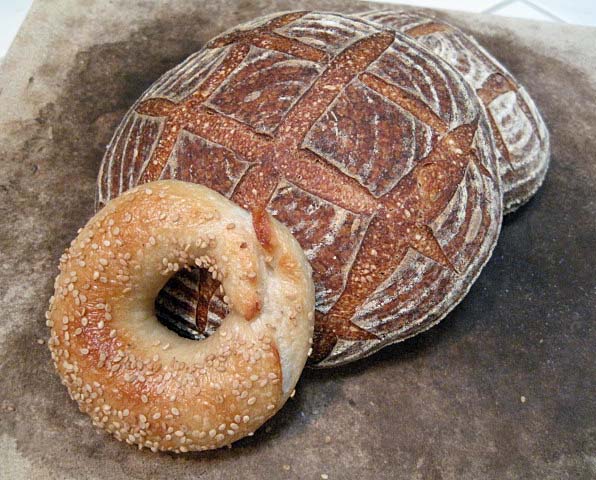
San Francisco Sourdough (and New York Bagel from ITJB. This weekend's "Coast to Coast" baking.)
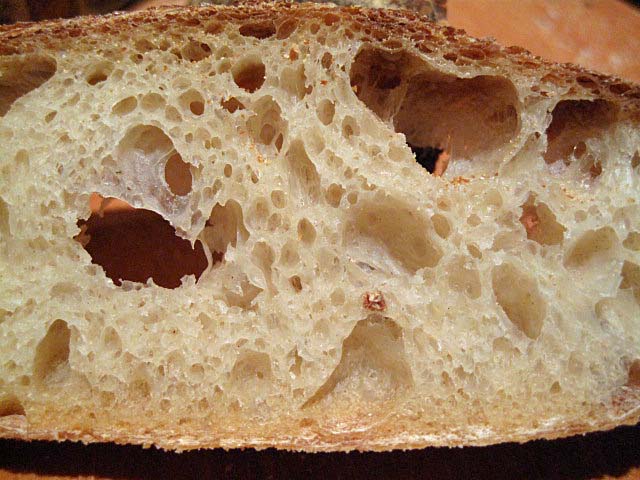
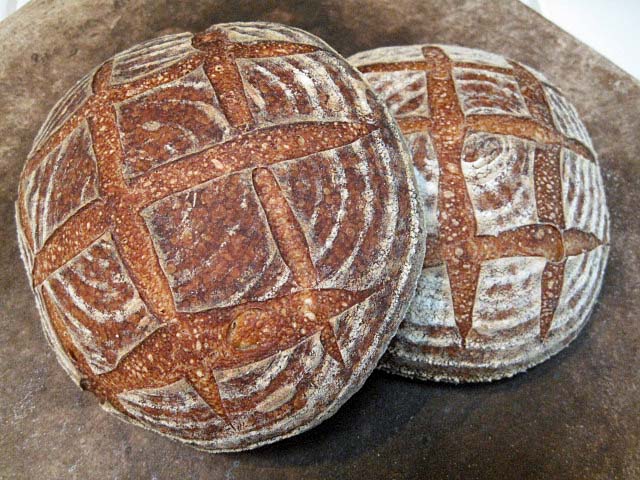
San Francisco Sourdough Crumb These loaves had a rather flat profile but did have fair oven spring and bloom. When sliced after cooling for 4 hours, the crust was crunchy. The crumb was open. The aroma was decidedly sour. The crumb was tender-chewy and cool in the mouth. The flavor of the crumb was a bit sweet and wheaty with a moderately sour after taste. The crust was nutty, but I would have personally enjoyed it more had it been darker, even though that would not have been strictly in the the “San Francisco Style” of old. This method is spread over 3 days, so it requires some advance planning. Since it requires little time, except on the second day, it should be easy to fit into almost anyone's schedule. It this is the kind of bread you're after, it's definitely worth the effort. Future plans
David Submitted to YeastSpotting Addendum added 2/4/2012: Please see My San Francisco Sourdough Quest, Take 2 for my next bake. The modifications resulted in improvements in the crumb and a more assertively sour bread. Submitted by Josh.S on September 23, 2011 - 10:09am Focaccia technique questionI made Reinhart's focaccia recipe from the BBA a couple weeks ago and it turned out very well. Interestingly, I noticed that the olive oil and water are simultaneously mixed with the flour. I understand that fats are typically added later in the mixing process so that the gluten is given more time to form and so the fat doesn't lubricate the gluten and prevent it from forming longer strands. Is this the typical mixing process for focaccia? Am I right in believing that the mixing order (combined with the dough's high hydration and generous fat content) produces the tender crumb of a well-baked focaccia? Has anyone tried a different mixing order or an autolyse with focaccia? Submitted by dmsnyder on April 10, 2011 - 1:58pm Apple Breakfast Cake from AB&P

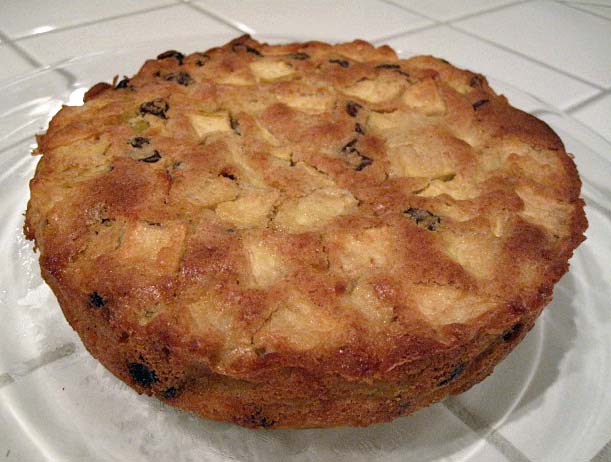
Apple Breakfast Cake I happened upon the formula for “Apple Breakfast Cake” while browsing Michel Suas' Advanced Bread and Pastry looking for something or other I've now forgotten. My wife loves cakes that are loaded with fresh fruit, and the photo in the book looked pretty wonderful. I was also thinking about the fabulously delicious Coffee Cake we were served for breakfast several mornings at SFBI, and hoped this cake might be as good. I'm not a cake baker. My one attempt at a genoise resulted in a wonderful, eggy-flavored, dry and crumbly, 8-inch cookie. That was 20 or 25 years ago. I have recovered sufficiently from that traumatic humiliation to be able to consider baking something called a “cake” without panic. The process for Suas' Apple Breakfast Cake had only one step that seemed like it might present a challenge, so I decided to make it.
Notes
Process
Suas' description of this pastry is, “This country-style cake is tasty, moist, and dense with apples.” All true. The cake is very moist. The texture is close to that of a moist bread pudding. There is really just enough batter to hold all the apples, raisins and walnuts together. It is rather sweet, but not too sweet. I just dusted slices with powdered sugar and was glad I skipped the icing. The cake is quite rich. I think it makes a nice dessert for any meal or a little something to have with a cup of tea or coffee. I couldn't make a whole breakfast out of it.
This is a lovely cake. It is delicious to eat and has aided in my recovery from the old cake trauma. David Submitted by dmsnyder on March 18, 2011 - 10:53pm Pan Francese from Advanced Bread & Pastry
Tre Franceses
“Pan Francese” simply means “French Bread” in Italian. It is a long, thin loaf that is the Italian version of a baguette. Daniel Leader has a formula in Local Breads which he titles “Italian Baguettes” and says are called “Stirato,” which means “stretched” in Italian. Michel Suas' Advanced Bread and Pastry includes a formula for “Pan Francese,” and we made this bread during the Artisan II workshop at SFBI. The differences between Leader's and Suas' formulas are relatively minor. Leader uses a biga at 60% hydration, and the biga is 61% baker's percentage of the total dough. Leader's dough hydration is 70%. Suas' hydration is 76% - a significant difference. Suas uses a poolish (100% hydration), and the poolish is 50% baker's percentage of the total dough. Leader uses all AP flour, while Suas' formula uses 13.6% whole wheat flour, the rest being AP. Leader's mixing instructions, as usual for his high-hydration doughs, call for an intensive mix (10-12 minutes at Speed 4). Suas specifies a short mix but 2 or 3 folds during bulk fermentation. Their shaping instructions are also significantly different: In spite of pointing out that “Stirato” means “stretched,” Leader tells you to shape the loaves like you do baguettes. Suas has you simply cut long strips of dough and stretch them to shape. Of course, there is no end to variations with breads. The Il Fornaio Baking Book, from the bakery chain of the same name, has a recipe for “Sfilatino” which they call “Italian Baguettes.” Theirs are made with a biga. They are shaped as demi-baguettes, then stretched to about 15 inches long. The “Pan Francese” I made followed Suas' formula and method from AB&P.
Method
Francese cross section crumb
Francese longitudinal section crumb The loaves had a thin, crisp crust that got chewy as it cooled. The crumb was very open with some chewiness. The flavor of the whole wheat was present when tasted still slightly warm. I expect it to meld by tomorrow. The flavor was similar to ciabatta, not surprisingly. The bread was nice as a chicken salad sandwich for dinner. David Submitted to YeastSpotting
Submitted by dmsnyder on December 5, 2010 - 6:49pm Miche from Michel Suas' "Advanced Bread and Pastry"
I have made miches from Peter Reinhart's BBA, from Daniel Leader's “Local Breads” and the Miche, “Pointe-à-Callière” from Jeffrey Hamelman's “Bread.” All were good breads. Reinhart's was the closest to the Pain Poilâne I remember from my single tasting in Paris some 25 years ago. This weekend, I baked the miche from Michel Suas' “Advanced Bread and Pastry” for the first time. Suas references Pain Poilâne as the best known miche, but he does not say his formula is an attempt to replicate it. His “miche” is a 2 lb boule. This is smaller than my notion of a miche, but what do I know? I'll ask M. Suas the week after next when I'm at the SFBI for the Artisan II class and report back. Suas' formula and procedures are quite unusual in several respects. It uses 3 builds and specifies a mixture of high-extraction, bread and medium rye flours. The final dough has 50% pre-fermented flour from the levain, and almost all the water comes from the 120% hydration levain. Even more remarkable is the very brief bulk fermentation of 15 minutes. I assume this works because of the very high percentage of pre-fermented flour. After shaping, the miche is retarded overnight before baking.
Note: I fermented at room temperature for 6 hours, then refrigerated overnight. I allowed the levain to warm up and ferment another 2 hours before mixing the final dough
Note on ingredients: I used "Organic Type 85" flour from Central Milling for the high-extraction flour, KAF Bread Flour and KAF Medium Rye flour. Process
Suas doesn't mention it, but most authors recommend waiting 12 to 24 hours before slicing this type of bread.
The miche
Miche crumb I sliced and tasted the bread after it had cooled for about 4 hours. The crust was crunchy. The crumb was chewy. The aroma and flavor were unlike any bread I've ever tasted. It did have a mild sourdough tang, but the flavor was uniquely wonderful. It had some nuttiness I associate with wheat germ and sweetness I've only tasted before in some baguettes that have had a long, slow fermentation or were made with pâte fermentée. I assume the wonderful flavor can be credited to the combination of the "Type 85" flour and the unusual process commented on above. I'm looking forward to baking some other miches using this flour. It's wonderful. David Submitted to YeastSpotting
Submitted by dmsnyder on September 19, 2010 - 10:33pm Sourdough Whole Wheat Bread from AB&P
In my continuing search for whole wheat breads to add to my list of favorites, today I baked the “Sourdough Whole Wheat Bread” from Michel Suas' “Advanced Bread and Pastry.” I had previously baked the Honey Whole Wheat from AB&P, but still prefer Peter Reinhart's 100% Whole Wheat from BBA to it. Most of my bread baking is with sourdoughs, and I want to have a sourdough whole wheat bread that I really enjoy in my repertoire. The one I have made - I can't remember where I got the formula - was not to my taste. I just didn't like the combination of sourdough tang and whole wheat flavor. On the other hand, I have enjoyed other sourdough breads with a high percentage of whole grains, so the AB&P formula seemed worth trying.
Yes. I know it's not “pure” sourdough, and it's not close to purely whole wheat, but if Chef Suas wants to call it “Sourdough Whole Wheat,” who am I to quibble? Procedure
I mixed the dough in a KitchenAid stand mixer for 3 minutes on Speed 1 and about 7 minutes on Speed 2. After bulk fermentation, the dough was still tacky but very extensible. I rested the loaves seam side down after pre-shaping. This was a mistake. There was enough flour on the seam side to interfere slightly with final shaping. (See my boule tutorial.) I recommend proofing seam side up. I think I slightly over-proofed (90 minutes) and got less oven spring than I thought I should get with this bread.
The crumb was quite chewy. The flavor was rather simple – A very slight sourdough tang and a straight ahead whole wheat flavor with no grassiness or bitterness. I look forward to tasting the bread as toast in the morning and as a sandwich for lunch tomorrow. David
Submitted by jrudnik on September 7, 2010 - 7:03pm ABAP Coffee CakeHi, I am a bit over extended next friday. Baking for a bake sale and an early morning sports practice. Coffee Cake, I don't know how there ended up being 2 Friday the 17ths. But anyway: I figured that making a full batch of one of the Advanced Bread and Pastry's coffee cakes might help. However, I cannot bake on the Thursday before and I don't have five 10 inch spring forms. I was wondering A) does Sour Cream Streusel Coffee Cake freeze well and B) Can I make this cake in a large (or several) glass (I have one metal 9x13) baking dishes, cool it and cut it into bars for freezing. and C) Any other homemade ideas, I have become pretty adept with rustic yeast breads and I am alright at sweet bread/viennoiserie but wasn't looking to invest too much time D) Is this coffee cake any good? Search ResultsViennoiserie but wasn't looking to invest too much time
Thanks, everybody here is the best and I am panicking! Submitted by dmsnyder on June 12, 2010 - 10:40pm Fougasse from AB&PDavesmall's recent postings of his Fougasses (Fougasse with refrigerated dough ) inspired me to finally make this bread from Provence and the Côte d'Azur. I first had this bread in Lourmarin, in the Vaucluse. My wife and I visited an old high school French teacher of mine. His French wife has a family connection with that village going back generations. We spent a delightful day on a motor tour of the area, including several stops at bakeries, because each had different specialties. We ate the fougasse with a delicious daube de boeuf for lunch that day. I made these fougasses from the formula in Michel Suas' Advanced Bread and Pastry. it uses a levain but is also spiked with a small amount of instant yeast. Per Suas' formula, I added some rosemary to the dough, fresh from the garden. We dipped it in EVOO with a bit of balsamic vinegar and had it with salmon cakes and a salad of tomatoes, cucumber and radishes with a mustard vinaigrette. A lovely Navarro Pinot Gris was a perfect accompaniment, although a rosé would have been more traditional with this bread.
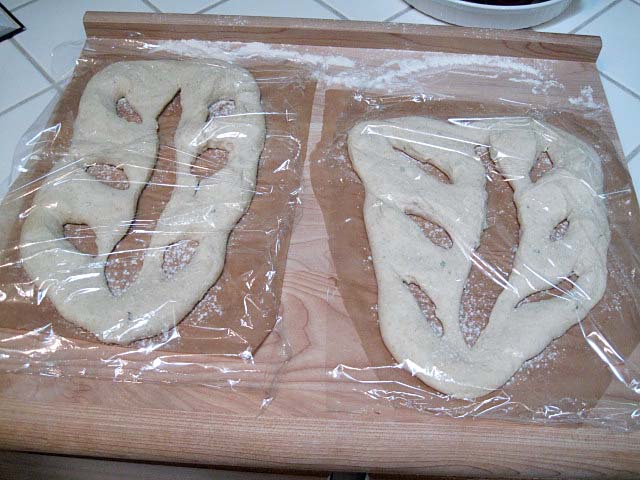
Fougasses proofing
Proofed, ready to bake (450ºF for 20 minutes with steam)
Fougasses Fougasse is a crust-lovers' bread. It is very crunchy but with enough tender, highly aerated crumb to absorb dipping oil. I enjoyed dipping it in the salad dressing more than the oil and balsamic. I ate 3/4 of one myself at dinner, demonstrating my customary restraint. David Submitted by dmsnyder on June 5, 2010 - 8:39pm Sourdough Bread from Advanced Bread & Pastry
I've been baking the San Francisco Sourdough from Michel Suas' Advanced Bread and Pastry frequently over the past few months. It's very good. This weekend, I decided to try a couple of his other sourdough breads. Right after the formula for “San Francisco Sourdough,” Suas gives two other formulas for Sourdough Bread, differing in the levain used. One uses a 100% hydration levain and the other a 50% stiff levain. Both differ from the San Francisco Sourdough in using a smaller starter inoculation for a levain that ferments for 24 hours. This week, I chose to make the one with the stiff levain, which Suas calls “Sourdough Bread One Feeding.”
Note: The over-all hydration of this dough is 64%.
Procedure
Note: My oven has a convection mode and a conventional baking mode. My actual baking procedure is to pre-heat the oven on Convection-Bake to 500ºF. After the bread is loaded and the oven steamed, I turn the oven to the recommended temperature using conventional (non-convection) baking. When the bread has started to color and has had full benefit of the steam, I switch to Convection-Bake again and lower the temperature by 20-25ºF. (This assumes I'm not baking with “falling temperatures,” as with some rye breads.) The loaves were proofed at 80ºF for 2 ½ hours and expanded by 50-75%. I was concerned about the long proofing. One of the boules did deflate slightly with scoring, but I got very nice oven spring and bloom.
The crust was crunchy and the crumb was soft - not very chewy. (I made this bread with KAF AP flour.) The flavor was sweet and wheaty with the barest hint of sour, and that was of the lactic acid type ... I think. Frankly, I missed the tang and the flavor tones of whole grains, which my preferred breads all have. On the other hand, this may approach the French ideal of a pain au levain, which is not sour in flavor. For those who prefer a not-sour-sourdough, I would recommend this bread without hesitation. David Submitted to YeastSpotting
Submitted by dmsnyder on June 5, 2010 - 8:29pm Sourdough Rye from Advanced Bread & Pastry
I have some experience baking Jewish Sour Ryes and German-type rye breads. Suas' formula for “Sourdough Rye Bread” (Advanced Bread and Pastry, pp. 212-213) seems to me to be for a French-style “Pain de Seigle,” although Suas does not label it as such. It uses a stiff levain identical to the one Suas uses for his “San Francisco Sourdough,” but then the final dough is 60% rye flour. Overall, the rye content is 52% of the total flour. The overall dough hydration is 70%.
Procedure
This dough does develop some gluten from the 12.7% protein bread flour used, but it otherwise handles like a high-rye bread. The dough is clay-like and sticky, although less so than if it had had higher hydration. It was easy to shape with a light dusting of flour on the board. The loaves expanded by no more than 50% after over 2 hours proofing at 80ºF on a couche, and they had modest oven spring. The cuts opened up nicely, considering.
The crust was hard and crunchy. The crumb was soft and moist. This is a pretty thin loaf - marginally bigger than a baguette. The ratio of crust to crumb is relatively high with a marked contrast in texture, which makes it quite interesting in the mouth. The flavor is mildly sour with a sweetish, earthy rye flavor. Very nice. The French prefer this type of bread with smoked meats, soft cheeses and fish. We are having salmon for dinner tomorrow, and I have a nice Laura Chanel Chevre in the fridge. This rye should be delicious with both. David Submitted to YeastSpotting
|
ALSO ON |