SearchUser loginRecommended BooksFavorite Recipes
|
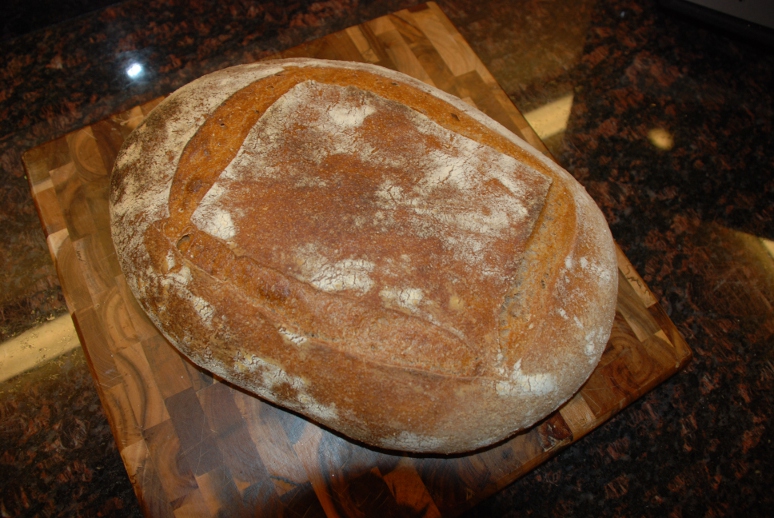
Submitted by Igwiz on October 15, 2009 - 11:20am My First 100% whole wheat sourdoughHi all. I finally got my starter going and this is the first sourdough loaf I baked (last week). Very happy with how it turned out. Looks quite a bit like the Desem that was posted a few months ago. Thanks all for your advice on getting my starter going.
This was a basic lean recipe.
33 ounces WW (King Aurthur) (100%) 24 ounces water (73%) 1 tablespoon salt 8 ounces happy, well fed white starter (50% hydration) (25%)
Total = 198%
Mix water and starter with whisk until well combined and frothy. Add flour and salt. Knead for 5 minutes. Autolyse for 10 minutes Knead another 2 minutes Allow to ferment at 62 degrees for 20 hours. Divide in half for 2 two-pound loaves. Fold, shape and ferment another 6-8 hours, folding 3-4 times. Proof for 2-3 hours until nearly doubled. Bake en Cloche at 425 for 45 minutes, 20 covered and 25 uncovered.
Thank you ALL for being such a great resource. I've baked straight dough for several years, but now that I've found TFL, I am absolutely smitten with extended ferments and growing my own sourdough bugs. TFL is such an awesome place. Submitted by summerbaker on September 7, 2009 - 8:57am Whole Wheat Sourdough - Finally!These loaves may not look like much but they are my first successful whole wheat sourdough loaves. Apart from the starter they are 100% whole wheat. I knew that something was going right when I noticed that they were rising vertically rather than spreading horizontally in a sticky mess during proofing. I want to thank everyone at TFL for all of the great tips: rice flour in the brotforms (lots of posts about this), use of vital wheat gluten with whole wheat (Thanks mainly to xaipete), and use of parchment paper under the loaves on the baking stone (Thanks mainly to SylviaH).
This was also the first use of my new brotforms and I used too much flour. At least they didn't stick!
I caught the lame a little on one of the cuts, but better dough = better scoring so overall I was happy with the slashes.
Dense but yummy.
I just had to include a picture of my second to last attempt at whole wheat sourdough for all of you out there who are still frustrated by it. Pretty nice UFO's huh? Just keep trying! What made all of the difference for my baking was making sure that my starter was strong. I fed it regularly over a period of about four days in advance of baking. By the way I used the Simple Sourdough recipe from Reinhart's TBBA with whole wheat instead of white flour. The only thing that I had to change was the water content. The whole wheat flour required more. Thank you everyone, it has been a wonderful adventure! Summer Submitted by davidjm on July 11, 2009 - 7:51am Sourdough help needed for Pain-PoilaneI am trying to make the Pain Poilane from BBA. About 50% of the time, I am successful. When it does not turn out, here's what happens: 1. The dough does not rise during firmentation. If it does, it is very little. The problem is, when I'm in the started stage, the starters behave beautifully. They rise, they smell good. 2. When I bake it, it may rise a little. But it does this weird thing where the bottom of the loaf will rise in the center rather than rise uniformly from the top. 3. The crumb is dense and wet, even though I don't pull it out until the internal temp is around 200F. Also, there are large wholes sporatically throughout the dense crust. 4. Taste is not very good compared to when it turns out right. I just can't figure out what is going on. I've tried shortening the rise times thinking that I was tiring out the yeast. I've tried lessening the amount of starter I used thinking it was too acidic (I was doubling the amount from BBA). They all seem hit or miss. Notes: These are 10 cup 100% sourdough wheat loaves. Lately, I've tried making it 80:20, Wheat:White. Any suggestions? Could it be the tap water? Should I try bottled when I make the dough? Thanks, David Submitted by Mini Oven on June 30, 2009 - 6:49pm Starter TerminologyI know this seems a little late but I think we could all benefit if we define these terms in order to remove any confusion surrounding them. What is a:
Thanks for participating. Oct 31, 2009 Changed title of thread so it is more easily located using the site search machine. I may turn this into a FAQ or anyone wanting to make a FAQ should feel free to use the information. Submitted by MountainRain on March 17, 2009 - 11:35am New book "Wild Bread" publishedLisa Rayner, a Flagstaff Ariz. author and activist, is pleased to announce the release of her third book, Wild Bread: Hand-baked sourdough artisan breads in your own kitchen. Wild Bread is much more than just another bread cookbook. The book reveals the secrets of baking San Francisco sourdough, crusty French artisan loaves, dense Russian ryes, Italian ciabatta, Indian naan, pita bread, great homemade pizza crusts, soft whole wheat sandwich bread, bagels, sweet doughs, Ethiopian injera crêpes and much more. This book explores what goes on inside dough as it is transformed from water, flour, wild yeast and probiotic bacteria into the kind of bread that makes your mouth water. You may never be satisfied with ordinary bread again. Once you learn what factors affect aroma, flavor, shape, crust and crumb, you too will be transformed — into an artisan. Wild Bread encourages your creativity and provides the basic principles you need to bake any bread you desire without needing a recipe. Wild Bread teaches you how to make authentic whole grain sourdough artisan breads that are easy to knead by hand and make in the variable temperatures and humidities of an ordinary kitchen. Part I explains the science and care of sourdough ecosystems, including how to capture your own sourdough culture from the air and where to buy authentic cultures from around the world. Sourdough cultures composed of wild yeast and lactic acid-producing bacteria. No baker’s yeast or chemical leaveners like baking soda are ever added to real sourdough breads. Part II explains how to make bread, including how to grind your own wholegrain flours and bake artisan-style breads in a home oven. Part III contains instructions for making a variety of artisan loaves, flatbreads, pan breads, batter breads, sweet rolls and more—from wheat, rye and gluten-free whole grain flours. Part IV introduces you to the world of sustainable bread baking, with an exploration of energy-efficient solar cookers and wood-fired earth and brick ovens. Part V includes a list of commercial sources for authentic sourdough cultures, bread troubleshooting tips, sources for sustainably-produced grains and flours, and books and DVDs on sourdough and artisan bread baking. Lisa Rayner is the author of Growing Food in the Southwest Mountains, a permaculture guide for home gardeners (3rd ed. 2002) and The Sunny Side of Cooking solar cookbook (2007). She has been interested in cooking ever since she became a vegan more than 20 years ago. Today, she continues to have a passion for learning about food, and she continues to share what she has learned through her books and workshops. Permaculture design and a lifelong interest in renewable energy inform her work. Wild Bread: Hand-baked sourdough artisan breads in your own kitchen ISBN 978-0-9800608-1-2 Published by Lifeweaver LLC © 2009 170 pp. 8 ½” x 7”. Color cover, black and white illustrations, comb binding $16.95 + $3 shipping and handling. Contact for wholesale prices Order online or pay by check. For more information on Lifeweaver LLC contact: URL: www.LisaRayner.com e-mail: P.O. Box 22324, Flagstaff, AZ 86002 Submitted by director517 on December 9, 2008 - 3:01pm help, advice? whole wheat sourdough breadHi everyone,
I'm new here, so I don't know if there may be some protocol I'm supposed to follow, so forgive me if I jump right in.
I have been trying for weeks now (every day or every other day), to get a loaf of 100% whole wheat sourdough out of my oven. No success. I've had a starter for about a year. I keep it refrigerated. Sometimes I neglect it, but it always bounces back, and at the moment, with 2xd feedings, it's bubbly and aliive.
I've painstakingly followed several different recipes, one from sourdoughhome.com, another from breadtime stories, the book, and others from the web. Here's what always happens: I get everything ready, kneaded, and in a bowl for the first rise. No problem. It doubles, beautiful. I deflate it, and, using different theories (knead it. Don't knead it. Fold it. Etc.), i give it a second rise. No problem, usually. Then, After second rise, I shape it, put it in a 8.5x4.5 pan, stick it back in the oven with the light on, and here's where it always goes wrong" I can never get this third rise , and I end up with a flat useless brick of bread (I eat it anyway: sliced thin and treated like cocktail rye). My first thought was, don't give it the third rise, just pan it after one rise. That worked OK, but not great, I still did not get a great rise. Other possibilities? I wait too long after feeding the starter to get it into the mix, but I've tried various approaches to that possibility with no real great success.
Perhaps my apartment is too cold. Perhaps I'm not using good flour (KAF all purpose whole wheat). Any and all suggestions, modifications, suggestions would be welcome. I just don't know what I'm doing wrong.
Thanks. Sam WW HolesI want to thank Jane for her excellent instructions on making whole wheat sourdough. http://www.thefreshloaf.com/node/2059/100-whole-wheat-bread Up until recently, I have been cooking dense WW bread with no holes. I thought that that was about as good as it was going to get. My wife told me that she doesn't like bread. I told her that I wanted to make a bread that she would like eating. |
ALSO ON |